

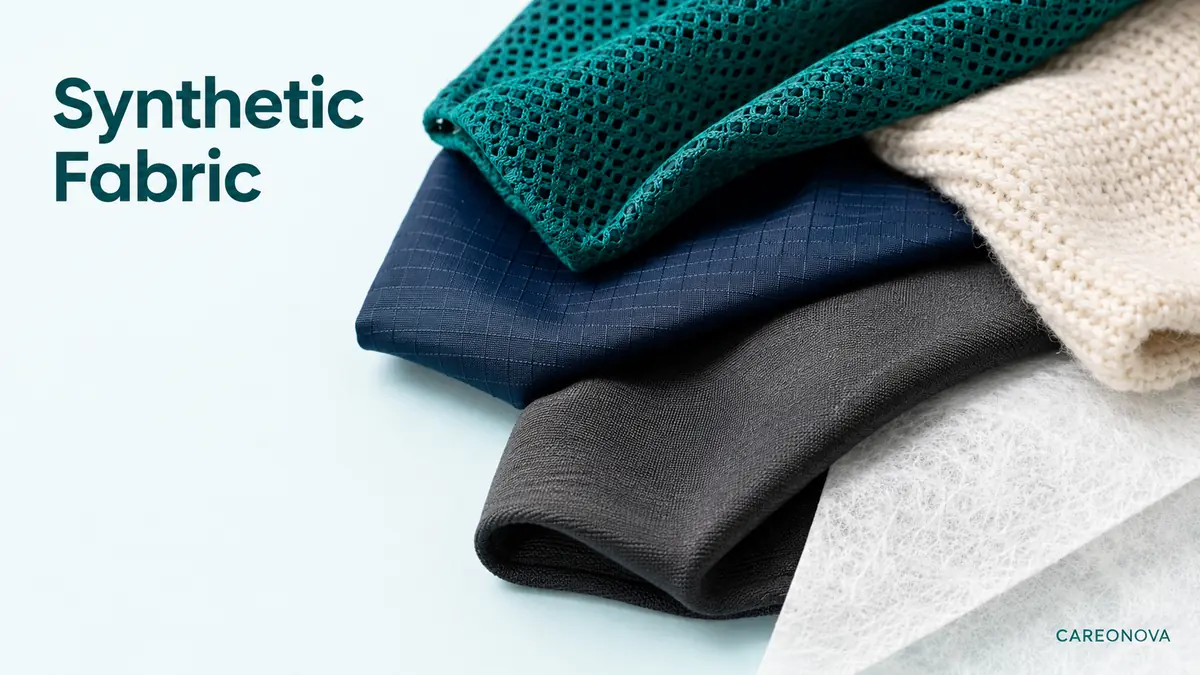
Synthetic fabric is textile material made from manufactured polymer fibers rather than fibers taken directly from plants or animals. Polyester, nylon, acrylic, spandex and polypropylene are familiar examples. Manufacturers can adjust these materials for strength, stretch, low weight, quick drying, warmth or specialized protection.
The fiber name is only the starting point. Yarn design, fabric construction, thickness, finishes, coatings and garment design determine how the finished textile feels and performs. A light polyester mesh and a coated polyester rain shell contain the same broad fiber type, yet they differ greatly in airflow, water resistance and comfort.
This Careonova guide explains what synthetic fabric is made from, how it is produced, how the main fibers differ, where synthetics work well and how to care for them in everyday use.
Quick Answer
Synthetic fabric is made from human-produced polymer fibers. Most common types, including polyester, nylon, acrylic, spandex and polypropylene, are forms of plastic, although they belong to different chemical families. Synthetic textiles can be durable, lightweight, quick-drying or stretchy. Their breathability, softness, water resistance and heat tolerance depend on the specific fiber, yarn, fabric construction and finish.
Synthetic Fabric at a Glance
| Feature | What it means |
|---|---|
| Source | Manufactured polymers, commonly derived from fossil-based chemicals |
| Common types | Polyester, nylon, acrylic, spandex and polypropylene |
| Main strengths | Durability, low weight, quick drying, stretch and consistent production |
| Main limits | Heat sensitivity, odor or oily-soil retention in some fabrics, static and difficult recycling |
| Construction | Woven, knitted or nonwoven; may also be coated or laminated |
| Typical uses | Clothing, activewear, rugs, upholstery, outdoor equipment, filters and protective textiles |
What Synthetic Fabric Is Made From
Most synthetic fibers begin with small chemical building blocks called monomers. Manufacturers join these molecules into long polymer chains, then form the polymer into filaments or staple fibers that can become yarn and fabric.
Conventional polyester, nylon, acrylic, spandex and polypropylene usually rely partly or mainly on fossil-derived feedstocks. Recycled and some bio-based inputs are also available, but a recycled or bio-based feedstock does not change the need to evaluate the finished textile’s durability, care requirements and end-of-life options.
Is Synthetic Fabric Plastic?
Many common synthetic fabrics are made from plastic polymers. Polyester, nylon, acrylic, spandex and polypropylene are not one identical plastic; each has a different polymer structure and performance profile.
The word plastic can therefore be accurate at the material level but too vague to predict how a textile will behave. A fine polyester lining, an elastic spandex blend and a rigid polypropylene sack are all polymer-based products, but they should not be treated as interchangeable.
Synthetic and Semi-Synthetic Fibers Are Different
Not every manufactured fiber is fully synthetic. Rayon, modal and lyocell begin with cellulose, usually from wood or another plant source. The cellulose is processed and regenerated into fiber, so these materials are commonly grouped as man-made cellulosic or regenerated cellulosic fibers rather than fully synthetic fibers. The U.S. federal fiber definitions also distinguish rayon and lyocell from polymer fibers such as polyester, nylon and spandex. 16 CFR § 303.7
This distinction matters because manufactured, man-made and synthetic do not always mean exactly the same thing. The broader types of fabric materials overview shows how fiber source, construction and finish create separate textile categories.
How Synthetic Fabric Is Made
Production varies by polymer, but most synthetic textile manufacturing follows five broad stages:
- Prepare the polymer. Manufacturers make or obtain polymer resin, often as chips, pellets or a chemical solution.
- Form the fibers. The polymer is pushed through a spinneret, a plate with small openings that shapes continuous strands.
- Cool or solidify the strands. Melt-spun polymers harden as they cool. Other polymers may solidify after a solvent evaporates or after the strands enter a chemical bath.
- Draw and texture the fibers. Stretching helps align polymer chains and can improve strength. Texturing can add crimp, bulk, softness or stretch.
- Build and finish the fabric. Fibers become filament yarn, cut staple fiber, woven or knitted fabric, or a bonded nonwoven sheet. Dyeing, brushing, heat-setting, coating and other finishes create the final appearance and performance.
Melt spinning is common for thermoplastic fibers such as polyester, nylon and polypropylene. Dry and wet spinning are used when the polymer is better processed in a solution. The exact route matters to manufacturers, but consumers gain more useful information from the finished fiber content, construction, finish and intended use.

Five Common Types of Synthetic Fabric
| Fiber | Typical qualities | Common uses | Main caution |
|---|---|---|---|
| Polyester | Durable, wrinkle-resistant, low moisture absorption | Clothing, fleece, upholstery, bedding | May hold oily soil or odor; sensitive to high heat |
| Nylon | Strong, smooth and abrasion-resistant | Hosiery, activewear, bags, ropes | UV and heat performance vary by product |
| Acrylic | Lightweight, warm and wool-like | Sweaters, blankets, hats, rugs | May pill, build static or distort with heat |
| Spandex | Exceptional stretch and recovery | Leggings, swimwear, fitted garments | Heat, chlorine and hard use can reduce elasticity |
| Polypropylene | Very light and absorbs little moisture | Base layers, rugs, nonwovens, ropes | Low heat tolerance; untreated fiber can degrade in sunlight |
Polyester Is the Most Common Synthetic Fiber
Polyester is a family of fibers made from polymers containing ester groups. The most familiar textile form is polyethylene terephthalate, or PET. It is widely used because manufacturers can produce it consistently in many weights, textures and constructions.
Polyester appears in shirts, trousers, dresses, fleece, linings, curtains, upholstery, bedding and industrial textiles. It generally absorbs little moisture, dries quickly and keeps its shape well. Strong filament fibers can also improve abrasion resistance and useful life.
The trade-offs depend on the product. Some polyester fabrics trap heat or retain body oils and odor, while open meshes and engineered sports knits can move air and moisture effectively. Polyester also softens or melts under excessive heat.
Nylon Combines Strength With a Smooth Feel
The term nylon fiber covers a group of synthetic polyamides. Nylon is valued for strength, flexibility and resistance to repeated rubbing, which helps explain its use in hosiery, activewear, swimwear, bags, tents, ropes and technical products.
Nylon usually absorbs more moisture than polyester or polypropylene but still far less than highly absorbent natural fibers. Its sunlight resistance, colorfastness and heat performance vary with the exact nylon, dye, stabilizers and fabric construction. A direct nylon vs. polyester comparison explains where each fiber tends to perform better.
Acrylic Provides Lightweight, Wool-Like Warmth
Acrylic fiber is often engineered to resemble wool. It is light, soft and able to hold loft, making it useful in sweaters, hats, scarves, gloves, blankets, rugs and craft yarn.
The fiber can hold bright color and is not itself a food source for clothes moth larvae. That does not make every acrylic item moth-proof: wool in a blend, food residue and other natural material can still attract pests. Acrylic textiles may also pill after friction, develop static in dry conditions or lose shape under excessive heat.
Spandex Adds Stretch and Recovery
Spandex is a synthetic fiber made primarily from segmented polyurethane. It can stretch far beyond its original length and move back toward its earlier shape. In the United States, spandex is the recognized generic name. Elastane is widely used internationally, while Lycra is a brand name rather than the generic fiber category.
Spandex usually forms a small part of a blend. Even a modest percentage can add useful movement to leggings, bras, socks, swimwear, cycling clothing, fitted jeans and compression garments. Repeated high heat, chlorine exposure, body oils and hard wear may gradually reduce recovery, although the rate depends on the construction and product quality.
Polypropylene Absorbs Very Little Moisture
Polypropylene is one of the lightest common synthetic fibers. It absorbs very little water, dries quickly and resists many chemicals. Manufacturers use it in base layers, thermal underwear, outdoor rugs, carpets, ropes, filters and medical or hygiene nonwovens.
In U.S. labeling, polypropylene fiber falls within the broader generic category called olefin. Olefin also includes qualifying fibers made mainly from ethylene or other olefin units, so the two words are not universally identical.
Polypropylene has relatively low heat tolerance, and untreated material may weaken during extended ultraviolet exposure. Outdoor products need construction and stabilization appropriate to their stated use.
Specialist Synthetics Serve Protective Uses
Some synthetic fibers are designed for demanding technical applications. Aramid fibers can provide high strength or heat resistance, while high-strength polyethylene appears in some cut-resistant and lightweight protective products.
These materials should not be judged by the behavior of ordinary polyester clothing. Protective performance depends on exact fiber chemistry, fabric engineering, product testing and certification. A generic fiber name alone does not prove that an item is flame-resistant, cut-resistant or suitable as personal protective equipment.

How Fabric Construction Changes Performance
Fiber content cannot predict the complete result. Construction changes stretch, airflow, drape, strength and resistance to water.
Woven Fabric Adds Stability
Woven fabric uses yarn systems that cross over and under each other. A tight weave often creates a firm, stable surface with less natural stretch than a knit, unless the fabric includes spandex or a stretch structure. Synthetic wovens are common in bags, jackets, tents, umbrellas, upholstery and work clothing.
Small spaces still exist between yarns, so a woven polyester, nylon or polypropylene fabric is not automatically waterproof.
Knitted Fabric Adds Flexibility
Knitted fabric is formed from connected loops. The loops move more easily than a basic weave, which can add stretch, softness, body movement and airflow. T-shirts, leggings, sportswear, socks and base layers commonly use knitted synthetic fabric.
Nonwoven Fabric Creates Bonded Sheets
Nonwoven fabric is made by bonding, pressing, entangling or fusing fibers instead of first producing a traditional weave or knit. Polypropylene and polyester are common in masks, medical gowns, wipes, filters, hygiene products and protective covers.
A nonwoven can be thin and disposable or thick and durable. Fiber size, web formation, bonding method, number of layers and surface treatment determine the final performance.
Coatings and Membranes Control Air and Water Movement
A coating, membrane or laminate can block liquid, slow airflow or protect the base textile. Two nylon jackets may contain the same fiber, yet only the product with an effective barrier and protected seams may qualify as waterproof.
For that reason, evaluate the whole product, not just the percentage on the fiber label, when comparing comfort, weather protection and care.
Main Properties of Synthetic Fabric
Synthetic fabric does not have one fixed level of strength, comfort, breathability or water resistance. The following are useful tendencies, not promises for every product.
Strength and Abrasion Resistance
Many synthetic fibers provide good strength for their weight. Nylon is especially useful where repeated rubbing is a concern, and polyester offers dependable durability in clothing and home textiles.
Fabric weight, yarn structure, seams and product design still matter. A thin, loosely built fabric may tear sooner than a heavy, tightly constructed fabric made from the same polymer.
Moisture Absorption, Wicking and Drying Speed
Many synthetic fibers absorb less water than cotton and other moisture-loving fibers. They often gain less water weight and dry faster, but three different properties should not be confused:
- Absorption is water entering the fiber.
- Wicking is liquid moving across or through the fabric.
- Drying speed is how quickly moisture leaves the textile.
A fiber can absorb little water yet still need a suitable yarn structure or finish to move sweat away from skin.
Is Synthetic Fabric Breathable and Good for Summer?
Synthetic fabric can be breathable and comfortable in summer when it is lightweight, open and designed to move moisture. Polyester mesh and thin performance knits can allow substantial airflow.
Dense weaves, thick fleece, tight garments and coated fabrics can feel hot because they restrict air or trap warm moisture near the body. Climate, activity, fit and fabric structure matter more than the word synthetic alone.
Is Synthetic Fabric Waterproof?
Ordinary synthetic fabric is not automatically waterproof. A low-absorption fiber may resist taking water into its own structure, but liquid can still pass through yarn gaps, stitching holes, fasteners or damaged finishes.
These terms describe different ideas:
| Term | Meaning |
|---|---|
| Hydrophobic fiber | The fiber absorbs little water |
| Water-resistant fabric | The material slows light moisture for a limited period |
| Water-repellent finish | A surface treatment encourages droplets to bead and roll away |
| Waterproof barrier | A coating or membrane blocks water under stated test conditions |
| Sealed seams | Covered or bonded seams reduce leakage through needle holes |
When reliable weather protection matters, look for a finished-product claim and its test conditions rather than assuming the fiber name provides a barrier.

Does Synthetic Fabric Shrink?
Synthetic fabric can shrink or distort, but the amount depends on the fiber, construction, heat-setting, blend and temperature. Many synthetic garments resist ordinary wash shrinkage better than some natural fabrics. Excessive dryer or iron heat can still cause contraction, warping, glazing or melting.
Heat can also damage spandex without an obvious melted area. A garment may look normal yet lose part of its stretch recovery. Understanding the causes helps with preventing clothes from shrinking or losing their intended shape.
Heat and Fire Behavior
Many common synthetic fibers soften or melt when exposed to high heat. Their exact ignition, burning, dripping and self-extinguishing behavior differs, so no universal burn description is accurate for all synthetics.
Specialist fibers and treated products may resist flame or heat, but a synthetic-fiber label does not establish protective performance. Keep ordinary synthetic textiles away from open flames, heaters and unapproved high-temperature drying or ironing.
Static, Pilling and Odor
Dry conditions and low moisture absorption can encourage static electricity, particularly in polyester and acrylic products. Pilling develops when loose or broken fibers tangle on the surface; fiber strength, yarn twist, fabric structure and friction all influence it.
Some synthetic fabrics also retain body oils and odor more readily than absorbent fibers. The result varies with the polymer, fabric structure, finish, activity level and washing method, so odor performance should be judged at the product level.
Safety and Skin Comfort Depend on the Finished Product
Fiber content alone does not determine skin comfort. Texture, fit, friction, trapped sweat, dyes, finishes and detergent residue can all affect how an item feels. One person may tolerate a fabric that irritates another.
For people with eczema or other sensitive-skin concerns, the issue is more complex than choosing only “natural” or only “synthetic” fiber. Surface design, fit and moisture behavior can change the result.
Stop using an item that causes persistent redness, itching or irritation, and seek medical advice when symptoms are severe or do not settle.
Advantages and Disadvantages of Synthetic Fabric
| Advantages | Disadvantages |
|---|---|
| Often strong for its weight | Most conventional types use fossil-derived feedstocks |
| Many types dry quickly | Wear and washing can release microfibers |
| Can resist wrinkles and retain shape | Excessive heat can cause permanent damage |
| Can provide stretch and recovery | Some fabrics retain oil or odor |
| Can be engineered for technical uses | Static and pilling may develop |
| Offers consistent large-scale production | Many products do not biodegrade readily |
| Available across wide price ranges | Blends, coatings and trims complicate recycling |
These are broad tendencies. A high-quality synthetic product can outlast a poorly built natural-fiber item, while a thin disposable synthetic may have a very short useful life. Quality, construction and suitability for the task are more meaningful than a simple natural-versus-synthetic label.
Common Uses of Synthetic Fabric
| Application | Common fibers | Why they are used |
|---|---|---|
| Everyday clothing | Polyester and blends | Shape retention, durability and accessible pricing |
| Activewear | Polyester, nylon and spandex | Low weight, drying speed, stretch and abrasion resistance |
| Swimwear | Nylon- or polyester-spandex blends | Smoothness, shape retention and movement |
| Home textiles | Polyester, acrylic, nylon and polypropylene | Wear resistance, color options and easy maintenance |
| Outdoor equipment | Nylon, polyester and polypropylene | Strength, low water absorption and low weight |
| Medical and hygiene nonwovens | Polypropylene and polyester | Lightweight sheets with controllable fiber and pore structures |
| Protective textiles | Aramid, modacrylic and specialist polyethylene | Engineered heat, flame, strength or cut performance when tested |
The same fiber can serve very different products. Polyester may form a soft fleece, a sheer curtain or a dense bag. Polypropylene may become a base layer, an outdoor rug or a filter. The product works because fiber selection, construction and finishing are designed together.
Cost also helps explain the category’s reach. Controlled production, consistent supply and large manufacturing scale make many synthetic textiles affordable, although specialist fibers and high-performance constructions can be expensive.
Synthetic Fabric vs. Natural Fabric
Synthetic and natural fibers solve different problems; neither group is universally better.
| Factor | Synthetic fabric | Natural fabric |
|---|---|---|
| Source | Manufactured polymers | Plant or animal fibers |
| Production consistency | Highly controllable | Can vary with biological source |
| Moisture absorption | Usually low | Often higher |
| Drying speed | Often faster | Often slower |
| Breathability | Depends on construction | Also depends on construction |
| Stretch | Can be engineered or added in blends | Usually limited without a stretch structure |
| Wrinkle resistance | Often good | Varies by fiber |
| High-heat response | Many soften or melt | Many scorch or burn |
| Biodegradability | Usually limited | Often greater, but processing and blends matter |
| Recycling | Limited by collection, blends and finishes | Also affected by blends and finishes |
Natural fibers such as cotton and wool often absorb more moisture and may feel familiar against skin. Synthetics can deliver lower weight, faster drying, stretch, wrinkle resistance or specialized protection. The best choice depends on climate, activity, cleaning method, required lifespan and the performance of the finished product.
Blended Fabrics Combine Selected Properties
Manufacturers blend fibers to balance performance. Cotton-polyester can combine moisture absorption with strength and faster drying. Wool-acrylic can offer warmth at a lower price. Nylon-spandex and polyester-spandex pair strength or shape retention with stretch.
Blends can also be harder to recycle because processors must separate fibers with different physical and chemical properties. More complexity is not automatically better; each added fiber should solve a real product need.
How to Identify Synthetic Fabric
The fiber-content label is more reliable than touch, shine or appearance. Modern finishing can make synthetic textiles resemble cotton, silk, wool, suede or fleece, and many products are blends.
U.S. labels may state, for example, 100% polyester, 88% nylon and 12% spandex, or 65% cotton and 35% polyester. The Federal Trade Commission explains that most covered U.S. textile products must identify fiber content, country of origin and the responsible manufacturer or business, using recognized generic fiber names. FTC textile-labeling guidance
Brand names do not replace generic fiber categories. Lycra, for example, is a brand; spandex is the U.S. generic fiber name. Avoid home burn tests for identification because unknown textiles can ignite, melt, drip or release irritating fumes.
How to Wash and Care for Synthetic Fabric
Careonova’s normal method for washing different fabrics can be adapted to everyday synthetics: treat oily marks before washing, use a cool or moderate cycle, measure detergent correctly and dry with low heat or air. This approach protects most polyester, nylon, acrylic and blended garments from the two most common problems, retained oily soil and excessive heat.

Careonova’s Standard Method
- Empty pockets, close fasteners and turn abrasion-sensitive or printed garments inside out.
- Pretreat body oil, cooking oil, makeup and other suitable stains with a small amount of liquid detergent.
- Wash similar colors together on a cool or moderate normal cycle; use a gentle cycle for delicate knits or stretch-rich garments.
- Add only the recommended detergent dose. Overdosing can leave residue and trap odor.
- Check stains before drying, because heat can make some marks harder to remove.
- Air-dry when practical or use low dryer heat.
Use this default for washable everyday synthetics, modifying it only when the finished product has a clear lower limit.
Pretreat Oily Marks Promptly
Polyester and polypropylene can hold oily soil. Treat oil stains on clothes with a suitable liquid detergent, allow brief contact time and wash before the mark ages. Do not scrub a delicate knit, print, membrane or coated surface aggressively.
Use Low Heat for Drying and Ironing
Air-drying reduces thermal stress. When using a dryer, remove the item once dry instead of leaving it in a hot drum. Iron only with an appropriate low or synthetic setting, preferably from the reverse side or through a pressing cloth when the surface is vulnerable.
Wrinkle resistance does not mean high-heat resistance. Excessive temperature can flatten texture, create shine, distort seams or damage stretch.
Give Stretch and Coated Products Gentler Care
Swimwear, leggings, technical jackets and elastane-rich garments benefit from reduced heat and friction. Avoid bleach, fabric softener or harsh treatment unless it is known to suit that exact product. Some membranes and water-repellent finishes also have specialized cleaning or reproofing requirements.
When the Finished Product Needs a Different Limit
Careonova’s method provides the normal starting point. If the finished item states a lower temperature, professional-cleaning requirement or another incompatible restriction, use that limit because its dyes, prints, seams, elastic, coatings or backing may need different treatment than the main fiber.
In practice, the fiber-based method explains how to clean the material, while the product restriction prevents damage to a hidden component.
Environmental Impact of Synthetic Fabric
Synthetic textiles create environmental effects during raw-material production, fiber manufacturing, dyeing, use and disposal. The scale varies by polymer, energy source, factory, product quality and lifespan, so a balanced assessment must consider the full product.
Raw Materials and Production
Most conventional polyester and nylon depend on fossil-derived chemicals. Production uses energy and creates greenhouse-gas emissions. Dyeing and finishing may also require water, heat, dyes, solvents, coatings and wastewater treatment.
Recycled or bio-based feedstocks can reduce reliance on some virgin fossil input, but they do not erase impacts from processing, product use or disposal. Their value depends on sourcing, manufacturing efficiency, useful life and what happens to the product after use.
Wear and Washing Can Release Microfibers
Fiber fragments may separate during manufacturing, wear, washing and drying. Synthetic textile fragments are one source of microplastics found in aquatic and terrestrial environments.
The amount released varies with fiber type, yarn strength, fabric structure, product quality, garment age, washing conditions and friction. No single shedding number accurately represents every synthetic textile.
Longer Use Can Reduce Replacement
Durability can be environmentally useful when an item remains functional for years and prevents repeated replacement. Long life does not cancel production or disposal impacts, but it improves the value gained from those impacts.
The most practical approach is to buy for a real need, choose sound construction, wash only when necessary, repair usable items and keep them in service for as long as they perform well.
Can Synthetic Fabric Be Recycled?
Some synthetic polymers can be recycled, but a technically recyclable fiber does not guarantee that a garment can enter a local collection and processing system.
Recycled polyester commonly comes from plastic bottles, manufacturing waste or textile waste. It can displace some virgin polymer, yet it remains polyester and may still shed fibers. Bottle-to-fiber production is also not the same as a closed textile-to-textile loop.
Recycling becomes harder when a product combines polyester, cotton, spandex, coatings, laminated layers, adhesives, foam, zippers, buttons and heavy finishes. Mechanical recycling can shorten fibers and reduce quality. Chemical processes may recover useful polymer building blocks, but collection, sorting, cost, energy demand and commercial capacity remain constraints.
Many U.S. curbside recycling programs do not accept clothing, and local rules differ. Use a municipal textile collection, retailer take-back program or verified textile recycler where available; do not place clothing in a curbside bin unless the local authority explicitly accepts it.
When Synthetic Fabric Is a Good Choice
Synthetic fabric is a strong match when a product needs quick drying, stretch, low weight, abrasion resistance, shape retention or a carefully engineered technical property. Activewear, swimwear, travel clothing, durable bags, rugs, upholstery, filters, medical nonwovens and protective products often benefit from these qualities.
Selection deserves more care when the textile will face open flame, sustained high heat, intense sunlight, very hot and humid conditions, severe skin sensitivity or a requirement for easy biodegradation. Waterproof and protective uses also require verified finished-product performance rather than an assumption based on fiber content.
The practical rule is simple: choose the material whose complete construction matches the job. Do not buy or reject an item solely because its fiber is synthetic.
Final Takeaway
Synthetic fabric is a broad category of textile made from manufactured polymer fibers. Polyester, nylon, acrylic, spandex and polypropylene can provide durability, low weight, quick drying, stretch and specialized performance, but they also bring limits related to heat, comfort, microfiber release and recycling.
The fiber name does not tell the whole story. Construction, weight, finishes, coatings, blends and product design shape real-world performance. Careonova’s approach is to give a clear method based on those factors, then account for any lower product-specific limit when a hidden component requires it.
