

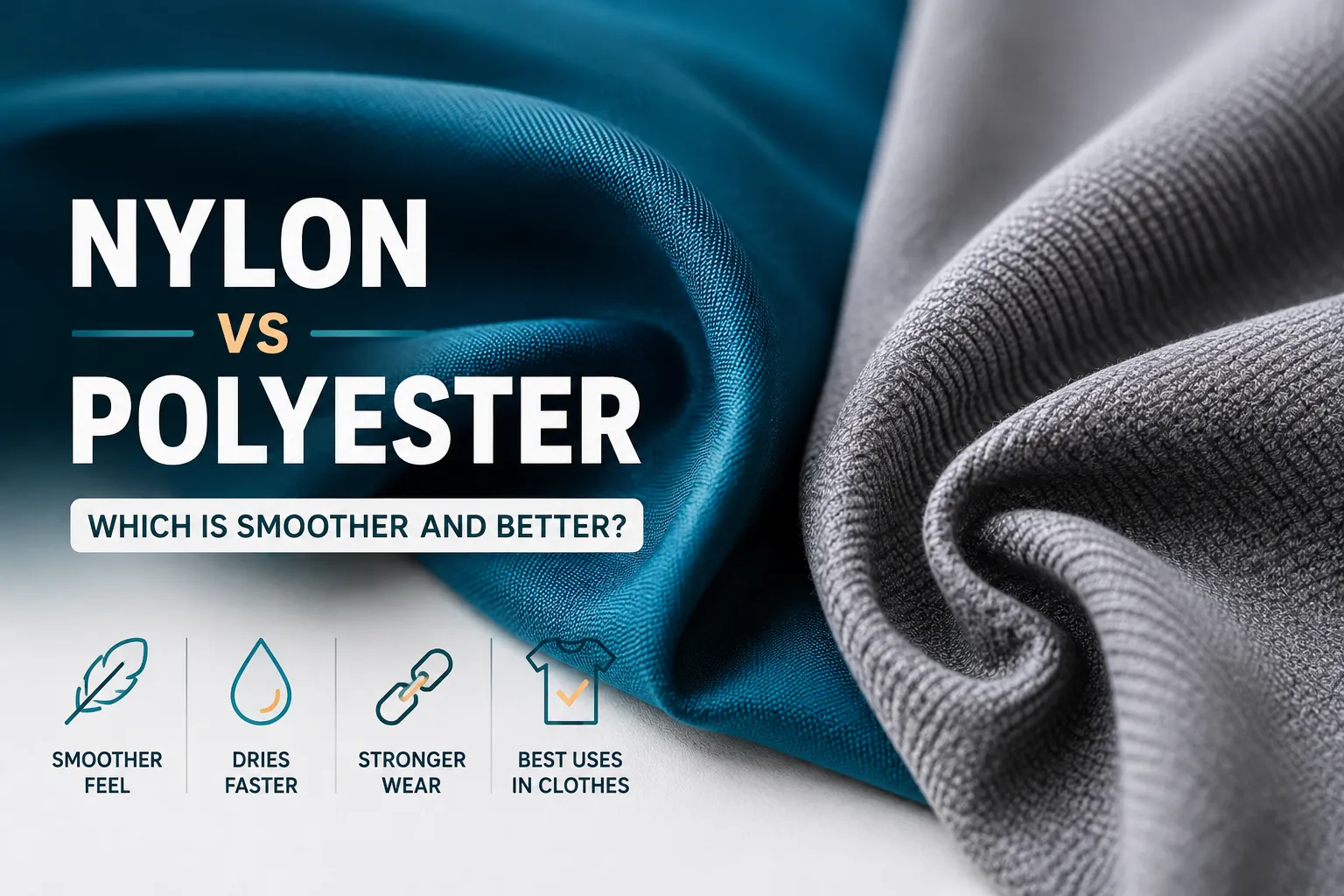
In a nylon vs polyester comparison, nylon usually feels smoother, softer, and silkier than standard polyester. Polyester normally absorbs less moisture, dries faster, and keeps its shape well. Nylon is often a good starting choice for leggings, hosiery, and fitted clothing. Polyester is common in running shirts, uniforms, and travel clothes.
The fiber name does not tell the whole story. Fabric weight, yarn size, knit or weave, surface finish, lining, and elastane content can change how a garment feels and performs.
Nylon vs Polyester at a Glance
Both are synthetic fibers, but they have different strengths. This table focuses on the differences that matter when choosing clothing.
| Buying factor | Nylon | Polyester |
|---|---|---|
| Typical feel | Often smooth, soft, and silky | May feel smooth, dry, crisp, brushed, or textured |
| Drying speed | Dries quickly | Usually dries faster |
| Moisture absorption | Absorbs some moisture | Absorbs very little |
| Flexibility | Often feels more flexible | Stretch usually comes from the knit or elastane |
| Repeated rubbing | Often selected for high-friction clothing | Durable, with good shape retention |
| Wrinkles | Resists wrinkles well | Usually keeps its shape very well |
| Sun exposure | Results depend on dye, stabilizers, and construction | Often used outdoors, but treatment still matters |
| Odor after wear | Can retain odor | Can retain odor |
| Typical price | Often higher | Usually more affordable |
| Common clothing | Leggings, hosiery, and underwear | Running shirts, uniforms, and jackets |
Which Is Smoother: Nylon or Polyester?

Nylon usually feels smoother and silkier than standard polyester. Fine nylon filaments can create a soft surface with less noticeable texture. This is one reason nylon blends are common in tights, hosiery, underwear, and close-fitting activewear.
Polyester has a wider range of possible textures. It may feel dry, crisp, fuzzy, brushed, slippery, or very smooth. Microfiber polyester uses very fine fibers, so it can feel softer than coarse nylon. Brushed polyester may also feel warmer and softer than a thin woven nylon shell.
Surface treatments can change the result. A coating may make nylon feel stiff or slick. Brushing can give polyester a soft, peach-like surface. A dense weave may feel firm, while a light knit may feel flexible and smooth.
The comparison is therefore about the finished textile, not only the fiber. CareOnova’s overview of polyester fabric properties explains how yarn, finish, weave, and blend can create very different textures.
Can You Identify Nylon and Polyester by Touch?
Touch may give you a clue, but it cannot identify either fiber with certainty. Nylon may feel silkier or more flexible. Polyester may feel drier, firmer, or more structured.
However, microfiber polyester can feel extremely smooth. Coated nylon can feel crisp and firm. Elastane, brushing, linings, and other finishes may also hide the expected texture.
Check the fiber label instead of relying on touch alone. A home burn test is unnecessary and may expose you to flame and fumes.
Are Nylon and Polyester the Same?
No. Nylon and polyester are separate manufactured fiber families. Nylon is a type of polyamide. Polyester used in everyday clothing is commonly based on PET, which belongs to a different polymer family.
Their different structures affect moisture behavior, dyeing, flexibility, heat response, and texture. A garment label may use “polyamide” instead of “nylon,” but that does not mean the material is polyester.
CareOnova explains the material itself in its overview of nylon fiber.
The separate comparison of polyamide and polyester labels covers the terminology in more detail.
Which Is Stronger: Nylon or Polyester?
Nylon is often described as the stronger and more flexible fiber. However, the better choice depends on what type of stress the finished garment must handle.
Tensile strength means resistance to being pulled apart. Tear resistance describes how well a fabric stops a small cut from spreading. Abrasion resistance means resistance to rubbing and surface wear. These properties are related, but they are not the same.
Nylon is often used where clothing bends, stretches, or rubs against other surfaces. Examples include hiking pants, hosiery, fitted sportswear, bags, and some lightweight shells.
Polyester is also durable. It is valued for shape retention, wrinkle resistance, and stable performance through regular wear and washing.
The yarn and fabric structure may matter more than the fiber name. Denier measures linear density, which means the mass of yarn or fiber per unit length. It is often used as a rough guide to yarn fineness or coarseness, but it does not directly measure thickness or guarantee durability.
A dense polyester fabric may outlast a light nylon fabric. A tightly woven nylon shell may handle rubbing better than a loose polyester knit. Seam type, coatings, yarn construction, and garment quality also affect service life.
Neither material is pill-proof. Pilling happens when loose surface fibers tangle into small balls. Strong synthetic fibers may keep those pills attached instead of allowing them to break away.
Nylon is often a better starting choice for flexibility and repeated rubbing. Polyester is often useful when shape retention, wrinkle resistance, and easy care matter more.
How Do Nylon and Polyester Handle Sweat, Drying, and Heat?
Polyester usually dries faster, while nylon absorbs somewhat more moisture. Neither fiber is automatically breathable, moisture-wicking, odor-free, or safe under high heat. Construction and finishing control much of the real-world performance.
Moisture Absorption, Wicking, and Drying

Polyester absorbs very little moisture into the fiber. This helps it dry quickly after exercise or washing. Nylon absorbs somewhat more moisture, although it still dries faster than many natural fabrics.
Wicking is different from absorption. Wicking means liquid moves through small spaces in the fabric so it can spread and evaporate. A fabric may absorb little moisture but still move sweat well if its yarn and knit are designed for that purpose.
For this reason, a polyester shirt is not automatically moisture-wicking. A nylon garment is not automatically poor at handling sweat. Yarn shape, knit structure, thickness, and surface treatment all matter.
Breathability and Hot-Weather Comfort
Neither fiber has one fixed level of breathability. Airflow depends mainly on the fabric structure.
A light polyester mesh may allow more air through than a dense nylon knit. A thin nylon fabric may feel cooler than heavy polyester fleece. Garment fit also matters because loose clothing allows more air to move around the body.
Linings, coatings, and tight compression fits may reduce airflow. CareOnova’s explanation of how nylon construction affects breathability covers weight, knit density, coatings, and fit in more detail.
Sunlight, Heat, and Odor
Both fibers can lose performance after long exposure to sunlight, heat, chlorine, or other harsh conditions. The result depends on the exact polymer, dye, stabilizers, coating, fabric construction, and exposure time.
Polyester is often selected for sun shirts, uniforms, and outdoor clothing. That does not mean every polyester fabric will resist ultraviolet exposure better than every nylon fabric. Neither fiber name alone guarantees UPF protection.
High heat can harm either material. Elastane, prints, waterproof coatings, adhesives, and glued details may fail before the main fabric shows obvious damage.
Both nylon and polyester can develop body odor after wear. Wearer chemistry, fabric finish, tight construction, detergent residue, body oil, poor rinsing, and delayed drying can affect how strong the odor becomes and how easily it washes out.
Nylon or Polyester for Clothing: What Should You Choose?
The best choice depends on where the garment sits on the body and what it must do.
| Clothing or use | Better starting choice | Main reason |
|---|---|---|
| Leggings | Nylon-elastane | Often smooth and flexible |
| Hosiery and tights | Nylon blend | Smooth feel and resistance to rubbing |
| Underwear | Depends | Nylon may feel smoother; polyester may dry faster |
| Sports bras | Either blend | Support and construction matter most |
| Running shirts | Polyester | Low absorption and fast drying |
| Loose gym tops | Polyester | Lightweight and easy to care for |
| Uniforms and jerseys | Polyester | Shape retention, color, and printing |
| Fashion swimwear | Either blend | Feel, lining, and elastane matter |
| Frequent pool wear | Check product claims | Chlorine performance depends on the complete fabric |
| Lightweight jackets | Either | Nylon for rubbing; polyester for shape and easy care |
| Hiking pants | Often nylon | Flexibility and abrasion resistance |
| Travel clothing | Polyester | Fast drying and wrinkle resistance |

Close-Fitting Clothes
Nylon-elastane blends are common in leggings, tights, hosiery, and underwear. They often feel smooth and flexible against the skin.
Polyester-elastane blends may feel slightly drier and often dry quickly. However, the base fiber is only one part of the decision.
Compression, opacity, seam placement, knit density, and elastane content can have a larger effect on comfort. In underwear, the gusset material and ventilation also matter.
A nylon legging may still feel uncomfortable when its seams are rough. A well-finished polyester legging may feel soft when it uses fine yarn and a brushed surface.
High-Sweat Sportswear
Polyester is common in running shirts, team uniforms, and loose gym tops because it absorbs little moisture and can dry quickly. It also works well with prints and repeated washing.
Nylon is common in fitted activewear where smoothness, flexibility, and resistance to rubbing are useful. It may appear in shorts, sports bras, leggings, and compression garments.
Neither material guarantees odor control or sweat movement. The knit, finish, fit, detergent dose, and drying routine still matter.
Jackets, Swimwear, and Outdoor Clothing
Nylon often appears in hiking shells, windbreakers, and outdoor pants because it can handle movement and surface rubbing.
Polyester is common in jackets, sun shirts, uniforms, and outdoor clothing where shape retention and quick drying are useful.
Both fibers can work in swimwear. Nylon blends often feel smooth and flexible. Polyester blends are also used in pool garments, but chlorine resistance cannot be judged from the base fiber alone.
Neither material is automatically waterproof. Rain protection depends on weave density, coatings, membranes, and sealed seams.
How to Compare Two Real Garments

Do not choose a garment by the main fiber name alone. Check the complete design.
- Read the fiber percentages.
- Note the elastane or spandex content.
- Check whether the fabric is knitted or woven.
- Compare its weight, thickness, and stretch.
- Feel the surface finish and the side that touches the skin.
- Check for a lining, coating, or waterproof membrane.
- Inspect the seams and any rough hardware.
- Read the complete care label.
- Match the garment to its intended use.
For example, an 80% nylon and 20% elastane legging may feel smoother and more compressive than a 92% polyester and 8% elastane running tight.
Those figures are illustrative. The different feel may come from the elastane level, yarn, finish, and knit density as well as the main fiber.
A dense woven nylon jacket may also feel firmer and less breathable than a light polyester mesh shirt. This shows why finished construction can override a simple fiber comparison.
Care Differences That Matter
Both materials are usually easy to wash, but the complete care label should control the method. Use cold or warm water when the label allows it. Turn fitted activewear and printed clothes inside out. Separate smooth fabrics from towels, exposed zippers, hook-and-loop fasteners, and other rough items.
Measure detergent carefully. Too much product may leave residue, reduce rinsing, and make odor harder to remove. Limit fabric softener on performance clothing when the manufacturer advises against it because coatings may affect moisture movement.
Heat warning: Elastane, glued logos, prints, waterproof membranes, and surface coatings may fail before the main nylon or polyester fabric. Follow the lowest heat limit on the care label.
Air-drying or low dryer heat is often the safer option, but the garment label comes first. A blend may contain elastane, lining, prints, adhesives, or coatings that need gentler care than the main fiber.
CareOnova’s instructions for washing polyester without heat or detergent damage cover washer settings, drying, stains, and odor in more detail.
Which Is Better, Nylon or Polyester?
Nylon usually has the advantage when you want a smoother feel, flexibility, and clothing that handles repeated rubbing. Polyester is often the better starting choice for fast drying, wrinkle resistance, shape retention, and easy-care sports or travel clothes.
Neither fiber is best for every garment. Check the weight, knit or weave, finish, lining, elastane percentage, intended use, and care label before deciding. When other materials are also under consideration, compare clothing fabrics by feel, airflow, drying, and care needs.
Sources
- Electronic Code of Federal Regulations: Generic names and definitions for manufactured fibers
- ASTM D1577: Standard test methods for linear density of textile fibers
- Synthetic Clothing and the Problem With Odor
- Effects of chlorine and sunlight exposure on swimwear materials
- Federal Trade Commission: Complying with the Care Labeling Rule
