

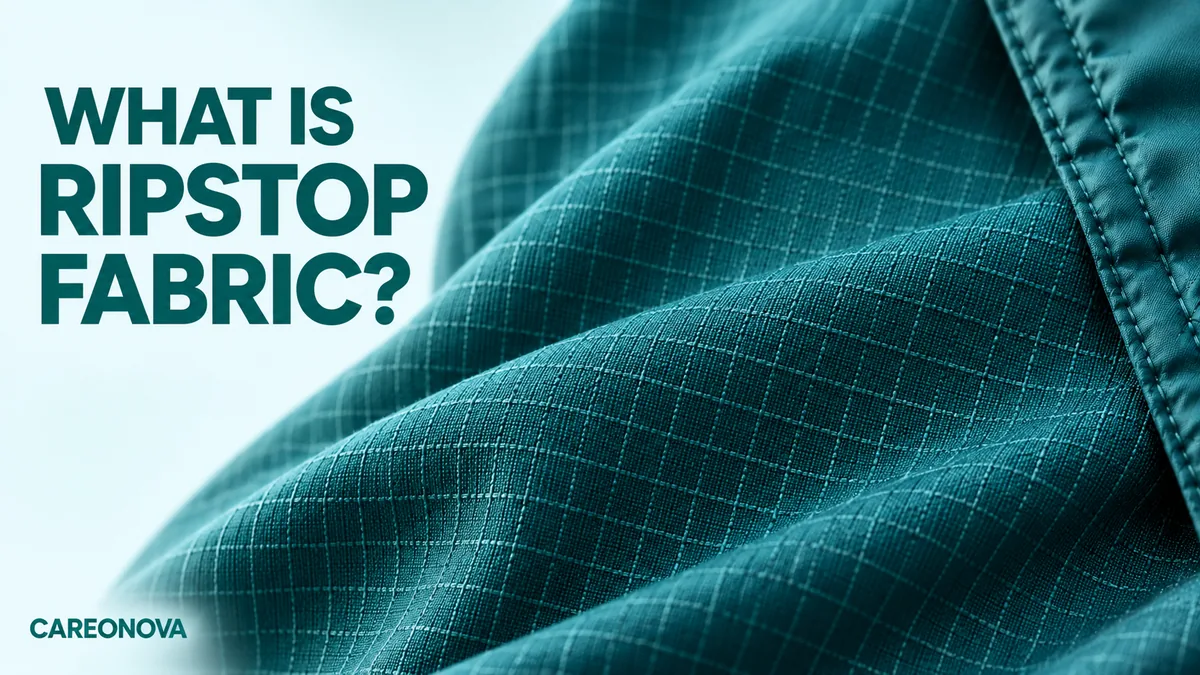
Look closely at a lightweight hiking jacket, tent, backpack, or pair of cargo pants. You may notice a faint pattern of small squares woven into the material. That pattern is often the identifying feature of ripstop fabric, a reinforced textile construction designed to resist the spread of small tears.
Ripstop has become a popular choice for outdoor equipment, workwear, uniforms, and everyday clothing because it can provide useful tear resistance without excessive weight.
However, the word ripstop does not automatically mean a fabric is waterproof, abrasion-resistant, or particularly strong. Its actual performance depends on the fiber, fabric weight, reinforcement yarns, coating, and finished-product construction.
Understanding those differences matters when choosing between nylon ripstop for a tent, polyester ripstop for a jacket, and cotton ripstop for work trousers.
What Is Ripstop Fabric?
Ripstop fabric is usually a woven textile containing stronger, thicker, doubled, or specially engineered reinforcement yarns arranged at regular intervals. These yarns generally run in both the lengthwise (warp) and crosswise (weft) directions, creating a square or rectangular grid.
The reinforcement is designed to increase resistance to tear propagation, which is the continued spreading of an existing cut or tear.
The underlying cloth is often plain woven, although other constructions are possible. Instead of using thicker yarns throughout the entire fabric, manufacturers add reinforcement where it can help resist the movement of a tear.
This construction can maintain a relatively lightweight and flexible fabric while improving tear resistance.
The important distinction is that ripstop describes a reinforcement construction, not a particular fiber.
Ripstop can be manufactured using nylon, polyester, cotton, polyester-cotton blends, or specialized high-strength yarns.
The reinforcement grid affects tear behavior, while the fiber and fabric finish influence other properties, such as water absorption, comfort, drying time, UV resistance, and washing requirements.
How Does the Ripstop Grid Work?
To understand ripstop, consider what happens when a woven fabric develops a small cut.
When the material is pulled, the force concentrates around the damaged yarns. If those yarns break, the tear may continue along the fabric.
Ripstop introduces reinforcement yarns along the possible tear path. When a spreading tear reaches those yarns, the reinforcement may carry more of the load and increase the force required for the damage to continue.
Three structural characteristics influence this behavior.

1. Reinforcement Yarn Strength
Ripstop uses selected yarns that are stronger, thicker, or otherwise engineered differently from the surrounding yarns.
Their purpose is to reinforce the base construction at regular intervals rather than simply increase the thickness of the entire cloth.
The effectiveness depends on the reinforcement yarn’s strength, spacing, and interaction with the surrounding structure.
2. Grid Arrangement
Reinforcement yarns usually run in two directions, creating the recognizable square or rectangular pattern.
This arrangement provides reinforcement across different potential tear paths.
However, a tear does not necessarily stop at the first grid line. Sufficient force, worn fibers, or sharp damage can still cause the tear to spread.
3. Base Fabric Construction
The reinforcement works together with the underlying fabric.
Fiber type, yarn density, weave, fabric weight, and coatings can all influence the final result.
A very lightweight ripstop fabric may still perform differently from a heavy non-ripstop textile.
Ripstop is tear-resistant, not tear-proof. Its intended benefit is to reduce the likelihood or extent of tear propagation, not eliminate the possibility of damage.
For technical testing, ASTM D1424-25 describes a falling-pendulum method for measuring the force required to propagate a tear in applicable fabrics.
Tear strength should not be confused with abrasion resistance, puncture resistance, or overall garment durability.
A Brief History of Ripstop Fabric
Ripstop construction is closely associated with the development of lightweight technical textiles during the twentieth century.
Reinforced woven fabrics became particularly relevant in applications where reducing weight while maintaining resistance to tearing was important, including military equipment, parachute fabrics, and outdoor products.
The reinforcement principle later became widely used in camping equipment, backpacks, uniforms, workwear, and casual clothing.
Today, ripstop constructions are available in many different fibers, weights, and finishes.
Rather than belonging to one specific product category, ripstop is a manufacturing approach that can be adapted to different textile requirements.
How to Identify Ripstop Fabric
The easiest way to recognize ripstop is to examine the fabric surface closely.
Most conventional ripstop textiles display a pattern of small squares or rectangles created by the reinforcement yarns.
On some fabrics, these lines are slightly raised and can be felt when running a finger across the surface.
On lightweight or tightly constructed ripstop, the grid may be less noticeable.
Holding the cloth toward a light source or examining it at an angle may make the pattern easier to see.
However, a visible grid does not prove that a fabric is genuine ripstop.
Some fabrics have printed or embossed square patterns that resemble reinforcement.
Likewise, genuine ripstop may have a grid that is difficult to feel because of fine yarns or surface coatings.
For reliable identification, check the manufacturer’s construction details.
A label stating “100% polyester” or “100% nylon” identifies the fiber content but does not confirm whether the fabric has ripstop reinforcement.
Main Types of Ripstop Fabric
Ripstop is available in several fiber compositions. Each offers different characteristics depending on its construction and intended use.
Nylon Ripstop
Nylon ripstop is widely used in lightweight outdoor equipment, including tents, tarps, sleeping bag shells, backpacks, kites, and packable jackets.
Nylon yarns can provide useful strength and flexibility at relatively low fabric weights.
Many technical nylon ripstop fabrics also contain polyurethane coatings or silicone treatments to improve resistance to water penetration.
Uncoated nylon ripstop does not automatically provide waterproof protection.
Nylon can absorb some moisture into its fibers, and certain lightweight constructions may change tension or sag when wet.
Prolonged UV exposure can also affect nylon performance, although the rate of deterioration depends on the particular yarn, coating, and exposure conditions.
When considering nylon vs polyester for outdoor equipment, moisture absorption, UV exposure, coating compatibility, and intended use are often more useful considerations than fiber strength alone.
Polyester Ripstop
Polyester ripstop is commonly used in outdoor covers, selected tents, flags, backpacks, lightweight jackets, and other technical textile products.
Because polyester fabric generally absorbs relatively little moisture into the fiber, polyester ripstop can maintain good dimensional stability in damp conditions.
Polyester may also offer advantages under prolonged sunlight compared with some nylon constructions, although UV performance still depends on the particular yarns, dyes, and finishes.
Like nylon ripstop, polyester ripstop can be supplied with different coatings and surface treatments.
A tightly woven polyester ripstop jacket may provide useful wind resistance, but the fabric is not automatically waterproof.
Waterproof performance requires an appropriate barrier and suitable construction of the finished product.
Cotton Ripstop
Cotton ripstop is frequently used in cargo pants, work trousers, uniforms, casual shirts, and utility clothing.
Unlike many lightweight synthetic ripstops, cotton versions usually have a more familiar textile feel suitable for everyday wear.
Cotton can absorb moisture, which may contribute to comfort in some conditions but also means the fabric generally takes longer to dry when wet.
Breathability depends on fabric density, finish, and garment construction rather than cotton content alone.
Cotton ripstop may also shrink during laundering, particularly if the material has not been preshrunk or is exposed to excessive washing and drying temperatures.
For regular workwear or casual clothing, a heavier cotton ripstop may offer a useful balance of comfort, structure, and resistance to small tears.
Polyester-Cotton Ripstop
Polyester-cotton ripstop combines two fiber types within a reinforced fabric construction.
These blends are used in certain uniforms, utility trousers, field shirts, and workwear.
Polyester can contribute dimensional stability and relatively quick drying, while cotton can influence the fabric’s feel and moisture absorption.
However, the performance depends on the blend ratio.
A fabric containing mostly cotton will not necessarily dry or behave like a polyester-rich blend.
The yarn specifications, fabric weight, and finishing treatments also influence the final product.
Specialist Ripstop Fabrics
Some technical ripstop constructions use high-tenacity yarns or specialized reinforcement materials.
These may be designed for demanding applications such as sails, lightweight shelters, high-performance backpacks, and specialist equipment.
Their performance should be judged using relevant material specifications and published test results rather than assumptions based on the ripstop name alone.
Is Ripstop Waterproof, Breathable, or Abrasion-Resistant?
These three properties are often confused, but they describe different aspects of fabric performance.
Is Ripstop Waterproof?
Ripstop construction does not make a fabric waterproof.
The reinforcement grid is designed primarily to resist tear propagation rather than stop water from passing through the cloth.
Water resistance depends on the weave density, fiber properties, coating, membrane, and finished-product construction.
A durable water-repellent (DWR) treatment helps water form droplets and roll off a fabric surface.
However, DWR alone is not equivalent to a waterproof membrane or continuous waterproof coating.
Some ripstop fabrics use polyurethane coatings or silicone treatments to create a more effective water barrier.
Waterproof seams are also important. Even a fabric with an effective waterproof coating can leak through unsealed stitching or damaged seam tape.

Is Ripstop Breathable?
Ripstop breathability varies considerably.
Uncoated, relatively open woven fabrics may allow air to pass through.
A dense weave or impermeable coating can greatly reduce airflow.
Cotton and cotton-blend ripstop garments may feel comfortable in everyday use, while coated nylon or polyester ripstop shells may provide less direct air circulation.
Waterproof-breathable membranes can allow some moisture vapor transmission while limiting liquid water penetration, but they do not behave like an open, uncoated fabric.
The fiber alone cannot determine breathability.
Is Ripstop Abrasion-Resistant?
Ripstop reinforcement does not guarantee superior abrasion resistance.
Tear resistance describes how a material responds to an existing cut or tear.
Abrasion resistance describes its ability to withstand repeated rubbing against another surface.
For example, lightweight ripstop may resist the spread of a small snag but still develop damage after repeated contact with rock, rough concrete, or backpack straps.
For equipment exposed to frequent rubbing, fabric weight, yarn strength, surface finish, and abrasion-test results are important.
Where Is Ripstop Fabric Used?
The combination of low weight and useful tear resistance makes ripstop suitable for many different products.
Outdoor equipment: Lightweight tents, tarps, kites, sleeping bag shells, stuff sacks, and selected backpacks use ripstop constructions where controlling weight and tear propagation matters.
Hiking and travel clothing: Ripstop trousers, shorts, and packable jackets can be useful when garments may catch on branches, rocks, or equipment.
Workwear and uniforms: Cotton and blended ripstop appear in cargo pants, field shirts, and utility clothing exposed to repeated handling and occasional snagging.
Sports and training clothing: Some martial arts and athletic garments use ripstop because reinforcement can be incorporated without making every part of the cloth particularly heavy.
Bags and accessories: Packing cubes, lightweight pouches, wallets, travel organizers, and selected luggage components may use ripstop.
Not every product in these categories is made from ripstop, and high-wear areas may require additional reinforcement or heavier materials.
Ripstop vs Plain Weave, Twill, Canvas, and Oxford Fabric
Ripstop is frequently compared with other fabric constructions, but these comparisons require care.
Ripstop describes the use of reinforcement yarns, while plain weave, twill, and Oxford describe weaving structures. Canvas commonly refers to a relatively substantial fabric and is not restricted to one fiber.
A ripstop fabric can even use a plain-woven base.
For example, Oxford fabric can be used in everything from lightweight shirts to coated equipment bags. Its strength, water resistance, and abrasion performance depend on the actual construction and finish.
The comparison below explains the main differences without assuming that one construction is always stronger.
| Comparison | Main Difference | What to Check |
|---|---|---|
| Ripstop vs Plain Weave | Ripstop adds reinforcement yarns. Its base fabric may itself use a plain weave. | Tear strength, yarn construction, and fabric weight. |
| Ripstop vs Twill | Twill uses diagonal weave lines. Ripstop focuses on reinforcement against spreading tears. | Abrasion resistance, fabric density, drape, and intended use. |
| Ripstop vs Canvas | Canvas is often relatively heavy and substantial. Ripstop can be much lighter. | Actual weight, abrasion performance, and flexibility. |
| Ripstop vs Oxford | Oxford describes a weave construction. Ripstop describes reinforcement yarns. | Fiber type, coating, tear resistance, and abrasion rating. |
Advantages and Limitations of Ripstop Fabric
Advantages
Useful tear resistance for its weight: Reinforcement yarns can improve resistance to tear propagation without requiring the entire cloth to be constructed from heavier yarns.
Lightweight options: Nylon and polyester ripstop are available in relatively light constructions suitable for packable outdoor equipment.
Different fiber choices: Ripstop can be manufactured using cotton, polyester, nylon, or blends, allowing manufacturers to target different comfort and performance requirements.
Repairability: Many small tears can be repaired using patches, adhesives, or stitching suitable for the fabric and its finish.
Versatility: Ripstop appears in garments, camping equipment, bags, and industrial textile applications.
Limitations
Not completely tear-proof: Reinforced fabric can still tear when exposed to sufficient force or sharp objects.
Variable abrasion resistance: A lightweight ripstop may wear through under repeated rubbing.
Coating deterioration: Waterproof coatings can degrade due to age, heat, moisture, and inappropriate care.
Comfort differences: Some coated synthetic constructions feel stiff, slippery, or noisy compared with softer clothing fabrics.
No universal performance rating: The ripstop designation does not establish a particular strength, waterproof rating, or expected lifespan.
How to Choose Ripstop Fabric
The best ripstop material depends on how the finished product will be used.
1. Check the Fiber Content
Nylon and polyester ripstop are common choices for lightweight technical gear.
Cotton and polyester-cotton blends are often selected for workwear and everyday utility clothing.
However, fiber content is only one part of the decision.
Understanding the relationship between fabric types and materials, construction, weight, and finishing treatments helps explain why two products with the same fiber content can perform differently.
2. Consider Fabric Weight
Fabric weight is commonly expressed in GSM, meaning grams per square meter.
A lower GSM generally indicates less mass per unit area, while a higher GSM indicates more. The same measurement is used when comparing rash guard fabric weight and GSM in performance clothing.
However, higher GSM does not automatically mean greater tear strength.
A lightweight fabric made from strong yarns may perform differently from a heavier fabric made from weaker yarns.
Denier is another specification found on technical fabrics. It describes yarn linear density rather than finished fabric weight.
Neither denier nor GSM alone establishes overall fabric quality.
3. Look at the Coating and Finish
Check whether the material is uncoated, PU-coated, silicone-treated, or DWR-finished.
These treatments serve different purposes.
An uncoated fabric may offer more airflow, while a waterproof coating may provide better protection against liquid water but reduce air permeability.
For rainwear and tents, consider waterproofing specifications and seam construction.
4. Match the Fabric to the Main Wear Risk
For lightweight outdoor equipment, minimizing weight while resisting tear propagation may be important.
For heavy-duty work trousers, repeated rubbing and abrasion may be greater concerns.
For everyday shirts and trousers, comfort, washability, and fit may matter more than maximum technical tear strength.
5. Read the Care Instructions
A coated nylon tent and an uncoated cotton ripstop shirt may share a reinforcement construction, but they require different cleaning procedures.
Care labels and manufacturer instructions should determine the final washing method.
How to Wash Ripstop Fabric
Ripstop clothing can often be washed safely, but the correct method depends on the fibers and finishes used.
Always follow the garment's care label before applying general washing advice.
Step 1: Identify the Fabric
Check whether the garment contains cotton, polyester, nylon, or a blend.
Look for waterproof coatings, special finishes, and restrictions on machine washing or drying.
Step 2: Prepare the Garment
Empty the pockets, close zippers, and fasten hook-and-loop closures.
These simple precautions can help prevent unnecessary snagging during washing.
Turning certain garments inside out may also reduce surface friction, where the care instructions permit it.
Step 3: Select an Appropriate Wash Cycle
Cool or lukewarm water is often suitable for machine-washable ripstop clothing when the care label allows it.
A gentle or appropriate normal cycle may be used depending on the garment.
Avoid excessive heat when shrinkage, coating damage, or finish deterioration is a concern.
Step 4: Use Suitable Detergent
Choose a mild detergent appropriate for the garment.
For technical or water-repellent clothing, use a cleaner approved by the manufacturer.
Fabric softener is generally best avoided on technical water-repellent fabrics unless explicitly permitted, because residues may interfere with intended performance.
Step 5: Dry According to the Label
Air drying is often a conservative option for ripstop garments.
If tumble drying is permitted, select the temperature specified by the manufacturer.
High dryer temperatures may damage certain synthetic finishes or cause cotton-containing fabrics to shrink.
The same fundamental precautions used when washing polyester are relevant to many polyester ripstop garments, although special coatings may require more restrictive instructions.
How to Clean Ripstop Tents and Coated Tarps
Ripstop tents and coated tarps should not be treated like ordinary machine-washable clothing.
Machine washing can place unnecessary stress on coatings, mesh panels, seams, and attachment points.
Instead, remove loose dirt and sand before using a nonabrasive sponge or soft cloth.
For routine cleaning, use cool water and a cleaning product approved for the tent material.
More thorough cleaning may involve gently soaking the fabric in a suitable cleaning solution, following the manufacturer's instructions.
Avoid aggressive scrubbing and harsh household cleaners.
Once cleaned, rinse thoroughly where required and allow the tent to dry completely in a shaded, ventilated area.
Packing damp camping equipment can encourage mildew and contribute to deterioration during storage.
How to Restore Water Repellency
If water no longer beads on a ripstop jacket, the DWR treatment may be contaminated with dirt or may have deteriorated.
Begin by cleaning the garment according to its care label.
Some DWR finishes can be reactivated through controlled heat, but only when the manufacturer permits that treatment.
Other garments may require a compatible spray-on or wash-in water-repellent product.
Importantly, restoring DWR is different from repairing a waterproof coating or membrane.
If the underlying waterproof barrier is peeling, damaged, or leaking, additional treatment or replacement may be necessary.
How to Repair a Small Tear in Ripstop Fabric
Small tears in ripstop clothing and equipment can often be repaired, although the correct technique depends on the fabric surface and coating.

Step 1: Identify the Fabric Finish
Determine whether the material is uncoated, polyurethane-coated, or silicone-treated.
This is particularly important for technical tents and tarps because repair adhesives are not universally compatible.
Step 2: Clean the Damaged Area
Carefully remove surface dirt and oils using a cleaning method approved by the equipment manufacturer or repair-product instructions.
Some repair products specify isopropyl alcohol for surface preparation, but it should not be applied indiscriminately to unknown coatings.
Allow the material to dry completely.
Step 3: Prepare the Tear
Bring the damaged edges together without stretching the fabric.
Remove only loose threads that interfere with the repair.
Avoid cutting away sound material unnecessarily.
Step 4: Apply a Compatible Patch
Choose repair tape or a patch intended for the actual textile and its coating.
Cut the patch large enough to extend onto undamaged fabric around the tear.
Rounded corners can help reduce the likelihood of the patch lifting at its edges.
Follow the repair-product manufacturer's minimum overlap and application instructions.
Step 5: Press and Allow the Repair to Set
Position the patch carefully and apply firm, even pressure.
Observe any specified curing or waiting period before washing, folding, or placing the material under stress.
Important for silicone-coated ripstop: Ordinary fabric repair tape may not adhere reliably to silnylon or silpoly. Silicone-compatible adhesive patches are designed for those surfaces.
For waterproof equipment, check whether compatible seam sealant or additional treatment is required.
A patch does not automatically restore the original waterproof performance or structural strength.
Large tears, damaged seams, and load-bearing attachment points may require professional repair or replacement.
How to Store Ripstop Fabric
Proper storage helps protect both the textile fibers and any specialist coatings.
Store clothing and outdoor equipment clean and completely dry.
Keep coated fabrics away from excessive heat, prolonged direct sunlight, and damp storage areas.
For camping equipment, loosely store tents when practical and follow the manufacturer's storage recommendations.
Avoid leaving wet tents or tarps compressed inside sealed storage bags.
Before reusing older waterproof equipment, inspect the coatings and seams for signs of peeling, stickiness, cracking, or other deterioration.
Final Verdict: Is Ripstop Fabric Worth Choosing?
Ripstop is a practical fabric construction when tear resistance matters and excessive material weight is undesirable.
Its reinforcement grid can reduce the likelihood of a small tear spreading, making it useful for selected outdoor equipment, workwear, travel clothing, and everyday garments.
However, the grid alone does not determine overall quality.
The most important buying factors are fiber content, fabric weight, reinforcement construction, coatings, tested performance, and intended use.
For lightweight camping equipment, nylon or polyester ripstop may offer an appropriate balance of weight and performance.
For everyday utility clothing, cotton or blended ripstop may provide a more familiar feel and suitable durability.
Choosing the right ripstop means matching the actual fabric specifications to the conditions in which the product will be used.
Sources and Further Reading
- ASTM D1424-25 — Standard Test Method for Tearing Strength of Fabrics: A technical testing standard covering the measurement of tear-propagation force using a falling-pendulum apparatus.
- REI — How to Clean and Care for a Tent: Guidance on tent cleaning, drying, storage, and waterproof coating care.
- GEAR AID — Silnylon Repair Patches: Product-specific repair instructions for silicone-treated nylon and polyester fabrics.
