


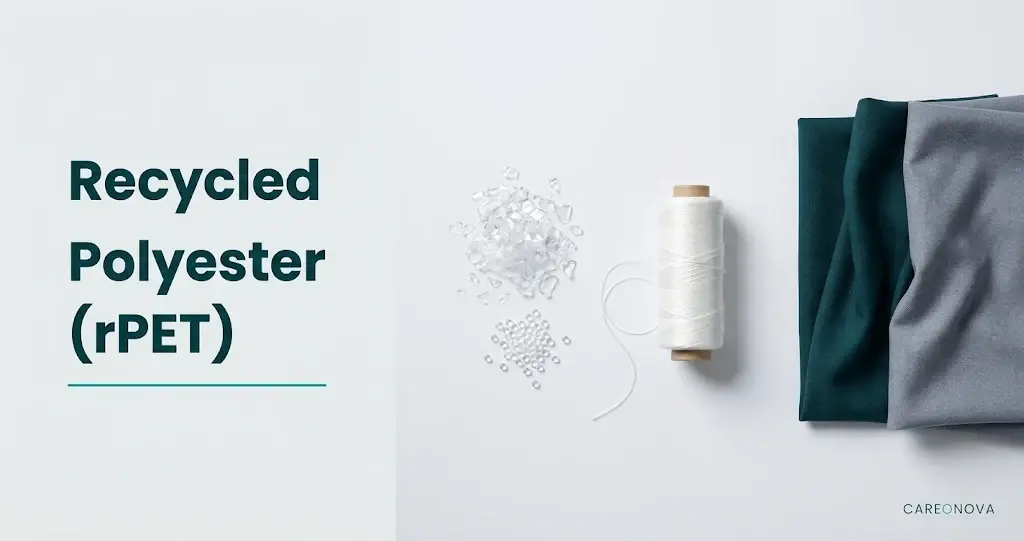
Recycled polyester often called rPET turns existing polyethylene terephthalate (PET) plastic into synthetic yarn instead of using newly drilled crude oil. According to Textile Exchange’s 2026 Materials Market Report, roughly 97% of clothing rPET still comes from post-consumer plastic bottles rather than old garments.
Here is the honest trade-off. Choosing rPET lowers upstream energy use and greenhouse gas emissions compared to virgin polyester, making it a real improvement over brand-new petroleum fiber. Still, it remains plastic. It never biodegrades, recent lab tests show mechanically recycled versions can shed more microfibers than virgin polyester, and uncertified activewear can leave chemical residues on sweaty skin.
What Is Recycled Polyester (rPET) and What Do Garment Tags Mean?
Chemically, recycled polyester uses the exact same PET resin that explains why polyester is plastic. Brands sometimes shorten the name to “recycled poly” on tags. What separates rPET fabric from conventional polyester is its starting feedstock, which falls into two categories:
- Post-consumer waste (PCW / PCR): Plastic that people already used and discarded. Clear PET beverage bottles make up most of this stream, alongside small amounts of fishing nets or old garments.
- Post-industrial or pre-consumer waste (PIW): Unused yarn scraps, fabric offcuts, and trim left on factory floors during production. Under Textile Exchange rules, factory scraps count as recycled content, though brands cannot market them as “post-consumer.”
How to Read Recycled Polyester Tags
The easy mistake here is seeing “made with recycled polyester” on a hangtag and assuming the entire garment came from waste. Always flip to the sewn-in label and check the exact fiber split:
- 100% Recycled Polyester: All polyester yarn in the main shell comes from recycled feedstock. Brands still exclude sewing thread, zippers, linings, and interfacings from that number.
- 50% Recycled Polyester / 50% Virgin Polyester: Common in budget athleticwear and hoodies. Mills blend in virgin fiber to keep tensile strength high and costs predictable.
- 60% Cotton / 40% Recycled Polyester (or 50/50): A softer, cooler blend for daily T-shirts and sweatshirts. It feels better against skin than 100% synthetic knit, though mixed fibers block easy recycling later.
- 95% Recycled Polyester / 5% Spandex (Elastane): Standard for leggings, swimwear, and fitted gym tops. Even 5% spandex adds strong stretch recovery, though it complicates chemical sorting at end-of-life.
How Factories Make rPET: Mechanical vs. Chemical Recycling
Manufacturers produce nearly all store-bought recycled polyester through mechanical recycling. This physical process melts waste plastic back into wearable yarn:
- Collection and sorting: Recyclers gather clear PET bottles, strip caps and labels, and sort them by color. Clear bottles yield cleaner, easier-to-dye fiber.
- Washing and shredding: Factories sterilize the plastic and chop it into small PET flakes.
- Melting and pelletizing: Machines heat and extrude the flakes into uniform resin chips.
- Spinning into yarn: Factories force melted chips through tiny nozzles called spinnerets to form continuous filaments. Mills either keep them smooth or cut them into short staple fibers for softer yarns.
- Weaving or knitting: Textile mills weave those yarns into crisp cloth like twill or canvas. Alternatively, they knit them into stretchy jersey or fleece.
Mechanical vs. Chemical Recycling Compared
That process sounds simple, but mechanical heat takes a toll. Every time recyclers melt PET down, its long molecular chains shorten slightly a problem called polymer chain degradation. Shorter chains weaken the yarn and make it more brittle. Mixed bottle batches also yield creamy or yellow-tinted chips instead of crisp white ones. To hit consistent shades, factories sometimes rely on chlorine bleaching or heavier dye loads.
Chemical recycling (depolymerization) avoids that quality loss. It breaks PET down to its base molecules, removes dyes and contaminants, and rebuilds fresh polymer chains matching virgin strength. However, chemical plants cost far more to build and run, so they still supply a tiny fraction of retail clothing.
| Attribute | Mechanical Recycling | Chemical Recycling (Depolymerization) |
|---|---|---|
| How It Works | Shreds, washes, melts, and re-spins solid PET flakes into yarn | Chemically breaks PET to base monomers, purifies, and repolymerizes |
| Main Feedstock | Clear post-consumer plastic bottles | Bottles, dyed polyester fabrics, and some blended textile waste |
| Fiber Quality & Color | Shorter polymer chains over time; flakes can yellow and need extra dyeing | Matches virgin polyester strength and clarity; strips dyes cleanly |
| Cost & Real-World Scale | Lower cost; produces almost all rPET clothing today | Higher cost and energy use; emerging commercial scale (e.g., Syre) |
The Open-Loop Downcycling Reality
This mechanical limit exposes a common marketing myth. Some apparel suppliers describe rPET as a "closed-loop" system where garments recycle endlessly without losing strength. In reality, turning a clear drinking bottle into a dyed shirt is open-loop downcycling.
Bottle recyclers can turn a clean PET bottle into a new food-grade bottle several times. Once a fashion brand turns that bottle into a blended shirt, it usually exits the recycling stream for good.

According to Textile Exchange's 2026 Materials Market Report, global fiber production hit a record 139 million tonnes in 2025. Polyester accounted for 82.5 million tonnes (59%), and recycled polyester reached 9.7 million tonnes (about 11.8%). Yet textile-to-textile recycled fiber made up well under 1% of the global polyester market. Until chemical fiber-to-fiber recycling scales up, most "recycled" clothes still compete with beverage companies for used bottles.
Recycled Polyester vs. Virgin Polyester (and Cotton Blends)
Chemically, rPET acts almost identically to standard polyester fabric once you put it on. It does not suddenly breathe like linen or absorb sweat like cotton. Its main advantage over virgin polyester happens before you buy the shirt—at the oil refinery and yarn mill.
| Comparison Factor | Recycled Polyester (rPET) | Virgin Polyester | Organic Cotton / Poly-Cotton Blends |
|---|---|---|---|
| Raw Material | Existing PET plastic (mostly bottles) | Newly extracted crude oil and natural gas | Plant cellulose (or cotton mixed with PET) |
| Upstream Energy & CO2 | Generally lower than virgin PET (LCA ranges vary by method) | High fossil-fuel energy and emissions | Lower fossil energy than virgin PET, but higher land and water use |
| Agricultural Water Use | Very low (wash water only) | Very low | Moderate to high (lower for rain-fed organic cotton) |
| Durability & Strength | High, though mechanically recycled spun yarns can pill faster | High tensile strength and abrasion resistance | Softer, less abrasion-resistant than 100% polyester; blends balance both |
| Breathability & Odor | Low natural airflow; traps body oils unless knit as athletic mesh | Low natural airflow; holds sweat oils easily | Pure cotton breathes and releases odor well; blends fall in between |
| Microplastic Shedding | Sheds synthetic microfibers (lab tests show higher rates in mechanical rPET) | Sheds synthetic microfibers | Pure cotton sheds biodegradable plant fibers; poly-cotton still sheds plastic |
Choosing between natural and synthetic fibers for warm-weather shirts or sheets? Comparing polyester vs. cotton clarifies breathability, drying speed, and comfort. When you truly need water resistance, quick drying, or heavy abrasion strength, rPET beats virgin polyester upstream—as long as you weigh its limits.
Is It Actually Sustainable? Pros, Cons & Microplastic Shedding
Think of recycled polyester as a harm-reduction step, not a zero-impact or truly circular material. Whether it makes environmental sense depends on what it replaces and how long you wear the garment.
Where rPET Truly Helps
When rPET replaces virgin fossil polyester—instead of fueling extra fast-fashion output—the upstream savings matter. Life-cycle assessments (including Textile Exchange benchmarks and peer-reviewed studies) estimate that mechanically recycled PET cuts manufacturing energy by 30% to 59%. It also lowers greenhouse gas emissions by 29% to 70% compared to virgin PET. Exact savings vary by local electricity grids and bottle-collection math. Even so, rPET consistently avoids new crude oil drilling and farmland irrigation.
The Trade-Offs: Microfiber Shedding and Overproduction
Two downstream realities keep rPET from being an uncomplicated sustainability win:
- Higher microfiber release: For years, eco-guides assumed recycled and virgin polyester shed microplastics equally. In December 2025, a Changing Markets Foundation and Çukurova University lab study (Spinning Greenwash) tested 23 retail garments. Mechanically recycled items released 55% more microfibers per gram than virgin polyester—roughly 12,000 fibers versus 8,028. The shed fibers also measured nearly 20% smaller, likely because shortened polymer chains snap more easily under wash agitation. Shedding still varies by weave and yarn quality, so fabric choice and gentle washing matter more than older guides claimed.
- Persistent waste and overproduction: Like virgin polyester, rPET takes centuries to break down in landfills or oceans. Worse, cheap bottle-derived yarn lets fast-fashion brands market disposable clothing as "sustainable" while total polyester output keeps rising.
Can Recycled Polyester Clothes Be Recycled Again?
Technically, chemical recyclers can break pure 100% polyester back down into fresh yarn. Practically, almost no consumer clothing enters a second recycling cycle today. Curbside bins reject textiles, and dyes or coatings interfere with processing. Blends with cotton, wool, or elastane also cost too much to separate. Treat every rPET garment as if it is on its final useful life. Buy fewer pieces, pick durable weaves, and wear them for years.
Is Recycled Polyester Safe to Wear? BPA, Antimony, PFAS & Skin Health
For most people, dry recycled polyester carries a low daily health risk. It shares many of the same polyester safety factors as conventional synthetics. What matters most is which chemicals appear in the fabric, how tightly it hugs sweaty skin, and whether it passed third-party testing.
Separating Real Chemical Risks from Myths
Online discussions often lump every synthetic chemical together, so it helps to separate real evidence from myths:
- BPA and BPS (Bisphenols): Researchers sometimes detect these hormone-disrupting chemicals in recycled plastics, thermal paper residue, or textile finishes. A September 2024 study in Environmental Science and Pollution Research tested everyday T-shirts and socks. Recycled items showed a higher median BPA level (13.5 ng/g) than conventional items (7.66 ng/g). However, levels varied widely—some polyester-elastane socks tested highest—and the median gap lacked statistical significance. Dry wear stayed low under standard risk benchmarks, while sweat increased skin transfer and washing lowered bisphenol levels.
- Antimony: Manufacturers widely use antimony trioxide as a catalyst when making PET plastic. A 2021 study by Biver, Turner, and Filella (Regulatory Toxicology and Pharmacology) found trace antimony leaching from polyester into artificial sweat. Certifiers screen certified recycled fabrics to keep extractable antimony within strict caps.
- PFAS ("Forever Chemicals"): Many shoppers assume rPET naturally contains PFAS, but PET resin itself contains no PFAS. When PFAS shows up on a recycled polyester raincoat or stain-resistant uniform, it comes from a DWR (durable water-repellent) coating factories apply after weaving.
- Skin irritation and disperse dyes: Synthetic fibers trap heat and sweat against skin, which can trigger eczema or heat rash. Dark, heavily dyed synthetics can also cause contact dermatitis if you react to disperse dyes.
Three Practical Ways to Lower Exposure
You do not need to panic or clear out your closet to stay safe. Three simple habits handle almost all risk:
- Wash new rPET clothes before wearing them. This flushes out surface residues, finishes, and loose bisphenols.
- Look for OEKO-TEX Standard 100 or bluesign labels. Prioritize these badges on tight, sweaty items like leggings, sports bras, socks, and base layers.
- Check for "PFAS-free DWR." Verify this specifically when buying rain shells, outdoor jackets, or water-resistant pants.
Quality, Feel & Performance: Where rPET Works Best
Shoppers often ask whether recycled polyester feels breathable, stretches well, or pills quickly. The honest answer is that fabric construction matters far more than the word "recycled." Like virgin polyester, rPET breathes poorly unless mills knit it into open athletic mesh or blend it with cotton.

Pure 100% polyester also has very little natural stretch unless mills knit it into flexible loops or add elastane. Tightly woven, smooth filament yarns resist pilling and shed far fewer microfibers. Short spun staple yarns brushed into fleece feel cozy. However, they trap lint, pill quickly, and shed heavily in the wash.
Best and Worst Uses for rPET
| Garment or Fabric Type | How Recycled Polyester Performs | Practical Buying Verdict |
|---|---|---|
| Outerwear & 600D Bags (plain weave, ripstop, canvas) | Tightly woven filaments resist tearing, shed very little, rarely need washing, and avoid sweaty skin contact. | Strongest use case. Great durability and clear upstream carbon savings. |
| Recycled Polyester Fleece (brushed knit) | Warm, lightweight, and fast-drying, yet brushed fibers pill over time and shed the most microfibers in the wash. | Buy selectively. Choose reputable brands, wash less often, and use a microfiber bag. |
| Athletic Knits (interlock, tricot, athletic mesh) | Engineered channels wick sweat and hold shape, though tight knits trap oil odor and sweat-transfer risk if uncertified. | Good if certified. Look for OEKO-TEX/bluesign labels and wash inside out to clear body odor from clothes. |
| Everyday Tees & Blends (50/50 or 60/40 poly-cotton) | Softer and more breathable than 100% rPET with less wrinkling than pure cotton, though blends block easy recycling. | Reasonable middle ground if you wear the garment for years rather than replacing it seasonally. |
| Bed Sheets & Pillowcases (brushed microfiber) | Wrinkle-resistant and budget-friendly, yet sleeps warmer than cotton or linen and holds facial oils over time. | Often better skipped for hot sleepers; compare breathability in microfiber vs. polyester bedding. |
How to Verify Labels (GRS, RCS, OEKO-TEX & REPREVE)
Casual US marketing phrases like "eco-friendly polyester" or "made with recycled materials" lack strict legal definitions. Real verification requires checking for third-party standards.
The simplest shortcut is the Two-Label Rule: recycled-content certifications verify where the plastic came from, while chemical-safety certifications verify what touches your skin. No single badge covers both jobs equally.
| Label or Brand | What It Actually Proves | Minimum Recycled Content | What It Does NOT Guarantee |
|---|---|---|---|
| GRS (Global Recycled Standard) | Chain-of-custody recycled content plus social, environmental, and chemical-management rules across processing sites | 20% to certify; 50% minimum to print the GRS logo on a finished product | Does not test every finished garment batch to strict skin-contact limits like OEKO-TEX |
| RCS (Recycled Claim Standard) | Tracks recycled material from source to final product via Transaction Certificates | 5% minimum (RCS Blended) or 95%–100% (RCS 100) | Does not audit factory labor conditions, wastewater, or chemical inputs |
| OEKO-TEX Standard 100 | Independent lab tests of finished textiles for hundreds of regulated substances, including recycled PET screening | None (tests safety, not recycled share) | Does not verify whether the fabric contains recycled material |
| REPREVE (by Unifi) | Traceable recycled polyester yarn from verified plastic bottles and textile waste, with built-in fiber tracing | Varies by garment blend (check the sewn-in fiber percentage) | Does not replace independent third-party chemical safety testing |
Textile Exchange is phasing GRS and RCS into a unified Materials Matter Standard, so newer hangtags will show updated wording. Either way, treat any "recycled fabric" claim that hides its exact percentage or certification with healthy skepticism.
Washing, Shrinkage & Care Labels for Recycled Polyester
Recycled polyester resists shrinking in cool or warm water. High dryer heat, however, can shrink, warp, glaze, or weaken it especially mechanically recycled knits and cotton or spandex blends. When you check a garment's care label, always follow the temperature limit for the most delicate fiber in the blend.
6 Care Habits That Cut Shrinkage and Shedding
Conveniently, the same laundry habits that prevent shrinkage and pilling also reduce microfiber shedding:
- Wash cold on a gentle cycle. Cold water (30°C / 86°F or below) protects heat-sensitive chains and cuts breakage—the core of washing polyester properly.
- Run full—not overloaded—wash loads. A moderately full drum creates less violent water-to-fabric friction than washing two items alone.
- Use liquid detergent and skip fabric softener. Powdered detergents can abrade fine synthetic filaments. Fabric softeners coat fibers in a waxy film that traps sweat oils and ruins moisture-wicking finishes.
- Air dry or tumble dry on low heat. High heat drives polyester shrinkage, locks greasy body odors into fibers, and speeds up wear.
- Catch loose microfibers from brushed fleece. Wash fleece inside a fine-mesh bag (like Guppyfriend) or install an external lint filter to block fibers from wastewater.
- Use low heat when pressing. When ironing polyester, pick the lowest synthetic setting and use a damp pressing cloth so yarns do not glaze or melt.
Recycled polyester is neither the climate miracle some hangtags promise nor a material you need to fear outright. Its real sustainability payoff comes down to longevity. Choose durable, certified pieces where synthetic strength truly matters, and wear them long enough for those upstream savings to count.
Sources & Further Reading
- Textile Exchange: Materials Market Report 2026 — Global fiber production totals (139 million tonnes), polyester market share (59%), recycled polyester volume (9.7 million tonnes), and bottle-to-textile vs. textile-to-textile feedstock data.
- Changing Markets Foundation & Çukurova University: Spinning Greenwash (December 2025) — Laboratory wash testing comparing microfiber shedding counts and fiber size in recycled versus virgin polyester garments.
- Environmental Science and Pollution Research (NIH PMC): Bisphenols in Daily Clothes from Conventional and Recycled Material (2024) — Peer-reviewed study comparing BPA and BPS levels in recycled and conventional clothing, sweat transfer, and washing reductions.
