

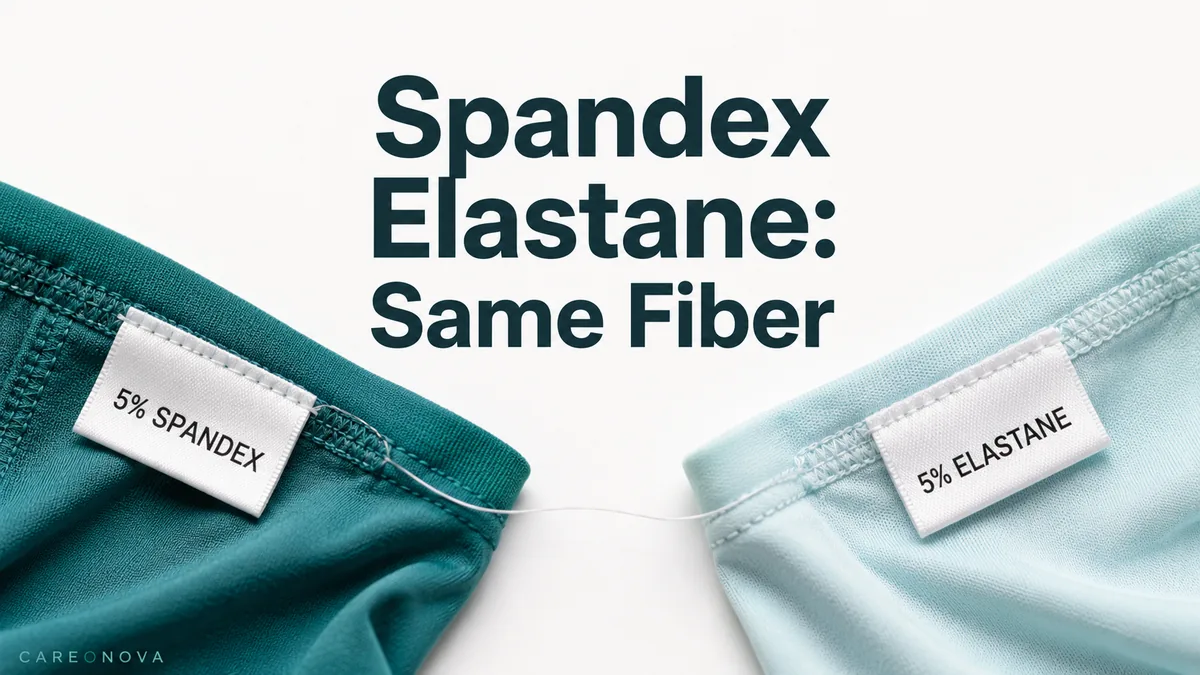
Spandex and elastane are the same fabric with two different names. Spandex is the word used in the United States and Canada, while elastane is the word used in Europe and most other countries. Neither name means the fiber is stronger, stretchier, or better made than the other.
This guide explains where each name comes from, how LYCRA® fits in as a brand rather than a separate fiber, and why two garments with the same spandex or elastane percentage can still fit and feel different. You’ll also see how fiber content, base material, fabric construction, and recovery affect stretch, plus how heat and washing can weaken that stretch over time.
Quick answer: Is elastane the same as spandex? Yes. They are two names for the same synthetic elastic fiber, generally made from segmented polyurethane. Spandex is the common name in the United States and Canada, while elastane is used more often in Europe, the UK, Australia, and many other markets. The different name does not make one fiber stronger, stretchier, or better than the other. LYCRA is a trademarked brand of spandex/elastane, not a separate generic fiber.
Spandex vs Elastane: What’s the Difference?
In a spandex vs elastane comparison, the main difference is terminology, not material. Spandex and elastane refer to the same general fiber category.
Spandex is the common U.S. term. Elastane is used more often in Europe and many international markets. A garment labeled 5% elastane is not automatically different from a similar garment labeled 5% spandex simply because a different regional word appears on the tag.
U.S. textile rules define spandex as a manufactured fiber whose fiber-forming substance contains at least 85% segmented polyurethane. The legal definition appears in 16 CFR 303.7. Elastane is an accepted alternative name for this same type of fiber.
The 85% figure describes the fiber-forming substance itself, not the percentage printed on a finished garment. If a label says 95% cotton and 5% elastane, the stretch fiber accounts for 5% by weight of the declared fiber content.
Fiber Is Not the Same as Fabric
Spandex or elastane is a fiber, not usually the entire fabric. Most clothing blends it with cotton, polyester, nylon, or another main material.
The base fiber strongly affects softness, moisture behavior, drying speed, warmth, and durability. The stretch fiber mainly adds movement and helps the material return toward its original dimensions. Our overview of different fabric materials explains how common base fibers behave.
Also, elastane should not be confused with a separate elastic band. A waistband can contain elastic even if the surrounding cloth has little or no elastane.
Why Are Spandex and Elastane Called Different Names?
Regional vocabulary explains most of the difference. American clothing labels commonly use spandex, while European and international labels more often use elastane.
Either term can appear legally on an American garment. The FTC textile labeling guide recognizes elastane as an alternative name for spandex. Seeing elastane on a U.S. garment does not mean the product is mislabeled.
A garment may also have separate fiber disclosures for different sections. For example, the body fabric, lining, waistband, or another panel can be listed individually. One section might use one regional name while another uses the alternative.
If the two names appear as separate percentages for exactly the same fabric section, the disclosure may be unclear. In that case, the manufacturer can explain the composition.

Spandex Elastane and Lycra at a Glance
Clothing tags can make these names look like three different materials. The first two are generic names for the same type of stretch fiber. The third is a trademark.
| Feature | Spandex | Elastane | LYCRA® |
|---|---|---|---|
| Type of name | Generic fiber name | Generic fiber name | Fiber trademark |
| Common regional use | United States | Europe and many other regions | Used internationally |
| Fiber category | Synthetic elastic fiber | Synthetic elastic fiber | Branded elastic fiber |
| Naturally stretchier? | No | No | Depends on the specific product and fabric |
| Main distinction | Regional wording | Regional wording | Brand and product specifications |
Lycra vs Spandex vs Elastane: What’s the Difference?
Spandex and elastane are generic names for the same stretch-fiber category, while LYCRA is a trademarked brand within that category.
So, Lycra is not a third completely different generic material. However, not every elastane or spandex fiber is LYCRA. Different manufacturers can produce stretch fibers with different specifications and intended uses.
The brand name alone also cannot predict how a finished garment will feel. Fiber percentage, yarn design, fabric density, knit or weave, finishing, and garment construction all influence stretch, recovery, comfort, and durability.
The simplest way to remember the distinction is:
- Spandex: generic U.S. term.
- Elastane: generic international term.
- LYCRA: trademarked brand name.
Is Elastane Better or Stretchier Than Spandex?
No. Elastane is not naturally better or stretchier than spandex because the two words refer to the same type of fiber.
What changes is how that fiber is made and used in the finished fabric.
One garment may extend easily but remain slightly loose after repeated wear. Another may feel firmer but quickly return toward its earlier dimensions. The second garment has better recovery, even if both products contain the same percentage of spandex or elastane.
| Property | What it means | What you notice |
|---|---|---|
| Stretch | How far the material can extend | Greater freedom of movement |
| Recovery | How well it returns toward its original dimensions | Less sagging and bagging |
| Compression | Pressure created by a close-fitting garment | Firmer, more supportive feel |
Stretch and recovery are not the same thing. A fabric can stretch far but recover poorly, leading to loose knees, a stretched waistband, or a sagging seat.
Does more spandex mean more stretch? Not always. A well-engineered fabric with a smaller amount can perform better than a weaker fabric containing more stretch fiber. Garment dimensions, fabric tension, construction, and fit also affect compression.
Why Can Two Spandex Elastane Fabrics Feel Different?

The wording on the label does not explain the whole performance of a spandex elastane fabric. Four factors are usually more useful.
1. Fiber Content
The amount of stretch fiber affects how easily a fabric can move and recover, but percentage alone does not determine performance.
A small share can add comfort stretch to jeans, shirts, chinos, and trousers. Higher amounts are more common in garments that need close fit and greater movement, such as leggings, swimwear, underwear, and compression clothing.
The same percentage can still feel different in thick woven denim and a lightweight performance knit.
2. Base Material
The main fiber often has a stronger effect on softness, moisture behavior, warmth, drying speed, and overall feel.
Cotton is absorbent and familiar in casual clothing. Polyester often dries quickly and is widely used in performance wear. Nylon usually feels smooth and resists rubbing well.
Elastane mainly adds stretch and recovery to these base materials rather than replacing their normal characteristics. People comparing blends can also review how different materials compare fabric properties.
3. Fabric Construction
Knitted fabrics use connected loops and usually provide more structural movement. Woven fabrics use interlaced yarns and normally have less natural give unless stretch fibers are added.
Construction also changes the direction of movement. Two-way stretch mainly works along one axis. Four-way stretch works across both width and length.
Retailers do not always use these descriptions consistently, so garment specifications or a physical stretch test can provide better information.
4. Recovery and Finishing
Good recovery helps clothing retain its dimensions after sitting, bending, wearing, and washing.
Poor recovery can cause loose knees, sagging waistbands, stretched seats, or other areas that stay distorted after wear.
Yarn structure, fabric density, finishing treatments, heat setting, and garment construction can all affect the result.
What matters more than the name: Check the stretch-fiber percentage, base material, construction, stretch direction, recovery, and intended use.
How Spandex and Elastane Blends Perform in Clothing
There is no universal best percentage. Garment purpose and construction matter as much as the number on the label. The patterns below are broad examples rather than fixed industry standards.
| Garment type | General amount pattern | Main purpose | What else to check |
|---|---|---|---|
| Stretch jeans and chinos | Small share | Comfort and easier movement | Denim weight and recovery |
| Fitted tops and light knits | Small to moderate share | Closer fit | Knit structure and thickness |
| Underwear | Moderate share | Fit and shape retention | Base fiber, seams, and waistband |
| Leggings and activewear | Moderate to high share | Multidirectional movement and body fit | Opacity, recovery, and stretch direction |
| Swimwear and compression wear | Often higher share | Support and strong stretch | Chlorine resistance and fabric density |
Consider jeans labeled 98% cotton and 2% elastane beside leggings labeled 80% nylon and 20% spandex. The leggings are not simply ten times stretchier. Knit structure, yarn tension, fabric weight, and garment cut also change the result.
How Stretch Fiber Changes Jeans
Stretch jeans often need only a small elastic component. It makes firm denim easier to move in, while cotton content and fabric weight preserve the familiar appearance.
More immediate give can feel comfortable, but weak recovery may produce loose knees or a sagging waist. Shape retention matters as much as the declared number.
Stretch and Recovery in Leggings
Leggings commonly use more elastic fiber than jeans because they must move in several directions and recover after repeated bending.
Percentage remains only one clue. Dense construction can improve coverage, while four-way movement can support mobility. Strong recovery helps the waistband and knees remain in place.
Fit and Comfort in Underwear
Underwear uses stretch fiber to stay close to the body and retain its fit. Softness and airflow depend more heavily on the main material and construction.
For example, cotton blends may feel soft and absorbent, while a synthetic blend may dry faster. People considering performance garments can also review how polyester underwear behaves with moisture, heat, and odor.
Stretch Durability in Swimwear
Swimwear requires movement and recovery while facing pool water, salt, sunscreen, and repeated drying.
The declared percentage cannot reveal everything. Chlorine resistance, fabric density, finishing, and construction may have a greater effect on how long a swimsuit retains its fit.
Cotton, Polyester, and Nylon With Spandex or Elastane
The stretch fiber rarely works alone in everyday clothing. The base fiber changes the hand feel, moisture response, drying time, warmth, and durability of the finished blend.
Cotton Blends
Cotton combined with elastane or spandex often feels soft and familiar. This pairing works well in jeans, fitted shirts, underwear, and casual clothing.
Cotton normally dries more slowly than many synthetic fibers and may shrink after too much heat. The added stretch improves movement but does not remove those cotton characteristics.
Polyester Blends
Polyester blends are common in activewear and leggings. Polyester is light, strong, and often quick to dry, while the stretch fiber supplies close-fitting movement. See our explanation of polyester fabric properties for its wider performance characteristics.
Elastane is not polyester. They are separate synthetic fibers that are often blended together. Polyester usually provides most of the fabric body, while elastane mainly adds stretch and recovery.
Polyester can retain and later release some odor compounds more readily than cellulosic fibers under certain conditions. Dense construction may also limit airflow.
Nylon or Polyamide Blends
Elastane is also different from nylon. A nylon-elastane fabric contains both fibers: nylon provides much of the smoothness, strength, and fabric structure, while elastane mainly adds stretch and recovery.
Brands commonly use this pairing in leggings, swimwear, fitted sports clothing, and underwear.
Fabric weight and construction still affect breathability and drying. Our nylon comparison explains how nylon and polyester differ as base materials.
How Heat and Washing Affect Stretch and Recovery
Does elastane shrink? It does not always shrink in the same way as cotton. Instead, excessive heat can weaken recovery, leaving a garment loose, wavy, or less supportive.
The main fiber can also change size. Cotton in a stretch blend may contract while the elastic component loses strength, changing both fit and shape. Preventive habits that help stop clothes shrinking can also protect mixed-fiber garments.

Washing Practices That Protect Stretch
| Do | Avoid |
|---|---|
| Use cool or moderately warm water | Repeated hot washes or high dryer heat |
| Choose a gentle cycle when needed | Long chlorine exposure |
| Rinse swimwear after use | Leaving chlorine or salt in the material |
| Let clothing dry fully before storage | Applying a hot iron directly to stretch fabric |
| Air-dry clothes when practical | Strong bleach unless the care label permits it |
Always follow the garment maker’s instructions when they require gentler treatment. Check the washing care symbols before choosing water temperature, cycle, drying method, or bleach.
Final Verdict: Spandex vs Elastane
The spandex elastane comparison has a simple answer: spandex and elastane are two names for the same generic synthetic stretch fiber, while LYCRA is a trademarked brand within that fiber category.
Neither regional name guarantees better stretch, recovery, comfort, or durability.
When comparing clothing, look at the complete blend. Consider the stretch-fiber percentage, main material, knit or weave, fabric weight, stretch direction, recovery, garment construction, and intended use.
A well-designed garment with a smaller amount of elastane can perform better than another garment containing more. The percentage is useful, but it is only one clue.
Choose the garment for how the entire fabric and design work together, not simply because the label says spandex, elastane, or LYCRA.
