


Polyester is one of the most shrink-resistant clothing fibers, so 100% polyester usually changes very littleon during care-label-approved washing and drying. However, a polyester garment can still become smaller, tighter, or misshapen when exposed to excessive heat.
The result also depends on more than the main fiber. Knitted construction, cotton or rayon in a blend, elastic, prints, coatings, seams, and garment finishes can all affect how the item responds. In some cases, what looks like shrinkage is actually heat distortion or damaged stretch recovery.
Does 100% Polyester Shrink?
Pure polyester is highly resistant to shrinkage. During manufacturing, polyester fabric is often heat-set to improve its dimensional stability and help it retain its original size during normal use and laundering.
That does not mean 100% polyester can never change. Excessive heat, repeated drying, loose knitted construction, poor stabilization during manufacturing, or sensitive garment finishes may cause limited tightening or distortion.
There is no universal shrinkage percentage for finished polyester clothing. Under normal care, pure polyester usually changes very little. The outcome depends on:
- Fabric construction
- Manufacturing and finishing
- Previous heat-setting
- Wash temperature
- Dryer temperature
- Length of heat exposure
A lightweight polyester knit may react differently from a woven jacket or thick fleece even when all three labels state 100% polyester.
Does Recycled Polyester Shrink?
Recycled polyester is generally as shrink-resistant as conventional polyester during care-label-approved washing and drying. Both are usually made from the same basic type of polymer, although their manufacturing and finishing processes may differ.
The finished garment can still change size because of its knit or weave, blended fibers, elastic, seams, prints, coatings, and dryer conditions.
Treat recycled polyester like other polyester clothing: follow the complete care label, avoid unnecessary high heat, and use low-temperature drying when permitted.
Why Can a Polyester Garment Become Smaller?
Fiber content is only one part of a garment. Clothing also contains yarns, seams, elastic, linings, prints, coatings, adhesives, and bonded sections that may react differently to washing and heat.
A knitted polyester item may tighten or change shape when its fabric loops relax or shift. A blended garment may become smaller because cotton, rayon, viscose, or wool contracts even though the polyester portion remains relatively stable.
Garment construction also matters. Woven polyester is often more dimensionally stable than a loose knit, but the final result still depends on how the fabric was manufactured, finished, and heat-set.
Did the Polyester Shrink or Suffer Heat Damage?
| What You Notice | More Likely Explanation | Best Next Step |
|---|---|---|
| The whole garment became evenly shorter or narrower | Dimensional change in the fabric or blended fibers | Stop using high heat and compare the garment’s measurements |
| Seams became twisted or puckered | Uneven heat response or garment construction | Reshape the item gently while damp and allow it to air-dry |
| The surface looks shiny, stiff, or glazed | Heat damage rather than useful shrinkage | Do not apply more heat |
| A stretch garment feels tight or has weak recovery | Elastane or spandex may have been affected | Avoid dryer heat and inspect whether the stretch returns |
| A printed area cracked or puckered | The decoration reacted differently from the base fabric | Follow care instructions for printed or decorated clothing |
| A cotton-polyester item became smaller | The cotton portion probably contributed | Use lower heat and follow the needs of the most sensitive fiber |

Applying more heat to a warped, glazed, or elasticity-damaged garment may make the problem permanent.
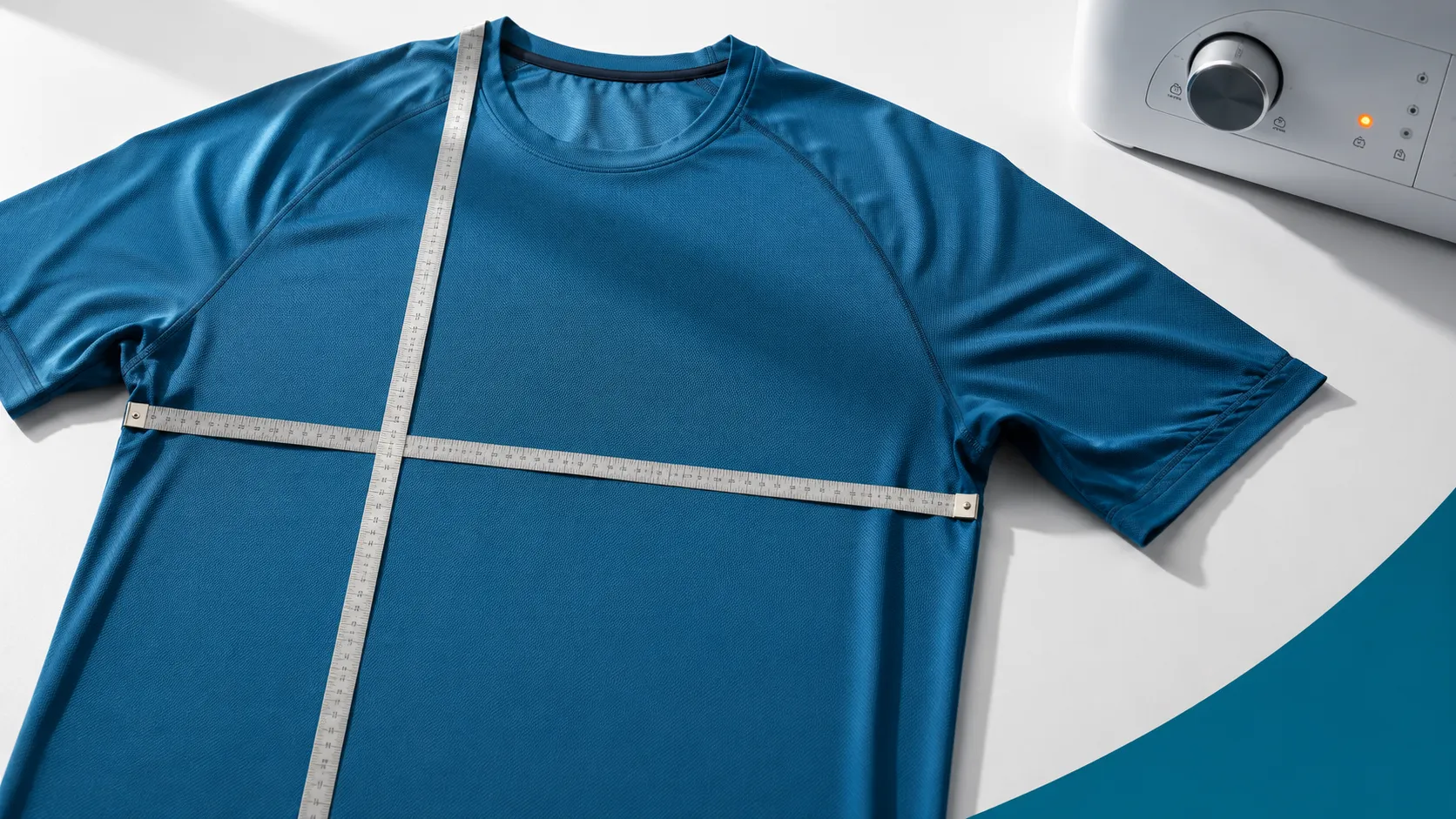
How to Check Whether Polyester Actually Shrunk
Let the garment cool and dry completely before judging its size. Damp fabric or an item that has just left the dryer may not show its final dimensions.
Measure the same points before and after laundering:
- Body length
- Chest or waist width
- Sleeve length
- Inseam
- Waistband width
An even reduction across several measurements suggests dimensional change. Twisted seams, glazing, cracked graphics, puckering, or weak elastic are stronger signs of heat damage or uneven distortion.
Does Polyester Shrink in the Dryer?
100% polyester usually shows little noticeable shrinkage on a low or care-label-approved dryer setting. The risk increases when the garment is exposed to high heat, repeated drying, or an unnecessarily long cycle.
Polyester is a thermoplastic fiber that is commonly heat-set during manufacturing. Excessive or repeated heat can affect its dimensions, finishes, seams, and other garment components. The result may be uneven distortion rather than smooth, predictable shrinkage.
Heat can also damage other parts of the garment before the polyester fabric changes noticeably. Stretch panels may lose recovery, heat-transfer graphics can crack, coatings may stiffen, and bonded sections can pucker.
Polyester blends may become smaller in the dryer because their other fibers respond differently. A cotton-polyester shirt, for example, may shrink mainly because the cotton content contracts.
Use low heat when the care label permits tumble drying. Remove the garment promptly when the cycle ends instead of allowing it to remain in a hot drum. Air-drying is the lower-risk choice when protecting shape, elastic, or decoration is the priority. Correct water temperature, cycle selection, and drying conditions also help you wash polyester without damaging its shape.
Repeated high-heat cycles may create a shiny surface, twisted seams, weakened elastic, cracked graphics, or permanent warping instead of producing an even size reduction. Use low heat only when the care label permits tumble drying.
Which Polyester Blends Shrink?
Polyester blends can shrink more than pure polyester because the second fiber can significantly influence how the garment responds to water, agitation, and heat.
Does Polyester Shrink More Than Cotton?
Cotton generally shrinks more readily than polyester, especially when exposed to hot washing or high dryer heat. Pure polyester is more dimensionally stable because it is commonly heat-set during manufacturing. The difference becomes clearer when you compare cotton with synthetic fabrics by absorbency, construction, heat sensitivity, and normal care requirements.
In a cotton-polyester blend, the cotton portion is usually more likely to contract. A blend containing more cotton, such as 80% cotton and 20% polyester, generally has greater shrink potential than a blend containing more polyester.
Fabric construction, finishing, and care conditions still influence the final result.
| Garment Label | General Tendency | What Usually Influences the Result |
|---|---|---|
| 100% polyester | Low shrink risk during normal care | Excessive heat may cause distortion rather than even shrinkage |
| 80% cotton, 20% polyester | More likely to shrink than a balanced or high-polyester blend | The larger cotton percentage |
| 60% cotton, 40% polyester | More likely to shrink than pure polyester | Cotton is the larger component and may contract |
| 50% cotton, 50% polyester | More stable than pure cotton, but not shrink-proof | Cotton content, fabric construction, and dryer heat |
| 65% polyester, 35% cotton | Usually more stable than a high-cotton blend | Polyester reduces shrink potential but does not eliminate it |
| 95% polyester, 5% spandex | Usually retains its size during correct care | High heat may weaken elasticity and stretch recovery |
| Polyester and spandex or elastane | Usually size-stable during care-label-approved washing | Excessive heat may damage stretch recovery before reducing size evenly |
| Polyester and rayon or viscose | More sensitive than pure polyester | Rayon or viscose may contract or lose shape |
| Polyester and wool | Higher and more complex shrink risk | Wool may contract or felt even when polyester remains stable |
| Recycled polyester | Usually similar to conventional polyester | Fabric construction, finishes, blends, and dryer conditions |

These are general tendencies, not guaranteed results. Two garments with the same fiber percentages may behave differently because of their fabric thickness, knit or weave, finishing, seam construction, and previous heat-setting.
A 60% cotton and 40% polyester sweatshirt may not react like a lightweight shirt with the same label because their structures and manufacturing processes differ.
Does Polyester Shrink in the Washing Machine?
Pure polyester usually does not shrink noticeably during a normal washing-machine cycle. Cold or warm water is commonly suitable when the care label permits it.
The washer can still affect a polyester garment’s dimensions. Strong agitation may stretch or distort a loose knit, while hot water can affect elastic, decorations, coatings, bonded sections, or blended fibers.
A properly stabilized 100% polyester garment should also show little noticeable change after its first care-label-approved wash. A major size change after one normal wash may result from:
- Sensitive blended fibers
- Loose fabric construction
- Unsuitable water temperature
- Excessive agitation
- Poor stabilization during manufacturing
The complete care label should control the method. A polyester jacket with a lining or bonded layer may require different care from a basic polyester T-shirt.
Use the recommended amount of detergent and avoid assuming that a hotter or more aggressive cycle will clean the item better. Lower heat, correct agitation, and suitable drying conditions can also help prevent clothes from shrinking.
Does Polyester Shrink in Hot Water?
Hot water usually causes little predictable shrinkage in pure polyester, but it can increase the risk of distortion. It may also affect blended fibers, elastic, prints, coatings, adhesives, and bonded sections.
Do not use hot water simply to force polyester to become smaller. Follow the wash temperature shown on the care label because other parts of the garment may be more heat-sensitive than the main fabric.
How to Prevent Polyester From Shrinking or Losing Shape
Polyester is generally easy to maintain when unnecessary heat and aggressive treatment are avoided.
- Read the complete care label. Follow the instructions for washing, drying, bleaching, and ironing.
- Use label-approved water. Cold or warm water is usually enough for routine polyester laundry.
- Avoid unnecessary dryer heat. Choose low heat or air-dry when the label allows it.
- Remove garments promptly. Do not leave polyester sitting in a hot dryer after the cycle ends.
- Protect stretch and decoration. Turn printed or stretch clothing inside out when appropriate.
- Reshape delicate knits while damp. Smooth seams and hems before air-drying.
When air-drying is suitable, use a ventilated location and support heavy knitted garments properly so their weight does not stretch the fabric.
Can You Shrink Polyester on Purpose?
Polyester cannot be shrunk as predictably as untreated cotton.
Hot washing and high dryer heat may make a polyester garment somewhat smaller, but the change can be limited or uneven. The fabric may become shiny, stiff, warped, or permanently creased. Elastic can weaken, seams may twist, and graphics may crack before the garment reaches the desired size.
Repeated high-heat cycles increase the risk of damage rather than producing controlled shrinkage.
Exchanging the garment, tailoring it, or adjusting the fit with sewing is usually safer than trying to force polyester to shrink.
Can You Unshrink Polyester?
A mildly distorted polyester knit may sometimes be improved by gently reshaping it while damp. Lay the garment flat, smooth the seams, and guide it toward its previous dimensions without pulling aggressively.
However, reshaping cannot reliably reverse permanent thermal damage. Glazed fibers, warped fabric, weakened elastic, cracked prints, and damaged bonded areas may not return to their original condition.
Conditioner, shampoo, or stretching methods should not be presented as guaranteed ways to restore heat-damaged polyester.
Final Takeaway
Does polyester shrink? Pure polyester usually remains stable during normal, care-label-approved washing and drying. More noticeable size changes are usually connected to excessive heat, blended fibers, knitted construction, elastic, seams, prints, or garment finishes.
Follow the care label, avoid unnecessary heat, and determine whether the item truly shrank or suffered distortion before attempting another treatment.
