

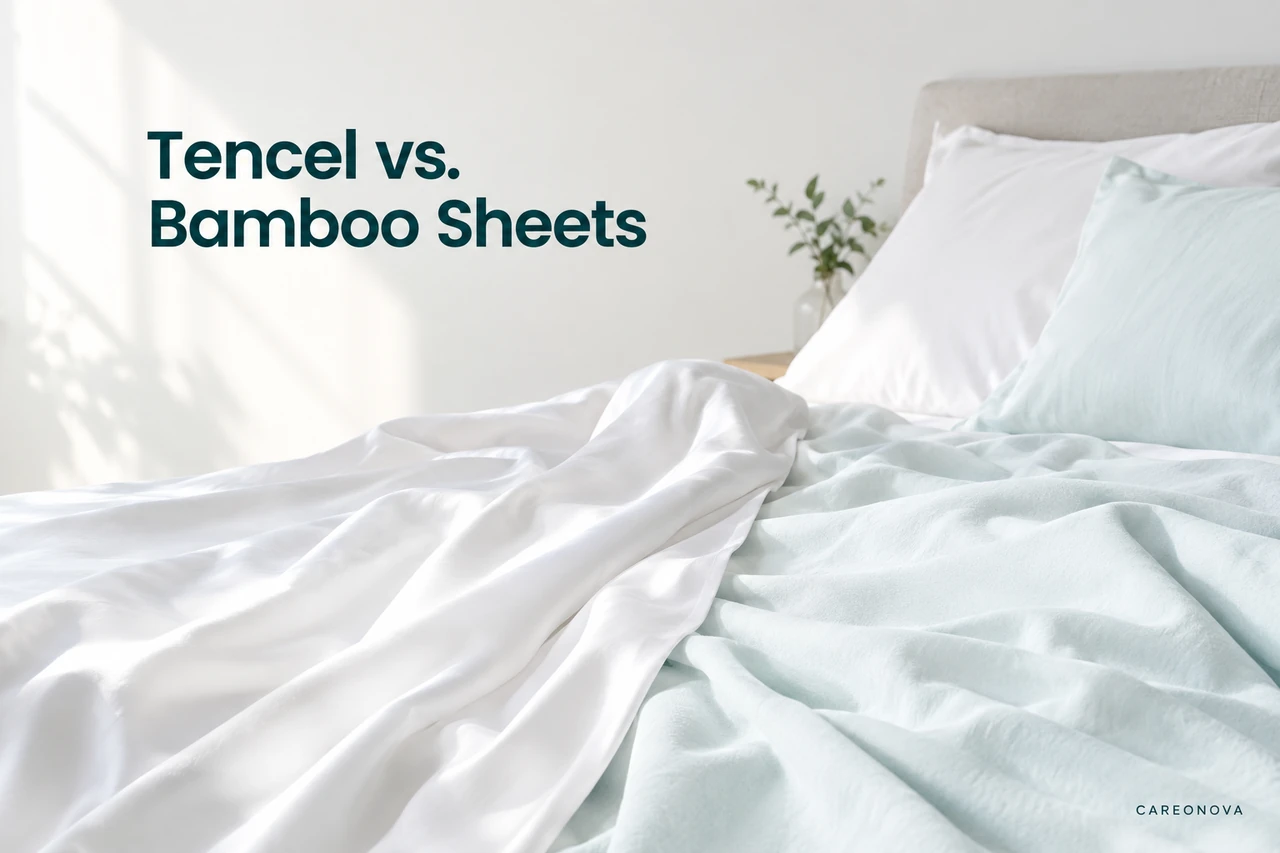
Are you struggling with night sweats or tossing and turning in damp cotton? If so, comparing tencel vs bamboo sheets is the ultimate showdown.
Both are sold as ultra-soft, eco-friendly fabrics that sleep cool. However, these two materials have very different chemical structures, cooling habits, and laundry lifespans. Before you spend $150 to $300 on new sheets, you must look past the sales pitch. You need to understand how these fabrics actually perform in the real world.
The Quick Verdict: Which Sheets Should You Buy?
To cut through the noise, here is the immediate, science-backed recommendation based on your sleep environment and laundry habits.
Buy Tencel (Lyocell) If:
- You experience severe night sweats.
- You wash your bedding on gentle cycles in cold water.
- You strictly want to avoid toxic manufacturing processes.
Buy Bamboo (Viscose) If:
- You live in a hot, dry climate.
- You want the lightest, airiest drape against your skin.
- You are working with a slightly tighter budget.
| Feature | Tencel (Lyocell) | Bamboo (Viscose) |
|---|---|---|
| Primary Cooling Mechanic | Active moisture absorption | High porosity and immediate airflow |
| Durability (Wet Strength) | High (Retains ~85% of strength) | Low (Loses up to 50% of strength) |
| Eco-Friendliness | True sustainable (>99% closed-loop) | Chemically intensive (toxic runoff) |
| Texture & Drape | Silky, smooth, slightly heavier drape | Cloud-like, exceptionally light and airy |
| Average Price Point | $180 – $300+ | $120 – $250 |
Note on sheet structure: Weave type also impacts breathability. A bamboo twill or sateen will feel heavier and warmer than a crisp Tencel percale, regardless of the fiber.
Understanding the Labels: Viscose, Rayon, and Lyocell
When comparing Tencel lyocell vs bamboo viscose, many shoppers get confused by the labels. Bamboo and eucalyptus are just the raw plants. To turn hard wood into soft fabric, factories use a chemical process.
What is Bamboo Viscose?
If you frequently wonder if viscose is the same as bamboo, the answer lies in the manufacturing. Bamboo is the plant, but viscose is the century-old chemical process used to break it down.
Here is how standard bamboo sheets are made:
- Factories dissolve raw bamboo wood pulp in harsh chemical baths.
- This process creates a soft, highly breathable yarn.
- This yarn shares the exact same properties as standard rayon.
Understanding these bamboo viscose fabric properties is essential to treating the fabric correctly in the laundry room. In fact, 95% of all bamboo sheets sold today are actually bamboo viscose.
What is Tencel (Lyocell)?
Tencel is not a generic plant fiber. It is a trademarked brand name owned by the Austrian company Lenzing AG. Factories make Tencel from sustainably grown eucalyptus trees using the advanced lyocell process. This modern method eliminates the harshest chemicals used in traditional viscose manufacturing.
When consumers search for eucalyptus sheets vs bamboo sheets, they are almost always comparing Tencel Lyocell to Bamboo Viscose. You may also occasionally see the term “bamboo lyocell.” This means the factory processed bamboo wood using the cleaner lyocell method.
Never compare “Tencel vs. Bamboo.” You must compare “Lyocell vs. Viscose.” The raw plant matters far less than the chemical process used to turn that plant into the sheets you sleep on.
Cooling and Breathability: How Do They Regulate Heat?
Both fabrics easily beat standard cotton and polyester for temperature control. But do bamboo sheets keep you cooler? They handle heat in two completely different ways.
Bamboo for Instant Airflow
Bamboo viscose is exceptionally porous. This microscopic structure allows massive amounts of air to flow through the fabric. When you slide into a bamboo bed, it feels distinctly icy and breezy to the initial touch. For sleepers who run hot but do not perspire heavily, this constant air circulation prevents the bed from trapping body heat.
Tencel for Moisture Absorption
Is Tencel cool? Yes, Tencel is incredibly cool because it relies on active liquid management. When looking at bamboo lyocell moisture absorption versus standard bamboo viscose, Tencel is highly hydrophilic (water-loving).
Here is how Tencel cools the body:
- It actively pulls sweat away from your skin.
- It absorbs the moisture directly into the fiber’s core.
- It safely releases that moisture into the air.
If you wake up shivering in damp cotton sheets, Tencel vs bamboo cooling ends in a decisive victory for Tencel. It simply manages the physical liquid of sweat better.
Texture and Feel: What to Expect
Both fabrics belong to the cellulosic family. Therefore, they offer a frictionless, silk-like hand feel that easily rivals many natural fibers while remaining naturally hypoallergenic and gentle on sensitive skin.
- Tencel has a fluid, almost liquid drape. Because it is slightly heavier than bamboo, it contours smoothly over your body with a subtle, elegant sheen.
- Bamboo feels lighter and fluffier. It lacks the heavy drape of Tencel, making it feel like you are sleeping underneath a soft, airy cloud.

Durability and the “Wet Strength” Problem
This is the hidden metric that online brands deliberately omit from their product descriptions. It is also the single most important factor for anyone tired of pulling ruined sheets out of the washing machine. In textile science, durability is measured by wet tensile strength (how much mechanical stress a wet fiber can endure).
According to published textile manufacturing data, standard viscose loses up to 50% of its structural strength when wet.
This causes massive problems in the laundry room:
- The agitation of a standard wash cycle causes these weakened, swollen fibers to snap.
- These resulting micro-tears are what ultimately causes sheets to pill and thin out over time.
- Coating these weakened fibers in liquid fabric softener degrades them even faster by destroying their breathability.
In contrast, Tencel lyocell was chemically engineered to solve this exact problem. Tencel retains roughly 85% of its dry strength when soaking wet. Therefore, it survives the intense mechanical agitation of washing machines significantly better than bamboo.
Tencel is not invincible. Improper washing with high heat and heavy friction causes micro-fibrillation (the splitting of the microscopic fiber tips). This creates a fuzzy or faded surface. Using the proper wash temperature for sheets strictly cold water up to 30°C (86°F) on a gentle cycle is vital to maintaining Tencel’s smooth surface.

Environmental Impact: Exposing the Greenwashing
If you are an eco-conscious buyer trying to uncover what is the difference between Tencel and bamboo sheets environmentally, you must look past the greenwashing.

The Toxic Bamboo Viscose Process
Bamboo brands love to advertise that the plant requires no pesticides and grows incredibly fast. While this is true, turning that tough wood into soft sheets requires soaking the pulp in highly toxic chemical baths.
Factories use carbon disulfide and sodium hydroxide (lye) to dissolve the wood. Sadly, these harsh solvents are rarely recovered. In many overseas manufacturing hubs, factories dump them directly into local waterways, causing severe air and wastewater pollution.
Tencel’s >99% Closed-Loop System
Tencel is widely considered the gold standard for sustainable textiles. The lyocell process uses an organic, non-toxic solvent to break down the eucalyptus wood.
More importantly, Tencel operates on a closed-loop production system.
- Factories recover, recycle, and reuse greater than 99% of the water and solvents in every single batch.
- Because of this closed loop, authentic Tencel is a genuinely sustainable product.
Cost and Value Comparison
The closed-loop manufacturing process is highly technical and tightly regulated. As a result, Tencel sheets are inherently more expensive to produce. You can expect to pay anywhere from $180 to over $300 for a high-quality set of 100% Tencel sheets. Alternatively, bamboo viscose is cheaper to manufacture, placing it in the $120 to $250 range.
However, when evaluating the long-term return on investment, the “wet strength” metric plays a critical role. While bamboo saves you $50 upfront, you will likely need to replace the sheets a year or two sooner due to friction, pilling, and washing degradation. Tencel’s superior structural integrity makes it the more cost-effective choice over a five-year timeline.
Ultimately, your choice comes down to your personal sleep biology and laundry habits.
- Choose bamboo viscose if you want an airy, lightweight sheet for a hot room and do not mind replacing them slightly more often.
- Choose Tencel Lyocell if you sweat heavily, prioritize genuine environmental sustainability alongside an eco-friendly laundry detergent, and want sheets that will survive years of washing without pilling.
