

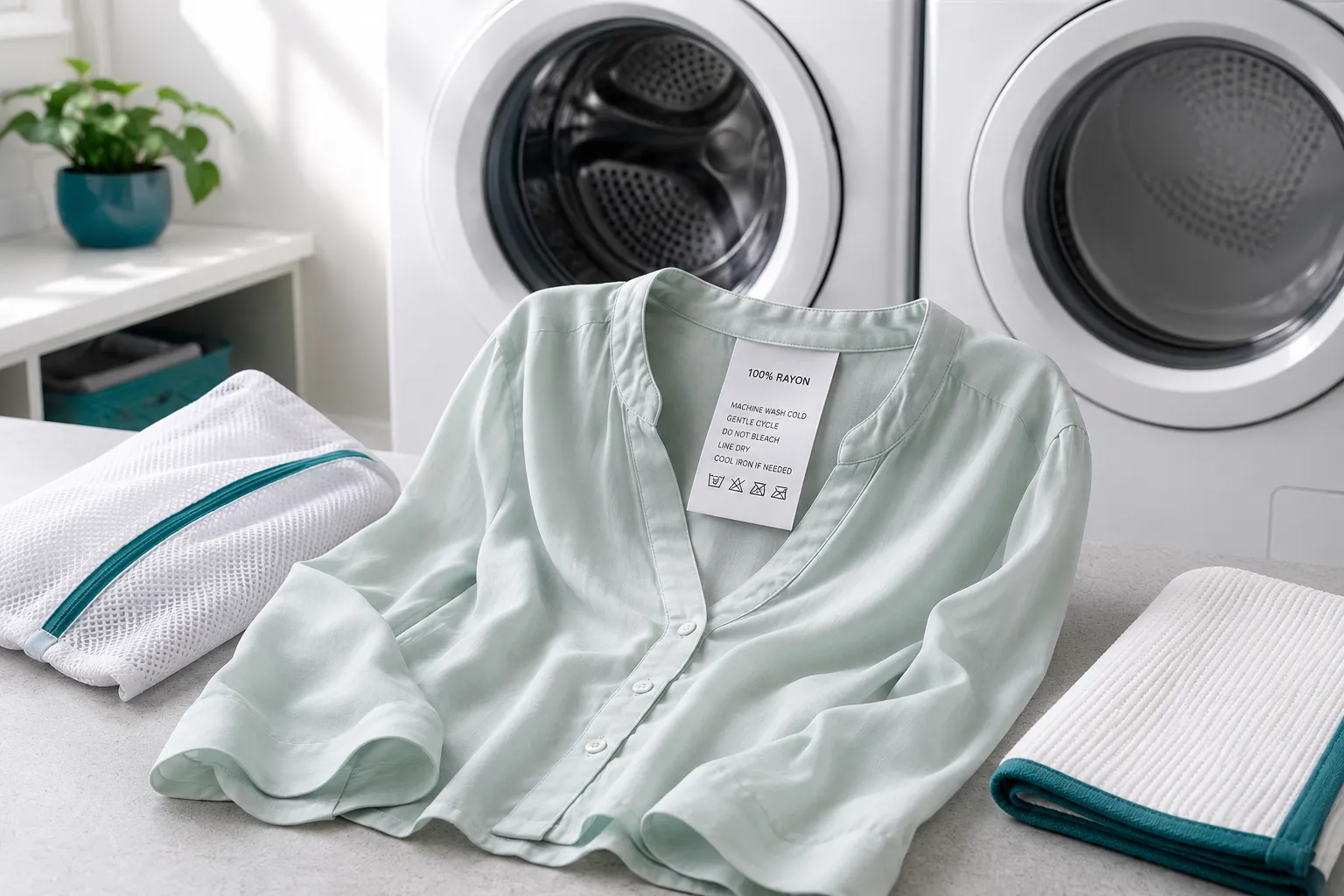
Yes, rayon can shrink in both the washer and dryer. Water may make some rayon fabrics less stable, while heat, friction, and repeated movement can change the garment’s size or shape.
The result is not the same for every item. A lightweight woven blouse may react differently from a heavy rayon knit dress. The fiber blend, fabric finish, garment construction, and care label also affect what happens.
To lower the risk, use cool water and gentle handling when home washing is allowed. Avoid twisting wet rayon, reshape it while damp, and follow the drying method shown on the label.
Rayon can shrink during washing or drying. High heat and long tumble cycles usually increase the risk. Check the care label before cleaning the garment, use cool water when home washing is allowed, and lay it flat or line-dry it when tumble drying is not permitted.
Rayon Shrinkage Quick Check
| Laundry Condition | General Risk | Safer Approach |
|---|---|---|
| Cool hand wash | Lower | Handle the fabric gently and support it while wet. |
| Cool gentle machine wash | Low to moderate | Use only when machine washing is allowed. |
| Warm wash | Moderate | Follow the temperature shown on the care label. |
| Hot wash | High | Usually unsuitable for shrink-prone rayon. |
| Flat drying | Lower | Useful for heavy, knitted, or easily distorted garments. |
| Line or hanger drying | Variable | Use only when the label permits it. |
| Low-heat tumble drying | Moderate | Use only when machine drying is allowed. |
| High-heat tumble drying | Highest | Avoid unless the label clearly permits it. |
These are general relative risks. The care instructions for the finished garment always take priority.
Does Rayon Shrink When Washed?
Rayon can shrink or lose shape during washing, even if it never enters a dryer. Moisture allows the fabric to relax, while agitation, friction, and spinning may change its dimensions.
Some rayon garments can be machine washed, while others need hand washing or professional cleaning. As with washing different fabrics safely, the correct method depends on the finished garment, not only the word “rayon” on the fiber label.
Does Rayon Shrink in Cold Water?
Cold or cool water reduces the risk, but it does not remove it.
A strong wash cycle may still twist or compress the wet fabric. Long soaking, a fast spin, or rough handling can also affect the item’s shape.
Cold water is not a way to ignore a dry-clean-only instruction. If the label does not allow home washing, the garment should not be tested in a cold machine cycle.
What Happens in Warm or Hot Water?
Warm and hot water may increase dimensional change. Before changing the setting, check which wash temperature suits the garment and follow its care label. A hotter wash may also affect dyes, prints, elastic, linings, and decorative parts.
Higher temperatures may also affect dyes, prints, elastic, linings, and decorative parts. For that reason, do not raise the water temperature only because the garment has a stain. Use a stain treatment that is safe for the temperature shown on the care label.
Is Hand Washing Better Than Machine Washing?
Hand washing gives you more control, but it is not automatically safe. Use a gentle hand-washing method that avoids rubbing, wringing, or lifting the wet garment from one shoulder, because those actions can stretch or distort rayon.
A gentle machine cycle offers steady washing and rinsing, but the garment still faces drum movement and spinning.
| Washing Method | Main Benefit | Main Concern |
|---|---|---|
| Hand washing | More control over movement | Rubbing, twisting, or lifting unsupported wet fabric |
| Gentle machine cycle | Consistent washing and rinsing | Drum movement, friction, and spin stress |
| Normal machine cycle | Stronger cleaning action | Often too rough for delicate rayon |
| Long soaking | May loosen some soil | Extended moisture exposure and possible color change |
Does Rayon Shrink in the Dryer?

Yes, rayon can shrink in the dryer, especially when it is exposed to high heat, a long drying cycle, or repeated tumbling.
A dryer should be used only when the garment’s care label allows machine drying. Some rayon items may permit a low setting. Others must be laid flat, line-dried, or kept out of the dryer completely.
Why Rayon Shrink or Lose Shape in a Dryer
During tumble drying, warm air removes moisture while the drum repeatedly lifts and drops the garment. This combination can make some rayon fabrics dry smaller, tighter, or misshapen.
High heat increases the risk. A long low-heat cycle can also affect sensitive rayon because the fabric continues tumbling for an extended time.
Overdrying can leave rayon more wrinkled, rough, or tight. Dryer heat can also affect stretch fibers, elastic, linings, prints, and trims. For this reason, the drying method should be based on the complete garment, not only its rayon percentage.
Can Rayon Go in the Dryer on Low Heat?
A low-heat dryer is suitable only when the label allows tumble drying. Check the garment’s dryer care symbols before choosing low heat, delicate, or no heat because these settings do not override a dry-flat or do-not-tumble-dry instruction.
Follow the exact instruction:
| Care Instruction | What to Do |
|---|---|
| Tumble dry low | Use low heat and remove the garment promptly. |
| Tumble dry delicate | Use the listed gentle setting without extending the cycle. |
| Dry flat | Lay the garment on a clean, flat drying surface. |
| Line dry | Hang the garment according to the care instructions. |
| Do not tumble dry | Keep the garment out of the dryer. |
A delicate or no-heat setting is not automatically safe. Even without strong heat, the garment still tumbles and may lose shape.
When machine drying is permitted, avoid overdrying. Remove the item promptly and reshape it while it is still slightly damp, when practical.
Should You Hang Rayon or Lay It Flat?
The better method depends on the fabric’s weight and structure.
Heavy, knitted, stretchy, or easily distorted rayon is usually better supported on a flat drying surface when the label permits flat drying. Hanging a heavy wet garment may stretch the shoulders or add unwanted length.
Lightweight woven rayon may sometimes be line- or hanger-dried. When that method is allowed, follow the same support and airflow principles used for air-drying clothes safely: smooth the seams, support the garment properly, and keep it away from strong heat.
What If Rayon Accidentally Went in the Dryer?
Let the garment cool before deciding what to do next. Place it on a flat surface and compare its length, width, seams, and texture with its original shape.
Mild distortion may sometimes improve through careful damp reshaping. Permanent shrinkage may not reverse. Do not place the item back in hot water or the dryer in an attempt to fix it.
Washer vs. Dryer: Where the Main Risks Occur
| Laundry Stage | Main Concern |
|---|---|
| Soaking | Swelling, color change, or reduced fabric stability |
| Washing | Friction, agitation, and distortion |
| Spinning | Stress on wet fabric and seams |
| Hanging while wet | Stretching caused by the garment’s weight |
| Tumble drying | Heat combined with repeated movement |
| Flat drying | Lower mechanical stress because the fabric is supported |
Neither machine is always safe or always damaging. The correct method depends on the finished garment.
How to Wash and Dry Rayon Without Shrinking It
A simple, careful routine is easier to follow than several separate treatment rules.
First, read the full care label. Check whether the item can be machine washed, hand washed, tumble dried, line-dried, or laid flat. Also look at the fiber blend and garment construction. Linings, pleats, prints, trims, and stretch panels may require extra care.
When home washing is permitted, follow these steps:
- Treat visible stains before starting the main wash.
- Use cool water and a mild detergent.
- Choose a gentle cycle or wash carefully by hand.
- Avoid rubbing, twisting, or wringing the wet fabric.
- Support the full garment when lifting it.
- Press out excess water with a clean towel.
- Reshape the neckline, sleeves, seams, and hem.
- Dry the item using the method shown on the label.
A mesh laundry bag may help protect lightweight rayon in the washer. Avoid washing it with heavy towels, jeans, or clothing with rough hardware.
Wet rayon may be easier to stretch or distort. Handle it with both hands, avoid sharp pulling, and support the full garment while moving it.
Care Symbols to Check
| Care Instruction | Meaning |
|---|---|
| Hand wash | Wash gently by hand at the listed temperature. |
| Gentle cycle | Use reduced agitation and a lower-stress cycle. |
| Dry flat | Place the garment on a flat surface to dry. |
| Line dry | Hang the garment on a line or drying rack. |
| Tumble dry low | Machine dry using low heat. |
| Do not tumble dry | Keep the garment out of the dryer. |
| Dry clean only | Use professional cleaning instead of home washing. |
Read the full label rather than relying on one symbol. The washing symbols on clothing labels explain the permitted cycle and temperature, while the drying instructions show whether the garment should be tumble dried, line-dried, or laid flat.
Why Rayon Shrinks and Why the Amount Varies
Rayon is a regenerated cellulose fiber made from processed plant-based cellulose. Understanding rayon fabric and its properties helps explain why some versions become easier to stretch, compress, or distort after they absorb water.
In simple terms, the fabric may become easier to stretch, compress, or distort after absorbing water. Heat and movement can then make the change more noticeable.
This does not mean that all rayon will react badly to water. Many garments are made for careful home washing. The final result depends on the fabric and the way the garment was produced.
Knit vs. Woven Rayon
Knit rayon is made from connected loops. It often feels soft and stretchy. Because of that structure, it may stretch while wet, become tighter after drying, or lose its original shape.
Woven rayon is made from crossing yarns. It may feel smoother or more structured. It can still lose length or width, but it may behave differently from a knit.
| Fabric Structure | Common Concern |
|---|---|
| Lightweight rayon knit | Stretching, tightening, or uneven shape |
| Heavy rayon knit | Lengthening while wet or shrinking under heat |
| Woven rayon blouse | Size loss, wrinkles, or seam distortion |
| Bias-cut rayon | Twisted shape or an uneven hem |
| Lined rayon garment | Outer fabric and lining changing differently |
Finishes and Garment Construction
Fabric makers apply finishes to improve softness, drape, color, or dimensional stability. Some rayon fabrics are also preshrunk or pretreated.
These processes can reduce size and shape changes, but they cannot guarantee that a finished garment will remain exactly the same.
Construction also affects the result. A lining and outer fabric do not always react in the same way. Pleats can lose definition, while bias-cut panels are more likely to twist. Interfacing may keep one area firm as another section changes.
Unsuitable heat can also reduce stretch recovery in spandex and elastic.
For these reasons, general fiber advice cannot replace the care label written for the finished garment.
How Much Can Rayon Shrink?
There is no single percentage that applies to every rayon item.
The final amount depends on the rayon type, fabric weight, knit or weave, manufacturing finish, blend ratio, wash temperature, agitation, spin speed, dryer setting, and previous care.
One garment may change very little. Another may lose noticeable length or width after one unsuitable cycle.
Claims that all rayon shrinks by one fixed percentage are not reliable because they ignore these differences.
Can Rayon Shrink During the First Wash?
Yes, rayon may shrink or lose shape during the first wash. It may be the first time the finished item has faced home detergent, machine movement, spinning, or household drying conditions.
Still, the first wash does not always cause a change. Pretreatment, garment construction, and correct care can improve stability.
Can Rayon Shrink More Than Once?
Rayon may continue to change after later washes or dryer cycles. The same habits that help prevent clothes from shrinking—cooler water, gentler movement, and less dryer heat—are especially important after the first wash.
A garment that survived one wash is not protected from future shrinkage. Repeated exposure to warm water, strong agitation, high spin speeds, tumble drying, or direct heat may cause additional size or shape changes.
The amount will not always be the same each time. One unsuitable high-heat cycle may cause more damage than several careful cool washes.
Does 100% Rayon Shrink More Than Rayon Blends?
A 100% viscose rayon garment may be more sensitive to moisture, agitation, and heat than some rayon-polyester blends.
However, adding polyester does not make the garment shrink-proof. A blend may still shrink, stretch, twist, or lose its original drape.
| Fabric Composition | General Tendency | Main Care Concern |
|---|---|---|
| 100% viscose rayon | Often more sensitive | Moisture, agitation, and dryer heat |
| Rayon-polyester | May have improved stability | Result still depends on the blend and construction |
| Rayon-spandex | Variable | Size change and reduced stretch recovery |
| Rayon-linen | May change in several directions | Both fibers can react to washing and drying |
| Rayon-cotton | Moderate risk | Both components may shrink |
| Modal | Often made for improved stability | Heat and care instructions still matter |
| Lyocell | Often stronger when wet than basic viscose | Finishing and drying method still matter |
These are general tendencies, not guarantees. Always follow the instructions written for the complete garment.
How to Read the Fiber Percentage
Consider a top labeled:
- 67% polyester
- 32% rayon
- 1% spandex
The polyester may improve overall stability, while the spandex gives the garment stretch. However, the rayon may still react to moisture and heat. Dryer heat may also affect the spandex’s ability to return to its original shape.
Do not choose the care method based only on the largest fiber percentage. The instructions apply to the complete garment.
My Rayon Garment Changed Size—Can It Be Restored?
A garment can look different after washing without shrinking evenly in every direction.
It may have lost real size, become heavily wrinkled, dried in a compressed shape, stretched while wet, developed twisted seams, or become stiff from detergent or mineral residue.
Inspect it carefully before trying to stretch or rewash it.
Signs of Real Shrinkage

Real size loss may include:
- A shorter body
- Narrower width
- Tighter sleeves or armholes
- A smaller neckline
- A higher hem
- Less room across the chest or hips
Measurements are more useful than appearance alone. Place the dry garment on a flat surface and compare the chest width, body length, and sleeve length with earlier measurements when available.
Shrinkage vs. Wrinkles and Distortion
Heavy wrinkles can make rayon appear smaller because the fabric is folded and compressed. Gentle steaming may relax wrinkles when the label allows it, but steaming may not restore true size loss.
A garment can also become longer when it is hung while heavy and wet. That is stretching rather than shrinkage.
Twisted seams and an uneven hem may point to fabric distortion or construction problems instead of even size loss.
How to Reshape Mildly Changed Rayon
Mild distortion or limited size change may sometimes improve through damp reshaping. Permanent shrinkage may not reverse.
Dampen the garment evenly with cool water, then place it flat on a clean towel. Support the fabric and ease it gently toward its original measurements. Align the sleeves, neckline, side seams, and hem before leaving it flat to dry.
Use light, even pressure. Do not pull sharply on one corner or seam.
Do not use hot water, forceful stretching, strong wringing, or dryer heat to restore rayon. These actions may cause more shrinkage, stretching, seam damage, or uneven shape.
When Professional Care Is Safer
Professional care is the better choice for dry-clean-only, structured, lined, pleated, decorated, expensive, or badly distorted garments.
Tell the cleaner how the item was washed and dried. This may help them judge whether the shape can be improved.
Can You Shrink Rayon on Purpose?
Rayon may shrink when it is exposed to unsuitable heat, water, or movement. However, the result is difficult to control.
The garment may lose more length than width, tighten in only one area, develop twisted seams, damage its stretch fibers, or become smaller than planned.
Tailoring is usually safer when you need a controlled change in fit.
Final Takeaway
Rayon can shrink during both washing and drying. Water may reduce fabric stability, while heat, agitation, spinning, and tumbling may increase the risk of size and shape changes.
The dryer often adds more risk because it combines heat with repeated movement. However, some rayon garments may be tumble dried on low heat when the care label specifically allows it.
Use cool water, mild detergent, and gentle handling when home washing is permitted. Reshape the garment while damp, then lay it flat, line-dry it, or use the listed machine setting.
Careful treatment cannot guarantee that every rayon garment will remain unchanged, but it gives you the best chance of protecting its size, shape, and drape.
Reviewed Sources
- U.S. Federal Trade Commission guidance on textile care labeling
- Textile-fiber information on viscose, modal, and lyocell
- Garment-care guidance for washing and drying rayon
This article provides general fabric-care guidance. Always follow the care label for the finished garment because its seams, linings, finishes, trims, and blended fibers may require different treatment.
