

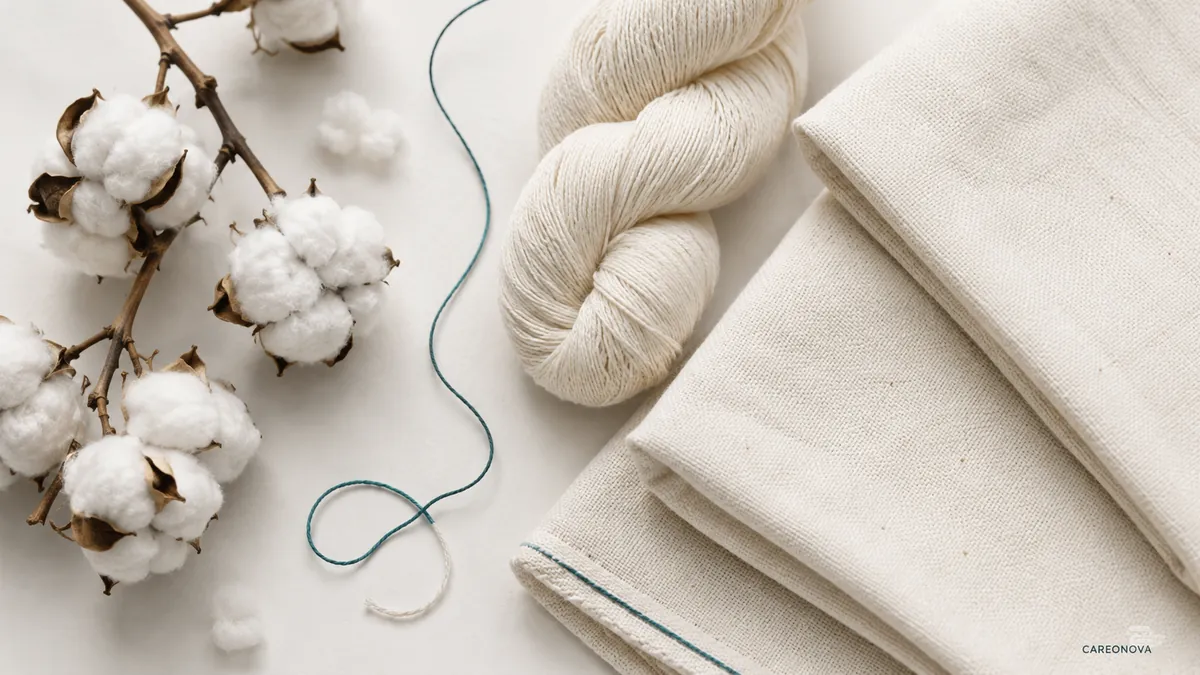
It’s easy to look at a rack of clothes or a shelf of fabric bolts and think of cotton as just a basic plant product. In reality, this natural textile—spun from the protective fibers of the cotton seed—is a masterclass in material science. The key properties you love actually come down to microscopic, hollow fibers composed of nearly 99% cellulose. That unique cellular structure acts like a tiny sponge, making the material incredibly breathable and highly absorbent, yet remarkably durable. Thanks to that built-in tensile strength, its applications are practically endless, dominating everything from everyday apparel to standard home goods.
But here is where most people completely ruin their laundry: assuming all cotton acts exactly the same. Your crisp hotel sheets and your rigid blue jeans might start from the same raw fiber, but they are categorized into distinct types based entirely on their construction. Lightweight weaves like muslin or voile create airy garments, while medium-weight options like poplin and twill form the backbone of standard shirts. Need rugged workwear? That is where heavyweight textiles like denim and canvas come in. There are even premium tiers—like Pima and Egyptian—that rely on extra-long staple fibers for unparalleled softness. To stop garments from shrinking or losing their shape, understanding these structural differences is non-negotiable. This guide explains exactly how knits compare to wovens, how to pick the right material for your project, and the actual science behind washing it properly.
Cotton Fabric Pros and Cons
Cotton fabric is breathable, absorbent, comfortable, and highly versatile, but its performance can vary with construction, weight, finishing, and care. This quick comparison highlights the main advantages and limitations before exploring cotton in more detail.
| Advantages of Cotton Fabric | Limitations of Cotton Fabric |
|---|---|
| ✓ Breathable and comfortable Many cotton constructions allow good airflow and feel comfortable against the skin. | – Can wrinkle easily Untreated woven cotton often creases more readily than many synthetic fabrics. |
| ✓ Highly absorbent Cotton’s cellulose fibers naturally attract and hold moisture. | – Slower to dry High moisture absorption means cotton can remain wet longer than many synthetic fibers. |
| ✓ Extremely versatile Cotton can become lightweight voile, crisp poplin, soft jersey, heavy denim, or absorbent terry. | – Performance varies widely Fiber content alone does not tell you how a cotton fabric will stretch, drape, or wear. |
| ✓ Available in many weights Cotton fabrics range from sheer summer textiles to durable heavyweight workwear. | – Can shrink Construction, finishing, moisture, and excessive heat can affect dimensional stability. |
| ✓ Accepts dyes well Cotton can be produced in a wide range of colors, prints, and textile finishes. | – Color may fade Some dyed cotton fabrics lose color gradually through repeated washing and sun exposure. |
| ✓ Suitable for everyday use Well-constructed cotton works effectively for clothing, bedding, towels, denim, and home textiles. | – Can feel heavy when wet Absorbed moisture increases fabric weight and can make garments cling to the body. |
| ✓ Natural cellulose fiber Cotton is plant-derived rather than made from petroleum-based synthetic polymers. | – Needs dry storage Damp cotton can develop musty odors or mildew when stored before it is fully dry. |
What is Cotton Fabric? (Fiber and Material Science)
Before you can choose the right fabric for clothing or home sewing, you need to understand how it is built from the ground up. This textile begins as the fluffy, protective fibers (called bolls) that grow around the seeds of the Gossypium plant.

The Chemical and Physical Properties
While raw agricultural cotton contains natural waxes and impurities (roughly 88% to 96% cellulose), scoured and purified cotton fabric is up to 99% pure cellulose. Under a microscope, a single fiber looks like a twisted, hollow tube. This hollow core is the secret to the material’s legendary breathability. It allows air to circulate against your skin in the summer and acts like a microscopic sponge, pulling sweat away from your body.
Cotton is naturally hydrophilic, meaning it actively attracts water. A single hollow cotton fiber can absorb up to 27 times its own weight in water. This is why cotton towels are so effective, but it is also why a cotton T-shirt feels heavy and clings to your skin during a sweaty workout.
Staple Lengths: Short, Long, and Extra-Long
Not all plants produce the same quality of fiber. In the textile industry, the length of a single fiber is called its staple. The staple length dictates the luxury, price, and durability of the final fabric.

- Short-Staple (SS): These fibers are roughly 1.125 inches long or shorter. Because the segments are short, more of the fiber ends stick out of the spun yarn. This makes the fabric feel slightly rougher and makes it much more prone to pilling (creating fuzzballs) in the wash. Standard denim and basic T-shirts use short-staple yarns.
- Extra-Long Staple (ELS): These premium fibers measure strictly 1.375 inches or longer. Because they are so long, they spin into tight, smooth, and incredibly strong yarns with very few exposed ends. Fabrics made from ELS plants (like authentic Pima or Egyptian varieties) are famous for their silky texture, bright dye retention, and immunity to pilling.
What Determines Cotton Quality?
Staple length is important, but it is not the only measure of cotton quality. Manufacturers also evaluate fiber strength, length uniformity, micronaire, color, and cleanliness because these characteristics affect spinning consistency and yarn quality.
Longer, stronger, more uniform fibers generally make it easier to produce smoother, finer yarns. However, the final cotton fabric still depends on yarn construction, weave or knit structure, fabric weight, and finishing.
How Cotton Becomes Fabric
Cotton passes through several stages before becoming finished cloth:
Cotton boll → ginning → cleaning and carding → spinning → weaving or knitting → dyeing and finishing
Ginning separates the fiber from the seed, while carding organizes the fibers for spinning. The resulting yarn is then woven or knitted into fabric. Finishing treatments can further change softness, appearance, shrinkage behavior, and surface feel.
Carded vs. Combed Cotton
Once the raw material is picked, the factory must clean and align it before spinning.
- Carded: The raw fibers are quickly brushed to untangle them. This process leaves shorter strands and minor impurities in the batch. Carded fabric is thicker, fuzzier, and significantly cheaper to produce.
- Combed: The fibers go through an intensive extra step where fine metal brushes physically pull out the short strands and impurities, leaving only the longest, straightest pieces. Combed fabric is incredibly smooth, strong, and comfortable against the skin.
Woven vs. Knitted Cotton Fabric: The Structural Difference
The biggest mistake shoppers make is assuming that all pure cotton feels the same. Once the yarn is spun, it is turned into cloth in one of two ways. This construction drastically changes how the material behaves. Moving from a rigid weave to a stretchy knit entirely dictates how a garment will fit.
| Feature | Woven Construction | Knitted Construction |
|---|---|---|
| Structure | Over-and-under grid (Warp/Weft) | Interlocking loops |
| Stretch | None (Rigid) | High mechanical stretch |
| Wrinkle Tendency | High (Requires ironing) | Low (Naturally falls out) |
| Common Uses | Dress shirts, jeans, sheets | T-shirts, activewear, hoodies |
Woven Construction (No Stretch, High Durability)
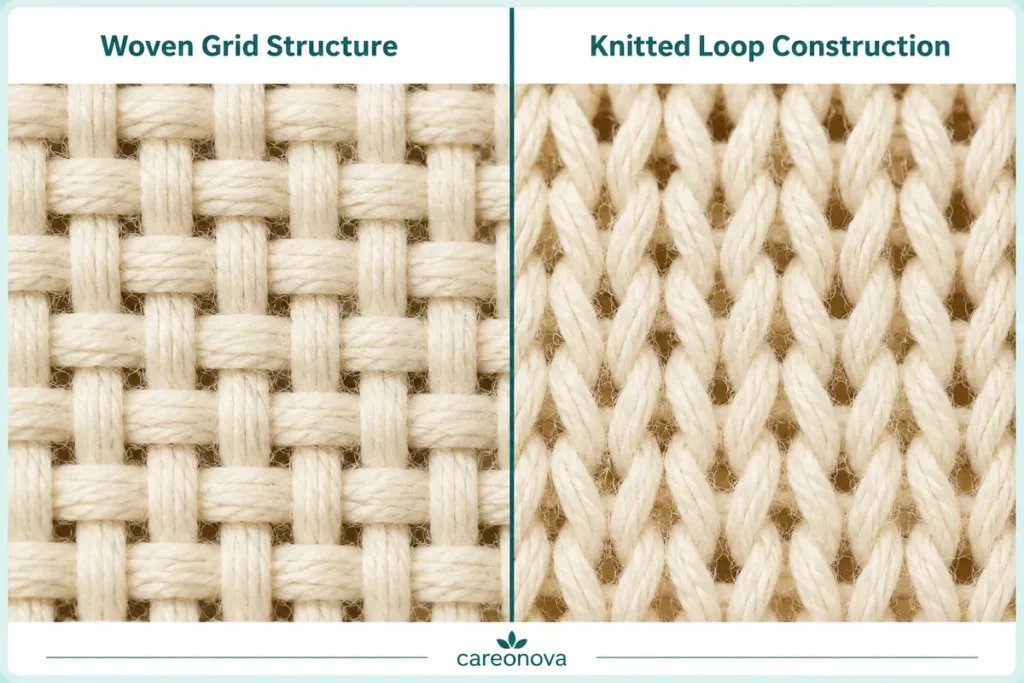
Created on a loom, a woven fabric interlaces yarns in a rigid grid pattern. The vertical threads are called the warp, and the horizontal threads are called the weft. Because of this tight over-and-under grid, woven material has zero natural stretch. It holds a crisp, structured shape, which makes it perfect for button-down shirts, bedsheets, and denim. However, because the yarns cannot easily move, the material wrinkles easily and requires an iron to look sharp.
Knitted Construction (Mechanical Stretch, Soft Drape)
Instead of a rigid grid, knitted fabric is created by looping one continuous yarn through itself over and over again, much like a chain-link fence. This looping structure gives the textile mechanical stretch, even without adding synthetic rubber. It drapes softly over your body, moves with you, and naturally resists wrinkles. This makes knits the absolute standard for comfortable, everyday clothing.
Why 100% Cotton Fabrics Can Feel So Different
The label 100% cotton tells you the fiber content, not how the finished fabric will behave.
A cotton jersey, poplin shirt, denim jean, and terry towel can all contain the same basic fiber but feel completely different because of their construction, yarn, weight, weave or knit structure, and finishing.
This is why choosing cotton by fiber content alone is not enough.
A Complete Directory of Cotton Fabric Types
To choose the right material, you must match the physical structure and weave to your specific project. Here is how the most common fabric options are categorized across the industry, what makes them unique, and exactly what garments they build.
Lightweight Wovens
When sewing summer garments that require maximum airflow and a fluid, floating drape, dressmakers rely on translucent plain weaves made from very fine yarns.
- Voile and Lawn: These are incredibly lightweight, slightly sheer plain weaves. Lawn has a slightly higher thread count and a crisper finish, while voile is softer and more fluid. Both are the industry standard for unlined summer dresses, delicate blouses, and sheer curtains.
- Muslin and Gauze: Featuring a loose, open weave, these fabrics prioritize breathability over durability. Unbleached muslin is notoriously cheap, making it the perfect “practice fabric” for dressmakers sewing pattern mock-ups (often called toiles). Gauze is similarly open but much softer, widely used for medical bandages and breathable baby swaddles.
Medium-Weight Wovens
For structured garments and durable home crafts, medium-weight fabrics provide the perfect balance of strength and comfort. They hold a crease well when ironed but remain highly breathable.
- Poplin and Broadcloth: Crisp, tightly woven, and incredibly smooth. The warp and weft threads are packed tightly together to create an opaque, flat surface. This is the global industry standard for professional, button-down dress shirts.
- Sateen and Percale: These are the two titans of premium bedding. Sateen uses a specialized “satin weave” (four threads over, one thread under) to create a silky, luminous finish that traps heat. Percale uses a standard one-over, one-under weave that feels crisp, matte, and cool to the touch.
- Flannel: This is a standard woven cotton that undergoes an aggressive mechanical brushing process on one or both sides. Brushing raises the fine fibers into a fuzzy surface that acts as an insulator, trapping body heat to create the ultimate winter pajama or cold-weather shirting fabric.
Heavyweight Wovens
Pants, jackets, and workwear require high friction resistance to survive sitting, bending, and daily abrasion. These garments rely on heavyweight, high-GSM textiles.
- Twill and Drill: Instead of a simple checkerboard grid, these fabrics use a stepped weave that creates highly visible diagonal lines (wales) across the surface. This diagonal structure allows the fabric to drape beautifully while remaining exceptionally strong, making it the standard for chinos, khaki pants, and heavy workwear (drill).
- Denim: Denim is simply a very heavy twill weave with a specific dyeing process. The vertical warp threads are dyed deep indigo, while the horizontal weft threads are left entirely white. This is why the inside of your blue jeans is white.
- Canvas and Duck: These are extremely stiff, tight, plain weaves. They offer almost zero drape but provide massive structural integrity and abrasion resistance. They are heavily utilized for tote bags, casual shoes (like Converse sneakers), and light upholstery.
Knitted Cottons
If you want a comfortable, stretchy top, you will almost always purchase a knit. Instead of a rigid grid, these are created by interlocking continuous loops of yarn.
- Jersey Knit: This is the lightweight, stretchy, flat-faced looped fabric used to make billions of standard T-shirts every year. It features a smooth front and a slightly textured back, offering incredible mechanical stretch and comfort.
- French Terry: A medium-weight knit designed for transitional weather. It features smooth, moisture-absorbing loops on the inside (which sit against the skin) and a flat, smooth surface on the outside. It is the go-to fabric for lightweight sweatshirts, sweatpants, and luxury athleisure.
Specialty and Pile Cottons
Some fabrics are woven on specialized looms to create a three-dimensional surface, either for maximum water absorption or decorative luxury.
- Terry Cloth: Woven with extra warp threads that are left as large, uncut loops on the surface. These loops drastically increase the surface area of the fabric, allowing it to act like a giant sponge. It is the only fabric used for high-quality bath towels and spa robes.
- Velvet and Velour: These begin similarly to terry cloth, but the surface loops are cleanly sliced open to create a dense, standing pile of fibers. This creates a fabric that reflects light beautifully and offers a heavy, luxurious drape for formal dresses and premium home decor.
- Jacquard and Dobby: Instead of printing colored patterns onto a flat piece of white cloth, these fabrics use specialized automated looms to weave complex, multi-colored geometric shapes and floral patterns directly into the structural grid of the fabric itself.
Understanding Fabric Weight (GSM) and Yarn Count
For apparel makers, understanding fabric weight is just as important as the weave type. The global standard for measuring weight is GSM (Grams per Square Meter). Alongside GSM, manufacturers often list the yarn count, which indicates the thickness of the individual threads (a higher yarn count means finer, thinner threads).
A lightweight textile under 120 GSM is fluid and often translucent. A medium-weight cloth around 150 GSM provides the structural integrity needed to hold a sharp collar or lay flat for patchwork quilting. Heavyweight fabrics over 200 GSM feel rigid and protective, making them ideal for high-friction workwear.
| Weight Category | GSM Range | Best Used For |
|---|---|---|
| Lightweight | 50 – 120 GSM | Summer blouses, sheer curtains, babywear |
| Medium-Weight | 120 – 200 GSM | T-shirts, dress shirts, quilting fabric |
| Heavyweight | 200 – 350+ GSM | Denim jeans, winter jackets, upholstery |
Conventional vs. Organic Cotton
When sourcing materials, consumers and dressmakers must increasingly decide between conventional agriculture and organic farming. The difference drastically affects both the environmental impact and the final price per yard.
Conventional farming relies heavily on synthetic pesticides, herbicides, and immense water consumption to maximize crop yields. Organic cotton, by contrast, is grown from non-GMO seeds without the use of toxic agricultural chemicals. To verify authenticity, buyers should always look for GOTS certification (Global Organic Textile Standard), which guarantees the fabric was grown, harvested, and processed under strict ecological and ethical guidelines. While conventional muslin might cost only a few dollars per yard, GOTS-certified organic equivalents or luxury Egyptian percales command premium prices due to the specialized, low-yield farming required to produce them.
100% Cotton Fabric vs. Synthetic Blends
Today, you will often find natural fibers blended with synthetic laboratory plastics. Here is why manufacturers mix them, and how it fundamentally changes the fabric.
The Benefits and Limitations of 100% Pure Cotton
Pure, unblended cellulose is unmatched for breathable comfort. It does not trap body odor, it releases lipid-based stains easily in the wash, and it sheds zero microplastics into our water systems. However, 100% pure garments are highly prone to wrinkling, and they will shrink aggressively if exposed to high heat.
Poly-Cotton Blends
Blending natural yarns with polyester creates a textile that is significantly cheaper and highly wrinkle-resistant. The polyester acts like a microscopic plastic skeleton inside the fabric, holding its shape straight out of the dryer. The downside is that polyester is hydrophobic. A poly-cotton blend will not absorb sweat or breathe nearly as well as a pure natural garment, often leading to trapped body odors.
Stretch Cotton Blends
Many modern jeans and fitted shirts use a blend of 95% cotton and 2% to 5% elastane (Spandex or Lycra). This tiny amount of rubbery synthetic fiber gives woven clothing “stretch recovery.” It allows a pair of tight jeans to stretch when you sit down, and perfectly snap back into their original shape when you stand up, preventing permanent baggy knees.
How to Wash and Care for Cotton Fabric
While this natural fiber is incredibly durable, bad laundry habits can severely damage its cellular structure in a single wash cycle.
Never expose 100% pure cotton garments to the high heat of a tumble dryer. High temperatures aggressively drive out moisture, which permanently warps and sets the cellulose fibers, causing irreversible shrinkage and puckered seams.
Why Does Cotton Shrink? (The Science of Tension and Heat)
When yarn is spun and woven in a factory, it is stretched tightly over the loom under immense mechanical tension. When you put that brand-new shirt in the washing machine, the hollow fibers act like sponges and swell up with water. This swelling acts as a lubricant, releasing the factory tension and allowing the threads to relax. If you immediately throw that wet, relaxed shirt into a hot dryer, the rapid heat locks the fibers into their new, shortened position. This is the exact mechanism that causes your clothing to shrink.
The Ideal Washing Machine Settings
To prevent shrinkage and protect the dye, always wash these garments in cold water. Cold water prevents the fibers from swelling too aggressively. Furthermore, because the hollow core absorbs water deeply, it also holds onto soap scum. Use a high-quality, clean-rinsing liquid detergent, and never use liquid fabric softeners. Softeners coat the breathable fibers in a layer of hydrophobic silicone, trapping sweat odors and ruining the fabric’s ability to absorb moisture.
If your 100% cotton dress shirts are coming out of the wash feeling stiff, skip the fabric softener. Instead, add half a cup of plain white vinegar to the rinse cycle. The mild acid dissolves trapped alkaline detergent, restoring the natural softness of the cellulose without coating it in silicone.
Drying, Ironing, and Wrinkle Removal
The safest way to dry your garments is to hang them on a drying rack at room temperature. If you must use a dryer, use the lowest possible heat setting and pull the clothing out while it is still slightly damp.
For woven garments like dress shirts, wrinkles are inevitable. To remove them, you must use steam. Dry heat from a hot iron is not enough. Steam actually breaks the hydrogen bonds inside the cellulose, allowing the stiff textile to lay flat, smooth, and crisp.
The Bottom Line on Choosing and Caring for Cotton
Understanding this foundational textile is entirely about matching the structural weave to your specific needs. When you know that a knitted jersey will stretch comfortably and a woven poplin will hold a crisp collar, you are protected from making expensive buying mistakes. Treat your garments with respect in the laundry room by relying on cold water and air drying, and this incredible natural fiber will easily outlast anything synthetic in your closet.
Sources & Scientific References:
- USDA Agricultural Marketing Service (AMS): USDA Cotton Fiber Classification on CottonWorks
- Journal of Textile Science & Engineering / Textile Research Literature: Extraction of Cellulose-Based Polymers from Textile Wastes on PubMed Central
- Global Organic Textile Standard (GOTS): Official GOTS Website
