


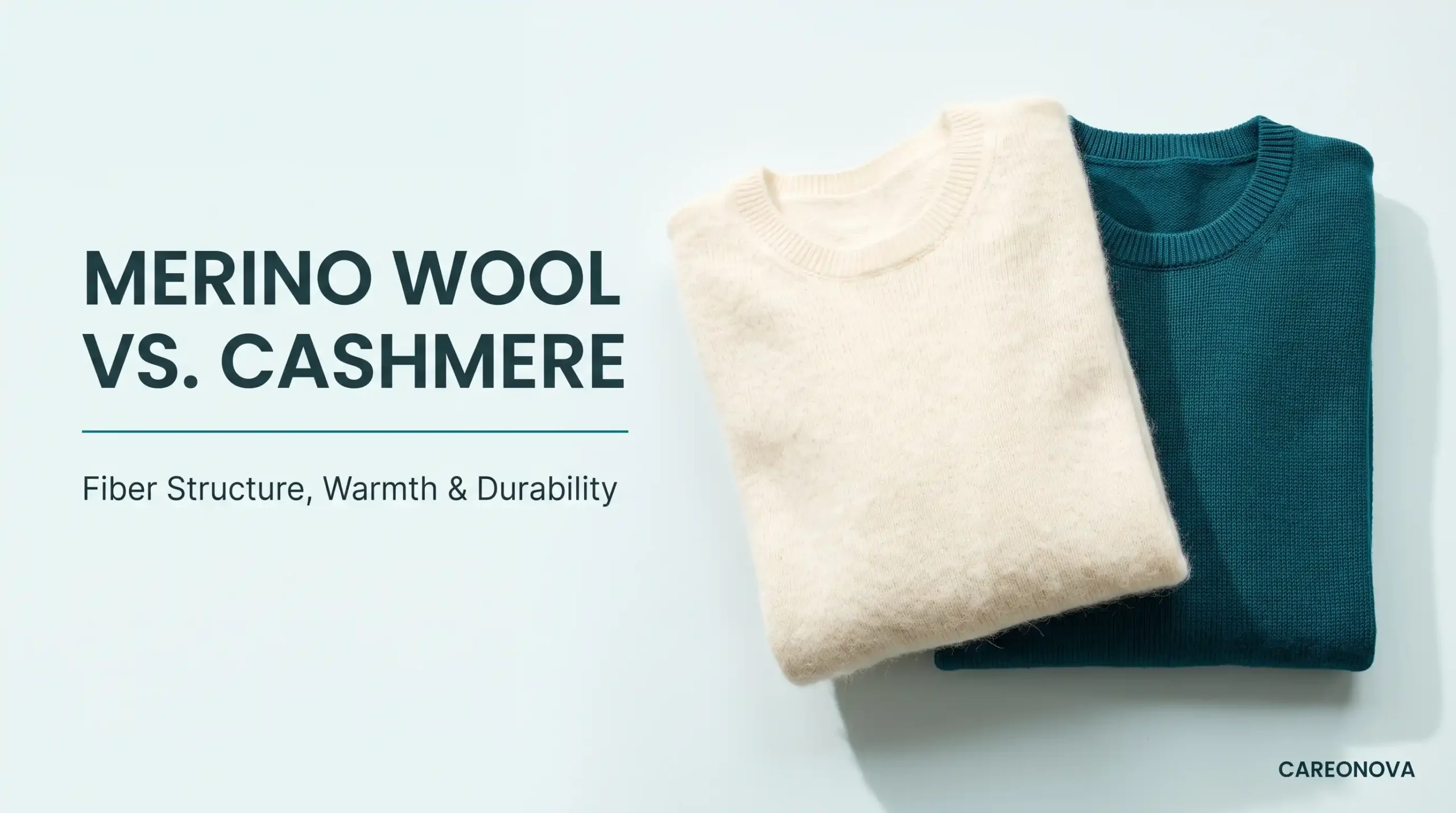
- Biological Origin & Lanolin: Merino wool is shorn from Merino sheep and contains trace natural lanolin, while cashmere is the lanolin-free winter undercoat combed from cashmere goats.
- Warmth vs. Thermoregulation: Cashmere offers superior static warmth-to-weight in dry, calm settings due to its hollow-core fibers, whereas Merino excels in damp cold, wind, and active sweat regulation.
- Softness & Skin Feel: Both sit well below the 25-micron human itch threshold, but cashmere (14–19 microns) feels silkier than Merino (15–24 microns) because its outer cuticle scales are half as thick.
- Durability & Pilling: Merino’s long staple fibers (65–100 mm) resist abrasion and hold their shape, while cashmere’s short fibers (30–45 mm) pill rapidly and require delicate handwashing.
Merino Wool vs. Cashmere: Quick Verdict & Master Comparison
The fundamental difference in merino wool vs cashmere is biological origin and structural fiber performance: Merino wool is shorn from Merino sheep and delivers superior tensile strength, elasticity, and active moisture regulation, while cashmere is combed from the downy undercoat of cashmere goats and provides unmatched static warmth-to-weight loft and buttery skin softness.
When evaluating cashmere vs merino for your wardrobe, neither textile is universally superior across every garment category. Instead, each fiber solves a distinct mechanical problem based on how the raw animal hair grows, how the yarn is spun, and how the finished knit interacts with body heat and friction.
- Merino Wool Is Built for Performance and Longevity: Spun from long, tightly crimped sheep fibers, Merino acts as a resilient, breathable thermal regulator. It handles daily friction, resists stretching out at the elbows, manages sweat vapor during movement, and tolerates gentle home laundering.
- Cashmere Is Built for Weightless, Static Luxury: Spun from short, hollow-core goat down, cashmere creates a lofty halo that traps massive volumes of still air without heavy fabric bulk. It offers a slicker, velvet-like hand-feel against bare necks and wrists, but sacrifices abrasion resistance and wet strength.
- Standard Sheep’s Wool Is the Heavy-Duty Baseline: When shoppers compare cashmere vs wool or wool vs cashmere broadly, they are often contrasting luxury fibers against traditional coarse sheep’s wool (such as Shetland or Donegal tweed), which uses thick fibers above 25 microns built for rugged outerwear rather than next-to-skin comfort.
To see how these three fibers stack up across engineering and care metrics, review the master comparison table below.
| Evaluation Metric | Cashmere | Merino Wool | Standard Sheep’s Wool |
|---|---|---|---|
| Animal Source | Cashmere goat (Capra hircus) winter undercoat | Merino sheep (Ovis aries) shorn fleece | Standard sheep breeds (Shetland, Corriedale) |
| Fiber Diameter | 14–19 Microns Ultra-fine, zero itch | 15–24 Microns Ultrafine to Strong | 25–40+ Microns Coarse, triggers prickle |
| Staple Length | 30–45 mm (Short-staple) | 65–100 mm (Long-staple) | 50–150 mm (Breed dependent) |
| Cuticle Scale Profile | Flat, smooth scales (~0.4 µm edge height) | Fine overlapping scales (~0.8 µm edge height) | Thick, serrated scales (High friction) |
| Lanolin Content | Zero Lanolin Safe for lanolin allergies | Contains trace sebaceous lanolin after scouring | Contains natural sebaceous lanolin wax |
| Static Warmth-to-Weight | Highest (10/10)
Hollow core traps still air
| High (8/10)
Scales with GSM weight
| High (8/10)
Requires heavy fabric bulk
|
| Active Breathability | Low–Mod (5/10)
Overheats during exertion
| Best (10/10)
Absorbs 30% moisture vapor
| Moderate (6/10)
Heavy when damp
|
| Pilling & Abrasion | Fragile (4/10)
Pills fast; bags at elbows
| Resilient (8.5/10)
Elastic 3D crimp recovery
| Rugged (9.5/10)
Withstands heavy wear
|
| Washing & Care | Cold handwash, towel roll, flat dry, wire comb | Gentle cold cycle in mesh bag, flat dry | Handwash or dry clean by garment structure |
| Annual Yield per Animal | 150–200 g (3–5 goats per sweater) | 4,000–5,000 g (8–10 sweaters per sheep) | 3,000–6,000 g per sheep annually |
Is Cashmere Actually Wool? Biological Origins & The Lanolin Divide
Biologically, cashmere is not sheep’s wool; it is the fine, downy undercoat hair harvested from cashmere goats (Capra hircus), whereas Merino is true wool shorn from Merino sheep (Ovis aries). However, under U.S. and international textile labeling laws, cashmere is legally classified under the umbrella category of specialty cashmere wool.
Because shoppers frequently ask, “Is cashmere wool, or is Merino wool cashmere?” understanding the biological divide between sheep fleece and goat hair clarifies how each textile behaves on your body.
Merino Sheep Fleece (Ovis aries)
Merino sheep grow a single, dense coat of finely crimped protein fibers year-round. Ranchers shear the entire fleece once a year in the spring, yielding a uniform, long-staple wool fabric raw material without harming the animal.
Cashmere Goat Underdown (Capra hircus
Cashmere goats live in extreme alpine plateaus across Inner Mongolia, China, and Central Asia, where winter temperatures plunge below -30°C (-22°F). To survive, the goats grow a double coat: a coarse outer layer of stiff guard hairs that shed snow, and a super-fine inner layer of insulating down. Herders comb out this soft undercoat by hand during the spring molting season, then mechanically de-hair the batch to separate the luxury down from the wiry guard hairs.
Why Legal Labels Say “Cashmere Wool”
Under the Federal Trade Commission’s Wool Products Labeling Act, the legal term “wool” encompasses both the fleece of sheep and the fine specialty hair of Cashmere goats, Angora goats (mohair), camels, alpacas, and vicuñas. Thus, cashmere is a type of wool in regulated garment commerce, even though biologically it is goat hair.
Does Cashmere Have Lanolin? (The Allergy Distinction)
No, cashmere does not contain lanolin, making 100% pure cashmere completely safe for individuals with a diagnosed clinical lanolin contact allergy.
When evaluating the difference between cashmere and wool for sensitive skin, lanolin is the primary chemical differentiator:
- Sebaceous Lanolin in Merino Wool: Sheep possess specialized sebaceous glands in their skin that coat their fleece in lanolin (wool wax) to shed rain. While commercial mill scouring washes away over 95% of raw grease before spinning, trace amounts of lanolin remain bound to Merino fibers and can trigger allergic contact dermatitis in people with a specific lanolin sensitivity.
- Lanolin-Free Goat Hair in Cashmere: Goats do not secrete lanolin wax. Because cashmere fibers are completely free of lanolin and feature ultra-smooth surface scales, pure cashmere is naturally hypoallergenic for wearers who react to sheep’s wool.
Softness & The Itch Factor: Micron Counts vs. Cuticle Scales
Cashmere is noticeably softer and slicker against bare skin than most Merino wool, even when both fibers share the exact same microscopic diameter. While neither fiber triggers mechanical skin itch, cashmere’s flatter outer cuticle scales glide across the epidermis with half the surface friction of sheep’s wool.
Many consumers wonder whether cashmere is itchy like wool because they associate all animal knits with the scratchy sensation of traditional winter sweaters. Dermatological textile testing shows that “wool itch” is not an allergic reaction; it is a mechanical nerve response governed by the 25-micron prickle threshold.
- The 25-Micron Prickle Threshold Explained: A micron is one-millionth of a meter. When a textile fiber is thicker than 25 microns, the shaft is too rigid to bend when pressed against human skin. Instead of flexing, the stiff fiber ends poke directly into cutaneous pain receptors (nociceptors) in your epidermis, creating a prickly, itching sensation.
- Cashmere Diameter (14 to 19 Microns): To qualify legally as true cashmere in the United States, the average fiber diameter must not exceed 19 microns, with top-tier Mongolian cashmere measuring 14 to 15.5 microns. At this fineness, every fiber bends effortlessly on contact.
- Merino Diameter (15 to 24 Microns): Standard merino wool ranges from 20 to 24 microns (soft, but slightly textured), while Superfine (17.6–18.5 microns) and Ultrafine Merino (15–17.5 microns) match cashmere’s exact thickness and sit well below the itch threshold.
Why Is Cashmere Softer Than Merino Wool at the Same Micron Count?
If you compare a 16-micron Ultrafine Merino sweater side-by-side with a 16-micron cashmere sweater, the cashmere garment will still feel noticeably more buttery and velvety. The reason comes down to cuticle scale architecture and spinning tension:
- Cuticle Scale Edge Height: All animal keratin fibers are wrapped in overlapping microscopic scales, similar to shingles on a roof. Merino wool scales have a protruding edge height of approximately 0.8 microns and sit closer together along the shaft, giving Merino a crisp, dry, lightly textured hand-feel. Cashmere scales have an edge height of only 0.4 microns—half as thick—and are spaced farther apart, creating a sleek, cylindrical surface that feels silky against the neck.
- Woolen Loft vs. Worsted Twist: Cashmere is almost always woolen-spun (carded and loosely twisted), allowing soft fiber ends to bloom outward into a plush surface halo. Merino is frequently worsted-spun (combed parallel and tightly twisted), producing a smoother, flatter, and firmer knit surface.
Warmth & Temperature Regulation: Debunking the “8x Warmer” Myth
When asking, “Is cashmere warmer than Merino wool?” the answer depends on your environment: cashmere delivers higher static insulation per gram of weight in dry, calm conditions, whereas Merino wool is warmer and more effective in windy, damp, or physically active settings. The popular retail claim that “cashmere is 7 to 8 times warmer than wool” is a marketing exaggeration that only applies when comparing lofty cashmere against coarse, un-lofted wool at identical light weights in still air.
To settle the question of which is warmer cashmere or Merino wool—for your specific climate, you must separate static warmth-to-weight loft from active thermoregulation.
Static Warmth-to-Weight Ratio (Where Cashmere Wins)
For sheer warmth without heavy garment bulk in dry indoor or calm urban cold, cashmere is warmer than wool of the same thickness. Three structural traits give cashmere its high thermal efficiency:
- Hollow Medullated Fiber Core: Unlike Merino wool fibers, which have a solid protein cortex, fine cashmere fibers feature a microscopic hollow medullated core running through the center of the shaft. Air is a poor conductor of heat, so this internal air channel acts like double-paned glass insulation inside every individual hair.
- High Crimp Density & Micro-Air Pockets: Cashmere underdown grows in fine, irregular waves that prevent adjacent fibers from packing flat. When spun into a loose 2-ply woolen yarn, cashmere traps millions of microscopic pockets of stationary dead air heated by your skin.
- Weightless Drape Indoors: Because cashmere traps so much air relative to its mass, a lightweight 200-gram cashmere crewneck provides the same indoor warmth as a much heavier 400-gram traditional wool sweater. For anyone asking is cashmere warm or does cashmere keep you warm in offices, restaurants, and dry winter layering, its warmth-to-weight ratio is unmatched.
Active Thermoregulation & Damp Cold (Where Merino Wins)
When you step into biting wind, wet snow, or physical movement that makes you sweat, the cashmere vs merino wool temperature regulation balance flips completely in favor of Merino wool.
- 30% Moisture-Vapor Sorption: Merino wool’s solid cortex is intensely hydrophilic (water-loving) on the inside while its waxy epicuticle remains water-repellent on the outside. Merino fibers can absorb up to 30% of their own dry weight in invisible sweat vapor directly off your skin before the fabric ever feels damp to the touch.
- Exothermic Heat of Sorption: As water vapor molecules bind chemically to the polar amino acids inside Merino’s keratin core, they lose kinetic energy and release measurable thermal energy—a physical reaction known as exothermic heat of sorption. This means Merino actively generates a burst of warmth when you walk into cold, damp air, preventing conductive chill.
- Wind Resistance in Dense Worsted Knits: Because cashmere relies on a loose, airy woolen knit to trap heat, brisk wind blows straight through an unlayered cashmere sweater and strips away the trapped warm air. Tightly twisted worsted Merino sweaters and heavy woven wool coats block convective wind loss far better outdoors.
Durability, Staple Length & Pilling Mechanics
Merino wool is vastly more durable, elastic, and abrasion-resistant than cashmere. Because Merino fibers are more than twice as long as cashmere fibers and possess a tighter 3D spring crimp, Merino garments hold their shape for years, whereas pure cashmere pills rapidly and stretches out under mechanical stress.
Shoppers investing $300 in luxury knitwear frequently ask, “Is cashmere durable?”—and are often dismayed when their new sweater develops fuzz balls under the arms after just three wears. Pilling and garment longevity are governed by staple length and tensile elasticity, not price tag.
- Staple Length Physics (65–100 mm vs. 30–45 mm):Staple length measures the average length of an individual raw fiber. Merino wool fibers measure 65 to 100 mm (2.5 to 4 inches) long. When twisted into yarn, these long fibers wrap around each other multiple times, locking the ends deep inside the yarn core. Cashmere fibers measure only 30 to 45 mm (1.2 to 1.8 inches). Because cashmere fibers are short and spun with a loose twist to maximize softness, thousands of tiny fiber tips remain exposed near the surface.
- Why Cashmere Pills Faster: Under cyclic friction from swinging arms, seatbelt straps, or handbag handles, cashmere’s short 30–45 mm fibers slip free from the loose yarn twist, migrate to the surface, and tangle into fuzz balls held by anchor fibers. While pure cashmere pills eventually shed once loose surface fibers exhaust, initial pilling is much heavier than on worsted Merino. To prevent wool pilling on either fiber, you must minimize surface friction and select multi-ply yarns.
- 2-Ply vs. Single-Ply Construction: If you buy cashmere, always verify that the garment is 2-ply (two individual threads twisted together in opposite directions to balance torque). Cheap single-ply cashmere sweaters lack structural counter-tension; they develop slanted side seams, thin out at the elbows, and tear easily.
- 3D Crimp Elasticity & “Elbow Bagging”: Merino wool grows with a tight, three-dimensional helical wave (up to 100 crimps per inch). This natural 3D fiber crimp allows a Merino fiber to stretch up to 30% beyond its original length and snap back like a coil spring without deforming. Cashmere has a flatter, looser wave with lower elastic recovery—meaning tight cashmere sleeves and knees will gradually bag out and sag if worn repeatedly without resting.
How to Test Knitwear Quality in 10 Seconds (The Pull & Rub Test)
Since garment tags rarely list micron counts or fiber staple length, use these three physical checks in the store before buying any Merino or cashmere sweater:
The 4-Inch Stretch Recovery Check
Gently pull a 4-inch section of the sweater body horizontally and release it. Long-staple Merino or tightly spun 2-ply cashmere snaps back immediately; cheap single-ply knits stay slack and wavy.
The 5-Second Surface Rub Test
Briskly rub two layers of the sleeve fabric together five times. If tiny loose fibers immediately ball up or shed onto your fingers, the mill used short leftover fibers (<28 mm) that will pill rapidly.
The Overhead Light Density Check
Hold the knit up to an overhead light. Even a lightweight gauge should display a uniform, even grid of stitches without thin, translucent patches or irregular thick-and-thin yarn slubs.
Breathability, Sweat Management & Odor Resistance
Both fibers are naturally breathable and odor-resistant compared to synthetic fabrics, but Merino wool outperforms cashmere in high-sweat environments. Merino moves moisture vapor faster and maintains structural strength when damp, whereas saturated cashmere traps humidity and weakens under sweat absorption.
Is Cashmere Breathable and Antimicrobial?
When evaluating whether cashmere is breathable and antimicrobial in real-world wear, it helps to clear up a widespread textile misconception regarding how animal fibers stop body odor:
- Correcting the Lanolin Odor Myth: Many retail blogs claim that sheep’s wool resists odor because lanolin wax kills bacteria. In reality, commercial scouring removes almost all lanolin before yarn is dyed, and cashmere has zero lanolin—yet both fibers resist odor.
- How Keratin Starves Odor Bacteria: Sweat itself is odorless; body odor is created when skin bacteria (such as Corynebacterium) feast on warm liquid sweat trapped on the surface of synthetic polyester fabric. Both Merino and cashmere are composed of keratin protein, which pulls moisture vapor inside the fiber core and locks it away from the outer surface. This leaves the fabric exterior dry and inhospitable to bacterial growth.
- Why Merino Wins for Sweat Management: While cashmere is breathable during calm, low-perspiration wear, its lofty air pockets hold too much stagnant heat once your heart rate rises. Furthermore, animal keratin loses up to 30% of its tensile strength when wet. Because Merino starts with much higher dry tensile strength and tighter yarn twist, a sweaty Merino shirt retains its integrity, whereas a sweat-soaked cashmere garment becomes fragile and prone to friction damage.
Garment-by-Garment Buying Guide (And the Case for Blends)
Choosing between merino wool or cashmere comes down to the mechanical demands of the specific garment. Use pure Merino for high-friction, active, or everyday foundational pieces; reserve 100% cashmere for low-abrasion luxury layers and neckwear; and choose a wool cashmere blend when you want cashmere’s softness backed by Merino’s structural frame.
Search interest for a cashmere base layer has surged as luxury brands market ultra-thin cashmere thermals for skiing and winter travel. From a textile engineering standpoint, 100% cashmere makes a poor active base layer. When worn tight against sweating skin beneath a mid-layer fleece or ski shell, cashmere absorbs perspiration, loses up to 30% of its wet tensile strength, and undergoes severe mechanical abrasion. The short 30–45 mm fibers will rapidly pill, mat, and wear thin at the underarms and lower back. For next-to-skin active thermal layers, always choose 100% Ultrafine Merino wool (15–17.5 microns) or a core-spun Merino blend.
90% Merino / 10% Cashmere
Everyday Durability WinnerLong-staple Merino (65–100 mm) forms 90% of the structural yarn spine for cuff snap-back and abrasion resistance, while 10% cashmere blooms outward during finishing to soften the surface hand-feel.
70% Merino / 30% Cashmere
High-Loft Luxury BalanceDelivers a visible cashmere halo and noticeably warmer static insulation while retaining enough long-staple Merino in the core to prevent seam twisting and elbow bagging at 40–50% lower cost.
Garment Decision Matrix: Merino vs. Cashmere vs. Blends
Use this garment-specific matrix to select the optimal fiber specification for sweaters, base layers, overcoats, and winter accessories.
| Garment Type | Winning Fiber | Ideal Specification | Why It Wins for This Application |
|---|---|---|---|
| Everyday Work & Travel Sweaters | Merino or 90/10 | 100% Worsted Merino (17.5–19.5 µm) or 90/10 Blend | Resists desk-arm abrasion, seatbelt friction, and wrinkling inside carry-on luggage. |
| Active Thermal Base Layers | 100% Merino | 150–250 GSM Ultrafine Merino (15–17.5 µm) | Manages high sweat output, releases exothermic heat when damp, and tolerates frequent washing. |
| Loungewear & Dress Sweaters | Cashmere or 70/30 | 2-Ply Grade A Cashmere (14–16.5 µm) | Provides weightless indoor warmth and unmatched velvet softness during low-friction wear. |
| Tailored Winter Overcoats | Wool-Cashmere | 85–90% Virgin Wool / 10–15% Cashmere (450–600 GSM) | In a cashmere coat vs wool coat comparison, 100% cashmere cuffs fray quickly; a 90/10 blend balances weather resistance with a luxurious drape. |
| Winter Scarves & Neckwear | 100% Cashmere | Woven or Brushed Cashmere (14–16 µm) | In a wool vs cashmere scarf matchup, the neck is highly sensitive and experiences low structural tension—making cashmere’s 0.4 µm scale profile ideal. |
Washing, Drying & De-Pilling Care Requirements
Merino wool is significantly easier to wash and maintain than cashmere. While many modern Merino garments tolerate gentle cold machine cycles, cashmere requires careful handwashing, towel-rolling to remove water weight, and manual wire-mesh combing to prevent holes.
Because both fibers are animal proteins covered in microscopic cuticle scales, exposing either textile to hot water, alkaline enzymes, or high-heat tumble drying will cause irreversible felting shrinkage. However, their structural differences require distinct maintenance protocols when deciding how to wash wool
and specialty goat hair:
- Washing Merino Wool: Many activewear and knit Merino garments are treated with a Superwash process (which smooths or coats the microscopic cuticle scales so they cannot ratchet together in the wash). Even untreated fine Merino has high wet strength and can be washed on a cold 30°C (85°F) delicate cycle inside a mesh laundry bag, provided you use pH-neutral, enzyme-free wool-safe detergents.
- Washing Cashmere: Never rely on a standard washing machine agitation cycle for 100% cashmere. Because cashmere fibers are short (30–45 mm) and loosely twisted, wet agitation causes rapid matting and dimensional distortion. Submerge cashmere in lukewarm or cold water in a clean basin with a no-rinse wool wash, gently press the suds through without wringing, support the wet garment in a ball when lifting it out, and roll it inside a dry bath towel to press out excess water before drying flat on a mesh rack.
- Steaming & Resting Between Wears: Neither fiber should be washed after every wear. Hang Merino or fold cashmere flat for 24 hours after wearing so the keratin fibers can release absorbed moisture vapor and allow natural crimp elasticity to recover.
- Safe De-Pilling Tool Selection: When surface bobbles appear, never press an unguarded rotary fabric shaver into a delicate 2-ply cashmere knit, as high-speed blades can easily suck the soft, low-twist yarn into the foil slots and clip a hole. Always use a manual wire-mesh sweater comb on cashmere and ultrafine Merino, reserving motorized rotary shavers (with a height spacer attached) for firmer medium-gauge wool blends.
- Moth Prevention & Seasonal Storage: Keratin-eating clothes moth larvae (Tineola bisselliella) are drawn to microscopic traces of sweat, skin oils, and food proteins—and they chew through ultra-fine 14-micron cashmere twice as fast as heavier wool. Always wash both Merino and cashmere before storing them for the summer, and seal folded knits inside breathable zippered cotton storage bags rather than open closet shelves.
Why Cashmere Costs 5x More: Yield Scarcity & Sustainability
Cashmere costs three to five times more than Merino wool because a single cashmere goat produces 20 to 33 times less usable fiber per year than a Merino sheep. Furthermore, from an ecological standpoint, Merino wool is generally the more sustainable fiber due to the destructive grazing habits of large cashmere goat herds.
Understanding the agricultural math behind raw fiber harvesting explains why a quality Merino sweater retails for $90 to $150, while a comparable 2-ply cashmere sweater commands $300 to $600+:
- The 25-to-1 Annual Yield Gap: A single Merino sheep produces 4,000 to 5,000 grams (4 to 5 kg) of raw fleece every year, which is enough scoured wool to manufacture 8 to 10 adult sweaters. By contrast, a cashmere goat only grows a thin layer of winter underdown. After hand-combing and mechanically removing the coarse outer guard hairs, one goat yields just 150 to 200 grams of usable cashmere per year—meaning it takes the entire annual harvest of 3 to 5 goats to knit a single sweater.
- Why “$50 Fast-Fashion Cashmere” Fails: When budget retailers sell 100% cashmere sweaters for under $75, they cut costs by buying shorter, coarser leftover fibers (18–19 microns, under 28 mm staple length) and spinning them into thin, single-ply yarns. These bargain garments pill almost immediately and develop holes within a single season.
- Ecological Grazing Impact: Rising global demand for cheap cashmere has caused goat herd populations across the fragile steppes of Inner Mongolia to skyrocket. Unlike Merino sheep, which nibble grass blades above the soil line allowing pastures to regrow, cashmere goats consume 10% of their body weight daily and pull plants out by the roots while their sharp hooves break up protective topsoil. This has contributed to widespread grassland desertification, making certified responsible Merino (such as ZQ or RWS Merino) or recycled cashmere the stronger environmental choice.
Choosing the Right Luxury Fiber for Your Wardrobe
Deciding between merino wool vs cashmere ultimately comes down to matching the fiber’s physical architecture to how you plan to wear and care for the garment. Rather than viewing cashmere as an automatic upgrade over Merino, treat them as specialized tools built for different environments.
- You want an everyday sweater, travel layer, or cardigan that resists pilling, holds its shape at the elbows, and handles backpack or coat friction.
- You need a next-to-skin thermal base layer for skiing, hiking, running, or damp, windy winter weather where active sweat regulation is essential.
- You have an $80 to $160 budget and want true luxury softness (look for Ultrafine or Superfine Merino under 18.5 microns) with easy washing care.
- You want maximum static warmth without heavy fabric weight for calm, dry winter days, heated offices, or evening dress wear.
- You have a clinical lanolin allergy or ultra-reactive skin around the neck and wrists that demands the flattest 0.4-micron cuticle scale profile.
- You are buying a winter scarf, beanie, or special-occasion 2-ply sweater—or you opt for a 70/30 or 90/10 Merino-cashmere blend for plush loft backed by Merino’s strength.
