

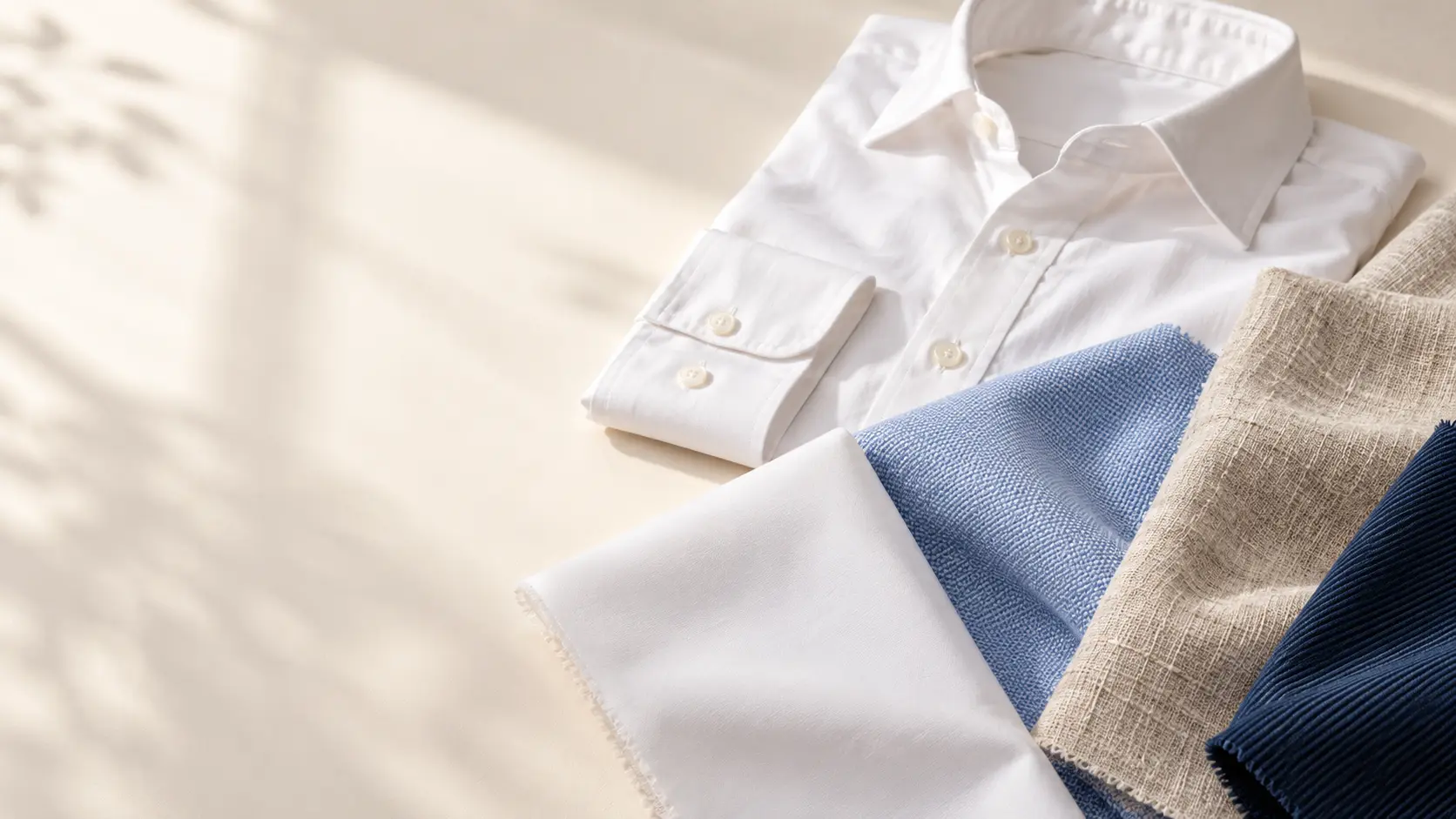
Shirt fabric types range from smooth poplin and textured Oxford cloth to linen, twill, denim and soft flannel. Some names describe the fiber a fabric contains, while others describe how weavers arrange the threads or how manufacturers finish the surface. Understanding these differences helps you choose a shirt that suits the occasion, weather, comfort preferences and care routine.
The best fabric isn’t necessarily the most expensive, the softest or the most durable. For example, a crisp business shirt, a lightweight summer button-up and a casual flannel shirt serve different purposes. Your ideal choice depends on how you plan to wear the shirt, how you want it to look and how much maintenance you’re willing to do.
What Do Shirt Fabric Names Actually Mean?
To compare fabrics accurately, separate three things: fiber composition, fabric construction and finishing. Each describes a different part of a shirt, and together they explain why two garments made from the same material can look and feel different.

Fiber Composition, Construction and Finish
Fiber composition identifies the material, such as cotton, linen, polyester or a blend. Fabric construction describes how yarns form the fabric, while finishing refers to treatments that influence its appearance, feel or performance.
Consider cotton poplin and cotton Oxford. Both can contain 100% cotton, yet poplin usually has a smooth, relatively flat surface, while Oxford has a more noticeable woven texture. Their differences come primarily from construction, yarns and finishing rather than the fiber name alone.
These distinctions also help when exploring broader fabric types and materials, because textile names often describe different characteristics rather than interchangeable categories.
Woven vs. Knitted Fabrics
Weavers create woven fabrics by interlacing two sets of yarns. The warp runs along the fabric’s length, while the weft crosses its width. By changing how these yarns intersect, manufacturers create different structures, including plain-weave construction and twill.
Knitted fabrics work differently. Instead of crossing two sets of yarns, they use interconnected loops. Jersey and interlock, for instance, commonly appear in T-shirts and other garments that need a different structure from woven dress shirts.
Fiber categories also extend beyond cotton, linen and polyester. Rayon, viscose and lyocell are manufactured cellulosic fibers made from cellulose, commonly sourced from wood pulp. Unlike conventional polyester, these fibers originate from cellulose rather than synthetic polymer production.
Ultimately, a fiber label tells you what a shirt contains, but it doesn’t reveal everything about its weight, softness, appearance, breathability or care requirements.
What Are the Main Types of Shirt Fabric?
The following fabrics and materials are among the most useful to recognize when shopping for dress shirts, casual button-ups and seasonal clothing. However, they don’t all describe the same textile characteristic: cotton and polyester identify fibers, twill identifies a weave structure, and herringbone describes a pattern.
| Fabric | Appearance | Common uses | Main consideration |
|---|---|---|---|
| Cotton | Smooth, crisp or textured | Dress and everyday shirts | Wrinkling and shrinkage depend on construction and care. |
| Linen | Textured, naturally creased | Summer and casual shirts | Wrinkles readily. |
| Polyester and blends | Varies by construction and finish | Performance and easy-care shirts | Comfort and moisture behavior vary. |
| Poplin and broadcloth | Smooth and relatively crisp | Formal and business shirts | Weight and opacity vary. |
| Oxford | Noticeable woven texture | Casual and business-casual shirts | Can feel more substantial than fine shirting. |
| Twill | Diagonal surface lines | Dress and everyday shirts | Weight and drape vary. |
| Herringbone | Repeating V-shaped pattern | Dress and casual shirts | More visually distinctive than plain fabrics. |
| Chambray | Often resembles lightweight denim | Casual shirts | Different construction from denim. |
| Denim | Distinctive twill texture | Casual and workwear shirts | Heavier versions can feel warm or stiff. |
| Flannel | Soft, often brushed surface | Casual and cooler-weather shirts | Warmth depends on weight and composition. |
| Seersucker | Characteristic puckered surface | Warm-weather shirts | Distinctive texture may not suit every setting. |
| Dobby, end-on-end and voile | Patterned, fine-textured or lightweight | Dress and lightweight shirts | Each describes a different fabric characteristic. |
Cotton Shirt Fabric

Cotton is one of the most versatile fibers for shirts. Manufacturers can turn it into smooth dress shirting, textured Oxford cloth, lightweight casual fabrics and many other constructions.
Its main advantages include versatility, a wide range of textures and suitability for both formal and everyday clothing. However, cotton doesn’t automatically mean lightweight, wrinkle-resistant or high quality. Some cotton shirts wrinkle readily, and shrinkage can occur depending on construction, finishing and care.
If you want to understand the material beyond its use in shirts, this explanation of cotton fabric provides a useful foundation.
Cotton is a strong starting point for a versatile wardrobe. Nevertheless, choose the specific construction according to how you intend to wear the shirt.
Linen Shirt Fabric

Linen comes from flax fibers and is commonly used for summer and casual shirts. Its distinctive texture and tendency to crease give it a relaxed appearance.
Linen can work well in warm weather, particularly when the fabric is lightweight and its construction allows airflow. However, not every linen shirt feels the same. Weight, yarn structure, finishing and fit all influence comfort.
Its main trade-off is wrinkling. Therefore, if you prefer a sharply pressed appearance throughout the day, linen may require more maintenance than you want.
Polyester and Blended Shirt Fabrics
Manufacturers use polyester in standalone fabrics and blends with cotton or other fibers. They may choose it to achieve particular properties, such as easier care, wrinkle resistance or quicker drying.
The results depend on the fabric’s construction, blend ratio and finishing. A suitable polyester blend may be convenient for travel or frequent wear, but polyester isn’t automatically more comfortable, more durable or easier to maintain than every natural fiber.
In particular, wrinkle resistance depends on the finished fabric rather than the fiber name alone. Compare the properties of different wrinkle-resistant fabrics before assuming a particular composition will meet your needs.
Poplin and Broadcloth
Shirtmakers and retailers use poplin and broadcloth to describe smooth, relatively crisp shirting, although their terminology can overlap in the US market.
Poplin generally uses a fine plain-weave construction. Its smooth appearance makes it a common choice for dress shirts and business wear.
The main advantages are its clean appearance and versatility for formal outfits. On the other hand, some lightweight versions may lack opacity, and their smooth surfaces can make wrinkles noticeable.
Choose poplin or a comparable broadcloth when you want a polished appearance. Still, check the actual weight and opacity instead of relying on the name alone.
Oxford Shirt Fabric

Oxford cloth has a recognizable woven texture and commonly uses a basket-weave variation of plain weave. That construction gives it a different surface from many fine dress-shirt fabrics.
Oxford shirts work well for everyday office wear, button-down collars and business-casual outfits. Their texture gives them a more relaxed appearance than many smooth poplin shirts.
The weight and refinement vary considerably. For example, a lighter Oxford can work well in an office, while a heavier version may feel too substantial in warm conditions. You can explore the construction in more detail in this explanation of Oxford cloth.
Twill Shirt Fabric
Twill is a woven construction with diagonal lines across the fabric. Manufacturers use it for many garments, including dress shirts, casual shirts and denim.
In shirting, twill can provide a distinctive texture and a different drape from a comparable plain-weave fabric. However, its properties vary with yarn selection, weave density, weight and finishing.
Twill is worth considering when you want a shirt with some texture or structure. Nevertheless, a diagonal weave doesn’t automatically make a fabric heavier, softer or more wrinkle-resistant.
Herringbone Shirt Fabric
Herringbone describes a recognizable V-shaped pattern that weavers create with a variation of twill. The repeated pattern distinguishes it from a conventional diagonal twill.
This construction adds visual interest without relying on a printed design. As a result, herringbone shirting can work well for dress shirts and smart-casual outfits, although the pattern may not suit every setting.
The underlying fiber and construction still determine most of the fabric’s practical properties.
Chambray Shirt Fabric

Chambray uses a woven construction and often has a denim-like appearance, commonly created with differently colored yarns. Manufacturers frequently use it for casual shirts.
Although chambray and denim can look similar, their typical constructions and weights differ. Chambray is often lighter and more flexible than typical denim shirting.
For that reason, chambray makes a useful choice for casual button-ups when you want a relaxed appearance without the substantial feel of heavier denim.
Denim Shirt Fabric
Manufacturers typically weave denim in a twill structure, creating its distinctive diagonal texture. Denim shirting ranges from relatively lightweight fabrics to heavier, more structured versions.
It works well for casual clothing, layering and workwear-inspired outfits. However, heavier denim can feel stiff or warm, while dyeing and finishing can influence how the garment changes with washing.
If you want a structured casual shirt, denim is worth considering. Check its weight and feel before buying, particularly if you plan to wear it in warm weather.
Flannel Shirt Fabric

Flannel has a soft surface that manufacturers often create by brushing the fabric. They can make flannel from cotton, wool or other fibers, so the name doesn’t identify a single fiber composition.
Brushing raises fibers at the surface, contributing to flannel’s familiar soft feel. Many people choose flannel for cooler weather and casual layering.
However, warmth depends on the fabric’s weight, composition and construction. Likewise, pilling and surface wear vary with fiber quality, yarns, finishing and use.
Seersucker Shirt Fabric
Seersucker has a puckered surface that creates its distinctive texture. Manufacturers often use it for warm-weather shirts.
The puckering comes from the fabric’s construction rather than a printed pattern. Consequently, seersucker offers a recognizable, relaxed appearance that suits many summer outfits.
Its main limitation is stylistic: the textured surface may not suit every formal setting.
Dobby, End-on-End and Voile
These terms describe additional shirting options, but each refers to a different fabric characteristic.
- Dobby: A dobby loom creates small woven patterns, such as geometric designs, subtle stripes or textured motifs.
- End-on-end: These fabrics often alternate differently colored yarns to create a fine, slightly speckled appearance.
- Voile: This lightweight fabric typically uses a fine, relatively open plain weave.
Dobby adds visual interest to a dress shirt, while end-on-end creates subtle texture. Meanwhile, voile suits situations where a lightweight fabric is desirable. In every case, opacity, drape and durability depend on the specific construction and weight.
How Do Common Shirt Fabrics Compare?
Fabric names help you identify the options. However, comparisons become more useful when they focus on the differences that affect a purchasing decision.
Oxford vs. Poplin: Which Is Better?
Neither fabric is universally better. Poplin usually offers a smooth, crisp appearance, while Oxford provides a more noticeable woven texture.
| Attribute | Poplin | Oxford |
|---|---|---|
| Surface | Smooth and relatively flat | More textured |
| Appearance | Often crisp and formal | Often casual or business-casual |
| Typical use | Dress and business shirts | Everyday and button-down shirts |
| Weight | Available in different weights | Available in different weights |
| Best when | You want a smooth, polished look. | You prefer a more textured style. |
Choose poplin when you want a smooth, polished look. In contrast, Oxford suits a more textured, relaxed style.
A fine Oxford can still work in a smart outfit, and poplin isn’t automatically formal. Collar design, color, fit and the rest of the garment also influence the finished appearance.
Cotton vs. Linen vs. Polyester
These materials differ in their sources and common characteristics. Even so, their finished fabrics can behave quite differently.
| Attribute | Cotton | Linen | Polyester |
|---|---|---|---|
| Source | Natural plant fiber | Natural fiber from flax | Synthetic fiber |
| Typical feel | Varies widely | Often textured | Varies by construction |
| Wrinkling | Can wrinkle readily | Commonly wrinkles readily | Often resists wrinkles better in suitable fabrics |
| Drying | Depends on construction and weight | Depends on construction and weight | Often relatively quick-drying |
| Common uses | Dress and casual shirts | Summer and casual shirts | Performance and easy-care shirts |
| Main consideration | Construction and care | Creasing and texture | Comfort and moisture behavior |
One important distinction is that moisture absorption, moisture wicking and breathability are not the same thing.
Moisture absorption describes how much moisture a fiber takes up. Moisture wicking describes how moisture moves along or through a fabric. Air permeability describes how readily air passes through the fabric.
These properties can vary independently. For example, fiber type matters, but yarns, weave or knit structure, density and finishing also influence performance. Therefore, a fabric’s composition alone cannot reliably predict how comfortable it will feel in every condition.
Cotton-polyester blends also illustrate why composition matters: the blend may combine properties of both fibers, but the result depends on their proportions and construction. You can compare cotton with polyester for a closer look at their differences.
Chambray vs. Denim
Chambray and denim can both have a blue, casual appearance, but their typical construction and weight differ.
Chambray is often lighter and more flexible, making it suitable for relaxed shirts that aren’t meant to feel heavy. By comparison, denim commonly has a more substantial twill structure and a stronger workwear appearance.
For a lightweight casual button-up, chambray is worth considering. If you prefer a more structured shirt for layering, denim may suit you better. In either case, check the actual fabric weight and construction instead of relying on the name alone.
Which Shirt Fabric Should You Choose?
The best fabric depends on the occasion, climate, desired appearance and amount of care you’re willing to provide.
| Your priority | Fabrics to consider | What to check |
|---|---|---|
| Formal or business wear | Poplin, broadcloth and suitable twills | Smoothness, opacity, crispness and care |
| Everyday office wear | Oxford, twill and suitable cotton blends | Texture, versatility and maintenance |
| Warm weather | Lightweight linen or cotton shirting | Weight, construction, fit and creasing |
| Casual textured style | Oxford, chambray or denim | Structure, weight and appearance |
| Cooler weather | Flannel or heavier shirt fabrics | Warmth, weight and layering |
| Lower maintenance | Suitable blends or wrinkle-resistant finishes | Care instructions and finish performance |
| Travel | Easy-care fabrics with suitable wrinkle recovery | Wrinkle behavior, drying and care requirements |
A few practical examples make the decision clearer.
For a crisp office shirt: Poplin may suit you if you prefer a smooth appearance and are willing to iron when needed.
For everyday business-casual wear: Oxford offers visible texture and versatility without the very smooth appearance of many formal dress shirts.
For summer: Compare lightweight linen with lightweight cotton shirting. Both can work well, but comfort depends on fabric weight, construction, fit and conditions. Linen’s characteristic creasing may also influence your choice.
For travel: Look for a fabric with suitable wrinkle recovery and care requirements. A well-chosen blend or treated fabric may be easier to maintain than a shirt that wrinkles readily. Still, no fabric remains completely wrinkle-free in every condition.
For a soft shirt: Look beyond the fiber name. Softness depends on fiber properties, yarn structure, construction, finishing and personal preference. Cotton can feel soft, but not every cotton fabric feels softer than every polyester, rayon or lyocell fabric.
For a thicker shirt: Check the actual weight and structure. A heavier fabric may offer more coverage or structure, but weight alone doesn’t prove quality, durability or warmth.
Rather than asking which fabric is best in general, consider which one offers the right balance of comfort, appearance, maintenance and performance for your situation.
How Can You Judge Shirt Fabric Quality and Read Its Label?
One number or marketing phrase cannot establish fabric quality. Instead, consider weight, yarns, construction, finishing and garment manufacturing together.
Fabric Weight, Yarn Count and Ply
GSM means grams per square meter. It measures the mass of a fabric over a defined area. In the United States, manufacturers and retailers may also express fabric weight in ounces per square yard.
Weight helps you compare how substantial two fabrics are, but it isn’t the same as thickness. More importantly, weight alone doesn’t establish quality. A lightweight fabric can be well made, while a heavier fabric can still have poor construction.
Yarn count describes yarn fineness under a particular counting system. A shirting description such as “120s” commonly refers to yarn count, not the number of threads per square inch. Because counting conventions vary, don’t compare figures blindly across different systems.
Ply describes how yarns are combined. A two-ply yarn combines two single yarns by twisting them together. This process can influence the resulting yarn’s properties, but two-ply construction doesn’t automatically guarantee a better shirt.
When evaluating quality, consider the combination of fabric weight, yarn quality, construction, finish, stitching and intended use. No single specification tells the whole story.
Fiber Labels, Finishes and Quality Claims
In the United States, the Federal Trade Commission requires most covered textile products to disclose their fiber content, country of origin and the identity of the responsible manufacturer or marketer. Clothing also has care-label requirements. The FTC explains these rules in its textile and apparel labeling guidance.
When evaluating a shirt, use the label alongside the garment itself.
- Check the fiber content. A label such as “80% cotton, 20% polyester” provides specific composition information. By contrast, a vague phrase such as “premium fabric” doesn’t tell you which fibers the shirt contains.
- Read the care instructions. These indicate how to clean and maintain the garment.
- Consider the construction. Look at the texture, opacity, weight and drape.
- Treat performance claims carefully. Terms such as “easy care” and “wrinkle-resistant” describe intended properties, but actual performance depends on the fabric and finishing.
- Don’t rely on touch alone. Texture can help you recognize a fabric, but it cannot reliably establish its fiber content.
Durability also deserves attention beyond the fiber name. Shrinkage depends on the fabric, garment construction, care and finishing. Similarly, fabric pilling depends on factors such as fiber characteristics, yarn structure, construction and use. Finishes may also change with repeated laundering.
These details don’t need to become a technical checklist for every purchase. Instead, compare the fabric’s specifications with how you intend to wear and care for the shirt.
Are T-Shirt and Polo-Shirt Fabrics Different?
Yes. Traditional woven button-up shirts and many T-shirts use different constructions, even when both contain cotton.
T-shirts commonly use knitted fabrics such as jersey or interlock. Knitting creates interconnected loops of yarn, producing a structure that differs from woven poplin or Oxford cloth. Many knitted fabrics stretch more readily, although the amount of stretch depends on construction and fiber content.
Polo shirts commonly use piqué, a recognizable textured fabric, although manufacturers also use other constructions.
Fiber composition remains a separate consideration: a knitted shirt can contain cotton, polyester or a blend. Therefore, when choosing a T-shirt or polo fabric, consider construction, weight, stretch, surface and intended use rather than applying every rule for woven dress shirts.
How Should You Care for Different Shirt Fabrics?
Care depends on fiber composition, construction, finishing and the garment’s instructions. Even two shirts made from the same fiber may need different care if their construction or finish differs.
- Follow the care label. Use the recommended washing, drying and ironing methods for the garment.
- Pay attention to heat. High temperatures can damage some fabrics or finishes and may contribute to shrinkage.
- Consider the surface. Brushed fabrics and delicate constructions may need different handling from sturdy everyday shirting.
- Account for blends. The proportions of each fiber and the finish can affect cleaning and drying behavior.
- Don’t assume wrinkle resistance eliminates maintenance. Some treated fabrics still need careful washing, drying or ironing to maintain their appearance.
For linen shirts, the right way to wash linen shirts depends on the garment’s composition, construction and care label. Likewise, following the label and learning how to prevent fabric shrinkage can help you avoid preventable changes in fit.
Because cotton, linen and polyester blends respond differently to heat and agitation, consult reliable care instructions for different fabrics when you need more specific washing guidance.
Ultimately, follow the garment’s instructions and consider the actual construction rather than relying on broad assumptions about cotton, linen or polyester.
Final Takeaway
Choosing among shirt fabric types becomes easier when you separate fiber composition from construction and finishing.
Cotton offers versatility, linen provides a distinctive warm-weather style, poplin creates a smooth appearance, Oxford adds texture, and twill offers another option for structure and drape. Meanwhile, flannel, chambray, denim and seersucker serve different casual and seasonal needs.
The best choice suits your intended use, feels comfortable, looks right for the occasion and fits your care routine. Check the actual fabric composition, construction and garment instructions rather than relying on the fabric name alone.
