


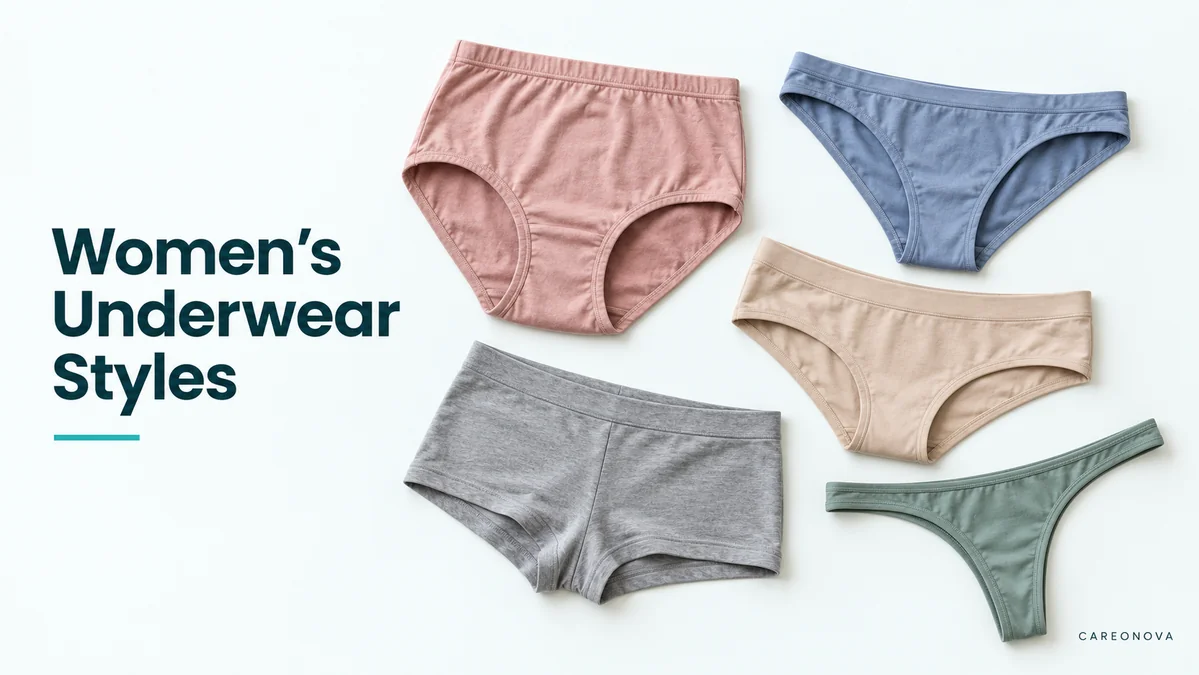
There are several kinds of women’s underwear, including briefs, bikinis, hipsters, boyshorts, cheeky panties, Brazilian cuts, tangas, thongs, and G-strings. These styles differ in waistband height, leg openings, side-panel width, and how much of the buttocks they cover.
Briefs and boyshorts generally provide more coverage, while thongs and G-strings use minimal fabric at the back. Bikinis, hipsters, and cheeky styles fall somewhere between them.
Understanding these differences can help you recognize underwear styles, compare similar cuts, and choose a comfortable option for everyday clothing, fitted outfits, or specific coverage preferences.
Women’s Underwear Styles at a Glance
Women’s underwear styles are easiest to compare by looking at their waistband position, side panels, and rear coverage.
| Style | Fit | Leg Coverage | Main Distinction |
|---|---|---|---|
| Boxers | Loose | Upper thigh | Relaxed legs with little close-fitting support |
| Briefs | Fitted | No extended legs | Support without thigh coverage |
| Boxer briefs | Fitted | Upper thigh | Close fit with leg coverage |
| Trunks | Fitted | Short | Shorter-leg alternative to boxer briefs |
| Long-leg boxer briefs | Fitted | Extended thigh | Longer inseam for additional coverage |
| Jockstraps | Supportive front | No leg coverage | Front pouch with open rear and straps |
These descriptions reflect common designs. Coverage varies between manufacturers, and some retailers use overlapping names for similar cuts.
The style illustrations are especially useful when comparing underwear online because front photographs alone may not reveal how much fabric covers the back.
Understanding Underwear Cuts, Rise, and Coverage
Before comparing individual styles, it helps to understand how underwear is constructed.
Four characteristics explain most of the differences.
Rise describes where the waistband sits. Low-rise underwear rests around the lower hips, mid-rise styles sit higher, and high-waisted designs extend toward or above the natural waist.
Rear coverage describes how much fabric covers the buttocks. Full-coverage styles use broader back panels, while cheeky and thong designs expose more skin.
Leg cut refers to the shape and height of the leg openings. Higher openings expose more of the upper thigh, while lower cuts provide more fabric around the hips and leg crease.
Side-panel width describes the amount of fabric connecting the front and back. Some panties have broad side panels; others use narrow bands or strings.
These characteristics can appear in different combinations. For example, a thong can be high-waisted, and a full-coverage brief can have high-cut leg openings.
Fabric and construction introduce further differences, including cotton linings, seamless edges, and elastic waistbands.
The Main Types of Women’s Underwear Explained

1. Briefs: Classic Coverage
Briefs are one of the most familiar underwear styles. They have a broad front panel, relatively wide sides, and substantial coverage across the buttocks.
Classic briefs usually have leg openings that follow the crease between the thighs and hips. Their waistbands can sit at different heights.
Common variations include:
- Regular briefs: Traditional front and rear coverage with a mid-rise or higher waistband.
- High-waisted briefs: Similar coverage with a waistband extending farther up the abdomen.
- High-leg briefs: A brief silhouette with leg openings cut higher toward the hips.
Fuller-coverage briefs are sometimes called granny panties. This informal term usually refers to traditional underwear with generous coverage, especially higher-waisted designs.
Briefs are worth considering if you want a broad back panel or prefer underwear that covers more of the hips.
The leg openings deserve attention. A pair may fit comfortably around the waist while feeling restrictive around the upper thighs. Checking both measurements and the garment’s leg shape gives a better picture of its fit.
2. Bikini Underwear: Moderate Coverage and Narrower Sides
Bikini underwear has a narrower side profile than traditional briefs. Its waistband commonly sits at or below the hips, although higher-rise versions also exist.
Most bikini panties provide moderate rear coverage, with leg openings that expose more of the upper thigh than classic briefs.
The style resembles bikini swimwear bottoms.
One variation is the string bikini, which uses very narrow side bands or ties rather than the broader fabric panels found on standard bikinis.
Bikini underwear is commonly worn with jeans, shorts, skirts, and casual clothing. Its narrower sides can reduce the amount of fabric around the hips.
When comparing a bikini with a brief, examine the front-panel shape, leg-opening height, and side width.
Two products labeled bikini may have noticeably different rear coverage. Look for back-view photographs when shopping online, particularly if coverage is an important preference.
3. Hipster Underwear: Wider Sides Around the Hips
Hipster underwear usually has a waistband that rests around the hips and relatively wide side panels.
Its leg openings are often lower than those of a bikini, creating more coverage around the sides of the hips.
Rear coverage generally ranges from moderate to full.
Hipsters are sometimes described as a combination of bikini and brief features because they retain a lower waistband while covering more of the sides.
The distinction becomes clearer when you compare the two styles directly:
- A bikini typically has narrower sides and more open leg cuts.
- A hipster generally has wider sides and a waistband positioned around the hips.
- Both can provide similar rear coverage, depending on the manufacturer.
Hipsters may work well beneath low- or mid-rise trousers when their waistband sits comfortably below the outer garment.
The wider side panels can also distribute elastic pressure over a broader area, although comfort ultimately depends on the size and construction.
4. Boyshorts: More Coverage Around the Hips and Upper Thighs
Boyshort underwear has a short-like shape inspired by boxer-style garments.
Unlike bikini or thong designs, boyshorts extend farther along the sides and may cover a small portion of the upper thighs.
Most provide substantial rear coverage.
Boyshorts are available in several lengths. Some end close to the leg crease, while others extend farther down the upper thigh.
This difference matters when wearing them beneath fitted pants or dresses. A longer leg hem may create a visible line, especially under thin fabric.
Boyshorts are also different from slip shorts. Slip shorts generally extend farther down the thighs and may be worn beneath dresses or skirts for additional coverage or to reduce skin contact.
If you want underwear with more side coverage, compare boyshorts with briefs. Check whether the leg hems stay flat when you sit or walk.
A pair that feels comfortable while standing may bunch near the upper thigh during movement.
5. Cheeky Underwear: Partial Rear Coverage
Cheeky panties have a narrower or more curved back panel than many traditional bikinis.
They cover the front and sides while exposing part of the buttocks. The amount exposed varies significantly by design.
Some cheeky panties resemble bikinis from the front. Their distinctive shape becomes clearer when viewed from the back.
A standard bikini typically covers more of the buttocks, while a cheeky cut leaves more skin visible around the lower or outer rear.
Cheeky styles are available with narrow or wide side panels and several waistband heights.
When selecting them, check where the rear leg openings sit. A back panel that is too narrow for your preferred fit may shift or bunch during movement.
If you want partial coverage while retaining more fabric than a thong, cheeky underwear is one option to compare.
6. Brazilian and Tanga Underwear: Narrower Back and Side Panels
Brazilian and tanga styles generally sit between cheeky underwear and thongs in terms of rear coverage, although their names are not standardized.
Brazilian underwear often has a relatively broad front panel and a narrower, angled back that exposes part of the buttocks.
Some Brazilian designs form a V-shaped rear panel, while others look similar to cheeky bikini underwear.

Tanga underwear commonly has slim side panels and reduced rear coverage. Some tangas have a small back panel, while more minimal versions approach thong-like construction.
The easiest way to compare these styles is to look at three features:
- The width of the side bands.
- The shape and size of the rear panel.
- The height of the leg openings.
A Brazilian cut may have more rear fabric than a minimal tanga, but this distinction varies between brands.
For example, one retailer may sell an angled, partial-coverage design as a Brazilian bikini, while another labels a similar garment as a tanga.
Product photographs showing both sides provide more reliable information than the style name alone.
7. Thong Underwear: Minimal Rear Coverage
A thong has a front panel, narrow side sections, and a thin strip of fabric extending between the buttocks.
Its defining feature is minimal rear coverage.
Thongs are available in several variations, including low-rise, mid-rise, high-waisted, and wider-waistband designs.
They are frequently chosen beneath fitted clothing because the narrow rear panel avoids the broad seam line created by many full-coverage styles.
However, a thong may still show through clothing at its waistband, side bands, or front edges.
The fabric and construction matter as much as the silhouette.
For everyday comfort, the rear strip should sit without excessive tension or rubbing. A narrow garment that repeatedly shifts or feels restrictive may have unsuitable proportions or sizing.
Thongs are a personal preference, and a well-fitting brief or bikini may be equally suitable for many outfits.
8. G-Strings: A More Minimal Thong Variation
A G-string is a minimal form of thong underwear.
It generally uses a small front panel, very narrow side bands, and a thin string at the back.
Compared with a conventional thong, the G-string usually has less material connecting the front and rear panels.
Some garments use a continuous string around the hips, while others use small elastic bands joined to a fabric panel.
G-strings are sometimes selected when minimal fabric coverage is the main preference.
Their fit depends heavily on elastic tension and correct sizing. Thin bands concentrate pressure over a smaller area, so they should be checked carefully for comfort.
Retailers sometimes use the terms G-string, T-string, and minimal thong interchangeably.
9. High-Cut and French-Cut Underwear
High-cut or French-cut underwear has leg openings that rise higher toward the hips.
The higher leg shape exposes more of the upper thigh compared with a conventional low-leg brief.
High-cut underwear can provide substantial rear coverage. It is commonly available in brief and bikini silhouettes.
The term describes the leg opening rather than a fixed waistband height.
For example, a high-cut brief may have a waistband near the natural waist, while a high-cut bikini may sit lower.
French-cut briefs should also be distinguished from French knickers, which traditionally describe a looser, shorts-style garment. In American English, similar loose designs may be called tap pants.
High-cut styles are worth comparing when you want a more open leg shape while retaining your preferred amount of rear coverage.

Which Underwear Styles Are Most Similar?
Several styles look nearly identical in product photographs. Their differences become clearer when you compare specific garment features.
Bikini vs. Hipster
Bikinis generally have narrower sides and more open leg cuts.
Hipsters usually have wider side panels and a waistband that sits around the hips.
Rear coverage can overlap considerably. Compare the front and side views when choosing between them.
Cheeky vs. Brazilian
Both typically provide partial rear coverage.
Cheeky underwear often resembles a bikini with a narrower back panel. Brazilian designs commonly have an angled back and may feature higher leg openings.
Because the labels vary by retailer, the garment’s actual cut is more useful than the name.
Thong vs. G-String
Both use minimal rear fabric.
A traditional thong generally has a narrow fabric strip, while a G-string typically uses an even thinner string-like construction.
The difference is most visible in the width of the rear material and side bands.
Briefs vs. Boyshorts
Briefs have leg openings shaped around the upper thighs.
Boyshorts extend farther along the sides and may cover part of the upper thighs.
If the waistband and back coverage are similar, the leg shape is the easiest feature to compare.
How to Choose Women’s Underwear for Different Outfits
The right choice depends on clothing fit, fabric thickness, waistband position, and how much coverage you prefer.
| Clothing or preference | Styles worth considering | What to check |
|---|---|---|
| Everyday jeans | Bikini, hipster, briefs | Waistband height and leg comfort |
| Low-rise pants | Low-rise bikini, hipster | Whether the underwear waistband shows |
| Leggings | Seamless bikini, brief, thong | Fabric thickness and visible edges |
| Fitted dresses | Smooth-edged briefs, bikini, thong | Seam placement and fabric visibility |
| Loose skirts and dresses | Briefs, boyshorts | Coverage and freedom of movement |
| More rear coverage | Briefs, hipsters, boyshorts | Back-panel width and leg openings |
| Minimal rear coverage | Thong, G-string | Band tension and personal comfort |
| More upper-thigh coverage | Longer boyshorts, slip shorts | Leg length and whether hems roll |
Underwear for leggings and fitted clothing
Visible panty lines, often abbreviated as VPL, occur when underwear edges create outlines beneath outer clothing.
A thong can reduce visible rear seams, while seamless briefs or bikinis may provide additional coverage with less prominent edges.
Fabric thickness, color, elasticity, and garment fit all influence whether the underwear shows.
A seamless label alone does not guarantee invisible underwear lines.
Underwear for everyday comfort
For daily wear, check the waistband and leg openings before prioritizing a particular style name.
Some people prefer the coverage of briefs or boyshorts. Others are comfortable in bikinis, hipsters, or thongs.
A suitable pair should remain in position during ordinary movement and avoid unnecessary pressure on the skin.
Underwear for more coverage
If you want more fabric around the hips and buttocks, briefs, hipsters, and boyshorts are useful options to compare.
A high-waisted design can provide additional abdominal coverage without changing the basic rear silhouette.
The waist height and back coverage should be considered separately when selecting a pair.
How to Tell Whether Women’s Underwear Fits Properly
Underwear sizing can vary between brands, even when two garments have the same letter size.
Fit depends on the garment’s measurements, fabric stretch, waistband construction, and cut.
Start with the manufacturer’s size chart
Check the brand’s size chart before purchasing.
Many underwear charts use hip measurements, while some also consider the waist. Measure at the locations specified in the chart rather than assuming every brand uses identical standards.
If your measurements fall between sizes, compare the garment’s stretch, intended fit, and the manufacturer’s advice.
Choosing a larger size may help with tightness, but it won’t necessarily correct a cut that shifts or bunches.
Common underwear fit problems
| Fit problem | Possible reason | What to try |
|---|---|---|
| Waistband rolls down | Tight waistband, unsuitable rise, or elastic construction | Compare rise, size, and waistband design |
| Leg openings dig in | Tight elastic or an incompatible leg shape | Try a different size or leg cut |
| Underwear rides up | Insufficient rear coverage or an unsuitable cut | Compare a wider back panel or another silhouette |
| Fabric bunches | Excess fabric, poor proportions, or insufficient support | Check the size and fabric stretch |
| Gusset feels uncomfortable | Position, width, or seam placement | Compare gusset dimensions and construction |
| Panty lines show | Raised seams, tight edges, or thin outer clothing | Try smoother edges or a different silhouette |
These are practical possibilities rather than definitive diagnoses of a fitting problem.
Check fit while moving
A useful fitting check takes only a few moments.
Stand normally and check the waistband and leg openings. They should sit comfortably without excessive pressure.
Next, sit down, stand again, and walk around.
Notice whether the waistband rolls, the rear panel shifts, or the fabric gathers near the crotch and upper thighs.
If the same issue keeps occurring, compare a different cut. Changing the size alone may not solve a problem caused by the garment’s shape.
Underwear Fabrics and Construction: What Matters?
The underwear style determines much of its shape and coverage. Fabric choice affects how the garment stretches, feels, dries, and sits against the skin.
Cotton
Cotton is widely used for everyday underwear because it can feel soft and breathable.
Cotton underwear may contain elastane or another stretch fiber to improve flexibility.
Check the full fabric composition. A garment described as cotton underwear may use a cotton blend rather than 100% cotton throughout.
Modal
Modal is a regenerated cellulose fiber in the rayon family. It is often used in soft, lightweight underwear and sleepwear.
Modal fabrics usually have a smooth feel and fluid drape.
Their stretch and durability depend on the knit construction and any additional fibers in the blend.
Nylon and Microfiber
Nylon and other synthetic microfiber fabrics can create smooth, lightweight underwear.
These materials are frequently used in fitted and low-profile designs because they can be manufactured with thin, flexible edges.
However, breathability and moisture management vary with fabric construction. A microfiber label alone does not establish how cool or comfortable a garment will feel.
Lace and Stretch Blends
Lace adds texture and can be used in briefs, bikinis, hipsters, or thongs.
Its comfort depends on the softness of the lace, seam positioning, and elastic tension.
Elastane, also called spandex, is commonly blended with other fibers to provide stretch and recovery.
If you’d like more detail about textile properties, Careonova’s fabric types and materials guide explains cotton, modal, nylon, and other clothing materials.
Gussets and Cotton Linings

The gusset is the panel in the crotch area of underwear. It may contain a separate lining made from cotton or another fabric.
Gusset width, placement, and seam construction can affect comfort.
The American College of Obstetricians and Gynecologists recommends avoiding tight-fitting pants and underwear and choosing underwear with a cotton panel as part of its vulvovaginal health guidance.
Fabric choice does not guarantee prevention of irritation or infection. Persistent itching, burning, or discomfort warrants medical evaluation.
Final Thoughts
Understanding the different kinds of women’s underwear becomes easier when you compare their rise, leg shape, side width, and rear coverage.
Use the style names as a starting point, then check the garment’s actual construction and fit. A comfortable choice should suit your coverage preferences, stay in place during movement, and work with the clothing you wear.
