


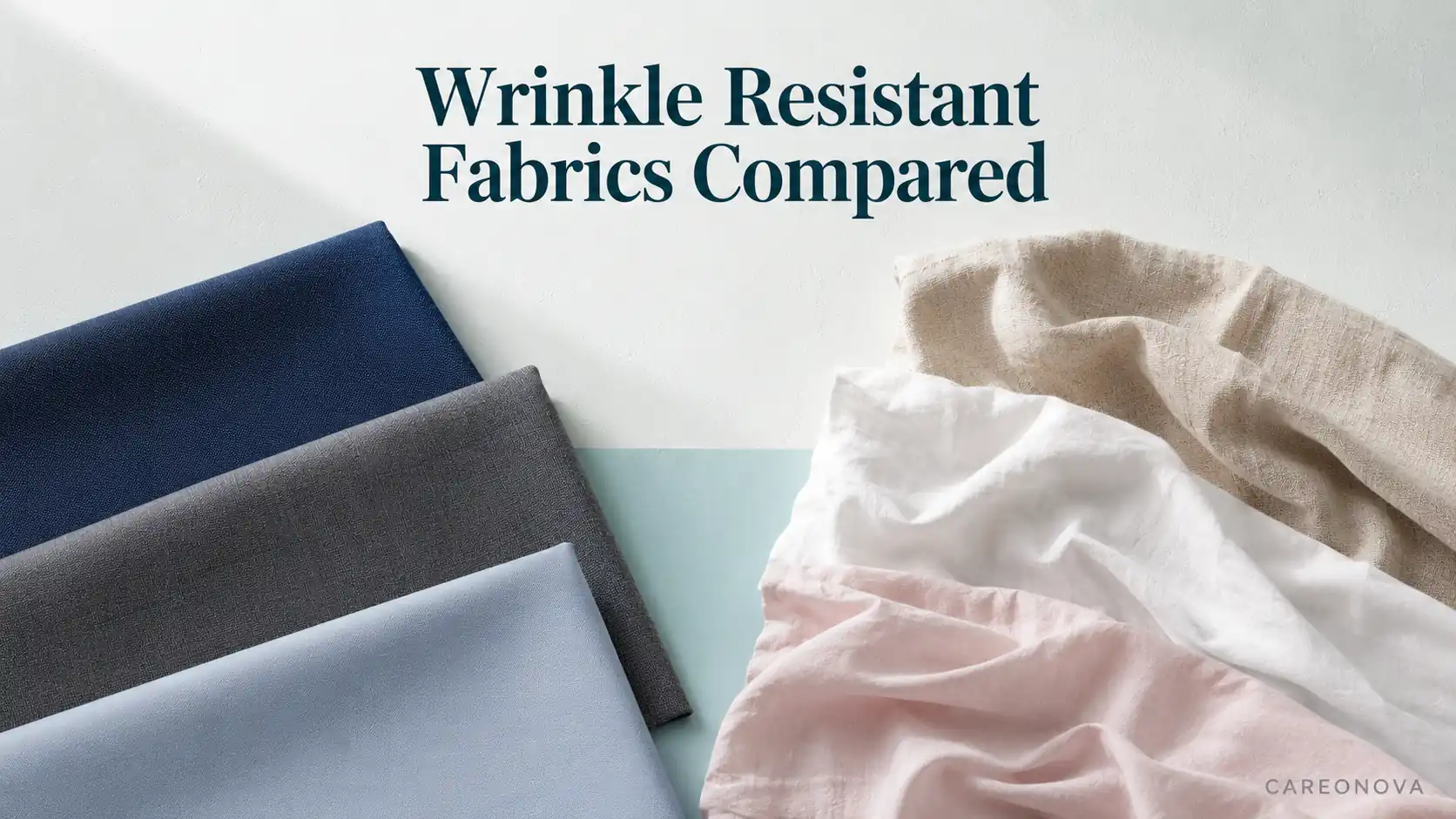
Wrinkle resistant fabrics like polyester, nylon, wool, and acrylic generally hold their shape best, while linen, rayon, viscose, and untreated cotton tend to crease much faster. But the fiber name only tells part of the story. How a fabric is woven or knitted, how heavy it is, whether it’s blended with other fibers, and how it’s finished all affect how much a garment wrinkles and how noticeable those wrinkles become.
That’s why two garments made from the exact same fiber can behave in completely different ways. A lightweight cotton poplin shirt and a heavy cotton denim jacket share the same base fiber, yet one shows every fold while the other barely looks creased. This guide walks through how different fibers and constructions like jersey, twill, denim, and poplin actually perform, explains what fiber recovery and finishing treatments do to improve wrinkle resistance, and helps you pick the right fabric for travel, office wear, hot weather, and everyday low-maintenance clothing.
Which Fabrics Wrinkle the Least and Most?
Polyester and nylon are generally among the better choices when wrinkle resistance matters. Wool also has useful natural recovery. Linen, conventional rayon or viscose, and many untreated cotton fabrics tend to crease more readily.
The comparison gets less straightforward once names such as jersey, poplin, denim, or twill enter the picture. Those describe fabric constructions rather than one specific fiber. A cotton jersey and polyester jersey may share the same knit structure while behaving quite differently after sitting, folding, washing, or packing.
| Fiber or Fabric Type | Typical Wrinkle Tendency | What Can Change the Result |
|---|---|---|
| Polyester | Low | Construction, blend, thickness, heat |
| Nylon | Low | Construction and heat exposure |
| Wool | Low | Weight, structure, fiber type |
| Acrylic | Low | Knit/weave and heat |
| Spandex / Elastane | Usually used to aid recovery | Main fibers and construction |
| Modal | Variable | Knit/weave, weight, blend, finish |
| Lyocell | Variable | Construction, weight, blend, finish |
| Silk | Moderate | Weave, weight, finishing |
| Jersey | Varies | Fiber content is especially important |
| Twill | Varies | Fiber, weight, weave density |
| Denim | Low–moderate to moderate | Weight, cotton content, stretch blend |
| Oxford cloth | Moderate | Cotton vs synthetic/blended versions |
| Corduroy | Moderate / visually forgiving | Fiber content and raised texture |
| Fleece | Usually visually forgiving | Fiber and construction |
| Cotton | Moderate–high | Finish, weave, weight, blend |
| Poplin | Moderate–high when cotton-rich | Fiber content and finishing |
| Chambray | Moderate–high when cotton-rich | Weight and blend |
| Rayon | High | Rayon type, construction, blend, finish |
| Viscose | High | Weight, knit/weave, blend |
| Linen | High | Weight, blend, finishing |
These are typical tendencies, not permanent grades. Textile guidance from the University of Georgia describes polyester as wrinkle-resistant, conventional rayon as easy to wrinkle, cotton as wrinkle-prone unless treated, and linen as especially prone to creasing. It also notes that blends and finishes can change performance.
If you are trying to avoid a fabric that wrinkles easily, fiber is a useful first clue, but the table should not be read as a fixed ranking of every garment made from that material.
What Makes a Fabric Wrinkle-Resistant?
Wrinkle resistance depends mainly on fiber recovery, fabric construction, weight, blends, and finishing. The fiber label matters, but it does not describe the whole garment.
A useful way to think about wrinkle behavior is:
Fiber → Yarn → Weave or Knit → Weight → Blend → Finish → Garment Construction → Moisture & Pressure → Visible Creasing
Fiber Recovery
Some fibers have better crease recovery, meaning they return closer to their original shape after bending, folding, or compression.
Polyester and nylon generally recover better than fibers such as cotton, linen, or conventional rayon. Wool gets there in a different way: its natural crimp and elasticity help it rebound after temporary compression.
That does not make any of them impossible to wrinkle. It means the crease is often less persistent or less obvious under similar conditions.
Weave and Knit Structure
Two fabrics made from the same fiber can behave differently simply because their yarns are arranged differently.
Take cotton. Lightweight cotton poplin and heavy cotton denim both contain the same basic fiber, yet their weight, weave, stiffness, surface, and drape are very different.
The same applies to polyester fabric. An open athletic mesh fabric, a smooth lining, and thick fleece can all use polyester without looking or behaving alike after being folded.
Weight, Thickness, and Surface Texture
Heavier fabric may sometimes hold a more structured shape, but heavier does not automatically mean more wrinkle-resistant.
Surface texture also changes what the eye sees. A crease on a smooth plain fabric can be obvious. Corduroy ribs, fleece loft, prints, or intentionally textured surfaces may hide light deformation more effectively.
This distinction is easy to miss:
Wrinkle formation and wrinkle visibility are not always the same thing.
A fabric may have creased without making that crease visually prominent.
Blends and Finishing Treatments
Blending fibers can change how a fabric behaves. Polyester is commonly blended with cotton or rayon to improve easy-care performance, while elastane can contribute stretch and recovery.
But there is no meaningful universal rule such as “30% polyester makes any garment wrinkle-resistant.” Fiber proportion is only one variable.
Finishing treatments can also improve wrinkle recovery, particularly in naturally crease-prone cellulosic fabrics such as cotton and rayon.

Fabrics That Usually Resist Wrinkles Best
Does Polyester Wrinkle?
Polyester can wrinkle, but it usually resists creasing better than cotton, linen, and conventional rayon. Its ability to recover from compression is one reason polyester is widely used in easy-care clothing.
Here’s the catch: polyester covers a huge range of finished fabrics.
Thin woven polyester, satin-like lining, fleece, and mesh can all show folding or packing marks differently. Blends change the result again.
So a label that says 100% polyester is useful, but it is not a promise that the garment will always stay perfectly smooth.
Does Nylon Wrinkle?
Nylon generally has good wrinkle resistance because the fiber is resilient and flexible.
That makes it useful in lightweight clothing that needs to tolerate folding and movement. The finished result still depends on how the nylon is woven or knitted.
Nylon is also heat-sensitive, so good wrinkle resistance should not be taken as permission to use high iron or dryer temperatures.
Does Wool Wrinkle?
Wool can wrinkle, but it has strong natural wrinkle recovery compared with many plant-based fibers.
Wool fibers have natural crimp and elasticity that help them recover after compression. Woolmark explains that this resilient fiber structure contributes to shape retention and recovery.
A wool garment can still develop sitting, packing, or storage creases. Giving it time to hang can sometimes allow light wrinkles to relax.
“Wrinkle-resistant” is reasonable. “Wool never wrinkles” is not.
Does Acrylic Wrinkle?
Acrylic generally resists wrinkles fairly well, although the finished knit or weave still matters.
Many acrylic garments are knitted, which can further influence flexibility and visible creasing. Acrylic is also sensitive to excessive heat, so any pressing should follow the garment’s care instructions.
There is little value in overthinking this one: acrylic is usually easier to keep looking smooth than highly crease-prone fibers such as linen.
Does Spandex or Elastane Wrinkle?
Spandex, also called elastane, mainly contributes stretch and shape recovery rather than acting as a standalone wrinkle-proof fiber.
It is normally blended with cotton, polyester, rayon, nylon, or other fibers. That means the main fibers and fabric construction still control much of the garment’s wrinkle behavior.
A small amount of elastane may help clothing rebound after movement, but it does not erase the characteristics of the base material.
Our spandex and elastane guide explains that fiber relationship in more detail.
Fabrics With Moderate or Variable Wrinkle Tendency
Modal
Modal can wrinkle, and its crease behavior varies enough that it should not be treated as universally wrinkle-free.
Modal belongs to the regenerated cellulosic fiber family and is related to viscose. The practical result depends heavily on whether the fabric is knitted or woven, how heavy it is, whether it is blended, and how it is finished.
A soft modal jersey may behave quite differently from a lightweight woven modal garment.
For that reason, the finished fabric is more useful than the word modal alone when wrinkle resistance matters. You can learn more in our modal fabric guide.
Does Lyocell Wrinkle?
Lyocell can crease, and its wrinkle performance varies with the finished fabric.
It is another regenerated cellulosic fiber, but that does not give every lyocell garment one predictable wrinkle grade. Woven versus knitted construction, weight, finishing, and blending can all change recovery.
I would not treat “lyocell” on a label as a guarantee of either high or low wrinkle resistance. Look at the actual garment structure.
Does Silk Wrinkle?
Silk can wrinkle, although it generally has moderate wrinkle resistance rather than being extremely crease-prone.
Weight and weave matter considerably. Lightweight, smooth silk can display folds and packing creases clearly, while heavier or more textured constructions may look more forgiving.
This is another case where the fiber name gives useful information without telling the whole story.
Does Jersey Wrinkle?
Jersey may resist wrinkles well or wrinkle noticeably because jersey describes a knit construction, not a fiber.
A polyester jersey and cotton jersey are both jersey fabrics, but their fibers have different recovery characteristics. Rayon-rich jersey adds another variation.
The knit structure can provide flexibility, but the fiber content still deserves attention.
Does Twill Wrinkle?
Twill can be wrinkle-resistant or wrinkle-prone because twill is a weave, not one specific fiber.
Cotton twill, wool twill, and polyester-blend twill do not have identical crease recovery.
Twill’s diagonal surface may also make small creases less visually obvious than they would be on some smooth plain weaves.
Denim
Denim wrinkles, but heavier denim often looks less obviously creased than lightweight cotton shirting.
Denim is typically a twill fabric, and its weight and structure give it a more substantial surface. Stretch denim may also include elastane, which changes recovery.
A thin denim shirt and heavy rigid jeans should therefore not be treated as the same wrinkle situation.
Oxford Fabric
Oxford fabric can wrinkle, particularly when it is cotton-rich, while synthetic or blended versions may recover better.
Oxford describes a woven construction rather than a single fiber.
For a dress or office shirt, look at both the word Oxford and the fiber-content label. Cotton Oxford and polyester-blend Oxford can behave differently after sitting or washing.
Corduroy
Corduroy can wrinkle, but its raised ribs can make light creasing less noticeable.
That does not necessarily mean the fabric resisted deformation better. The surface simply does a better job of hiding it.
This is a useful example of why visible smoothness and actual crease resistance should not be treated as exactly the same thing.
Fleece
Fleece usually looks fairly forgiving after folding because its raised surface can hide light compression marks.
Many apparel fleeces are polyester-based, which also helps with wrinkle resistance.
The word fleece, however, describes the fabric structure rather than guaranteeing one fiber composition, so the label still matters.
Fabrics That Tend to Wrinkle More Easily
Does Cotton Wrinkle?
Yes. Untreated cotton commonly wrinkles because it has relatively poor natural crease recovery.
But that does not mean every cotton garment wrinkles equally.
Thin, smooth cotton can show folds clearly, while heavy denim or textured cotton may look far less creased. Synthetic blends and wrinkle-resistant finishes can also improve recovery.
If low-maintenance clothing matters to you, check the finished cotton fabric rather than rejecting the fiber altogether.
Poplin
Poplin can wrinkle noticeably, especially when it is made mainly from cotton. But poplin itself is a weave, not a fiber.
That distinction matters because cotton poplin and polyester-blend poplin can behave differently.
A smooth poplin surface can also make folds and sitting creases particularly easy to see.
For shirts, the fiber-content label tells you more about likely crease recovery than the word poplin alone.
Chambray
Chambray can wrinkle, particularly when it is lightweight and cotton-rich.
Like poplin, chambray describes a fabric construction rather than one fixed fiber composition.
Most cotton-heavy versions will share some of cotton’s tendency to crease, while blended constructions may recover differently.
Rayon
Yes. Conventional rayon tends to wrinkle fairly easily, particularly in lightweight woven fabrics.
That is a fiber-level tendency, not a guarantee that every rayon garment will look crushed after wear.
A lightweight woven blouse, heavier dress fabric, and rayon-elastane jersey can all have different wrinkle behavior because construction, weight, blending, and finishing affect recovery.
For the wider material picture, see our rayon fabric guide.
Does Viscose Wrinkle?
Yes. Viscose generally wrinkles fairly easily. It is a common type of rayon, so the two share much of the same wrinkle-prone behavior.
Still, one viscose garment may remain noticeably smoother than another.
Weight, knit versus weave, blends, finishing, and garment construction can all affect the final result.
So if two labels both say viscose but the fabrics behave differently after sitting or packing, that is not unusual.
Linen
Yes. Linen is one of the more wrinkle-prone common clothing fibers.
It can develop visible creases during sitting, bending, folding, and normal wear. Blends and finishing may improve recovery, but they do not change linen into a completely crease-free fiber.
There is also an aesthetic point worth remembering: linen’s relaxed, slightly rumpled appearance is often accepted as part of the material’s character rather than treated as a flaw.
Why Can the Same Fiber Wrinkle So Differently?
Two garments with the same fiber content can wrinkle differently because fiber is only one layer of fabric performance.
Consider polyester mesh and smooth polyester lining. Both may be 100% polyester, yet one is open and flexible while the other has a smooth continuous surface where folding marks may be much easier to see.
Now compare a woven rayon blouse with rayon-spandex jersey. The fiber family overlaps, but changing the construction and adding an elastic fiber changes how the garment moves and recovers.
Cotton provides another obvious example. Cotton poplin and cotton denim share the same main fiber, yet a light smooth shirt and heavy twill jeans differ in weight, weave, structure, drape, and wrinkle visibility.
That is why I would not judge clothing from the fiber label alone.
The fiber label is a useful clue. The finished fabric is the better predictor.
What Do “Wrinkle-Resistant,” “Wrinkle-Free,” and “Non-Iron” Mean?
These terms indicate that a garment is designed to stay smoother or recover better from creasing, but they should not be read as promises that wrinkles are impossible.
Wrinkle-resistant usually describes fabric that develops fewer wrinkles or recovers more effectively after pressure.
Wrinkle-free is stronger wording, but even a garment marketed this way can crease after tight packing, prolonged sitting, storage, or unsuitable care.
Non-iron clothing is designed to maintain a smooth enough appearance that routine ironing is reduced or unnecessary under normal care.
Permanent press or durable press generally refers to fabric engineering or finishing treatments intended to improve wrinkle recovery and shape retention.
Best Fabric Choices When Wrinkles Matter
There is no single best low-wrinkle fabric for every situation. The right choice depends on what else the clothing needs to do.
| Use | What to Prioritize | Fabrics Often Worth Considering |
|---|---|---|
| Travel | Recovery after packing, low maintenance, suitable weight | Polyester, nylon, wool, resilient blends |
| Office / dress wear | Recovery after sitting, structure, smooth appearance | Wool, polyester blends, suitable twills, treated cotton |
| Hot weather | Wrinkle performance plus airflow and comfort | Suitable lightweight blends, wool, modal or lyocell constructions |
| Everyday low-maintenance wear | Easy recovery and practical care | Polyester, nylon, blends, wrinkle-resistant finishes |
For summer, wrinkle resistance should not be the only criterion. The smoothest fabric in your suitcase is not very useful if it feels uncomfortable in the weather where you are wearing it.
What I would check first is the combination of fiber content, construction, weight, surface, finishing, and care requirements.
When two materials otherwise seem similar, our fabric comparison guides can help you judge the trade-offs.
How to Keep Clothes From Wrinkling as Much

Good handling can reduce wrinkles even when the fabric itself is crease-prone.
Do not leave damp clothing compressed in a washer or laundry basket longer than necessary. Reshape garments before drying, and hang or lay them flat when the care instructions call for it. Overpacked drawers and suitcases also keep fabric under pressure for longer, making creases more likely.
For wrinkles that have already formed, steaming or pressing may help, but the garment care label should override generic advice. Polyester, nylon, acrylic, spandex, wool, rayon, silk, and other materials have different heat tolerances.
If laundry itself is causing the problem, our guide to washing different fabrics covers care by material rather than treating every garment the same.
Which Fabric Is Best If You Hate Wrinkles?
If low maintenance is the priority, polyester, nylon, wool, and well-designed synthetic blends are good places to start. They generally provide better wrinkle resistance or recovery than untreated cotton, linen, and conventional rayon.
But I would not buy clothing from the fiber name alone.
A cotton poplin shirt, heavy cotton denim, polyester fleece, polyester lining, and rayon jersey all reinforce the same point:
Fiber matters, but construction changes the result.
For a real garment, the most useful check is:
fiber content + weave or knit + weight + blend + finish + care requirements
That combination tells you far more about how clothing is likely to look after wearing, washing, folding, and packing than any promise that one material is completely “wrinkle-free.”
