

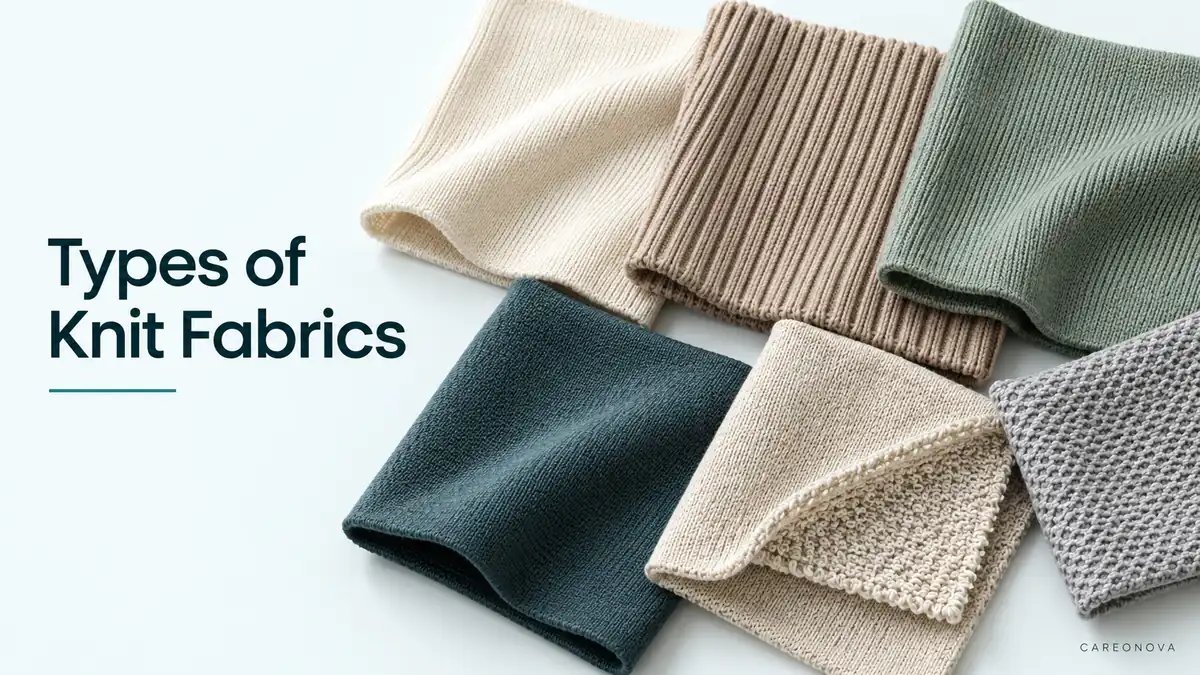
Knit fabrics are made from interconnected loops of yarn. Common types include jersey, rib, interlock, ponte, French terry, tricot, and raschel. They differ in stitch construction, texture, thickness, stretch, and the clothing they are used to make.
A cotton jersey T-shirt, for example, has a different structure and feel from a ribbed cuff or a ponte dress. Some knits drape softly, while others provide more body and shape.
Understanding the different types of knit fabrics helps you identify unfamiliar materials, compare similar fabrics, and choose suitable options for clothing. The key is to examine their construction, surfaces, and behavior rather than relying on the fabric name alone.
Types of Knit Fabrics at a Glance
These ten common knit fabrics include basic knitted structures and widely used apparel variations.
| Knit Fabric | Key Characteristics | Common Uses |
|---|---|---|
| Single Jersey | Smooth face, different-looking reverse, flexible | T-shirts, tops, underwear |
| Rib Knit | Raised vertical ribs, often stretches readily across its width | Cuffs, collars, fitted clothing |
| Interlock | Smooth, similar-looking faces, relatively stable | Tops, dresses, baby clothes |
| Purl Knit | Textured, often reversible, with horizontal ridges | Sweaters, textured knitwear |
| Ponte | Dense double knit with substantial body | Dresses, skirts, trousers |
| French Terry | Smooth face and looped reverse | Sweatshirts, joggers, loungewear |
| Sweatshirt Fleece | Usually has a brushed or raised inner surface | Hoodies, sweatpants |
| Knit Piqué | Raised, patterned texture, often resembling small cells | Polo shirts, casual sportswear |
| Tricot | Fine warp knit, often with a smooth surface | Linings, lingerie, activewear |
| Raschel | Versatile warp knit, including lace and open mesh structures | Mesh, lace, technical textiles |
Note: Characteristics vary by yarn, fiber content, stitch construction, and finishing.
These characteristics are typical. Yarn type, fiber content, stitch construction, and finishing can change how an individual fabric feels or performs.

How Are Knit Fabrics Classified?
Knitted fabrics fall into two major construction families: weft knits and warp knits. The difference lies in how yarns form and connect the loops.
Weft Knit vs. Warp Knit Fabric
In weft knitting, yarn forms successive rows of loops across the fabric. These horizontal rows are called courses, while the vertical columns of stitches are called wales.
The four foundational weft-knit structures are jersey, rib, interlock, and purl. Many familiar clothing fabrics use these constructions or their variations.
Weft knits often have noticeable widthwise stretch. Some, particularly single jersey, may curl or unravel at cut edges.
In warp knitting, multiple yarns are fed lengthwise into the knitting process. The yarns form connected loops between neighboring columns.
Tricot and raschel are two major warp-knit categories. They are used for materials ranging from fine garment linings to lace and technical mesh.
Warp knitting can produce fabrics that resist unraveling, although their stretch and other properties depend on the particular construction.

Knit Structure, Fiber Content, and Finish
Names for different types of fabric materials do not always describe the same characteristic.
Jersey, rib, and interlock identify knitted structures. Cotton, wool, polyester, and nylon identify fibers. Terms such as brushed fleece describe additional construction or surface characteristics.
For example, cotton jersey uses cotton yarn in a jersey structure. A polyester interlock fabric uses polyester yarn in an interlock construction.
This explains why two garments labeled jersey can have different weights, textures, stretch recovery, and care requirements.
Common Weft Knit Fabrics and Their Characteristics
Weft knitting produces many everyday clothing materials, including lightweight T-shirt fabrics, ribbed trims, and structured double knits.
1. Single Jersey Knit
Single jersey is a common fabric for T-shirts, casual tops, lightweight dresses, and underwear.
Its face typically shows small, vertically arranged V-shaped stitches. The reverse has curved loop segments that create a different appearance.
That difference between the two sides is one of the easiest ways to recognize single jersey.
Cotton jersey often feels different from polyester jersey, even when their basic stitch structure is similar. The properties of cotton jersey depend on the yarn and fabric construction.
Single jersey also has a tendency to curl at unfinished edges. This happens because the arrangement of loops creates unbalanced forces in the fabric.
A lightweight jersey T-shirt usually drapes more freely than clothing made from a dense double knit. This makes single jersey especially useful for comfortable, casual garments.
2. Rib Knit
Rib knit has raised vertical columns produced through alternating face and reverse stitches.
Common arrangements include 1×1 rib and 2×2 rib, which describe how the columns of stitches alternate.
A basic rib structure can expand considerably across its width as the columns separate. This makes it useful for garment areas that need to stretch and fit closely.
Rib knit is commonly found in sweatshirt cuffs, sweater neckbands, waistbands, fitted tops, and ribbed dresses.
Consider a sweatshirt cuff. The material must stretch as the hand passes through, then return toward its original size around the wrist. A suitable rib knit provides that flexibility.
However, not every rib fabric has the same recovery. A loosely knitted material may gradually lose its shape, while a well-constructed rib containing elastane may recover more effectively.
3. Interlock Knit
Interlock is a double-knit structure formed by intermeshing two 1×1 rib structures.
It generally has smooth surfaces that look similar on both sides. Compared with an equivalent lightweight single jersey, interlock often feels fuller and holds its shape more consistently.
Interlock also tends to lie flatter at cut edges.
These qualities make it useful for T-shirts, children’s clothing, dresses, and comfortable garments that benefit from a relatively smooth, stable fabric.
For example, a cotton interlock top may feel more substantial than a lightweight cotton jersey top.
Interlock is sometimes confused with single jersey because both can have smooth faces. Checking the reverse is useful: interlock usually looks similar on both sides, while jersey has a more distinct reverse.
Its actual stretch depends on the construction and yarn, so interlock should not be assumed to be rigid.
4. Purl Knit
Purl knit is one of the four basic weft-knit structures.
In a purl construction, the appearance of face and reverse loops alternates along the vertical columns of stitches. This creates a textured surface, commonly with horizontal ridges.
Basic purl fabrics can have similar-looking sides and substantial lengthwise extension.
They are used in selected sweaters and other textured knitwear, although the structure is less commonly named in everyday fabric shops than jersey or rib.
Purl construction should not be confused with every garment that has a raised or uneven surface. Cable patterns, tuck stitches, and other knitting techniques can also produce texture.
5. Ponte Knit (Ponte di Roma)
Ponte is a dense double-knit fabric commonly used for garments that need more structure than lightweight jersey provides.
Traditional Ponte di Roma is related to interlock construction. Its closely formed stitches create a relatively smooth fabric with substantial body.
Ponte is often used for dresses, skirts, trousers, blazers, and structured knit separates.
For example, a ponte skirt can maintain a defined silhouette while allowing some movement. Lightweight single jersey generally has a softer, more fluid drape.
Many ponte fabrics contain polyester, viscose, nylon, or elastane in different combinations. These blends affect stretch, recovery, thickness, and feel.
Some ponte fabrics are firm and substantial; others are relatively lightweight and flexible. Check the actual composition and weight when selecting one.
CottonWorks describes the construction and applications of ponte in its reference on single and double knits.
6. French Terry Knit
French terry is commonly recognized by its smooth outer face and small, uncut loops on the reverse.
Turn a French terry sweatshirt inside out, and you can usually see these loops forming a distinct texture.
French terry is widely used for sweatshirts, joggers, hoodies, casual shorts, and loungewear.
It comes in different weights. Lightweight versions may have a soft drape, while heavier French terry provides a more substantial feel.
Cotton and cotton-polyester blends are common, although other compositions are available.
The looped reverse is the most useful identifying feature. It also helps distinguish French terry from many brushed sweatshirt fabrics, whose inner surfaces appear fuzzy rather than distinctly looped.
7. Sweatshirt Fleece Knit
Sweatshirt fleece commonly has a knitted base with a raised or brushed surface, often on the inside of the fabric.
Brushing lifts fibers from the yarns and produces the familiar soft, fuzzy feel found inside many hoodies and sweatpants.
The raised fibers can hold air within the fabric, contributing to its insulating properties.
Sweatshirt fleece is used for warm casualwear, including hoodies, sweatshirts, joggers, and sweatpants.
The word fleece requires some care, though. Sweatshirt fleece and polyester polar fleece are not necessarily made with the same structure or finishing process.
A fabric’s weight, thickness, fiber content, and raised surface all influence how warm it feels. The name alone does not guarantee a particular level of insulation.
8. Knit Piqué
Knit piqué is a textured fabric commonly associated with polo shirts.
Its surface may show small raised cells, dots, or geometric patterns. In many constructions, the texture is created through combinations of knit and tuck stitches.
A cotton piqué polo shirt, for example, often has a more textured appearance than a smooth jersey T-shirt.
Knit piqué is also used in casual sportswear and uniforms. The exact texture varies with the stitch pattern and yarn.
One important distinction is that piqué can be knitted or woven. The name describes a recognizable fabric category and surface effect rather than one exclusive knitting structure.
When identifying a piqué fabric, examine the yarn arrangement as well as its texture.
Common Warp Knit Fabrics
Warp knits are made using multiple lengthwise yarns that form interconnected loops. Tricot and raschel are two important examples.
9. Tricot Knit
Tricot is a warp-knit fabric often made with fine yarns to produce a relatively smooth, closely formed surface.
Many tricots show fine vertical lines on the face and diagonal or crosswise loop connections on the reverse.
Tricot is used for garment linings, lingerie, swimwear, activewear, and other apparel applications.
A lightweight tricot lining, for example, can provide a smooth inner surface without adding much bulk.
Some tricot fabrics are relatively stable, while others are designed to stretch. Composition and stitch construction determine the actual behavior.
10. Raschel Knit
Raschel is a broad category of warp-knitted fabrics.
Raschel knitting can produce structures ranging from fine lace and open mesh structures to thicker patterned or technical textiles.
A raschel lace used in lingerie may have delicate openings, while raschel mesh intended for another application can have a much more substantial construction.
Because raschel fabrics vary widely, their appearance alone may not reveal the exact structure.
The main distinguishing feature is the knitting method, which allows a range of patterns, yarns, and fabric designs.
Other Knit Fabric Names You May Encounter
Fabric shops use additional names for recognizable knit textures and patterns. These terms do not always represent separate foundational structures.
Waffle or Thermal Knit
Waffle knit has a raised and recessed texture resembling a grid of small squares.
Many thermal knits use tuck stitches to create textured pockets within the fabric. They are commonly used for thermal tops, base layers, pajamas, and loungewear.
Fabric thickness, fiber content, and construction influence their warmth.
Pointelle Knit
Pointelle has small decorative openings formed during knitting.
The openings are often arranged into repeating lines or patterns, making pointelle recognizable in lightweight tops, cardigans, and baby clothing.
The amount of open space varies with the design.
Jacquard Knit
Jacquard knitting creates patterns through the knitting process itself.
A knitted jacquard may feature geometric designs, multiple yarn colors, or textured areas.
The pattern is formed within the fabric construction rather than being applied solely as a surface print. Jacquard knitting can use different structures.
Sweater Knit and Cable Knit
Sweater knit is a broad name for fabrics used in sweaters and cardigans. It can include fine, lightweight constructions or thick, chunky materials.
Cable knit refers to raised, twisting stitch patterns formed by rearranging groups of stitches.
These patterns are common in sweaters, scarves, and winter accessories.
How to Identify Different Knit Fabrics
You can often narrow down the type of knitted fabric through practical fabric identification, examining its surfaces, stretch, and texture. No single feature identifies every construction reliably.
1. Examine Both Sides
Start by laying the fabric flat under good lighting.
Look for the shape and arrangement of the stitches on the face and reverse.
A smooth face with a visibly different reverse can suggest single jersey. Similar-looking smooth surfaces may suggest interlock.
Raised vertical columns are characteristic of rib knit. Visible loops on the reverse suggest French terry, while a fuzzy raised surface may indicate brushed fleece.
Fine fabrics may require closer inspection. Printing, brushing, and other finishes can also hide the underlying loops.
2. Check Stretch and Recovery
Gently stretch a small section of fabric across its width, then release it.
Repeat along its length if practical.
Stretch is how far the fabric extends under tension. Recovery is how well it returns toward its original dimensions after the tension is removed.
For example, if a marked four-inch section extends to six inches, the extension is two inches, or 50% of the original length.
That describes the particular sample under the test conditions. It does not mean every fabric of the same type has 50% stretch.
Good recovery can be especially important for close-fitting garments and bands that repeatedly stretch during wear.
3. Look at Texture and Cut Edges
The fabric’s surface and edges can reveal useful clues.
Single jersey often curls at unfinished edges. Many interlock fabrics lie flatter.
Visible ribs, small raised cells, loop-backed surfaces, and decorative eyelets may help identify rib, piqué, French terry, and pointelle respectively.
Thickness and drape also matter, although neither is a reliable identification test by itself.
For instance, a dense jersey and a lightweight double knit can feel similar even though their structures differ.
Use several observations together. When the stitch pattern is hidden by finishing or the fabric is very fine, exact identification may require technical examination.
Knit Fabrics That Are Easy to Confuse
Some fabric names overlap in appearance or everyday use. These are the distinctions most worth checking.
Jersey vs. Interlock
Turn the fabric over first.
Single jersey generally has noticeably different face and reverse surfaces. Interlock usually looks similar on both sides.
When comparing fabrics made from similar yarns, interlock also tends to be fuller and more stable. Jersey is often preferred for softer, more flowing clothing.
Rib Knit vs. Interlock
Look for raised columns.
Basic rib knit has visible vertical ribs that become more pronounced when stretched sideways.
Interlock usually has a smoother surface and less obvious ribbing. The two fabrics are often used differently: rib for fitted bands and trims, interlock for garment panels.
French Terry vs. Sweatshirt Fleece
Inspect the reverse.
French terry typically retains visible loops. Brushed sweatshirt fleece commonly has a fuzzy surface created by raising fibers.
Either can be made in lighter or heavier versions, so the interior texture is a more useful starting point than thickness alone.
Ponte vs. Single Jersey
Compare how the fabrics hang.
Ponte generally has more body and can maintain a defined garment shape. Lightweight single jersey usually drapes more freely.
For structured dresses or trousers, ponte is often a suitable option. For relaxed T-shirts, jersey is more commonly used.
How to Choose the Right Knit Fabric for Clothing
Choose a knit according to the garment’s fit, movement, drape, and intended use.
| Clothing Use | Common Knit Options | What Matters |
|---|---|---|
| Everyday T-shirts | Single jersey, interlock | Softness, drape, weight, opacity |
| Cuffs and Neckbands | Rib knit | Stretch and recovery |
| Structured Dresses and Trousers | Ponte | Body, stability, shape retention |
| Hoodies and Joggers | French terry, sweatshirt fleece | Thickness, warmth, interior texture |
| Polo Shirts | Knit piqué | Surface texture, drape, weight |
| Lingerie and Selected Linings | Tricot and suitable specialty knits | Smoothness, stretch, garment design |
| Sweaters and Cardigans | Sweater knits, cable knits | Yarn, stitch structure, thickness |
A fabric’s suitability depends on more than its knit structure.
For fitted clothing, check both stretch and recovery. For loose garments, drape and weight may be more important.
Fabric weight is often expressed in GSM, meaning grams per square meter. A higher GSM means more fabric mass per unit area, although it does not automatically indicate better quality or greater warmth.
Fiber composition also matters. A cotton jersey and a polyester-elastane jersey may share a similar stitch structure but differ in their feel and recovery.
When buying fabric for sewing, check the pattern’s fabric requirements, the supplier’s specifications, and any recommended prewashing instructions.
For finished clothing, follow the care label when washing different fabrics rather than assuming that every fabric with the same name can be washed identically.
Final Thoughts
The easiest way to understand knit fabrics is to examine how they are constructed, what their surfaces look like, and how they behave when handled. Jersey, rib, interlock, French terry, ponte, tricot, and raschel each have recognizable characteristics and common clothing applications.
When comparing fabrics, consider their structure alongside fiber composition, weight, stretch, and recovery. These details will help you make a more informed choice than the fabric name alone.
