

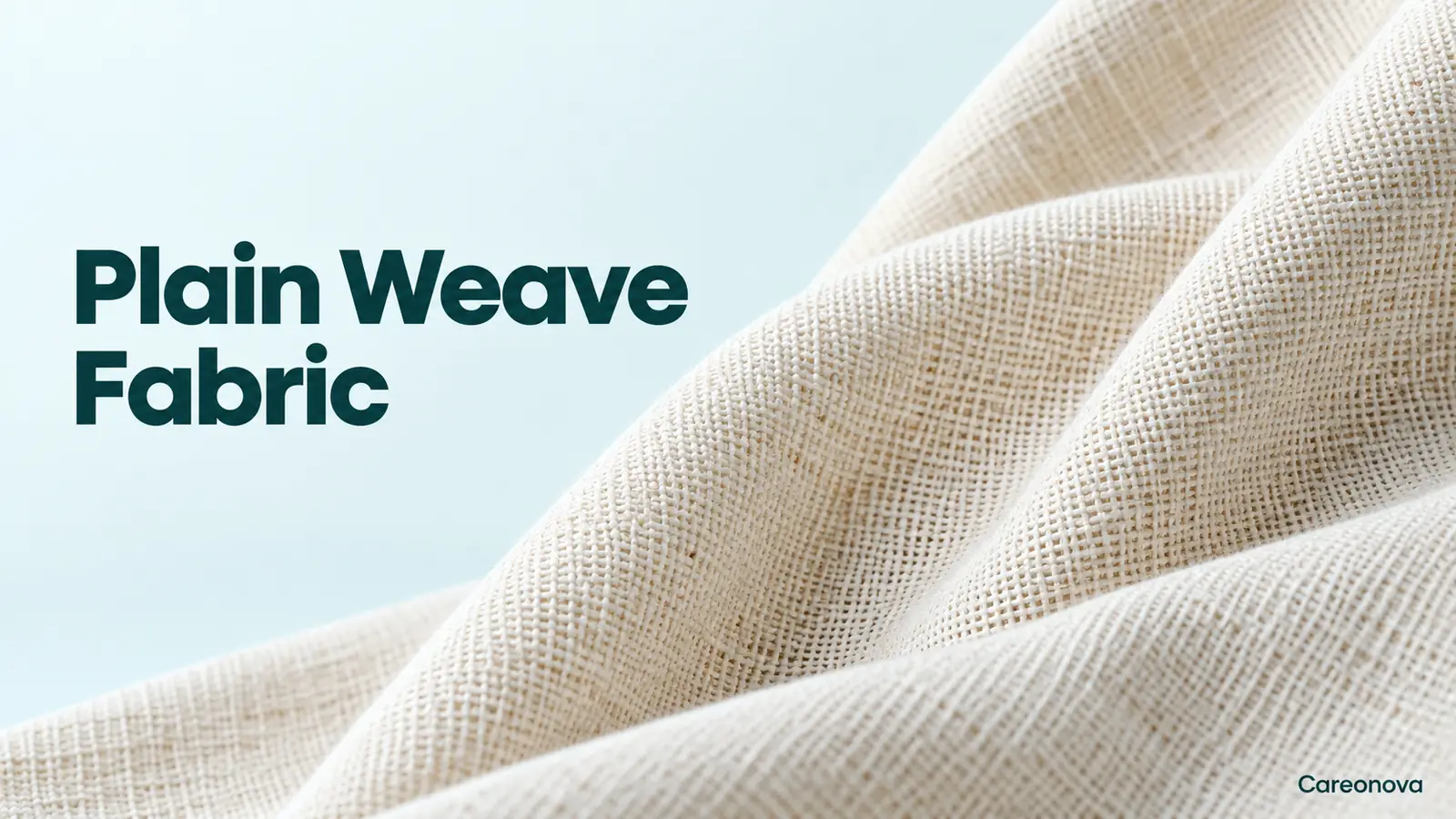
Plain weave fabric is the most common and basic way to make cloth in the world. It is simply a method of weaving threads together. Horizontal threads pass over and under vertical threads to make a basic checkerboard pattern. A plain weave does not mean a specific fiber like cotton or silk. It just describes how the threads cross each other.
Because the threads cross at every single point, plain weaves are very strong, hold their shape well, and look exactly the same on the front and the back. From the crisp percale sheets on your bed to heavy cotton work pants and breezy linen summer shirts, plain weaves are the starting point for most of our clothes and home goods.
What Is Plain Weave? (Definition & Mechanics)
In weaving, two distinct sets of yarns meet at right angles on a loom: the lengthwise warp threads, held under continuous tension, and the crosswise weft threads (also called filling yarns), which travel horizontally through the warp. In a plain weave, this crossing follows an unvarying formula: over one, under one, across the entire width of the loom.
On the next pass, the loom reverses the shed: threads that went over on the previous row are pushed under, and threads that were under are lifted over.
Plain Weave (1/1 Interlacement)
    Warp (Vertical)
    ↓   ↓   ↓   ↓
 ───█───────█─────── ◄ Weft (Over 1, Under 1)
 ───────█───────█─── ◄ Weft (Alternating shed)
 ───█───────█─────── ◄ Weft (Row repeats)
 ───────█───────█─── ◄ Weft
The 1/1 Over-Under Pattern
In textile terms, this over-one-under-one method is called a 1/1 interlacement. This tight pattern means the threads cross each other more often than in any other weave. Because every thread is locked in on all four sides, there are no long, loose threads floating on the surface.
This tight physical grid creates high friction. The threads grab onto each other, which keeps the fabric from slipping out of shape.
Tabby Weave: Just Another Name
If you read older sewing books or cross-stitch guides, you will often see plain weave called a tabby weave or taffeta weave. These mean the exact same thing.
The word “tabby” comes from al-‘Attābīya, an ancient part of Baghdad famous for making striped silk cloth. Over time, European weavers started using the word to describe any basic over-under weave. Whether it is called a plain weave, a tabby weave, or a flat weave, it is built the exact same way.
Core Characteristics of Plain Weave Fabric
Because plain weave is built like a tight grid, it has specific strengths and a few weaknesses you should know about.
Identical Faces (It Is Reversible)
Because the threads cross perfectly evenly, an unfinished plain weave looks exactly the same on the front and the back. There is no natural “right side” or “wrong side.”
Here is the catch: once the fabric is turned into a finished product, that might change. If a factory prints a pattern on the top, or adds a waterproof coating to one side, it will have a front and a back. But if the fabric is woven with yarn that is already dyed (like a checked gingham shirt), both sides stay identical.
High Strength & Durability
Every time threads cross, they lock together. Because a plain weave has so many crossing points, it holds its shape extremely well.
Threads cannot slide around easily when you pull on them. This lock makes plain weaves very tough. They do not snag easily on jewelry or pet claws. It also means these garments hold up well to the heavy tumbling in household washing machines without losing their shape.
Stiffness & Wrinkles
The tight grid that makes plain weave strong also makes it stiff. The threads are packed so closely that they cannot slide out of the way when the fabric bends.
As a result, plain weaves do not flow or drape around the body like silk satin does. Instead, they fold in crisp lines. Because of this stiff grid, plain weaves made of natural cellulose fibers like cotton or flax will wrinkle very easily when you wear them.
Balanced vs. Unbalanced Plain Weaves
Not all plain weaves look perfectly square. By changing the thickness or the number of threads, factories make three different types of plain weave.
  Balanced Plain Weave           Ribbed Weave (Unbalanced)           Basket Weave (2x2)
   (Equal Yarn Size)              (Thick Weft Inserions)         (Paired Parallel Yarns)
       █   █   █                       ═════════════                   ██  ██  ██
       ─────────                       ═════════════                   ██  ██  ██
       █   █   █                       ═════════════                   ──────────
Balanced Plain Weaves
A plain weave is considered balanced when the warp and weft yarns are identical (or nearly identical) in diameter, and the thread count is roughly equal in both directions. In textile engineering terms, the Ends Per Inch (EPI) match the Picks Per Inch (PPI).
Balanced plain weaves display a perfectly square checkerboard grid under a magnifying glass. They stretch and behave with complete symmetry along both the lengthwise and crosswise grains. Everyday muslin, lightweight batiste, and crisp percale cotton bedsheets are classic examples of balanced construction.
Rib Weaves (Unbalanced Plain Weave)
An unbalanced plain weave happens when one set of threads is much thicker than the other. Usually, the factory weaves a thick crosswise thread over very fine, tightly packed vertical threads.
This creates raised lines or ridges across the fabric, known as a rib weave. It is still a simple over-under pattern, but the thick threads make cords you can feel.
Basket Weaves
A basket weave groups two or more threads together and weaves them as if they were a single thread. Instead of going over one and under one, two threads might go over two and under two (a 2×2 basket weave).
Because the threads do not cross as often, basket weaves feel softer and looser. They breathe better and have a very clear, chunky checkerboard look.
Master Directory: 45 Types of Plain Weave Fabric
Plain weave is just a method, so it can be used on almost any material. It covers nearly all types of fabric from very thin silks to rough, heavy bags.
A common mistake is confusing the weave with how the fabric looks at the end. For example, some blogs say velvet or denim are plain weaves. That is false. Denim is a diagonal twill weave, and velvet is a complex pile weave.
Here is a list of real plain weaves, broken down by weight, to help you spot them in the wild:
Lightweight & Sheer Fabrics
These use very thin threads. They are light, breathable, and you can often see right through them.
- Chiffon: A sheer, light fabric with a slightly rough feel.
- Organza: A crisp, sheer fabric that holds its shape well (used for bridal dresses).
- Voile: A soft, slightly sheer fabric great for summer tops and curtains.
- Batiste: A very light, soft fabric that is not see-through.
- Lawn: A crisp, fine cotton used for handkerchiefs.
- Organdy: The stiffest fine cotton, treated so it stays crisp forever.
- Georgette: Like chiffon but slightly heavier and springy.
- Cheesecloth: A very loose, open cotton used for cooking or crafts.
- Gauze: A loose, open weave often used for bandages or beach clothes.
- Habotai (China Silk): A very soft, smooth plain weave silk used for lining jackets.
- Mull: A soft, fine cotton or silk historically used for bookbinding.
- Ninon: A very sheer fabric (often synthetic polyester) used for curtains.
- Dimity: A sheer fabric with a faint striped texture.
- Bunting: A light, loose fabric used mostly for flags.
- Tissue Gingham: A very thin, see-through version of checked gingham.
Medium-Weight Apparel & Home Fabrics
These are the everyday fabrics we use the most. They are sturdy, you cannot see through them, and they are easy to wear.
- Chambray: Looks like denim but is much lighter and softer. It uses a blue vertical thread and a white horizontal thread.
- Poplin: A crisp, strong fabric with tiny ridges. Great for dress shirts.
- Muslin: Cheap, unbleached cotton used by designers to test sewing patterns.
- Gingham: A checked fabric made by weaving colored and white threads together.
- Percale: A tight, smooth cotton used for high-quality bed sheets.
- Broadcloth: A sturdy fabric very similar to poplin but slightly thicker.
- Calico: A rougher, heavy cotton often printed with bright flowers.
- Flannel: Plain-weave flannel is heavily brushed to make it soft and warm.
- Taffeta: A crisp, shiny fabric with small ridges, popular for formal dresses.
- Madras: A light, colorful plaid fabric.
- End-on-End: Uses alternating light and dark threads so it looks speckled from a distance.
- Seersucker: Woven with uneven tension to create permanent, puckered stripes.
- Crash: A rough, bumpy fabric often made from linen.
- Challis: A soft, flowing fabric often printed with flowers.
- Homespun: Woven loosely with bumpy threads to look handmade.
Heavyweight & Utility Fabrics
These are built to be tough. They handle heavy wear, wind, and heavy objects.
- Canvas: Very heavy and thick. Used for tote bags and painting canvases.
- Duck Cloth: A super-tough, packed canvas used for heavy work coats and tents.
- Burlap (Hessian): A rough, scratchy fabric made from jute. Used for potato sacks.
- Sailcloth: Extremely tight canvas made to block wind on boats.
- Buckram: Stiffened with glue or starch, used inside hats and book covers.
- Ticking: A heavy, tight fabric used to stop feathers from poking out of pillows.
- Hopsack: A coarse basket weave used for jackets and couches.
- Monk’s Cloth: A heavy basket weave used for thick curtains.
- Osnaburg: A rough, cheap cotton historically used for grain bags.
- Barkcloth: A thick fabric with bumpy threads that looks a bit like tree bark.
- Donegal Tweed: A heavy wool with colorful flecks of yarn woven into it.
- Gunny Cloth: Very coarse, much like burlap, used in farming.
- Tarpaulin Base: Heavy canvas that gets coated in rubber to make tarps.
- Drop Cloth: Heavy cotton meant to soak up paint spills on floors.
- Ironing Board Cover Cloth: Thick plain weave treated to survive high heat
Structural Comparison: Plain Weave vs. Twill vs. Satin Weave
All woven fabrics fall into three foundational weave architectures. Every other weave (including jacquards and dobby weaves) is an elaboration or combination of plain, twill, or satin.
| Performance Criteria | Plain Weave | Twill Weave | Satin Weave |
|---|---|---|---|
| Interlacement Pattern | 1/1 alternation (over one, under one) | Diagonal float structure (e.g., 2/1 or 2/2 steps) | Long filament floats (over 4 to 7 crossing yarns) |
| Visual Texture | Flat, balanced checkerboard grid or subtle rib | Distinct diagonal ridges (wales) running across face | Smooth, unbroken, highly lustrous, glassy surface |
| Fabric Faces | Identical (fully reversible before printing/finishing) | Distinct front and back (diagonal wales run opposite) | Dramatic difference (lustrous face, dull back) |
| Drape & Fluidity | Crisp, structured hand; low fluid drape | Supple, pliable, heavy diagonal drape | Exceptionally fluid; skims and clings to curves |
| Snag & Abrasion Resistance | Very high; threads locked by frequent crossings | High; tight packing protects internal floats | Low; long surface floats catch easily on objects |
| Wrinkle Resistance | Low to moderate; holds creases stubbornly | High; diagonal architecture naturally resists creasing | High; long floats absorb bending without creasing |
| Air Permeability | High to moderate (depends entirely on thread count) | Moderate to low (intersections are packed tighter) | Very low (filament yarns beaten into dense barrier) |
| Common Examples | Poplin, Percale, Canvas, Chiffon | Denim, Chino, Gabardine, Tweed | Charmeuse, Duchess Satin, Sateen |
The Sewist’s Workshop: Working With Plain Weav
If you are learning to sew, plain weave fabrics are the most forgiving materials you can put under a presser foot. But while they lack the tricky stretch of knits or the shifty fluidness of bias-cut satins, they still demand proper handling to achieve clean, professional results.
Grainline Stability vs. Bias Stretch
Because plain weave yarns intersect at rigid 90-degree angles, the fabric possesses zero mechanical stretch along the straight grain (lengthwise warp) or crossgrain (horizontal weft). You can pull firmly along the edges of a cotton broadcloth, and it will not yield.
However, rotate that fabric 45 degrees, and you encounter the true bias. Along the bias diagonal, the square grid collapses into diamond shapes under tension, providing surprising elasticity and drape.
When cutting plain-weave patterns, always align pattern pieces precisely with the fabric grainline using a ruler and cutting mat. If an unanchored seam (such as a curved armhole or neckline) is cut slightly off-grain, it will stretch out of shape during handling unless stabilized immediately with staystitching.
       Straight Grain (Warp/Weft)                    True Bias (45° Diagonal)
       [Rigid, Zero Elasticity]                    [Grid Deforms, Stretches Easily]
             █   █   █   █                                ╱   ╲   ╱   ╲
             ─────────────                                ╲   ╱   ╲   ╱
             █   █   █   █                                ╱   ╲   ╱   ╲
             ─────────────                                ╲   ╱   ╲   ╱
Machine Calibration: Needles, Tension & Stitch Length
- Needle Selection: For lightweight plain weaves (voile, chiffon, organza), use a sharp Microtex needle (size 60/8 to 70/10) to pierce directly through the fine yarns without deflecting threads. For medium-weight plain weaves (poplin, chambray, quilting cotton), a standard Universal needle (size 80/12) performs reliably. For heavy cotton duck or canvas, switch to a sturdy Jeans/Denim needle (size 90/14 to 100/16) with a reinforced blade to prevent needle deflection.
- Stitch Length: A standard 2.5 mm stitch length works well for most apparel plain weaves. If you are stitching fine, lightweight plain weaves like batiste, reduce stitch length to 1.8–2.0 mm to prevent seam puckering. On heavy canvas, lengthen your stitch to 3.0–3.5 mm so the needle penetrations do not perforate and weaken the fabric edge.
- Presser Foot Pressure: Plain weaves feed consistently under standard feed dogs without specialized walking feet. Maintain neutral presser foot pressure; excess downward pressure can cause the upper layer of fabric to creep forward as the feed dogs pull the lower layer.
Preventing Edge Fraying
Because plain weave threads travel in straight, uninterrupted paths across the fabric, cut raw edges will unravel rapidly under mechanical friction or washing.
Never leave raw interior seams unfinished in a plain-weave garment. For medium-to-heavy cottons, finish cut edges with a serger (overlocker), a 3-step zigzag stitch, or pinking shears. For sheer, lightweight plain weaves like chiffon or voile, construct French seams to encase the raw edges entirely inside a sleek, clean fold.
Laundering, Stain Removal, and Wrinkle Care
Taking care of plain-weave textiles requires understanding how soil settles into the 1/1 grid and how heat and moisture alter natural fibers. While checking laundry care symbols is always your first step, the mechanical structure of the fabric dictates how you should treat stains and wrinkles.
Releasing Trapped Particulate Stains
The tight, intersecting grid of a balanced plain weave acts like a microscopic net. While liquid stains (like wine or coffee) absorb directly into the core of the fiber, particulate stains—such as dried mud, clay, foundation makeup, soot, and mineral powders—become physically trapped in the microscopic crevices between the crossing warp and weft yarns.
Here’s why that matters: simply throwing a mud-stained plain-weave cotton shirt into the washing machine can permanently drive those mineral particles deeper into the weave matrix
Cross-Section: How Particulate Stains Lock into a Plain Weave Grid

     [Warp Thread]        [Warp Thread]
          ██                   ██
    ══════██═══════════════════██══════  ◄ Weft Thread
          ██   ▲           ▲   ██
               │  [Dirt]   │
               └─ Particles ── Physical "Trap" Zone
What I’d check first before applying water or liquid detergents to a dry particulate stain is whether the soil can be dislodged mechanically. Follow this exact sequence to lift the stain out of the grid:
- Let Mud Dry Completely: Never rub wet mud on plain-woven cotton or canvas. Rubbing forces wet soil slurry deep into the yarn interlacings. Wait until the mud is bone dry.
- Dry Mechanical Brushing: Use a soft, horsehair laundry brush or a clean, dry toothbrush to flick the dried dirt particles off the surface. You will often remove 70% of the soil before the garment ever touches water.
- Surfactant Pre-Treatment: Once loose particles are brushed away, apply a concentrated heavy-duty liquid laundry detergent containing enzymes (specifically proteases and amylases) directly to the spot. Work the detergent into the grid using gentle, circular motions with your thumb. The surfactants wrap around the microscopic particles, lifting them away from the thread crossings so the rinse cycle can flush them out completely.
The Physics of Wrinkle Removal: Heat, Steam & Hydrogen Bonds
Because plain weave fabrics feature continuous yarn friction, they are the most wrinkle-prone category of woven textiles—especially when made of 100% cotton, linen, or hemp.
Natural plant fibers are built from cellulose chains held together by weak chemical links called hydrogen bonds. When a plain-weave cotton shirt is worn, the warmth of your body and the mechanical bending of your arms break these hydrogen bonds. As the fabric bunches, the stiff 1/1 grid locks into place, and the hydrogen bonds reform in that crumpled state, creating a stubborn wrinkle.
To eliminate wrinkles in plain weave fabrics, you must break those bonds deliberately and force the grid flat again:
- Steam Is Non-Negotiable: Dry heat from a standard iron is rarely enough to flatten a heavy plain-weave linen or cotton shirt. Water molecules—delivered via fine mist or hot water or steam—penetrate the cellulose chains, temporarily dissolving the rigid hydrogen bonds and making the yarns pliable.
- The Damp Ironing Method: The single most effective way to press plain-weave cotton percale sheets or linen shirts is to pull them from the clothesline or tumble dryer while they are still slightly damp to the touch (around 10–15% moisture retention).”. Press immediately using a hot iron. The residual moisture turns instantly to steam under the iron’s soleplate, flattening the yarn crossings with minimal effort.
- Allow Fibers to Cool Flat: Once you iron a section of plain-weave cloth, let it rest flat on the ironing board for 15 to 30 seconds before moving it. As the fabric cools and the moisture evaporates, the hydrogen bonds permanently reform in a crisp, completely flat alignment. Hanging a warm, freshly pressed plain-weave garment in an overcrowded closet before it cools will instantly cause new wrinkles to form.
