

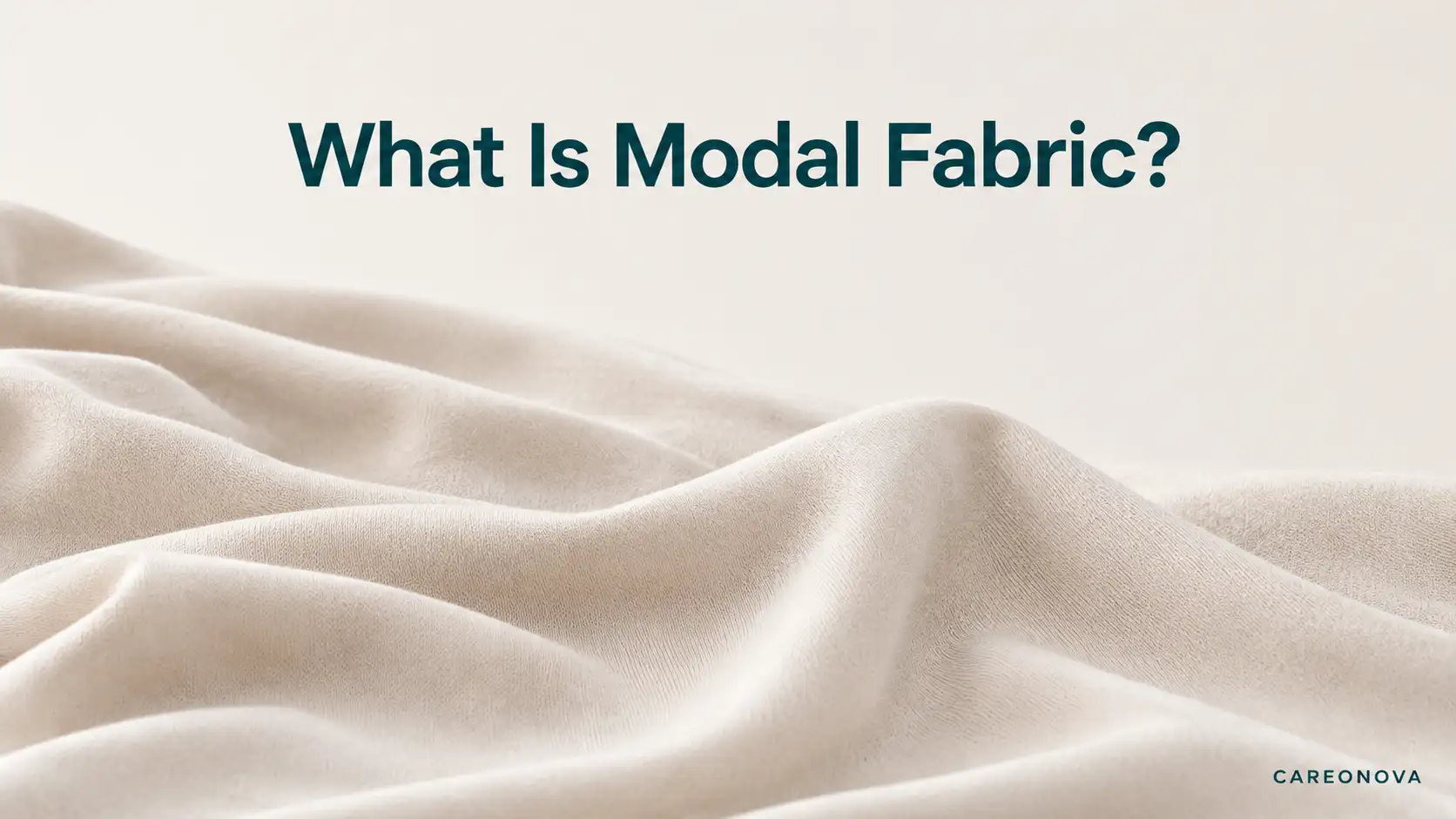
Modal fabric is a soft, plant-based textile made by processing cellulose, usually from wood pulp, into a regenerated fiber that manufacturers spin into yarn and knit or weave into fabric. It sits between natural and synthetic, since the raw material comes from plants but needs heavy chemical processing to become wearable material, which is why textile experts classify it as a regenerated cellulosic fiber rather than either category alone. Most people notice modal in underwear, sleepwear, T-shirts, and bedding, where its smooth feel, fluid drape, and moisture-handling ability make it a common choice for clothing worn close to the skin.
This guide explains what modal is made of, how manufacturers turn wood pulp into finished fabric, and how it compares to closely related fibers like rayon, viscose, and lyocell. It also covers how modal actually performs, including its stretch, shrinkage, pilling, and durability, since these depend heavily on fabric construction and blending rather than the fiber name alone. You’ll also find guidance on common modal blends, sustainability considerations, and how to wash and care for modal fabric so it keeps its softness and shape over time.
Modal Fabric at a Glance
| Property | Modal Fabric |
|---|---|
| Fiber family | Regenerated cellulosic |
| Main raw material | Plant cellulose, usually wood pulp |
| Feel | Soft, smooth, and fluid |
| Drape | Good |
| Breathability | Can be breathable; construction matters |
| Moisture handling | Absorbs and releases moisture |
| Stretch | Depends on construction and blends |
| Shrinkage | Possible; heat and construction matter |
| Pilling | Depends on yarn, quality, construction, and friction |
| Common uses | Underwear, sleepwear, T-shirts, dresses, bedding |
| Common blends | Cotton, elastane/spandex, polyester |
| Basic care | Follow the garment label; gentle care is usually safer |
| Fiber type | Manufacturers create it from plant-derived cellulose |
What Is Modal Fabric?
Textile experts classify modal as a regenerated cellulosic fiber. In simple terms, manufacturers take cellulose from plant material, process it, and form it again into textile fiber.
It belongs to the wider group of man-made cellulosic fibers, which also includes viscose and lyocell.Modal shares a close relationship with rayon or viscose, berut manufacturers use modified processing and spinning conditions to give the fiber its own properties.
Modal also has a historical connection with the term high-wet-modulus (HWM) rayon. “Wet modulus” sounds technical, but the idea is simple: modal keeps better strength and shape when wet than traditional viscose. This improved wet performance helped modal develop into a distinct regenerated cellulose fiber.
It is also important to understand the difference between fiber and fabric.
Modal refers to the fiber itself. Manufacturers spin the fibers into yarn and then knit or weave that yarn into fabric.
This explains why two garments with modal on the label may behave very differently. A lightweight jersey used for underwear may feel soft and flexible, while a woven dress fabric containing the same fiber may have much less stretch.
In the United States, clothing brands can also use Modal as an accepted fiber name on textile-content labels.
Japanese researchers developed high-wet-modulus modal fibers in the early 1950s, and commercial production expanded during the following decades.
Today, fiber source, fabric construction, blend, quality, and care instructions matter much more to buyers than the material’s history.
What Is Modal Fabric Made Of?
Modal starts with cellulose, the main structural material found in plants.
For commercial textile production, manufacturers usually obtain this cellulose from wood pulp.
The basic path is:
Wood or another cellulose source → pulp → purified cellulose → regenerated fiber → yarn → fabric
Many people associate beechwood with modal production, especially because some major branded fibers use it. However, not every modal fabric comes from beechwood. The exact wood source depends on the producer and supply chain.
Although the raw material comes from plants, manufacturers cannot turn wood pulp directly into clothing fiber.
They first separate, dissolve, and process the cellulose. They then form it again into fine fibers that textile mills can spin into yarn.
This process explains why modal does not fit neatly into the simple categories of “natural” or “synthetic.”
How Is Modal Fabric Made?
Manufacturers make modal by turning plant cellulose into usable textile fiber.
The process can be simplified into these steps:
- Manufacturers process wood or another cellulose source into pulp.
- They separate and prepare the cellulose.
- They dissolve the cellulose through a chemical process.
- They push the prepared material through very small openings to create fine strands.
- The process regenerates the cellulose into solid fibers.
- Manufacturers wash and finish the fibers.
- They spin the fibers into yarn, which textile mills can knit or weave into fabric.

The term regenerated simply means that manufacturers dissolve the original cellulose and then form it again as textile fiber.
Not every producer follows identical practices. Companies may differ in how they source wood, manage chemicals, use water and energy, and control waste.
These differences become especially important when you judge the environmental impact of a textile.
Is Modal Natural or Synthetic?
Textile experts classify modal as a regenerated cellulosic fiber rather than simply natural or synthetic.
Its starting material, cellulose, comes from plants. However, that cellulose does not naturally exist in the form used for modal clothing. Manufacturers must dissolve and reform it through an industrial process.
Consumer guides also often use the term semi-synthetic. This phrase offers a simple way to explain that the fiber starts with a natural raw material but requires significant processing.
Still, “regenerated cellulosic” gives a more precise description.
The differences become clearer when you compare modal with cotton and polyester.
Cotton grows naturally as usable textile fiber.
Modal starts with plant cellulose that manufacturers dissolve and regenerate into fiber.
Polyester comes from synthetic polymers with a very different raw-material base.
So, a garment labeled modal is not the same as cotton, polyester, or an untreated natural fiber.
What Does Modal Fabric Feel Like?
Modal fabric usually feels soft, smooth, and fluid.
It often drapes easily instead of feeling stiff or crisp. This makes it useful for clothing designed to move comfortably with the body.
Still, not every fabric containing this fiber will feel the same.
A lightweight jersey may feel soft, thin, and flexible. A heavier knit may feel smooth but more substantial. A cotton-modal blend can have a different hand feel from 100% modal, while added elastane can make the material much stretchier.
Finishing methods can also change the final texture.
In short, fiber influences feel, but construction, weight, finishing, and blending matter too.
How Does Modal Fabric Perform?
Clothing makers often choose modal because it combines softness with useful everyday properties. However, fabric construction and garment design strongly influence the final performance.
Comfort, Breathability, and Moisture
Because modal comes from cellulose, it can absorb and release moisture.
This quality helps explain why brands often use the material in underwear, sleepwear, and other clothing worn close to the skin.
It can also feel breathable, but the way manufacturers build the fabric makes a major difference.
A thin, open knit usually allows more air and heat movement than a thick, tightly constructed textile, even when both contain the same fiber.
It is also useful to separate three terms that people often confuse:
Absorbency describes how well a material takes in moisture.
Moisture transport describes how moisture moves through or across a textile.
Quick drying describes how quickly that moisture leaves the material.
These properties are related, but they are not identical. A fabric can absorb moisture well without drying especially fast.
Stretch, Shrinkage, and Shape
Modal does not behave like a naturally elastic fiber such as spandex or elastane.
A garment can still stretch because of its construction. Knitted fabrics usually have more natural give than many woven fabrics.
When manufacturers add elastane, the garment can stretch more and return to its original shape more effectively.
Heat, washing method, finishing, fabric construction, and the other fibers in a blend can all affect final size and shape.
For example, a modal-cotton garment may react differently to washing and drying than a modal-elastane garment.
This is why claims such as “modal never shrinks” are too broad.
The finished garment and its care instructions provide more useful guidance.
Wrinkles, Pilling, and Durability
Modal can wrinkle and pill, although the amount varies between fabrics.
Pilling happens when small fibers loosen and tangle together on the surface. Friction plays a major role, but yarn quality, construction, finishing, and washing habits also affect the result.
A high-quality fabric may resist surface wear better than a loose or poorly made knit.
The same principle applies to durability.
A heavier, well-constructed fabric may handle frequent wear better than a thin or loosely made one. Gentle care can also help preserve softness, shape, and surface quality.
For this reason, it makes more sense to judge the finished textile than to assume every modal product offers the same durability.
Advantages and Disadvantages of Modal Fabric
Modal offers several useful qualities, but it also has limitations.
| Advantages | Disadvantages |
|---|---|
| Soft and smooth against the skin | Quality varies between fabrics and manufacturers |
| Fluid drape | Price varies by quality, blend, and construction |
| Can feel comfortable in breathable fabrics | May shrink or lose shape under unsuitable care |
| Handles moisture well | Some fabrics can pill |
| Useful for close-to-skin clothing | Manufacturing requires chemical processing |
| Blends easily with other fibers | Sustainability depends on sourcing and production |
| Works well in lightweight garments | Stretch depends on construction or added elastic fiber |
Its biggest strength is comfort.
Its main limitation is that the fiber name tells only part of the story. Two garments made with modal can have very different quality, durability, stretch, and care needs.
What Is Modal Fabric Used For?
Clothing and textile brands often use modal where softness, movement, and comfort matter.
Underwear and base layers: Its smooth feel makes it popular for briefs, undershirts, and other garments worn directly against the skin. Manufacturers often add elastane when they need extra stretch.
Sleepwear and loungewear: Pajamas, robes, and relaxed clothing can benefit from the material’s softness and fluid drape.
T-shirts, tops, and dresses: The fiber works well in fabrics designed to feel soft and move easily rather than remain stiff.
Bedding and home textiles: Manufacturers also use it in sheets and other soft home-textile products.
A modal bedsheet and a modal T-shirt can still behave very differently because their fabric structures, weights, and finishes differ.
Modal Blends and Related Terms
Manufacturers often blend modal with other fibers instead of using it alone.
| Blend | What It Can Change |
|---|---|
| Modal + cotton | Combines modal softness with cotton characteristics |
| Modal + elastane/spandex | Adds more stretch and recovery |
| Modal + polyester | Can change drying, durability, and wrinkle behavior |

The exact result depends on the blend percentage.
For example, a garment containing only a small amount of modal should not behave exactly like one made almost entirely from the fiber.
This is why the full fiber-content label provides more useful information than one material name.
MicroModal
Brands commonly use the term MicroModal for very fine modal fibers or fabrics designed to create an especially soft and lightweight feel.
It does not represent a completely separate basic fiber family.
Finer fibers can help manufacturers create fabrics with a smooth, soft hand, but yarn quality, construction, and finishing still shape the final result.
TENCEL™ Modal
Lenzing produces TENCEL™ Modal as its branded modal fiber.
The distinction is simple:
modal = generic fiber type
TENCEL™ Modal = branded modal fiber
This difference matters because a manufacturer may publish specific information about its own sourcing, production methods, moisture performance, and environmental impact.
Consumers should keep those claims connected to the branded product rather than applying them automatically to every generic modal fabric.
Modal vs Similar Fabrics
Modal shares some features with other clothing fibers, but the materials are not interchangeable.
| Fiber | Relationship to Modal | Main Difference |
|---|---|---|
| Rayon/Viscose | Closely related regenerated cellulosic fiber family | Modal is a modified viscose-type fiber with better wet strength and dimensional stability |
| Lyocell | Also comes from regenerated plant cellulose | Manufacturers use a different production process |
| Cotton | Both are cellulose-based | Cotton grows naturally as textile fiber; manufacturers regenerate modal |
| Polyester | Both are common clothing fibers | Polyester is synthetic and behaves differently with moisture and heat |
The difference between modal and traditional viscose is especially useful to understand.
Both start with cellulose and belong to the same wider regenerated-fiber family. However, manufacturers produce modal under modified conditions that improve wet strength and help the fiber resist changes in size and shape when wet.

There is still no single “best” fiber for every use.
Cotton may suit someone looking for a naturally grown textile fiber.
Polyester can work well when fast drying or synthetic durability matters.
Lyocell offers another regenerated-cellulose option that uses a different production route.
Modal works especially well when softness, smoothness, and fluid drape are priorities.
Is Modal Fabric Sustainable?
The word modal alone cannot prove that a garment is sustainable. Manufacturers can produce the fiber using more or less responsible environmental practices.
Several factors matter.
Wood Sourcing
Because manufacturers usually start with wood pulp, the source of that wood matters.
Responsible forestry can reduce risks linked with poor land management, habitat loss, and forest degradation.
The environmental impact therefore depends partly on where manufacturers obtain the raw material and how suppliers manage those forests.
Manufacturing
Manufacturers use chemical processing to turn cellulose into textile fiber.
The environmental impact depends partly on how producers manage:
- chemicals;
- water;
- energy;
- emissions;
- waste;
- worker exposure.
Some producers recover more processing chemicals and reduce waste through more efficient systems. Others may use less efficient methods.
For this reason, consumers should not apply environmental claims from one manufacturer to the entire modal category.
Is Modal Biodegradable?
Independent certification bodies classify some modal fibers as biodegradable or compostable under defined conditions, but consumers should not treat this as a guarantee for every modal garment.
A finished textile can include cotton, polyester, elastane, dyes, finishes, coatings, sewing threads, labels, and trims. These materials can change how the complete product behaves at the end of its life.
A biodegradability claim for a specific fiber therefore does not automatically mean every garment containing that fiber will quickly or completely break down.
Chemical Processing and Skin Safety
Manufacturers use chemicals during modal production, but that fact does not automatically make the finished garment unsafe to wear.
Manufacturing chemistry and finished-product exposure are different issues.
A completed garment can also include dyes, finishing treatments, elastic fibers, prints, and other materials that influence the final product.
The same principle applies to sensitive skin.
A soft fabric may feel comfortable for many people, but the fiber name does not guarantee that every garment will suit every person’s skin.
When chemical exposure matters, independent textile certifications can provide extra information about testing for restricted or potentially harmful substances.
How to Wash and Care for Modal Fabric
The most important rule for modal clothing is simple:
Check the garment care label first.
Manufacturers create care instructions for the finished garment, not just one fiber within it.
| Care Step | Safer General Approach | Why It Matters |
|---|---|---|
| Washing | Cool water and gentle action when allowed | Helps reduce unnecessary stress |
| Detergent | Use the correct amount of mild detergent | Excess residue can affect feel |
| Drying | Air dry or use lower heat when permitted | Reduces unnecessary heat exposure |
| Ironing | Follow the label; use moderate heat if allowed | Helps prevent heat damage |
| Stain treatment | Treat gently and test first | Helps protect color and surface |
Washing
Cool or cold water gives you a sensible general starting point when the care label allows it.
A gentle cycle can reduce friction on lightweight knits and other soft fabrics.
However, do not assume the same rule applies to every product. A blended garment may require different care because it also contains cotton, polyester, elastane, or other materials.
Detergent
Use the correct amount of detergent for the load and your water conditions.
More detergent does not automatically produce cleaner clothes. Too much product can become harder to rinse away and may leave fabric feeling coated or stiff.
Stain Treatment
Treat stains as early as practical, but avoid aggressive scrubbing on soft or lightweight fabrics.
Strong rubbing can increase surface wear.
The best stain treatment also depends on the garment’s color, finish, and complete fiber blend.
Drying
When the care label allows machine drying, lower heat usually gives you the safer option.
Excessive heat can increase the risk of shrinking, distortion, or damage to heat-sensitive fibers in a blend.
Air drying reduces heat exposure, but you should still shape and dry the item according to its care instructions.
Ironing
Check the care label before ironing.
If the label allows ironing, use only as much heat as needed and avoid leaving the iron in one place for too long.
Care for the Garment, Not Only the Fiber
A label that reads:
47% modal / 47% cotton / 6% elastane
describes three different fibers.
The cotton affects how the garment handles moisture and heat. The elastane affects stretch and heat sensitivity. Construction, dyes, finishing, and garment design also matter.
This is why broad advice such as “modal can always be washed hot” or “modal never shrinks” provides less value than the instructions written for the finished garment.
Is Modal a Good Fabric?
Modal can be a good choice when softness, smooth drape, comfort, and moisture handling matter.
It works especially well in underwear, sleepwear, T-shirts, loungewear, and other garments designed to feel comfortable against the body.
Still, the word modal does not guarantee quality.
A better buying decision considers the fiber percentages, fabric construction, garment quality, manufacturer information, and care instructions.
Those details tell you much more about how a garment is likely to feel, perform, and last than the fiber name alone.
