

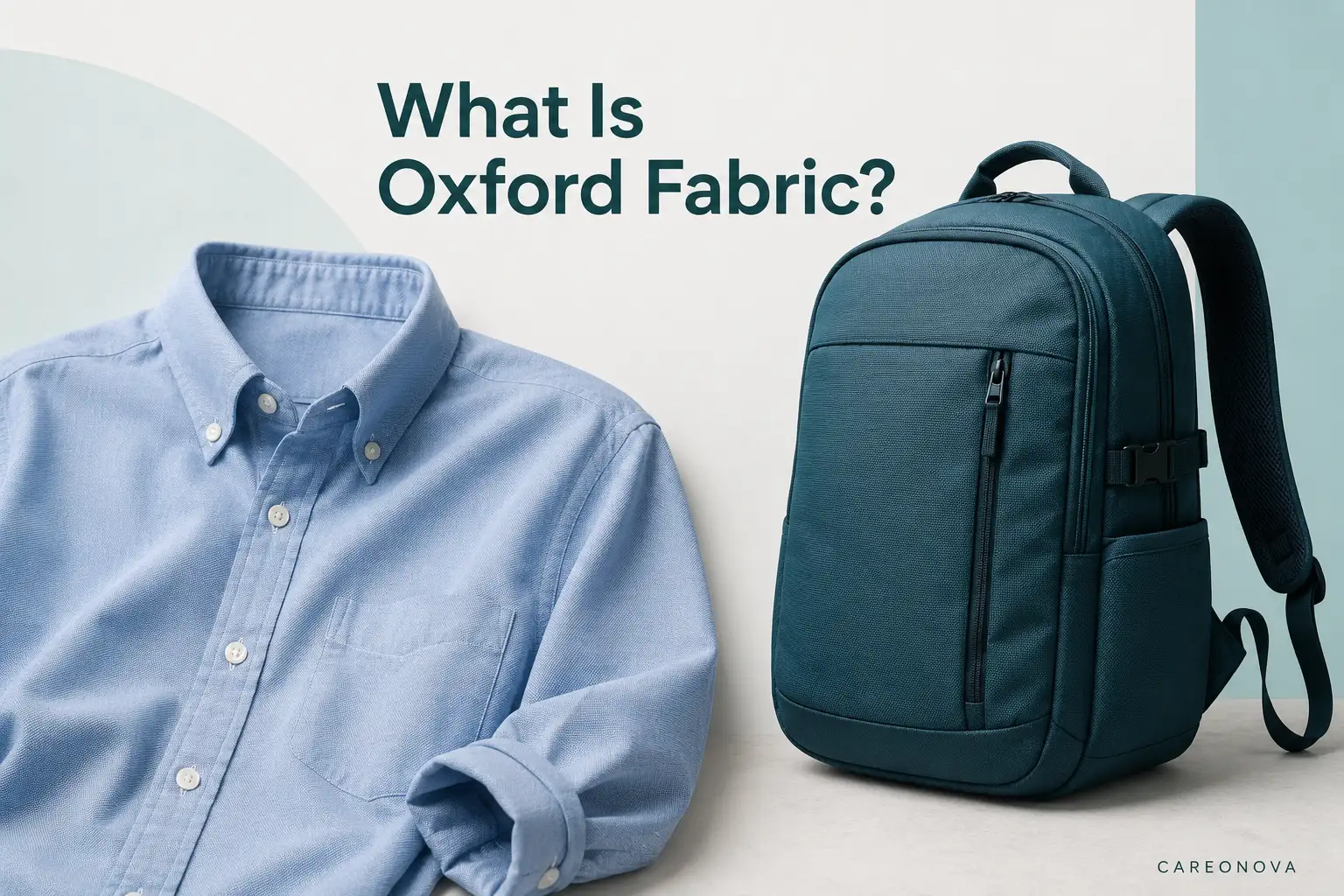
Oxford fabric is a woven textile with a distinctive basket-style construction. The name mainly describes how the yarns are arranged rather than one specific fiber, so manufacturers can make the fabric from cotton, polyester, nylon, or blends. This is why a soft shirt and a rugged backpack can share the Oxford name while looking, feeling, and performing very differently.
In everyday use, Oxford cloth, Oxford fabric, and sometimes Oxford cloth fabric refer to the same general fabric family. However, performance varies widely. Fiber type, construction, weight, denier, coatings, and finishing all influence how a particular version behaves.
What Is Oxford Fabric?
Oxford fabric is a woven textile that people traditionally associate with shirts, although manufacturers now use it for clothing, backpacks, luggage, covers, storage products, and outdoor equipment.
Classic Oxford cloth has a slightly textured appearance created by its distinctive weave. Manufacturers commonly make traditional versions from cotton, while many modern technical versions use polyester or nylon.
That difference matters. A cotton shirt prioritizes comfort and everyday clothing performance. By contrast, a synthetic backpack fabric may use heavier yarns, coatings, and a more technical construction to handle repeated wear.
| Question | Quick answer |
|---|---|
| What is Oxford fabric? | A woven fabric defined mainly by its basket-style construction, not one specific fiber. |
| What is it made from? | Common versions use cotton, polyester, nylon, or fiber blends. |
| How does it feel? | Cotton versions are softer and more textured; coated synthetics tend to feel firmer. |
| Is it waterproof? | Not by default. Water resistance depends on construction, treatments, and coatings. |
| Is it breathable? | Cotton versions usually breathe better than dense or coated synthetic versions. |
| What does 600D mean? | 600D describes yarn denier, not a guaranteed strength or waterproof rating. |
| Where is it used? | Shirts, backpacks, luggage, covers, tents, and other utility products. |
Is Oxford a Material or a Weave?
Oxford is best understood as a fabric construction rather than one specific raw material.
Think of it this way: cotton, polyester, and nylon tell you which fibers a fabric contains. Oxford tells you how the yarns are arranged to create the textile.
A fiber is the basic textile material. Fibers or continuous filaments form yarns, and manufacturers weave those yarns together to create fabric.
Therefore, there is no single answer to the question, “Is Oxford cotton or polyester?” Manufacturers can weave cotton into this construction or use polyester and nylon instead.
The name alone does not tell you exactly how heavy, breathable, durable, or water-resistant a product will be. Fiber composition, yarn size, fabric weight, weave density, coatings, and finishing determine those properties together.
Oxford is not one specific fiber. Cotton, polyester, and nylon describe what the fabric is made from, while Oxford mainly describes its construction.
How Is Oxford Fabric Woven?
Traditional Oxford uses a basket-style variation of plain weave that textile professionals usually describe as a 2 × 1 basket weave.
In simple terms, pairs of lengthwise yarns work together as they cross yarns running from side to side. This arrangement creates the small, visible texture associated with classic shirts made from this cloth.
Textile makers call the lengthwise yarns the warp and the crosswise yarns the weft, or filling yarns.

However, not every version uses the same yarn size or surface structure. Finer variations use smaller yarns and create a smoother appearance. Technical synthetic fabrics can use much heavier yarns and may also include coatings or laminates.
The weave provides the basic identity, while fiber, yarn size, density, and finishing determine how the completed textile behaves.
What Is Oxford Fabric Made Of?
Manufacturers make Oxford fabric from cotton, polyester, nylon, or blends. The fiber choice strongly affects how the finished textile feels, handles moisture, dries, wrinkles, and responds to cleaning.
Cotton Oxford
Cotton Oxford is the version most closely associated with button-down shirts.
It usually has a soft but slightly textured hand and can become more comfortable with wear and laundering. Because cotton fibers absorb moisture, this fabric generally takes longer to dry than synthetic alternatives.
Cotton can also wrinkle. Unsuitable washing or drying may cause a susceptible garment to shrink.
Still, not every cotton garment will shrink noticeably. Fabric finishing, garment construction, previous laundering, water temperature, and drying method all affect the result.
For clothing, the care label should take priority over general advice.
Polyester Oxford
Polyester Oxford is common in backpacks, luggage, storage products, furniture covers, and outdoor equipment. Compared with cotton, its polyester fabric properties help explain the lower fiber moisture absorption, quicker drying, and shape retention seen in many everyday applications.
Manufacturers may also add surface treatments or coatings when a product needs greater moisture resistance or easier cleaning.
Even so, polyester itself does not make the fabric waterproof. An uncoated version and a coated outdoor textile can perform very differently in rain.
Nylon Oxford
Manufacturers use nylon fiber in backpacks, lightweight equipment, bags, and other technical products where low weight, flexibility, and resistance to everyday wear matter.
When fiber choice matters more than the weave itself, the differences between nylon and polyester become especially useful when comparing technical versions.
Blended Oxford Fabric
Manufacturers can also create the construction from blended fibers.
For example, cotton-polyester blends may combine some of cotton’s familiar feel with characteristics associated with polyester, such as quicker drying or easier shape retention.
The main lesson is simple: two fabrics can share the same weave family while behaving very differently because their fibers and finishes differ.

Why Can a Shirt and Backpack Both Be Oxford Fabric?
A shirt and a backpack can both use Oxford construction even though almost everything else about them may differ.
Compare a cotton shirt fabric with a 600D polyester backpack textile:
| Feature | Cotton Oxford shirt | 600D polyester Oxford backpack |
|---|---|---|
| Typical fiber | Cotton or cotton blend | Polyester |
| Feel | Soft and textile-like | Firmer and more technical |
| Typical weight | Relatively light | Usually heavier |
| Coating | Usually none | Often treated or coated |
| Breathability | Generally higher | May be limited, especially when coated |
| Water behavior | Usually absorbs some moisture | May resist water if engineered for it |
| Typical care | Garment laundering | Often product-specific or spot cleaning |
This comparison explains why statements such as “Oxford is breathable” or “Oxford is waterproof” are too broad.
In practice, the weave tells you only part of the story. Fiber, weight, coating, and intended use tell you much more about how the finished product is likely to behave.
What Are the Properties of Oxford Fabric?
This fabric family does not have one fixed set of properties. Cotton shirting, nylon technical textiles, and coated polyester versions can behave very differently.
Texture and Feel
Basic cotton versions usually have a slightly textured surface. Pinpoint Oxford is finer and smoother, while coated synthetic alternatives may feel firmer, slicker, or more structured.
As a result, fiber, yarn size, fabric weight, weave density, and finishing all shape the final feel.
Durability and Abrasion Resistance
Manufacturers often choose this construction for practical products, but the fabric name itself does not provide a standardized durability rating.
For bags, luggage, and outdoor equipment, fiber type, yarn construction, fabric weight, denier, weave density, coating, and product design all affect resistance to wear.
Therefore, if abrasion performance matters, actual product specifications or test data are more useful than the fabric name alone.
Breathability
The fabric is not automatically breathable or non-breathable.
Cotton shirting can allow useful airflow and moisture movement. Meanwhile, a dense synthetic textile with a coating may allow much less air to pass through.
Fiber type, finished weight, construction, and finishing all influence breathability.
Weight and Flexibility
This fabric family ranges from lightweight shirting to much heavier technical textiles.
A shirt needs softness and flexibility. Luggage may need more structure, while outdoor covers may need a coating and greater dimensional stability.
Despite those differences, each product may still use the same general weave family.
Moisture and Drying
Cotton absorbs more moisture into the fiber than polyester and many other synthetics, so cotton versions often feel wetter and take longer to dry.
Manufacturers frequently choose synthetic alternatives for bags and outdoor products partly because synthetic fibers absorb relatively little moisture.
However, lower absorbency does not mean waterproof. A fabric can dry relatively quickly and still allow water to pass through it.
Is Oxford Fabric Waterproof?
Oxford fabric is not inherently waterproof.
Its water performance comes from the combined effect of fiber type, fabric construction, weave density, finish, coating, and sometimes the seams and construction of the finished product.
Uncoated Fabric
Do not treat untreated cotton cloth as waterproof.
An uncoated polyester or nylon version may absorb less moisture into the fiber than cotton, but water can still pass through spaces in the weave.
For rain-exposed products, manufacturers often add surface treatments, coatings, or laminates.
Water-Repellent Treatments
A durable water-repellent treatment, commonly called DWR, helps water bead on the surface instead of immediately wetting the fabric.
That treatment improves resistance to surface wetting. However, it does not automatically turn the material into a waterproof barrier.

Waterproof Coatings and Laminates
For greater protection, manufacturers may add PU, PVC, or TPU-based layers to improve resistance to water penetration.
Manufacturers commonly use PU, or polyurethane, as a flexible coating on synthetic textiles. PVC can create a heavier and more substantial protective layer, so it appears in some covers and utility products. TPU, or thermoplastic polyurethane, can serve as a flexible film or laminate in technical applications.
Still, the coating name alone does not tell you exactly how waterproof the finished material is. Coating formulation, thickness, base fabric, seams, and product construction all influence the result.
Even when the textile itself has strong water resistance, stitched seams can let water enter unless the finished product uses suitable seam construction or sealing.
Water-Repellent, Water-Resistant, and Waterproof
Marketers often use these terms loosely, but they do not mean exactly the same thing.
| Term | Practical meaning |
|---|---|
| Water-repellent | Helps water bead on the surface or reduces surface wetting. |
| Water-resistant | Resists some water penetration under stated conditions. |
| Waterproof | Designed and tested to resist water penetration to a defined level. |
A fabric that makes water bead on its surface is not automatically waterproof.
Therefore, for tents, covers, and other rain-exposed products, look for an actual water-resistance or waterproof specification rather than relying on the Oxford name as proof of weather protection.
A coating can improve water resistance, but the fabric name alone does not prove that a finished bag, cover, or tent is waterproof. Seams, coating quality, and product construction also matter.
What Does the “D” Mean in Oxford Fabric?
The D stands for denier, a unit used to describe yarn or filament linear density.
In simple terms, linear density relates the mass of a yarn or filament to its length.
Some sources describe denier as though it directly measures finished fabric thickness, density, strength, or quality. It does not.
Instead, denier describes the yarn or filament. Construction and finishing then help determine the performance of the completed textile.
Denier vs GSM
Denier and GSM describe different things.
Denier describes the linear density of the yarn or filament.
GSM, or grams per square meter, measures the weight of the finished fabric over a fixed area.
For example, two fabrics using the same denier yarn can still have different GSM values because their weave density, yarn arrangement, coatings, and finishes differ.
Therefore, do not use denier as a substitute for finished fabric weight.

Common Denier Numbers
Synthetic Oxford products often use specifications such as 210D, 300D, 420D, 600D, 900D, and 1000D.
| Denier | Common positioning | Example uses |
|---|---|---|
| 210D | Lightweight | Linings, light covers, lightweight gear |
| 300D | Light to medium | Bags, organizers, covers |
| 420D | Medium | Backpacks and general outdoor gear |
| 600D | Medium to heavier | Backpacks, luggage, utility covers |
| 900D | Heavier | Rugged bags and equipment |
| 1000D+ | Heavy-duty range | Higher-wear technical applications |
Higher denier generally means a heavier or coarser yarn when similar materials are compared. It does not automatically mean stronger, more waterproof, or better-quality fabric.
What Is 600D Oxford Fabric?
600D Oxford fabric is a technical textile that uses yarn or filament with a 600-denier specification.
Suppliers commonly offer 600D versions made from polyester, and manufacturers use them for backpacks, luggage, storage products, covers, and other utility applications.
Some 600D fabrics also receive PU, PVC, or other finishes for additional moisture protection.
Even so, the 600D label alone does not guarantee waterproofness, abrasion resistance, thickness, or overall quality.
Does Higher Denier Mean Better Fabric?
Not necessarily.
When otherwise similar yarns are compared, a higher denier generally means a heavier or coarser yarn. That can be useful when a product needs more structure or material.
However, it can also increase weight, bulk, or stiffness.
The completed textile still reflects fiber type, yarn construction, weave density, GSM, coatings, finishing, and manufacturing quality.
For example, a well-designed 420D material may be the better choice for a lightweight backpack, while 600D or 1000D may make more sense in products exposed to heavier wear.
In short, the right denier depends on the job.
What Are the Main Types of Oxford Fabric?
You can classify Oxford fabric by weave variation, fiber, and finish. Keeping those categories separate makes the terminology much easier to understand.
Plain Oxford
Plain Oxford has the traditional textured construction that people commonly associate with casual button-down shirts.
Its surface usually looks more textured than finer shirting fabrics.
Pinpoint Oxford
Pinpoint Oxford uses finer yarns and creates a smoother, more refined surface than the basic version.
Even so, it retains some of the visual character of traditional Oxford cloth while usually appearing less coarse.
Royal Oxford
Royal Oxford is a refined shirting variation with a decorative surface and dressier appearance.
Unlike heavy technical fabrics, Royal Oxford mainly serves apparel applications.
You can also describe the textile by its fiber, such as cotton, polyester, or nylon, and by its finish, such as uncoated, water-repellent, coated, or laminated. These labels describe different characteristics of the finished fabric rather than competing “types.”
What Is Oxford Fabric Used For?
Manufacturers use Oxford fabric across many product categories because they can adjust the fiber, yarn size, weight, coating, and finish for different jobs.
Clothing
Cotton versions are best known for casual and smart-casual shirts.
Plain Oxford offers a more textured appearance, while Pinpoint and Royal Oxford provide finer alternatives.
In addition, cotton-polyester blends may suit garments that need easier care or improved shape retention.
Bags, Backpacks, and Luggage
Synthetic versions are common in backpacks, travel bags, organizers, luggage, and equipment bags.
Manufacturers can adjust denier, finished weight, coatings, and construction to balance structure, overall weight, wear resistance, and cleaning needs.
Outdoor Gear, Covers, and Storage Products
Technical versions appear in tents, camping accessories, canopies, equipment covers, furniture covers, storage bags, laundry products, and organizers.
For outdoor exposure, the exact specification matters more than the fabric name.
Therefore, do not assume that a product can handle prolonged rain, sunlight, or harsh weather without checking its coating, construction, and performance claims.
Oxford Fabric vs Polyester, Nylon, and Canvas
Some fabric comparisons become confusing because the terms being compared do not always describe the same thing.
Oxford vs Polyester
Oxford and polyester are not direct alternatives.
Polyester is a fiber. Oxford describes fabric construction.
Therefore, manufacturers can use polyester to create this type of fabric. A label saying 100% polyester Oxford tells you both the fiber composition and the construction.
Oxford vs Nylon
The same principle applies to nylon.
Nylon is a fiber, while Oxford describes how manufacturers construct the textile. As a result, nylon and polyester versions may look similar but behave differently because their fibers and finished specifications differ.
Oxford vs Canvas
Canvas and Oxford are more direct fabric comparisons.
Both appear in bags, covers, storage products, and utility applications. However, their construction, fiber composition, weight, and finishing can vary widely.
Neither is universally better. The right choice depends on the specific product and the performance it needs.
How Do You Choose the Right Oxford Fabric?
Choose Oxford fabric by looking at fiber, fabric weight or denier, finish, intended use, and actual performance specifications together.
In practice, you should not make the decision from the fabric name alone.
Check the Fiber
For clothing, cotton or cotton-rich versions may provide the feel and moisture behavior expected from a shirt.
By contrast, polyester or nylon is more common in bags, covers, and outdoor products.
Check the Weight or Denier
For synthetic versions, denier provides useful information about the yarn class.
A lighter construction may suit products where flexibility and low weight matter. Meanwhile, a heavier construction may make more sense where structure or wear resistance is a higher priority.
Compare denier with finished fabric weight rather than treating either measurement alone as a quality score.
Check the Coating or Finish
For outdoor products, find out whether the material is uncoated, DWR-treated, PU-coated, PVC-coated, laminated, or otherwise finished.
If rain protection matters, look for a stated water-performance specification instead of assuming that a coating makes the product waterproof.
Check the Performance Specification
Terms such as heavy duty, waterproof, or high abrasion resistance become more useful when the manufacturer provides supporting specifications or test information.
If waterproofing, UV exposure, abrasion resistance, or another performance property matters to your purchase, look for evidence related to that property rather than relying on marketing language alone.
Match the Fabric to the Use
| If you are choosing it for… | Prioritize… |
|---|---|
| Shirt | Fiber, comfort, weave variation, and care |
| Backpack | Fiber, denier or weight, wear needs, and overall weight |
| Luggage | Durability-to-weight balance and overall construction |
| Outdoor cover | Coating, water performance, and weather suitability |
| Tent | Purpose-built fabric, water specification, and seam construction |
| Storage product | Structure, cleanability, and moisture needs |
| Upholstery or home use | Wear resistance, feel, and cleaning requirements |
The best option is not automatically the thickest or highest-denier fabric. Instead, choose the construction and performance level that fit the job.
How Do You Clean and Care for Oxford Fabric?
There is no universal method for washing different fabrics. Care depends on fiber composition, dyes, coatings, product construction, and finishing.
Most importantly, the care label or manufacturer’s instructions should override general fabric advice whenever they are available.
Cotton Oxford Clothing
Many cotton garments tolerate machine washing when their care labels allow it.
Follow the garment instructions for water temperature, detergent, drying, and ironing.
Because cotton can wrinkle and shrink under unsuitable conditions, understanding how to prevent clothes shrinking can help when washing cotton shirts and other susceptible garments.
Polyester and Nylon Bags
Do not automatically wash bags and backpacks like clothing.
The outer textile may tolerate water, while foam, coatings, stiffeners, adhesives, zippers, printed surfaces, or other components may not tolerate machine washing.
For routine care, remove loose dirt first and use the least aggressive cleaning method that works for the product.
Coated Fabric
Coated versions need extra care because cleaning affects both the woven base and the protective layer.
Strong chemicals, excessive scrubbing, unsuitable machine washing, or high heat can damage some coatings or laminates.
Therefore, use product-specific cleaning guidance when available, especially for waterproof or outdoor equipment.
Drying and Storage
Allow the product to dry fully before long-term storage.
Otherwise, trapped moisture can encourage odors and microbial growth, especially in warm or poorly ventilated spaces.
Keeping the material clean and dry before storage also reduces the chance of stains and odors becoming harder to remove later.
Is Oxford clothe Fabric a Good Choice?
Oxford fabric can be an excellent choice when you match the right construction to the right use.
For a shirt, fiber, comfort, and weave style matter most. Backpacks and luggage place more emphasis on fabric weight, denier, wear requirements, and overall construction. Meanwhile, tents and outdoor covers depend much more on coatings, seams, and actual water-performance specifications.
The simplest rule is to look beyond the label.
Check what the fabric is made from, its weight or denier where relevant, whether it has a coating, and what the finished product needs to do.
Those details tell you far more about performance and care requirements than the Oxford name alone.
Sources
- CottonWorks, Cotton Incorporated — Oxford weave, basket-weave construction, warp/weft relationships, and Oxford shirting variations.
- ASTM International D1059 and D1907 — yarn number and linear-density measurement relevant to denier interpretation.
- AATCC TM22 — textile resistance to surface wetting and water repellency.
- AATCC TM127 — textile resistance to water penetration under hydrostatic pressure.
