

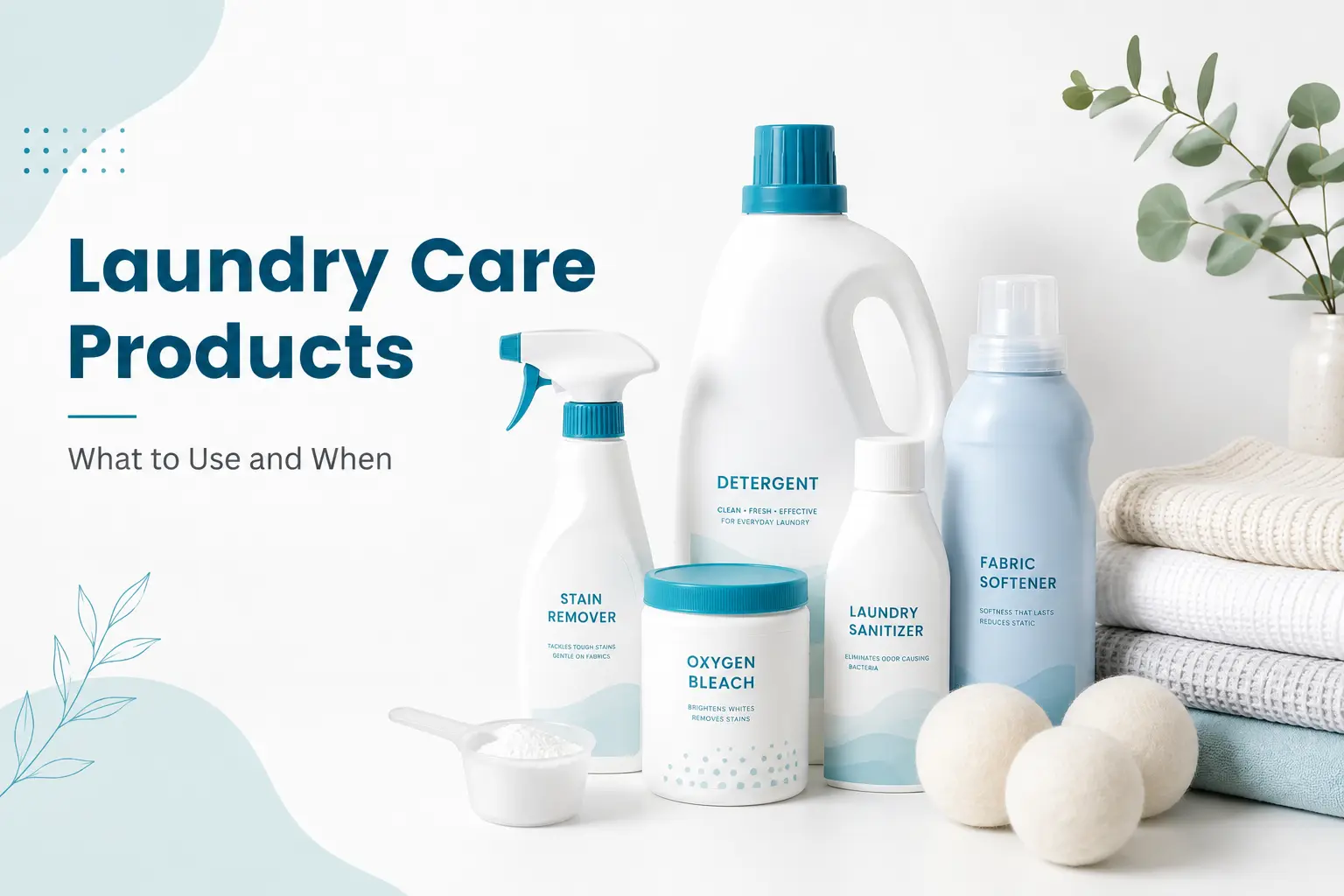
Choosing the right laundry product starts with one rule: use a suitable detergent for most loads, and add a targeted product only when the laundry has a specific problem. Detergent handles routine soil and body oils on its own, so extras like stain removers, boosters, bleach, sanitizers, and fabric conditioners are optional tools for particular fabrics or laundry issues, not everyday additions. Before reaching for a second product, check the care label, the fabric type, the kind of soil, and the washer and water conditions, since these four factors decide what the load actually needs.
This guide breaks down the main types of laundry products, from wash products like detergent, stain treatments, and bleach to laundry-care tools like dryer aids and fabric-protection bags. It walks through what each product does, when it helps, and where common mistakes happen, such as adding a booster to a load that doesn’t need one or using chlorine bleach on the wrong fabric. You’ll also find guidance matched to specific fabrics and specific problems, placement tips for where each product goes in the wash cycle, and a safety note on products that should never be mixed together.
Which Laundry Product Should You Use?
| Laundry Need | Start With | Optional Support | Main Caution |
|---|---|---|---|
| Everyday dirt and body oils | Suitable laundry detergent | Usually none | Too much detergent can leave residue |
| Visible stain | Stain pretreatment | Enzyme detergent or oxygen treatment | Match the treatment to the stain and fabric |
| Persistent odor | Detergent suited to the odor source | Enzyme treatment or sanitizer | Fragrance may only cover the smell |
| Mold or mildew | Detergent plus a fabric-safe treatment | Oxygen or specialist mold product | Never combine several cleaning chemicals |
| Wool, silk, or delicates | Fabric-specific wash | Gentle stain treatment | Avoid unsuitable enzymes and strong alkalinity |
| Extra hygiene | Laundry detergent | Label-approved sanitizer | Sanitizer does not replace cleaning |
| Hard-water residue | Suitable detergent and measured dose | Water conditioner or laundry booster | More detergent may worsen buildup |
Detergent is the basic cleaning product. Therefore, anything in the optional-support column should be added only for a defined need.
How Do You Choose the Right Laundry Product?
Choose a laundry product by checking four things: the care label, fabric construction, actual laundry problem, and washing conditions. In most cases, the mildest suitable product is the safest starting point.
- Read the care label. Check whether the garment can be machine washed, bleached, tumble dried, or only professionally cleaned. White fabric is not automatically safe for chlorine bleach.
- Identify the fabric and construction. Wool, silk, elastane, microfiber, waterproof coatings, glued seams, and structured garments may require gentler products. When the material is unfamiliar or mixed, check how to wash different fabrics safely before applying a strong treatment.
- Define the problem. Decide whether you are treating normal soil, a stain, odor, mold, mineral buildup, detergent residue, static, or a hygiene concern. Each issue requires a different product function.
- Check the washer and water. HE machines, short cold cycles, hard water, and soft water affect product choice and dosage. For example, common hard-water laundry problems include stiffness, dullness, mineral residue, and weaker detergent performance.

What Are the Main Types of Laundry Care Products?
Laundry care products include formulas used during washing as well as tools that protect, dry, or maintain clothing.
Wash products
| Category | Common Examples | Main Job | How Often Needed |
|---|---|---|---|
| Cleaning products | Liquid, powder, pods, sheets, delicate wash | Remove routine soil, oils, and washable residue | Most loads |
| Stain treatments | Sprays, gels, enzyme treatments, stain sticks | Treat concentrated marks before washing | When stains occur |
| Laundry additives | Borax, washing soda, baking soda, water conditioners | Support detergent under specific conditions | Problem-specific |
| Bleach and brighteners | Oxygen bleach, chlorine bleach, bluing | Treat stains, whiten, or improve appearance | Optional |
| Hygiene products | Laundry sanitizer and approved hygiene products | Add label-defined hygiene support | Specialist |
| Fabric enhancers | Fabric conditioner, scent boosters, fabric rinses | Change softness, fragrance, static, or appearance | Optional |
Laundry-care tools
| Category | Common Examples | Main Job |
|---|---|---|
| Fabric-protection aids | Mesh laundry bags and color-catcher sheets | Reduce friction or unwanted dye transfer |
| Drying aids | Dryer sheets and dryer balls | Address static, softness, or airflow |
| Surface-care tools | Lint rollers, sweater combs, fabric shavers | Improve garment appearance after washing |
The American Cleaning Institute’s laundry basics similarly separates detergents from stain treatments, bleach, sanitizers, softeners, and other laundry aids according to the job they perform.

Laundry Detergent Is the Main Cleaning Product
Laundry detergent uses surfactants and supporting ingredients to loosen oily residue, suspend soil, and help it rinse away. When the formula, dose, cycle, and load size are suitable, detergent should handle most everyday laundry.
Laundry soap and modern detergent are not always interchangeable. Soap can react with hard-water minerals and form residue, whereas detergent is generally formulated to work more reliably in washing machines.
Main detergent formats
| Format | Often Useful For | Main Limitation |
|---|---|---|
| Liquid | Grease, body oil, cold washing, and pretreatment | Easy to overdose |
| Powder | Mud, outdoor soil, whites, and some mineral-heavy water conditions | Must dissolve properly |
| Pods or packs | Convenient premeasured washing | Dose cannot be adjusted easily |
| Sheets | Compact storage and simple handling | Dissolution and performance vary |
| Tablets | Premeasured use | Limited dose flexibility |
Premeasured products offer convenience. However, bottled liquid and powder allow you to adjust the amount for load size, soil level, and water conditions.
Specialty formulas include HE, enzyme, fragrance-free, cold-water, heavy-duty, and fabric-specific detergents. In particular, enzyme laundry detergent can help break down organic residue such as sweat, food, blood, grass, body oil, and urine.
Generic protease or enzyme formulas may not suit wool or silk. As a result, use them only when the garment label or product manufacturer confirms compatibility.
Before buying a new formula, compare the main formats, washer requirements, and fabric considerations in CareOnova’s guide to choosing laundry detergent. Afterward, measure the correct detergent amount instead of relying on a full cap or estimated pour.
Find the Right Laundry Detergent
Answer a few simple questions about your washer, fabrics, stains, water conditions, and fragrance preferences to find a detergent that matches your laundry needs.
Use the Detergent FinderStain Removers and Pretreatments
A stain is a concentrated mark that may require treatment before the main wash. Product choice depends on the stain family, including protein, oil, tannin, dye, and mineral stains, as well as the fabric and colorfastness.
| Product Type | Main Role | Main Limitation |
|---|---|---|
| Enzyme pretreatment | Breaks down many protein, starch, sweat, and food stains | Not suitable for every delicate fiber |
| Oxygen treatment | Supports stain removal and brightness | Can affect some dyes and finishes |
| Grease treatment | Targets oils, cosmetics, and fatty residue | Strong formulas may affect color or coatings |
| Spray or gel | Provides controlled treatment on a small area | Easy to overapply |
| Stain stick or bar | Useful for portable, targeted treatment | Rubbing can damage delicate surfaces |
| Stain pen | Helps with small, fresh marks | Not suitable for large or set-in stains |
Treat stains before tumble drying because heat can make some marks harder to remove. Likewise, test stronger treatments on a hidden seam before applying them to a visible area.
Do not layer several products at once. Instead, rinse out one treatment before applying another unless both labels specifically permit combined use.
Normal detergent may be enough for a light, fresh mark. By contrast, concentrated, oily, dried, or resistant stains often need a separate prewash product. Protein-based marks require particular care, and the recommended detergent approach for blood stains explains when an enzyme formula or separate pretreatment is appropriate.
Laundry Boosters and Water Conditioners
Laundry boosters support detergent when a specific condition interferes with cleaning. Even so, they should not automatically be added to every load.
| Product | Main Function | When It May Help | Main Caution |
|---|---|---|---|
| Borax | Supports detergency and mineral control | Some hard-water, odor, or buildup problems | May leave residue if poorly dissolved |
| Washing soda | Raises alkalinity and supports heavy-soil removal | Greasy or heavily soiled sturdy fabrics | Can be harsh on delicate fibers |
| Baking soda | Provides mild odor and pH support | Occasional odor problems | Does not replace detergent |
| Water conditioner | Reduces mineral interference | Hard-water laundry | Must suit the water and detergent dose |
Borax may support detergent in mineral-heavy or odor-prone loads. Washing soda is more alkaline, so it is better reserved for sturdy fabrics with greasy or heavy soil. Meanwhile, baking soda is milder and may help with some odors, although it does not contain the full cleaning system of detergent.
The comparison of baking soda and washing soda for laundry explains how their alkalinity, cleaning strength, uses, and fabric risks differ.
Oxygen bleach is also commonly sold as a laundry booster. Nevertheless, it is covered separately below because it has its own stain, whitening, and fabric-safety conditions.
A booster is usually unnecessary when clothing is lightly soiled, the water is soft, the detergent already contains suitable builders, and the load rinses clean.
Bleach, Whiteners, and Brighteners
Oxygen bleach mainly supports stain removal and brightness on compatible washable fabrics. Chlorine bleach is stronger and may whiten or sanitize label-approved items. However, it carries greater color, fiber, and chemical-mixing risks.
| Feature | Oxygen Bleach | Chlorine Bleach | Key Decision |
|---|---|---|---|
| Main purpose | Stain and brightness support | Strong whitening and approved sanitizing | Choose according to the required result |
| Typical use | Many label-approved washable whites and colors | Bleach-safe white or colorfast items | Check the garment care label first |
| Main risk | Color change or damage to sensitive finishes | Color loss, fiber weakening, and dangerous incompatibility | Test colorfastness and follow the product label |
| Replaces detergent? | No | No | Use with a suitable detergent when required |
Oxygen bleach
Oxygen bleach, also called non-chlorine or color-safe bleach, can support stain removal, brightness, and odor control. Although it is generally more color-friendly than chlorine bleach, it is not safe for every dye, coating, or delicate material.
Before use, check the care label and test colorfastness on a hidden area. Then follow the product directions for soaking time, water temperature, dose, and placement.
Chlorine bleach
Chlorine bleach can whiten or sanitize compatible laundry when used according to the garment and product labels.
Avoid it on:
- Wool and silk
- Elastane or spandex
- Non-colorfast garments
- Many prints and coated fabrics
- Items marked “do not bleach”
Bluing products and optical brighteners change how whites or colors appear. However, they do not necessarily remove additional soil.
Because the correct compartment depends on the bleach type and washer design, follow the product instructions together with CareOnova’s guide to using bleach in a washing machine.
Laundry Sanitizers and Hygiene Products
Detergent removes soil, while laundry sanitizer provides the antimicrobial action stated on its label. Therefore, most routine loads need detergent rather than automatic sanitizing.
A sanitizer should be used only under the conditions listed on its label, including the correct dose, wash stage, contact time, and fabric compatibility.
Extra hygiene steps may be useful for:
- Illness-related laundry
- Items contaminated with body fluids
- Reusable cleaning cloths
- Contaminated workwear
- Households with medically vulnerable people
For ordinary household laundry, proper detergent use, complete rinsing, and thorough drying are usually enough. Consequently, sanitizer does not need to be added to every load.
Sanitizer also differs from bleach. Some liquid sanitizers are intended for the rinse cycle and colored fabrics, whereas chlorine bleach has stricter material and color limitations.
CareOnova’s explanation of when laundry sanitizer is needed covers suitable loads, placement, fabric cautions, and its differences from detergent and bleach.
Fabric Softeners, Scent Products, and Drying Aids
Fabric enhancers are optional products designed to change softness, fragrance, static, wrinkles, or appearance after the main cleaning step.
| Product | Main Job | Cleans Clothes? | Main Limitation |
|---|---|---|---|
| Fabric softener or conditioner | Changes feel and helps reduce static | No | May coat absorbent and performance fabrics |
| Fabric rinse | Targets formula-specific residue, odor, or fabric-feel concerns | No | Purpose and placement vary |
| Scent booster | Adds fragrance | No | Does not remove the source of odor |
| Dryer sheet | Adds softness, fragrance, and static control | No | May leave a coating |
| Dryer ball | Separates items and supports airflow | No | Static reduction varies |
| Color-catcher sheet | Traps some loose dye in wash water | No | Does not make unsafe color mixing risk-free |
| Wrinkle-release spray | Relaxes light creases | No | Does not replace proper drying or ironing |
Fabric conditioner leaves softening ingredients on fibers. For that reason, repeated use may reduce towel absorbency or interfere with microfiber and moisture-wicking performance. Correct fabric-softener use depends on the garment, dispenser, dose, and desired result.
Standard scent boosters primarily add fragrance. When clothing still smells after washing, first identify whether the cause is body oil, mildew, detergent residue, incomplete drying, or washer buildup. Understanding what scent boosters can and cannot do helps separate fragrance enhancement from actual odor removal.
Dryer sheets can reduce static, but they may also leave a coating. Dryer balls, in comparison, separate items and support airflow, although they do not provide every benefit of fabric conditioner or dryer sheets.
Which Laundry Product Should You Use for Each Fabric?
| Fabric or Item | Best Starting Product | Use Carefully |
|---|---|---|
| Everyday cotton | General-purpose detergent | Excess detergent and repeated bleach |
| Wool | Wool-approved or mild wash | Generic enzymes, chlorine bleach, and alkaline boosters |
| Silk | Silk or delicate wash | Strong pretreatments, bleach, and rubbing |
| Synthetic blends | Suitable liquid or HE detergent | Excess heat and heavy product buildup |
| Rayon or viscose blends | Mild detergent according to the care label | Aggressive agitation and strong alkalinity |
| Activewear | Suitable liquid or sports detergent | Fabric conditioner and dryer-sheet coatings |
| Towels | Correctly dosed detergent | Frequent softener and scent-product use |
| Whites | Detergent plus a suitable brightener when needed | Assuming chlorine bleach is always safe |
| Darks | Color-conscious detergent | Whitening products and overdosing |
| Baby clothing | Suitable fragrance-free detergent | Heavy fragrance and unnecessary additives |
| Bedding | Detergent matched to fabric and soil | Overloading and excessive dosing |
| Delicates and structured garments | Mild product plus a mesh laundry bag | Aggressive spinning and strong chemicals |
Which Laundry Product Should You Use for Each Problem?
| Laundry Problem | Start With | Consider Next |
|---|---|---|
| Choosing detergent | Suitable detergent type | Adjust the format, dose, or formula |
| Blood | Enzyme detergent or pretreater | Oxygen treatment where permitted |
| Grease or oil | Liquid detergent or grease treatment | Suitable enzyme formula |
| Sweat and body soil | Enzyme detergent | Targeted odor treatment |
| Mold or mildew | Detergent plus a fabric-safe treatment | Oxygen or specialist mold product |
| Persistent odor | Detergent matched to the odor source | Sanitizer or booster when justified |
| Dingy whites | Correct detergent and dose | Suitable brightening treatment |
| Hard-water residue | Suitable detergent and measured dose | Water conditioner or booster |
| Detergent residue | Rewash without a full detergent dose | Correct future dosing and rinsing |
| Dye transfer | Rewash promptly according to the fabric directions | Color-run remover or dye-catching product |
| Rust or mineral stain | Fabric-safe specialist treatment | Laundry rust remover |
| Static | Adjust drying conditions first | Dryer aid or conditioner when suitable |
| Extra hygiene | Detergent | Label-approved sanitizer |
Choose the treatment according to the source of the problem. Mold, body oil, detergent buildup, mineral residue, rust, and dye transfer do not respond to the same formula.
For example, mold and mildew need a fabric-safe treatment rather than extra fragrance or a larger detergent dose. The correct process for removing mold from clothes depends on the fabric, amount of growth, staining, odor, and care instructions.
Likewise, a fragrance product may cover odor temporarily, but it will not remove the residue causing it. Adding more detergent can also make detergent buildup worse.
Finally, do not use chlorine bleach on a rust stain because it may intensify the discoloration.
Where Should You Add Each Laundry Product?
Product placement affects when a formula is released and whether it rinses properly.
| Product | Typical Stage | Typical Placement |
|---|---|---|
| Prewash detergent | Prewash stage | Compartment marked I or 1, only when using a prewash cycle |
| Liquid or powder detergent | Main wash | Main detergent compartment or label-approved location |
| Pod or pack | Beginning of wash | Usually the empty drum before clothing |
| Stain pretreatment | Before washing | Directly on the approved stain area |
| Oxygen bleach | Main wash or presoak | Follow the product and washer directions |
| Chlorine bleach | Main wash | Designated bleach dispenser when approved |
| Fabric conditioner | Final rinse | Softener compartment |
| Liquid sanitizer | Often the rinse stage | Label-specified compartment |
| Scent beads | Beginning of wash | Usually the empty drum |
| Dryer sheet | Drying stage | Dryer drum |
| Dryer ball | Drying stage | Dryer drum |
These are common placements rather than universal instructions. Therefore, always follow the product label and washing-machine manual.
Separate compartments release detergent, bleach, conditioner, and other products at different stages. As a result, never pour a product into another compartment simply because the correct one is full.
Which Laundry Products Should Never Be Mixed?
Sensitive-Skin and Lower-Impact Laundry Products
Choosing for fragrance or skin concerns
Fragrance-free and unscented do not always mean the same thing. A fragrance-free formula does not contain ingredients added to create or mask a scent. An unscented product, however, may still include ingredients used to neutralize another odor.
Dyes do not improve cleaning. Even so, a dye-free product is not automatically suitable for every person. Broad terms such as “hypoallergenic” should not replace a review of the ingredients and product directions.
Correct dosing and complete rinsing also matter because leftover formula increases contact with the fabric. Therefore, base the dose on product concentration, load size, soil level, water hardness, and washer type.
An extra rinse may help in some cases. Nevertheless, correcting excessive dosing is usually the better first step.
Evaluating environmental claims
Do not rely only on terms such as:
- Green
- Natural
- Clean
- Eco-friendly
- Non-toxic
Instead, look for specific information about ingredients, concentration, biodegradability, packaging, refill systems, certification, and dose per load.
A concentrated product may reduce packaging per load. However, it still needs to be measured correctly to prevent waste and residue.
Which Laundry Products Do You Actually Need?
Products for most homes
- One suitable everyday detergent
- One reliable stain pretreatment
Products for regular needs
- Oxygen bleach
- Wool or delicate wash
- Hard-water treatment
- Laundry sanitizer
- Fabric conditioner or dryer aid
- Mesh laundry bags
Products for specific problems
- Mold or mildew treatment
- Pet-odor treatment
- Sportswear detergent
- Rust remover
- Color-run remover
- Specialty grease treatment
Final Laundry Product Checklist
- Read the garment care label.
- Identify the fabric and garment construction.
- Define the stain, odor, hygiene, or performance problem.
- Start with a suitable detergent.
- Add one targeted treatment only when needed.
- Check fabric compatibility, dose, and placement.
- Inspect stains before machine drying.
- Never improvise chemical combinations.
Ultimately, the best laundry care products are not necessarily the strongest or most heavily scented. They are the products that solve the actual problem without damaging the fabric, leaving residue, or adding unnecessary steps.
