


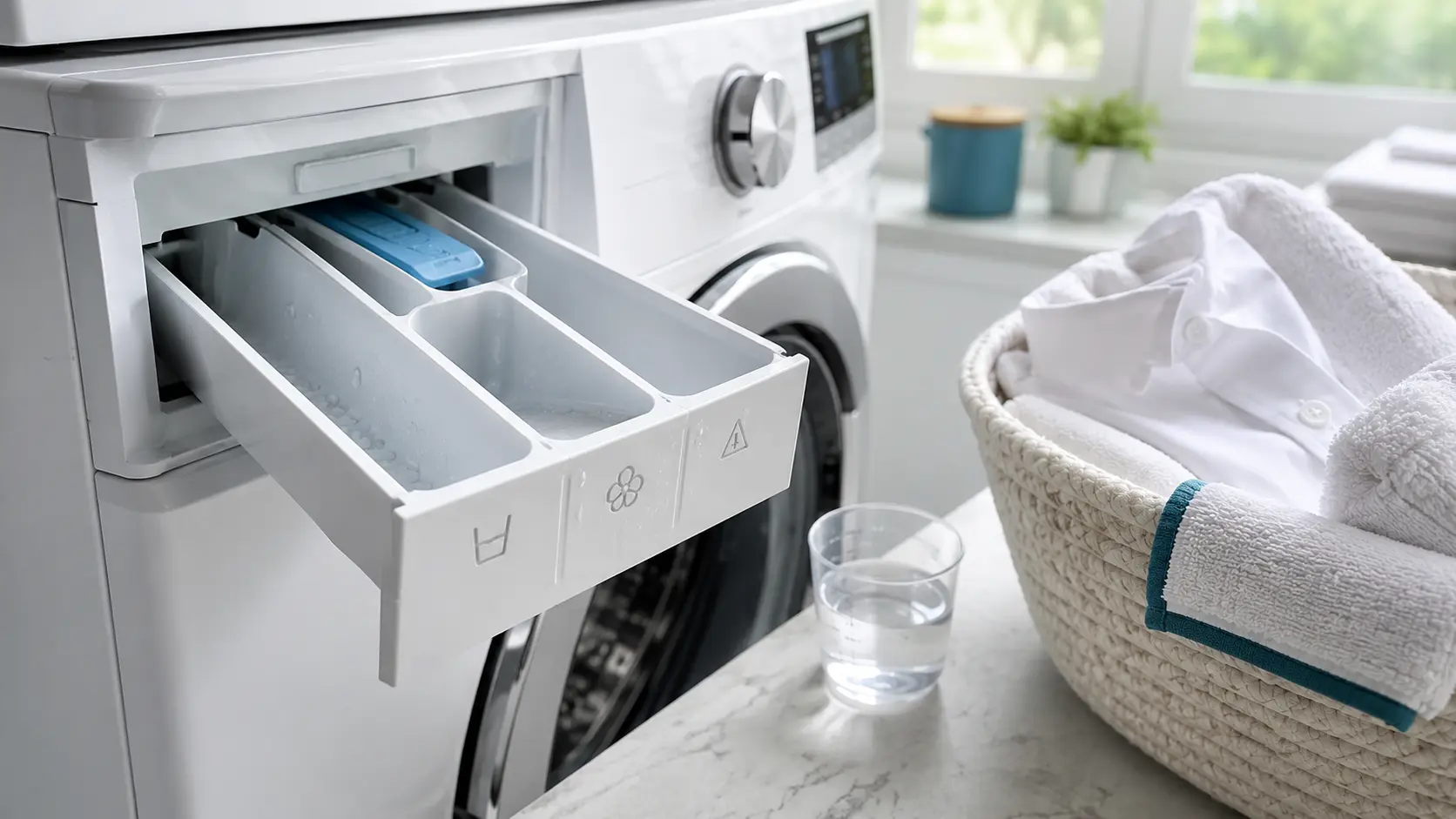
You can use bleach in a washing machine when the product label, garment care label, and washer manual all permit it. Liquid chlorine bleach usually goes in a clearly marked bleach dispenser when one is provided, never directly onto clothes. Powdered oxygen bleach and liquid color-safe products often go elsewhere. Do not guess the compartment, exceed its maximum line, or combine bleach with vinegar, ammonia, or unknown cleaners.
Before adding bleach: confirm that the product is labeled for laundry, the washer accepts that type of bleach, the clothing permits bleaching, and you know the correct placement and dose. Toilet bleach, surface cleaner, and other bleach-containing household products should not be used as laundry substitutes unless their labels specifically provide washing-machine directions.
Where Do You Put Bleach in a Washing Machine?
Put liquid chlorine bleach in the compartment clearly marked for liquid bleach, when your washer has one. Do not use the detergent or softener section unless the model manual specifically tells you to. Powdered oxygen bleach and liquid color-safe products often go elsewhere, so check both the product label and washer instructions.
| Situation | What to Do |
|---|---|
| Liquid chlorine bleach with a labeled dispenser | Use the bleach compartment without passing its maximum line. |
| Front-loader with a dispenser drawer | Use only the section marked for liquid chlorine bleach. |
| Top-loader with a separate bleach opening | Use that opening according to the washer manual. |
| Traditional top-loader without a dispenser | Follow the manual for adding diluted bleach through the filling water. |
| Powdered oxygen bleach | Follow its label. It is often added to the empty drum. |
| Liquid color-safe bleach | Follow its label. Do not assume it belongs in the chlorine-bleach compartment. |
| No clearly labeled compartment | Check the model manual instead of guessing. |
| Product | Bleach Type | Best For | Get It |
|---|---|---|---|
| Clorox Regular Bleach with CLOROMAX | Liquid chlorine bleach | Whitening whites, sanitizing towels and bedding, removing tough stains on bleach-safe fabrics | Check Price → |
| OxiClean Versatile Stain Remover | Powdered oxygen bleach | Brightening colors, treating stains on fabrics that can’t tolerate chlorine bleach | Check Price → |
Automatic dispensers are designed to hold, dilute, and release liquid chlorine bleach during the correct part of the cycle. Filling beyond the maximum line can make the product enter the drum too early and leave permanent pale spots on colored fabric.
Front-Load Washers
In a front-loading washer, the bleach compartment is usually inside the dispenser drawer. Look for a bleach label or symbol rather than relying on the compartment’s position or shape.
Measure the liquid and keep it below the maximum line. Do not use the main detergent or fabric-softener section unless the manual gives that instruction for a specific cycle.
Drawer layouts differ between models. Some machines restrict chlorine bleach or do not provide an approved compartment. Check the model number in the owner’s manual when the markings are missing or unclear.
Top-Load Washers With a Bleach Dispenser
Many top-load machines have a separate opening near the edge of the tub. The liquid may disappear from view because it moves between the inner basket and outer tub before being diluted and released.
Use only the product type named in the washer instructions. A dispenser marked for liquid chlorine bleach should not be filled with oxygen-bleach powder, detergent, or fabric softener.
Top-Load Washers Without a Bleach Dispenser
Follow the model manual. Some traditional top-loaders allow diluted bleach to be added to the filling wash water before clothes come into contact with it.
Do not apply this method to every machine. A high-efficiency (HE) washer uses less water than a traditional deep-fill washer and can rely on different dispensing steps. Do not open, pause, or override a locking washer unless its instructions permit it.
Never pour undiluted chlorine bleach directly onto dry or wet clothing. Direct contact can remove dye and weaken the exposed area.
Which Type of Bleach Are You Using?

The product type determines where it belongs, which clothes it can treat, and whether it can be used for whitening, stain removal, or sanitizing.
| Product | Use | Where It Goes | Main Limit |
|---|---|---|---|
| Liquid chlorine bleach | Whitening, stains, or sanitizing when labeled | Liquid-bleach dispenser or another approved location | Can remove color and damage sensitive fibers, elastic, or prints |
| Powdered oxygen bleach | Brightening and stain treatment | Follow the label, often adding it to the empty drum | Never place powder in a liquid-only dispenser |
| Liquid color-safe bleach | Permitted whites and colors | Follow the label; some formulas go with detergent | Placement and fabric safety vary by formula |
| Splashless or thickened bleach | Laundry only when the label permits it | Follow that formula’s exact instructions | It may not have the same sanitizing use as regular bleach |
| Toilet or surface bleach | Household surface cleaning | Do not use it as laundry bleach | It can contain thickeners, fragrance, or unsuitable additives |
“Bleach” is not one universal product. Powdered oxygen bleach does not follow the same placement rules as liquid chlorine bleach. A liquid color-safe formula can also belong with detergent rather than in the chlorine-bleach compartment.
Use a product for laundry sanitizing only when its label includes that use and gives the required amount, cycle, and contact conditions. A product that brightens or removes stains does not automatically sanitize laundry.
How to Use Bleach in a Washing Machine
Use the following process for an ordinary clothing load:
- Read the washer manual. Confirm that the machine accepts the product and identify the correct compartment.
- Check each garment label. Do not assume a white item or cotton garment is automatically safe for chlorine bleach.
- Identify the bleach type. Confirm whether it is liquid chlorine bleach, powdered oxygen bleach, or a liquid color-safe formula.
- Sort the load. Separate suitable whites or colorfast items from clothing that limits or prohibits bleach.
- Measure the product. Follow the amount stated on its laundry label.
- Use the approved location. Add detergent and bleach to their assigned compartments or follow the machine’s approved method.
- Choose a fabric-safe cycle. Follow the garment’s care instructions before selecting a wash setting.
- Complete the full cycle. Let the washer finish washing, draining, and rinsing.
Do not automatically choose hot water or a heavy-duty cycle. A stronger cycle does not make an unsuitable garment safe to bleach. Water temperature, agitation, and cycle length should match the clothing’s care instructions.
When Should Bleach Be Added?
In a washer with an automatic dispenser, liquid chlorine bleach can usually be measured into the labeled compartment before starting the cycle. The machine controls when the liquid enters the drum.
For a traditional top-loader without a dispenser, the manual may direct you to add diluted bleach to the filling wash water before adding clothes. Do not use this method in a low-water or locking machine unless the manufacturer permits it.
Powdered oxygen bleach is often added to the empty drum before clothing, but the product label should control the exact order.
Can Bleach and Detergent Be Used in the Same Load?
Yes, detergent and laundry bleach can be used in the same wash cycle when the machine, garment, and product instructions allow it.
Place each product in its assigned location. Do not manually mix concentrated detergent and chlorine bleach in a cup, bottle, or compartment that is not designed for both.
The washer dilutes and releases the products during the cycle. Detergent does not make an unsuitable fabric safe to bleach, and using too much detergent can leave residue that is harder to rinse away.
How Much Bleach Should You Use 🧺 Washing Laundry?
There is no single amount that is correct for every bleach product, washing machine, and load.
Follow the product’s laundry directions and never exceed the washer dispenser’s maximum line. The correct amount changes with product concentration, load size, machine capacity, HE or standard design, and whether the goal is whitening, stain treatment, or sanitizing.
Check the product label first, then confirm any machine limit in the washer manual. Measure the liquid instead of pouring by eye.
Do not copy a cup measurement from another brand or appliance page without checking your bottle. Product strengths and directions differ. The dose used for general whitening can also differ from a label-approved sanitizing dose.
Using more than the label directs does not guarantee better cleaning or sanitizing. It increases the chance of poor rinsing, strong odor, early dispensing, fabric damage, and spills.
Which Clothes Can Be Washed With Bleach?
Only bleach clothing when its complete care instructions permit it. Color and fiber content alone are not enough to make the decision.
Read the Bleaching Instruction
Under US care-label rules, a label does not have to mention bleach when all commercially available bleaches can safely be used during regular care.
When chlorine bleach would harm the item but non-chlorine bleach would not, the label must say:
Only non-chlorine bleach, when needed.
Chlorine bleach can harm the item, but a non-chlorine product can be used when the care instructions permit it.
When all commercially available bleaches would harm the item, the label must say:
The instructions apply to the complete garment, including non-removable linings, stitching, elastic, buttons, prints, coatings, and decorative trim.
White Clothes, Towels, and Sheets
White clothing is not automatically safe for chlorine bleach. A white shirt can contain colored stitching, printed graphics, stretch fibers, or a finish that reacts badly.
Check the care label, sort the load carefully, and leave enough room for wash water to move through the fabric. Choose a wash temperature suited to the white items in the load instead of selecting hot water by default.
Towels and sheets can also contain colored borders, embroidery, elastic, or blended fibers. Follow the most restrictive care instruction on the item.
Colored Clothes
Liquid chlorine bleach can permanently remove or change dye. Use a non-chlorine or color-safe product only when both the garment and product instructions permit it.
“Color-safe” does not mean safe for every dye, print, trim, or fabric. Follow the product’s directions when a hidden-area colorfastness test is recommended. Do not create your own bleach mixture for testing.
What Should Never Be Mixed With Bleach?
Never combine household chlorine bleach with vinegar or another acid, ammonia, toilet cleaner, descaler, rust remover, or an unknown cleaning product. These combinations can release dangerous vapors.
Use the product in a ventilated laundry area. Follow official guidance for using bleach safely, including any directions for gloves or eye protection, and avoid leaning over the washer to breathe fumes.
Using detergent and bleach in separate, approved compartments during the same wash cycle is different from manually mixing their concentrated forms.
Other laundry products, including oxygen bleach, borax, baking soda, stain treatments, scent boosters, and laundry sanitizer, still require a label check before they are used in the same load as chlorine bleach. These products do not all create the same immediate chemical hazard, but combining incompatible formulas can damage fabric, interfere with cleaning, or go against the product directions.
When germ reduction is the main goal, check whether the laundry needs a separate sanitizing process rather than assuming that every whitening product provides the same result.
Common Bleach Mistakes and How to Fix Them

| Problem | Likely Cause | Safe Next Step |
|---|---|---|
| Bleach touched clothing | Wrong placement or early release | Add no more product and let the washer complete its rinses. |
| Compartment was overfilled | Bleach entered the drum too early | Clean the drawer and measure less next time. |
| Product remains in the drawer | Blockage, wrong insert, or weak water flow | Clean the dispenser according to the washer manual. |
| Too much bleach was added | Measuring or concentration error | Finish the cycle and use an extra rinse if permitted. |
| Pale spots appear on colored fabric | Chlorine bleach removed the dye | Stop bleaching the item. Washing cannot restore lost color. |
| Strong chlorine odor remains | Excess product, poor rinsing, or an interrupted cycle | Check drainage and use an approved additional rinse. |
| Orange or brown marks appear | Iron, manganese, rust, or another deposit | Stop using bleach until the source is identified. |
| The rubber seal was splashed | Concentrated liquid remained on the surface | Rinse and clean it according to the appliance instructions. |
Direct pouring, wrong-compartment use, overfilling, excessive dosing, and a blocked dispenser can all cause permanent bleach marks.
Orange, brown, or dark marks are not always bleach burns. Iron, manganese, rust, and other mineral deposits that leave marks during washing can become more noticeable after chlorine bleach is used. Identify the source before treating the garment again.
Does Bleach Stay in the Washing Machine?
A working dispenser and completed cycle should release, drain, and rinse away the measured product used for the load.
Bleach residue or carryover is more likely when the compartment is overfilled or blocked, the washer does not drain, the cycle is interrupted, or liquid is spilled around the drawer or tub opening.
After a dispensing problem, inspect the compartment before washing dark or bleach-sensitive clothing. Run an additional rinse only when the washer instructions permit it.
Can Bleach Damage a Washing Machine?
A washer designed to accept laundry bleach should tolerate correct use. Problems are more likely when too much is used, the wrong product is added, spills remain on the machine, or concentrated liquid sits in a compartment.
Rinse fresh spills according to the appliance instructions. Clean buildup from removable drawers and inspect the door gasket when product has collected around it.
For a front-loader, remove residue collected around the door gasket using a method suited to the machine. Do not repeatedly pour chlorine bleach over rubber or metal parts unless the model instructions specifically call for it.
A damaged seal or rust mark is not proof that normal bleach use caused the problem. Leaks, trapped moisture, worn components, mineral deposits, and unsuitable cleaners can produce similar damage.
Can You Clean an Empty Washing Machine With Bleach?
Some washing machines allow chlorine bleach during a Self Clean, Tub Clean, or maintenance cycle, but the method is specific to the model.
Remove all laundry and follow the machine’s maintenance instructions. Do not reuse the dose or compartment advice for an ordinary clothing load. Some models direct bleach to a different drawer section during a special cleaning cycle, while others advise against adding it during routine maintenance.
Bleach can be part of a visible mold or mildew cleaning procedure on certain machines, but only when the model instructions specifically call for it. Do not add it automatically to every maintenance cycle.
Never combine chlorine bleach with vinegar, descaler, or another washer cleaner. Start the cycle promptly, complete any required follow-up rinse, and allow the washer to dry as directed.
Use a maintenance routine matched to the washer’s design instead of treating bleach as the only solution.
Final Takeaway
Safe use of bleach in a washing machine depends on three things: the product label, the garment care label, and the washer manual. Identify the product, measure the directed amount, and use only the approved compartment or addition method. Never pour undiluted chlorine bleach onto clothing or combine it with ammonia, acids, or unknown cleaners. When placement or dosage is unclear, stop and verify the instructions before starting the load.
Editorial Sources
This article was reviewed against US clothing-care requirements, public health safety guidance, and current appliance instructions for dispensers, dosage limits, top-load addition, troubleshooting, and maintenance cycles.
