

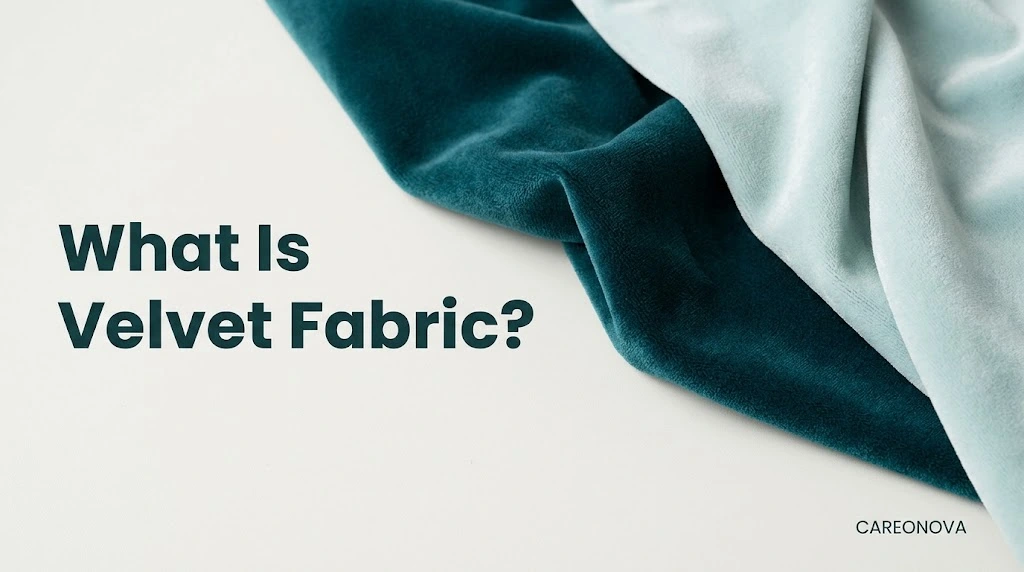
Velvet fabric is known for its soft, raised surface and the way its color seems to shift as light moves across it. Used in everything from evening dresses to upholstered furniture, it has a distinctive appearance that few other textiles can replicate.
Despite its recognizable texture, velvet isn’t made from one particular fiber. It can contain silk, cotton, polyester, viscose, or a combination of materials. Its construction, composition, and finish influence how it feels, drapes, wears, and responds to cleaning.
Understanding these differences makes it easier to recognize velvet varieties, choose a suitable material, and care for its surface without unnecessary damage.
What Is Velvet Fabric?
Velvet is traditionally a woven fabric with a dense, short, cut-pile surface. Instead of lying completely flat, additional yarns rise above the underlying cloth, creating the smooth, soft texture associated with velvet.
The raised fibers are called the pile, while the woven foundation holding them in place is known as the ground fabric. Together, they give velvet its characteristic depth, softness, and directional sheen.
Although velvet was historically associated with silk, modern varieties contain several natural and manufactured fibers. The name describes the fabric’s structure and appearance rather than guaranteeing a specific composition.
Traditional woven velvet has a warp-pile construction, meaning its raised surface is formed from yarns running lengthwise through the fabric. Some modern materials sold as velvet, particularly stretchy clothing fabrics, use knitted constructions instead.
This distinction matters because two textiles with a similar velvety appearance may have very different flexibility, durability, and care requirements.
How Is Velvet Made, and Why Does It Change Shade?
Velvet’s appearance begins with the way its raised fibers are formed and arranged. The manufacturing process creates a surface that feels different from ordinary flat-woven cloth and responds noticeably to light and pressure.
How the Raised Pile Is Formed
One common method of making woven velvet involves producing two layers of fabric simultaneously. Additional yarns connect the layers during weaving, and a cutting mechanism separates them, leaving a raised pile on each finished surface.

The result is a fabric with a woven foundation beneath closely arranged upright fibers.
Traditional velvet can also be made using techniques that form and cut pile loops over wires. Modern velvet-like materials may use other production methods.
After weaving, finishing processes can even out the pile, alter its direction, introduce patterns, or change its appearance. This is why some velvets have a relatively uniform surface while others look deliberately crushed or textured.
The pile’s height, density, and arrangement affect the finished material, but these characteristics aren’t identical across every velvet product.
Why Velvet Looks Lighter or Darker From Different Angles
Run your hand across a piece of velvet in one direction, then reverse it. You may notice that the same area appears lighter or darker.
This happens because the raised fibers have a direction, often called the nap. When their orientation changes relative to the light and the viewer, the surface reflects light differently.
That effect can make a velvet sleeve, curtain, or cushion appear to contain several shades even though the fabric has been dyed one color.
Directional shading is a normal characteristic of velvet, not necessarily a sign of fading or staining.
However, pressure can flatten or disturb the pile, creating marks that remain visible even after the fabric is no longer being touched. Unlike ordinary nap-related shading, these changes may involve actual alteration of the surface.
What Is Velvet Made Of?
Velvet can be produced using different fibers, and its composition plays an important role in how the finished textile behaves.
The pile and underlying fabric may even contain different materials, so a product described as silk velvet or cotton velvet isn’t necessarily made from one fiber throughout.
The most commonly encountered compositions include silk, cotton, polyester, and rayon or viscose.
| Velvet composition | General characteristics | What to check |
|---|---|---|
| Silk or silk blends | Can provide a fluid drape and rich surface sheen | Actual fiber content, backing, and care |
| Cotton | Often offers a more substantial, structured feel | Weight, pile construction, and cleaning requirements |
| Polyester | Available in many weights, finishes, and applications | Backing, stretch, surface quality, and care |
| Rayon or viscose | Can create a soft, flowing fabric with pronounced sheen | Moisture sensitivity, construction, and care |
Silk velvet is traditionally associated with fine garments and decorative textiles. Its appearance can be especially fluid and reflective, although the exact result depends on whether silk is used in the pile, the ground fabric, or both.
Cotton velvet is often selected when more body or structure is desirable. Cotton is also used in velveteen, a separate weft-pile fabric that can resemble velvet. Appearance and fiber content alone don’t establish which construction a product uses.
Polyester velvet is widely used for clothing, furnishings, and decorative items. Polyester belongs to the family of synthetic fibers, but it can be made into many textile constructions and finishes, including stretch and crushed varieties. Its fiber content alone doesn’t establish how durable or washable a particular product will be.
Rayon and viscose velvet can have a flowing drape and noticeable luster. Viscose is a type of regenerated-cellulose fiber, and its behavior when exposed to moisture depends on the fabric’s construction and finishing.
Fiber blends introduce further variations. For example, a fabric might combine one material in its pile with another in its backing.
Because these differences aren’t always visible, the product’s fiber-content label is a more reliable guide than appearance alone.
What Are the Different Types of Velvet?
Velvet varieties are often named for different reasons. Some names describe the fiber content, while others refer to the surface finish, pattern, or ability to stretch.
These categories can overlap. A polyester velvet, for example, may also have a crushed finish.
Common Velvet Finishes and Patterns
| Type | Defining feature | Common application |
|---|---|---|
| Crushed velvet | Pile arranged or pressed in different directions for an irregular sheen | Clothing, accessories, decorative textiles |
| Panne velvet | Deliberately flattened pile with a smooth, reflective appearance | Fashion garments and costumes |
| Embossed velvet | Pattern created by altering the pile’s appearance with pressure and finishing | Furnishings, decorative clothing |
| Burnout or devoré velvet | Pattern formed by selectively removing suitable fiber components | Sheer patterned garments, decorative textiles |
| Voided velvet | Pattern includes areas intentionally left without pile | Decorative upholstery and patterned fabrics |
Crushed velvet is particularly recognizable because its surface reflects light unevenly, creating a textured appearance even when the underlying material is relatively smooth.
Panne velvet also involves pile manipulation, but its flattened finish generally produces a smoother, more directional shine.
Burnout velvet is different. Its patterns are created by selectively removing certain fibers from a compatible fabric composition, leaving areas with different levels of coverage.
These names describe appearance or manufacturing characteristics, not one specific level of quality.
What Is Stretch Velvet?
Stretch velvet is designed to extend and recover more readily than conventional nonstretch woven velvet.
Many varieties are knitted, while others achieve flexibility through elastic fibers or specialized construction.
This makes stretch velvet useful for fitted dresses, dancewear, and garments that need to move with the body.
Still, the amount of stretch varies. A fabric that stretches comfortably across its width may behave differently along its length, and recovery depends on its construction.
When choosing stretch velvet, check the actual stretch direction and recovery rather than assuming every product will fit or move the same way.
Velvet vs Velour vs Velveteen: What’s the Difference?
Velvet, velour, and velveteen can look similar because all three may have soft, raised surfaces. Their traditional constructions, however, are not identical.
Velvet is traditionally woven with a cut pile formed from warp yarns, which run lengthwise through the fabric.
Velveteen is a woven fabric whose pile is formed from weft yarns, which run across the fabric. It is often made from cotton and can resemble a short, dense velvet.
Velour is a broader textile term commonly used for soft pile fabrics, including many knitted varieties found in casual clothing and upholstery.
These distinctions describe construction, not a hierarchy of quality. One material isn’t automatically softer, stronger, or more luxurious than the others.
Retail terminology can also vary, so fiber content and construction details remain important when comparing individual products.

What Are the Main Properties of Velvet?
Velvet’s raised surface gives it several recognizable characteristics, but not every property comes directly from the pile. Fiber composition, fabric weight, backing, and finishing can produce substantial differences between products.
Softness, Sheen, and Drape
The pile gives velvet its characteristic soft feel, while the density and arrangement of its fibers influence the surface’s texture and luster.
Drape describes how a material hangs and forms folds. It depends on factors such as fiber composition, weight, and the construction of the underlying fabric.
A lightweight viscose-blend velvet may fall into soft, flowing folds, while a heavier cotton variety with a firm backing may hold a more structured shape.
Neither construction is inherently better. The appropriate choice depends on the intended garment or furnishing.
Is Velvet Warm, Breathable, or Stretchy?
Velvet can provide warmth, but it isn’t automatically a winter fabric.
A substantial velvet jacket may feel warmer than a lightweight velvet dress, even though both have a similar surface appearance. Thickness, backing, lining, and garment design all influence insulation.
Breathability also varies. A lightweight material with a relatively open construction may allow air and moisture vapor to move differently from a dense, heavily backed upholstery textile.
The fiber alone cannot reliably predict how breathable the finished product will feel.
Stretch is another variable. Traditional woven velvet generally has limited inherent stretch unless its construction or fiber blend is designed to provide it. Many knitted stretch-velvet products offer considerably more flexibility.
For clothing, these differences affect comfort, movement, and how the fabric fits the body.
Is Velvet Durable?
Velvet’s durability has two separate aspects: the strength of the underlying fabric and the ability of its raised pile to maintain its appearance.
A product may remain structurally sound while developing flattened areas, changed sheen, or visible wear on frequently contacted surfaces.
Friction and repeated pressure can disturb the pile, particularly on areas such as elbows, seats, and armrests.
Some velvets are engineered for demanding upholstery applications, while others are intended for garments or decorative use with less frequent abrasion.
Suitability therefore depends on more than the velvet name. The product’s construction, intended use, and maintenance requirements help determine how well it performs over time.
What Is Velvet Used For, and How Do You Choose the Right Type?
Velvet is used in clothing, curtains, furniture, and accessories because its raised surface adds texture and visual depth. The appropriate variety depends on how the finished item needs to behave.
Velvet for Clothing
For dresses and eveningwear, drape is often important. A material that falls into fluid folds may be suitable for a flowing dress but less appropriate for a sharply structured jacket.
Jackets, blazers, and other tailored garments may require more body, stable construction, and a surface that can tolerate regular handling.
Fitted garments introduce another consideration: stretch. A velvet made for close-fitting clothing needs suitable flexibility and recovery, not simply a soft pile.
Comfort should also be considered. Weight, lining, and overall garment design can influence how an item feels during prolonged wear.
Velvet for Curtains and Upholstery
Curtains benefit from fabric that hangs attractively, but weight, backing, light exposure, and maintenance requirements also matter.
For upholstery, surface appearance alone is not enough.
A sofa or chair covering should be evaluated for its intended level of use, abrasion performance, pile retention, cleaning requirements, and compatibility with the furniture’s construction.
Some products are marketed as performance velvet, but the term itself does not guarantee stain resistance, washability, or a particular service life.
When comparing velvet fabrics, use a practical checklist:
- Confirm the fiber composition and any stated blend.
- Examine the pile for unevenness or visible defects.
- Check the nap direction and how the surface looks under different lighting.
- Consider the weight, backing, drape, and stretch.
- Verify that the fabric is intended for the proposed application.
- Review the available care and performance information.
Price can reflect fiber content, manufacturing complexity, finishing, and other quality differences, but a higher price doesn’t automatically mean the material is more suitable for your needs.
How to Wash and Care for Velvet Without Damaging It
Velvet needs careful handling because its raised pile can react to pressure, moisture, and heat. There is no single cleaning method that is appropriate for every velvet garment or furnishing.
The safest starting point is the finished item’s care instructions, which account for more than the visible surface material.
Can You Wash Velvet?
Some velvet products are designed to be washed, while others require professional cleaning.
Before laundering an item, check its care symbols and written instructions for the permitted cleaning method, water temperature, drying requirements, and warnings about heat or ironing.
A polyester velvet garment isn’t necessarily machine washable simply because polyester is commonly used in washable textiles. Its backing, dyes, finishes, seams, and other components may require more restrictive care.
Likewise, cotton content does not guarantee that a velvet item can tolerate an ordinary washing cycle.
If the care instructions permit machine washing, use the specified cycle and temperature. General recommendations for washing different fabrics can help explain why washing conditions matter, but they should never override velvet-specific instructions.
A label stating dry clean only warns against washing the garment at home. A plain dry clean instruction is not the same restriction, although it also shouldn’t be interpreted as automatic permission to machine wash the item.
Drying deserves equal attention. Excess heat, tumbling, or pressure may alter susceptible surfaces, while certain blends can experience dimensional changes.
For upholstery, follow the furniture manufacturer’s cleaning instructions rather than applying garment-care methods.
Can You Iron or Steam Velvet?
Direct ironing can compress the raised fibers and leave flattened areas or unwanted shine.
For this reason, pressing velvet in the same way as an ordinary cotton shirt can damage its appearance.
Steam may help relax wrinkles in some products, but it is not universally safe. Its suitability depends on the fiber, finish, construction, and care instructions.
If steaming is permitted, follow the manufacturer’s method and avoid putting unnecessary pressure on the pile.
Delicate garments, structured pieces, and materials with uncertain care requirements are better evaluated by a professional cleaner.
Steam also should not be treated as a guaranteed way to restore flattened or damaged velvet. Some changes to the pile may be permanent.
Common Velvet Problems: Crushing, Water Marks, and Pile Damage
One of the most common concerns with velvet is a change in surface appearance.
Pile crushing occurs when pressure compresses the raised fibers. It can create flattened or shiny-looking areas, particularly where clothing or upholstery experiences repeated contact.
Water marks may develop when moisture affects the pile or finish. The result can vary from temporary changes in appearance to more persistent distortion.
Matting happens when raised fibers become compressed or tangled, reducing the surface’s original appearance.
Shedding occurs when fibers detach from the material. Pilling happens when loose fibers tangle into small surface balls; friction is one of the common causes of fabric pilling.
These problems shouldn’t be confused with ordinary nap-related shading, which can make an undamaged surface appear lighter or darker from different directions.
The Dry Cleaning and Laundry Institute’s guidance on velvet explains that certain types, particularly some acetate velvets, can develop permanent pile flattening when exposed to moisture, heat, or pressure.
A few careful habits can help reduce unnecessary damage. Avoid prolonged compression where practical, store garments according to their construction, and do not rub or press wet areas without confirming that the treatment is appropriate.
If a mark persists or the item is particularly delicate, seek professional advice rather than attempting increasingly aggressive cleaning methods.
Is Velvet the Right Material for You?
Velvet is a distinctive choice when surface texture, rich-looking color, and an attractive drape are important. It can work beautifully in clothing, furnishings, and decorative textiles, but different varieties have different strengths and limitations.
The most useful question isn’t whether velvet is a good fabric in general. It’s whether a particular velvet suits the intended use and the level of maintenance you’re comfortable providing.
Check the composition, construction, finish, and care instructions before choosing. Those details tell you far more about a fabric’s suitability than its appearance or name alone.
