

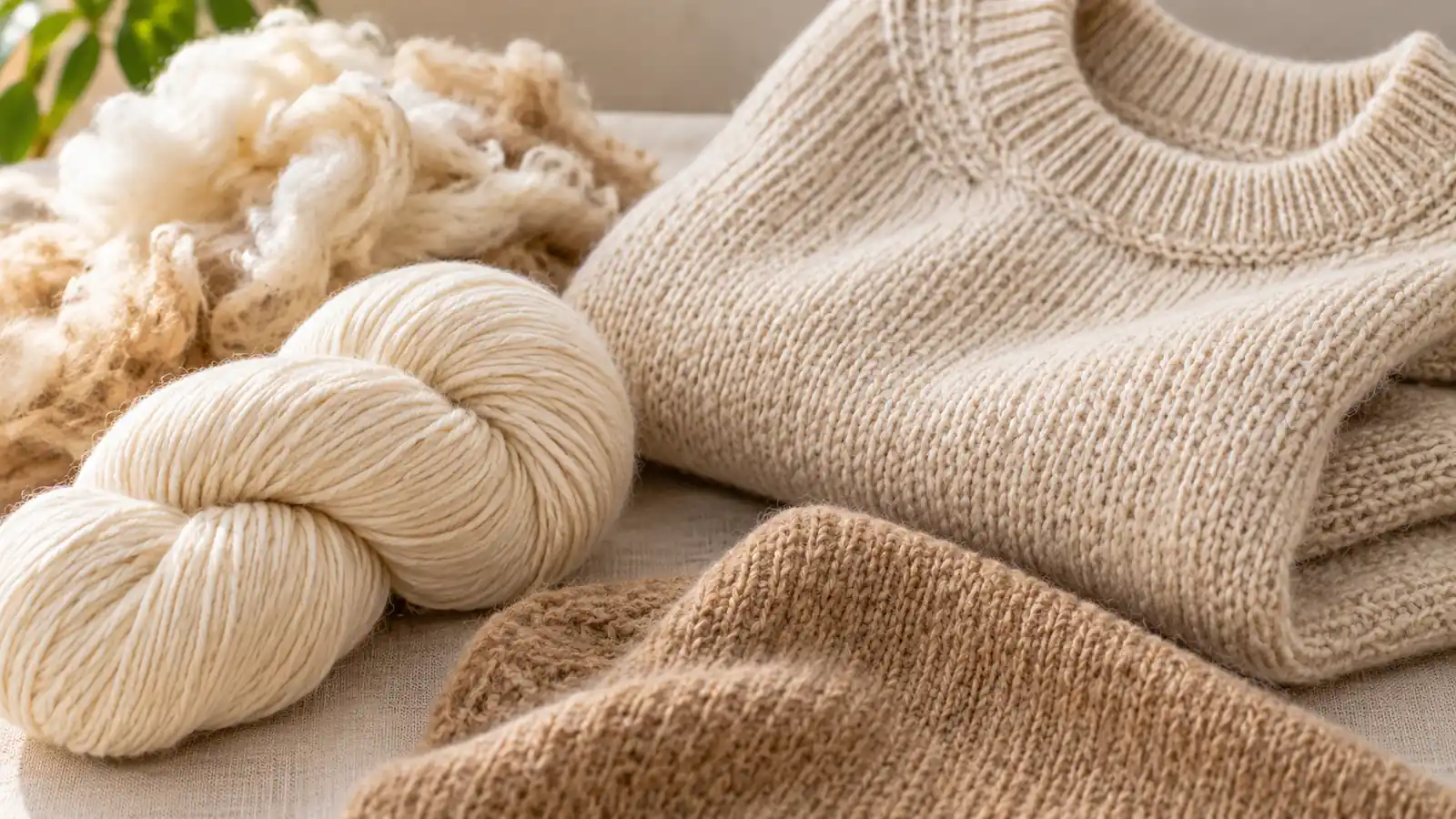
Alpaca wool is a natural animal fiber obtained from the fleece of alpacas, South American camelids known for producing soft, warm, and lightweight textiles. It is commonly used in sweaters, scarves, blankets, and luxury knitwear because of its insulating properties, smooth feel, and elegant drape.
But not every alpaca garment feels or performs the same. Some are exceptionally soft, while others can feel itchy, pill during wear, or stretch out of shape. These differences often come down to fiber fineness, yarn construction, and how the fabric is made.
Understanding those details makes it easier to recognize alpaca’s benefits, judge its limitations, and decide whether the material suits your needs.
Alpaca wool at a glance
| Feature | What to Know |
|---|---|
| Fiber type | Natural animal protein fiber |
| Source | Fleece from Huacaya and Suri alpacas |
| Main strengths | Warmth, softness, drape, and low fleece grease |
| Potential drawbacks | Pilling, stretching, shedding, and occasional itchiness |
| Common uses | Sweaters, scarves, blankets, shawls, and socks |
| Quality indicators | Fiber fineness, uniformity, composition, and construction |
| Care | Follow the garment label; gentle handling is often important |
What Is Alpaca Wool?
Alpaca wool is a natural protein fiber made primarily of keratin, the same structural protein found in sheep's wool and human hair. It comes from alpacas, which have been raised for their fleece in the Andes of South America for centuries, particularly in Peru.
Alpaca belongs among the different types of wool produced by sheep, goats, camelids, and other animals. Its distinguishing feature is that it comes from an alpaca rather than a sheep.
Although alpaca fiber is often used to distinguish it from conventional sheep's wool, calling it alpaca wool is not incorrect. Under the U.S. Wool Products Labeling Act, alpaca is recognized as a specialty wool fiber.
Unlike synthetic materials such as polyester, alpaca fiber grows naturally on the animal. Its surface has microscopic scales, and individual fibers vary in thickness, length, and internal structure. These differences influence how the fleece is processed and how the finished textile behaves.
Where Alpaca Wool Comes From and How It Becomes Fabric
Alpacas are typically shorn to collect their fleece. After shearing, the fiber goes through several preparation stages before becoming clothing or other textiles.
The fleece is sorted to separate finer, more uniform fibers from coarser sections. Dirt and plant matter are removed, and the cleaned fibers are aligned and spun into yarn. That yarn can then be knitted or woven into fabric.
Sorting is especially important for alpaca. Fiber diameter, length, and the proportion of coarse fibers can vary across different parts of the same animal. Careful selection and processing help manufacturers produce more consistent yarn.
This explains why two products labeled 100% alpaca can have noticeably different textures. Their fiber content may be identical, but their fineness, yarn structure, and finishing can differ substantially.
What Are the Different Types and Grades of Alpaca Wool?
Alpaca fleece is mainly associated with two types: Huacaya and Suri. Manufacturers also use names such as baby alpaca and royal alpaca to describe premium fiber grades.
These classifications represent different things. Huacaya and Suri describe fleece types, while commercial grade names generally refer to fiber fineness or quality.
Huacaya vs. Suri Alpaca Fiber
Huacaya alpacas produce dense, fluffy fleece with a naturally crimped structure. Suri alpacas produce longer, smoother locks with a distinctive silky appearance.

| Characteristic | Huacaya | Suri |
|---|---|---|
| Fleece appearance | Dense and fluffy | Long, hanging locks |
| Natural texture | Lofty, with visible crimp | Sleeker, with less crimp |
| Luster | Usually less pronounced | Often more noticeable |
| Fabric character | Commonly fuller-looking | Often smoother with flowing drape |
| Typical uses | Sweaters, scarves, hats, blankets | Shawls, woven fabrics, luxury garments |
Huacaya's crimp helps give many yarns a fuller appearance, while Suri's smoother locks are valued for their luster and flowing character.
Neither fleece type is automatically better.
A well-made Huacaya sweater can feel luxurious, while carefully processed Suri fabric may offer beautiful drape. The final result still depends on fiber fineness, processing, and construction.
What Are Baby and Royal Alpaca Wool?
Baby alpaca generally refers to a fine commercial grade of alpaca fiber, not necessarily fleece taken from a baby animal.
This matters because the name can make shoppers assume the material comes exclusively from young alpacas. In practice, suitably fine fiber may also come from mature animals.
Royal alpaca is another premium trade description, often associated with particularly fine fibers. However, these names do not have one universally consistent definition across grading systems.
Fiber diameter provides a more measurable way to assess fineness.
Diameter is measured in microns (µm). One micron equals one-thousandth of a millimeter. Finer fibers generally bend more easily against the skin, although softness also depends on fiber uniformity, yarn structure, and finishing.
The U.S. Alpaca Fiber Standard uses numbered grades defined by fiber diameter rather than marketing names.
| U.S. Fiber Grade | Diameter Range |
|---|---|
| Grade 0 | 15.0–16.9 microns |
| Grade 1 | 17.0–19.9 microns |
| Grade 2 | 20.0–22.9 microns |
| Grade 3 | 23.0–25.9 microns |
| Grade 4 | 26.0–28.9 microns |
The standard also includes Grades 5 and 6. Its fiber committee deliberately avoided names such as baby, royal, and superfine because these terms are used inconsistently internationally.
These measurements help classify fiber fineness. They do not, by themselves, establish the comfort or performance of every finished garment.
How Does Alpaca Wool Feel and Perform?
Alpaca is valued for warmth, softness, and drape. How successfully it delivers those qualities depends on the particular fibers and the textile made from them.
The most useful distinction is between the properties of individual fibers and the performance of a finished garment.
Is Alpaca Wool Soft or Itchy?
Alpaca wool can be exceptionally soft, but it can also feel itchy when coarse fibers protrude from the fabric and press against the skin.
The main factors affecting comfort include fiber diameter, the proportion of coarse fibers, yarn construction, and finishing.
Fine fibers generally bend more easily when they touch the skin. Coarser fibers resist bending and may create a prickling sensation, particularly around the neck, wrists, or other sensitive areas.
A 2024 study on alpaca fiber diameter and medullation investigated genetic traits associated with different types of medullated fibers in Huacaya alpacas.
The research is relevant to fiber quality and breeding decisions, but it was not a controlled experiment measuring skin irritation in people wearing finished alpaca garments.

Medullation refers to the presence of an internal core, or medulla, within a fiber. The amount and type of medullation vary, and some alpaca fibers have no medulla.
Fiber diameter is particularly important because stiff, coarse fibers can create mechanical prickle.
Dermatological research on sheep's wool has associated prominent prickle with coarser fibers, particularly around 30–32 microns and above. However, that finding should not be treated as a universal alpaca-specific comfort threshold.
Consider two hypothetical alpaca scarves.
One uses carefully sorted fine fibers in a smooth yarn. The other contains more coarse fibers protruding from the surface. Both may be labeled 100% alpaca, yet the second can feel noticeably rougher against the neck.
Is baby alpaca wool itchy? It can be. Although fine-grade alpaca is often chosen for softness, a baby alpaca label does not eliminate coarse fibers, finishing differences, or individual skin sensitivity.
Is alpaca wool hypoallergenic?
Alpaca fleece generally contains much less natural grease than sheep's wool. However, low grease content should not be interpreted as proof that alpaca is completely free of substances capable of causing irritation.
More importantly, low lanolin content does not make alpaca universally hypoallergenic.
Mechanical prickle, dyes, finishing chemicals, and individual skin reactions can still cause discomfort. Prickle from stiff fibers is also different from a medically diagnosed allergic reaction.
For sensitive skin, the comfort of the actual finished fabric is more informative than an unqualified hypoallergenic claim.
How Warm and Breathable Is Alpaca Wool?
Alpaca wool can provide excellent warmth because fabrics made from its fibers can trap air and slow heat loss.
Air held within and between fibers helps provide insulation. A thick, lofty knit usually holds more insulating air than a thin, compact fabric made from the same material.
You may encounter claims that alpaca is exceptionally warm because every fiber is hollow. That explanation is too simplistic.
Warmth also depends on garment thickness, fabric density, fit, and environmental conditions.
For example, a thick alpaca sweater may provide more insulation than a thin merino top. But that does not prove alpaca is inherently warmer than merino at every comparable fabric weight and construction.
What about breathability?
Two related properties need to be distinguished:
- Air permeability: How easily air passes through fabric. An open, loose knit may allow more airflow than a dense one.
- Moisture-vapor absorption: The ability of fibers to absorb water vapor from the surrounding air. Alpaca, like other animal protein fibers, can absorb moisture vapor.
These properties are not interchangeable. A fabric can absorb moisture while allowing relatively little air to pass through it.
Moisture absorption also does not automatically mean rapid moisture-wicking or fast drying.
For everyday winter clothing, alpaca's warmth and drape can be useful. For high-intensity activity, ventilation, drying behavior, garment fit, and moisture management may be more important than fiber type alone.
Does Alpaca Wool Pill, Stretch, Shed, or Shrink?
Alpaca garments can experience all four problems, but their causes are different.
Pilling happens when loose fibers move to the fabric surface and become tangled through friction. Fiber length, yarn twist, knit structure, and everyday abrasion influence the result.
This is the same basic process behind wool pilling in other animal-fiber garments. An expensive alpaca sweater is not automatically pill-resistant.
Stretching and shape loss are especially relevant to heavy or loosely knitted garments. Alpaca's natural drape can be attractive, but a soft knit may gradually lengthen under its own weight, particularly when stored on a hanger.
Shedding occurs when loosely held fibers escape from the yarn or brushed surface. Some early shedding is not necessarily a sign of poor quality, but persistent fiber loss may indicate a construction or finishing problem.
Shrinkage and felting can occur when susceptible alpaca fabrics are exposed to moisture, agitation, heat, or unsuitable cleaning conditions.
Understanding the mechanisms behind preventing garment shrinkage is useful because different textiles can change size for different reasons. Alpaca's care requirements depend on its yarn, fabric construction, and finishing treatment.
A dense woven scarf and a loosely knitted sweater can therefore behave differently, even when their fiber labels are identical.
Alpaca wool benefits and limitations at a glance
| Potential Benefit | Important Limitation |
|---|---|
| Can feel exceptionally soft | Coarse fibers may cause prickle |
| Provides useful thermal insulation | Warmth varies with construction |
| Offers attractive drape | Heavy knits may lose shape |
| Contains relatively little fleece grease | Does not guarantee freedom from irritation |
| Can be used in durable textiles | Wear performance depends on yarn and fabric quality |
| Comes in many natural shades | Dyeing and finishing affect the final material |
These benefits become most useful when the garment is designed around the fiber's strengths.
What Is Alpaca Wool Best Used For?
Alpaca works particularly well in textiles that benefit from warmth, softness, and drape. Its suitability depends on skin contact, expected abrasion, garment weight, and the need for shape retention.
| Textile Application | Why Alpaca Can Work Well | What to Consider |
|---|---|---|
| Sweaters and cardigans | Insulation and soft drape | Weight, elasticity, and shape retention |
| Scarves and shawls | Soft feel and flowing texture | Fineness and neck comfort |
| Blankets and throws | Warmth and a soft handle | Pilling, weight, and cleaning |
| Hats and accessories | Warmth with flexible construction | Fit, stretch, and sensitivity |
| Socks | Warmth and comfortable texture | Abrasion resistance and reinforcement |
| Lightweight layers | Softness and possible thermal comfort | Knit density, moisture, and activity level |
A loose alpaca cardigan may be ideal when drape and softness matter more than a sharply defined shape.
Socks have different requirements. They experience repeated friction inside shoes and need reliable elasticity around the foot. A blend containing nylon or elastane may therefore be more practical than a loosely constructed, unreinforced 100% alpaca sock.
Adding another material is not necessarily a sign of lower quality. A well-designed blend may improve fit, shape recovery, or abrasion resistance while retaining some of alpaca's desirable characteristics.
The best choice depends on what the finished fabric needs to do, not simply on which label sounds more luxurious.
How Can You Tell if Alpaca Wool Is Good Quality?
Good-quality alpaca should be evaluated through fiber composition, fineness, uniformity, construction, and suitability for the intended use.
A label reading 100% alpaca identifies the claimed fiber composition. It does not independently establish softness, processing quality, or durability.
Likewise, a high price does not guarantee that the garment uses exceptionally fine fiber.
Five practical quality checks
- Check the fiber composition. Read the percentages rather than relying on descriptions such as luxury alpaca blend.
- Look beyond grade names. Ask what measurable fiber fineness or grading information is provided.
- Assess comfort for the intended use. Neck comfort matters for a scarf; an outer-layer sweater may be worn over another garment.
- Examine the construction. Look at knit density, loose surface fibers, stitching, and shape recovery.
- Consider maintenance requirements. Check whether the care label fits your everyday routine.
A Practical Example: 100% Alpaca vs. an Alpaca Blend
Imagine two sweaters with different labels.
| Sweater A | Sweater B |
|---|---|
| 100% alpaca | 70% alpaca, 30% polyamide |
| No additional reinforcement fiber | Contains a synthetic reinforcement fiber |
| Performance depends on its yarn and knit | May offer greater stability or strength if appropriately engineered |
Sweater A may appeal to someone seeking an entirely alpaca-fiber garment. Sweater B may be designed to improve strength or dimensional stability.
However, composition percentages alone cannot establish which sweater will last longer. Yarn twist, knit structure, finishing, and actual wear conditions still matter.
This is a hypothetical example, not a comparison of tested products.
The practical rule: Fiber content tells you what a garment contains. Construction and workmanship help determine how it performs.
Why Is Alpaca Wool Expensive?
Alpaca products can command higher prices because of fiber selection, sorting, processing, yarn quality, manufacturing, and the skilled work involved.
Fine, uniform fiber may require more selective sorting. Producing consistent yarn and well-finished fabric can add further processing costs.
Price also reflects brand positioning, garment design, retail margins, and the supply chain.
An expensive alpaca sweater is therefore not necessarily better than a moderately priced one.
A more useful comparison is to examine garments with similar intended uses and evaluate their fiber information, construction, comfort, and care requirements.
Alpaca Wool vs. Sheep Wool, Merino, and Cashmere
Alpaca, sheep's wool, merino, and cashmere are all animal-derived fibers, but their structures and typical textile uses differ.
Merino is a fine type of sheep's wool, while cashmere comes from the fine undercoat of cashmere goats.
Alpaca comes from camelids and is often valued for its smooth feel and flowing drape.
| Property | Alpaca | Merino | Cashmere |
|---|---|---|---|
| Fabric character | Often smooth; fluid drape | Crimped; often springy | Fine, soft; often lofty |
| Softness | Depends on fineness | Fine grades can be soft | Fine grades prized for softness |
| Shape recovery | Construction-dependent | Crimp can help recovery | Depends on yarn and knit |
| Warmth | Can insulate well | Can insulate well | Can insulate well |
| Common uses | Sweaters, scarves, blankets | Base layers, socks, knitwear | Luxury knitwear, accessories |
There is no universal winner for warmth or softness.
For example, fine merino wool may be preferable for a fitted garment that needs reliable recovery, while a flowing alpaca shawl can benefit from the fiber's drape.
Cashmere may be chosen for its soft handle, but it is not automatically more durable or comfortable than every alpaca textile.
When comparing materials, start with the garment's purpose. A soft scarf, a hard-wearing sock, and a lightweight thermal layer require different combinations of properties.
How Do You Care for Alpaca Wool?
Alpaca wool needs cleaning and storage methods that protect the fibers and the garment's shape.
Always follow the finished item's care label first. Washing requirements vary with construction, dyes, blends, and finishing treatments.
Some garments allow gentle hand washing, while others require professional cleaning. Machine washing should only be used when the manufacturer's instructions permit it.
If hand washing is allowed, choose a suitable wool-safe detergent and use the water temperature specified on the label. Handle the fabric gently rather than rubbing, twisting, or wringing it.
The goal is to limit friction and avoid distortion while the material is wet.
Drying matters just as much. Heavy alpaca knits can stretch under their own weight, so supported flat drying is generally preferable when the care instructions permit it.
Avoid direct heat unless the label specifically allows the method.
The same principles used when washing wool safely can help protect washable alpaca garments, but the individual item's instructions always take priority.
Between washes, airing may help refresh lightly worn clothing. Surface lint and pills should be removed carefully rather than pulled from the fabric.
For longer-term storage, clean and dry the garment fully before putting it away. The usual recommendations for storing wool clothing also apply: fold heavy knits, avoid prolonged hanging, and protect garments from moisture and pests.
Proper care cannot eliminate every risk of pilling or stretching, but it can reduce avoidable damage.
Is Alpaca Wool Ethical and Sustainable?
Alpaca wool can be produced responsibly, but being a natural animal fiber does not automatically make every product ethical or environmentally sustainable.
Alpacas are generally shorn to collect their fleece. Responsible shearing should minimize unnecessary stress and injury, while farm management should support animal health, suitable nutrition, shelter, and appropriate land use.
Environmental impacts also depend on processing, dyeing, transportation, and product longevity.
Textile Exchange's Responsible Alpaca Standard (RAS) provides a framework for animal welfare, land management, and supply-chain verification. However, certification does not prove that a product has no environmental impact.
Alpaca wool is also not vegan, because it comes from an animal.
For responsible purchasing, look for verifiable certification claims, transparent fiber-content information, and specific sourcing practices rather than vague descriptions such as eco-friendly luxury.
