

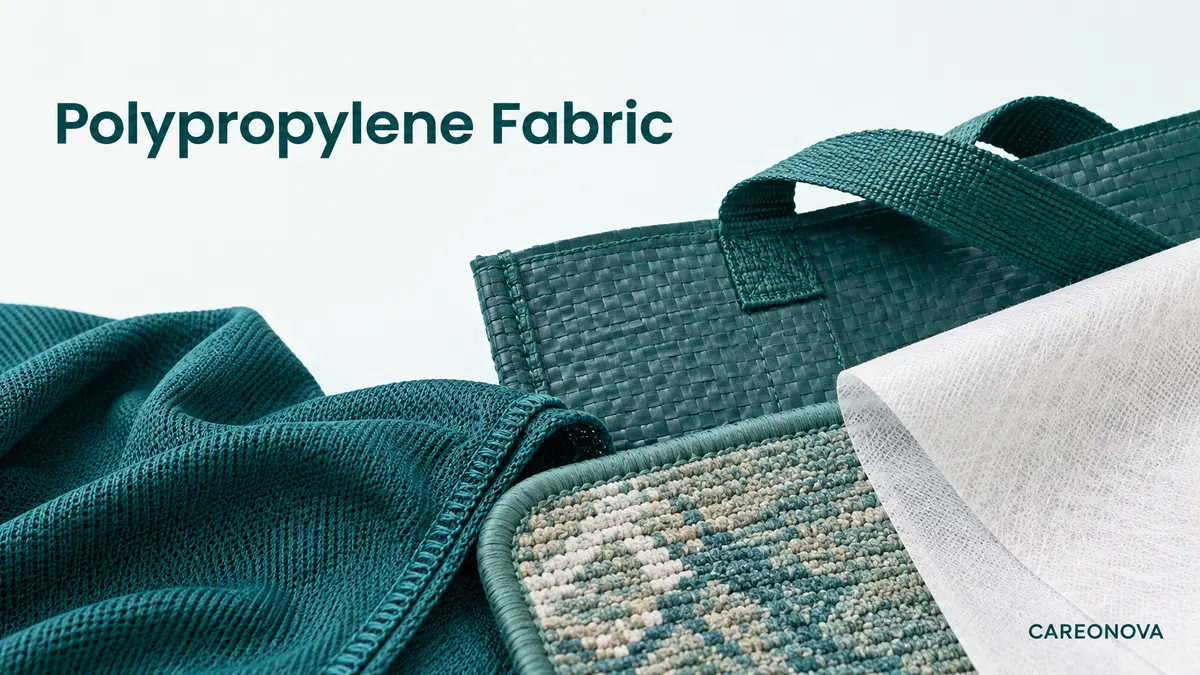
What is polypropylene fabric? It is a light synthetic textile made from polypropylene plastic. Factories melt the plastic and form it into fibers, yarns, flat tapes, or bonded sheets. The material absorbs very little water. As a result, it dries fast and works well in damp settings. Common uses include clothing, rugs, upholstery, reusable bags, filters, and hygiene products.
You have probably touched this material without knowing it. For example, a soft base layer, a sturdy grocery bag, and an outdoor rug can all contain the same polymer. They feel and work differently because makers build them in different ways.
This guide explains how makers produce polypropylene fabric, what it feels like, where it works best, and how to care for it.
Polypropylene Fabric at a Glance
| Feature | What It Means for You |
|---|---|
| Material | Synthetic thermoplastic polymer |
| Fiber name | Polypropylene; often labeled as olefin |
| Common forms | Woven, knitted, spunbond, meltblown, and needle-punched |
| Main strengths | Lightweight, fast-drying, durable, and resistant to many chemicals |
| Main limits | Sensitive to high heat, untreated sunlight, and oily soil |
| Common uses | Clothing, rugs, upholstery, bags, filters, and hygiene products |
What Is Polypropylene Fabric?
Polypropylene is a type of plastic. Factories turn that plastic into textile material. They shape the melted polymer into thin fibers, thicker yarns, flat tapes, or fine webs. Next, they weave, knit, or bond those materials into fabric.
The abbreviations PP and polypro both mean polypropylene. You may also see olefin on a U.S. textile label.
Olefin is a larger fiber family. It includes polymers made mainly from propylene, ethylene, or other olefin units. PP belongs to that family, but not every olefin fiber is PP. The official U.S. definition appears in 16 CFR 303.7.
What Does 100% Polypropylene Mean?
A label that says 100% polypropylene means all the listed textile fiber is polypropylene. It does not prove that every part of the finished item is PP.
A rug, sofa, or garment may still include thread, elastic, backing, coatings, trim, or hardware made from other materials.
This difference matters most during cleaning. For example, the PP face fiber might handle water well. In contrast, glue, foam, elastic, or a printed finish might need gentler care.
What Is Polypropylene Made Of and How Is the Fabric Made?
The process starts with propylene, a small molecule that often comes from oil and natural gas processing. Makers join many propylene molecules into long chains. Experts call this step polymerization. The result is PP resin, which often comes as small pellets.
Fabric production follows four basic steps:
- A machine melts the resin pellets.
- The liquid polymer passes through a spinneret or narrow opening.
- The new fibers, yarns, tapes, or webs cool and become solid.
- Manufacturers weave, knit, or bond the material into fabric.
Makers can mix in color, softeners, and UV stabilizers that protect against sunlight. These ingredients change its color, softness, sunlight resistance, and strength.
The British Plastics Federation describes PP as a low-density plastic with strong chemical resistance and many ways to shape it.
Woven Polypropylene Fabric
Woven PP usually starts as flat tapes or yarns. A loom crosses them over and under each other. As a result, the fabric has a firm, strong surface.
This build is common in reusable bags, storage sacks, rugs, outdoor covers, and some upholstery.
Knitted Polypropylene Fabric
Knitted PP uses connected loops. The loops add stretch, softness, and airflow. Therefore, this form works well in thermal underwear, socks, base layers, and sports clothing.
Nonwoven Polypropylene Fabric
Nonwoven PP is made by forming fibers into a web. Heat, pressure, or another method bonds the web without a normal weave or knit.
Spunbond material uses longer strands and provides strength. In contrast, meltblown material uses very fine fibers and is common in filter layers.
Needle-punched PP has a felt-like surface. It appears in carpet backing and ground-control fabrics called geotextiles.

What Does Polypropylene Fabric Feel Like?
There is no single PP feel. How the fabric is built changes the surface more than the polymer name does.
Woven PP often feels firm, crisp, or slightly plastic-like. Knitted PP usually feels smoother, lighter, and more flexible.
Thin nonwoven PP can feel soft and papery. In contrast, needle-punched material feels closer to felt. Coatings can make any of these surfaces stiffer, smoother, or less breathable.
If feel matters for clothing or furniture, touch a sample before buying. After all, fiber content alone does not show softness, drape, or comfort.
Main Properties of Polypropylene Fabric
Lightweight and Durable
PP is one of the lightest common synthetic fibers. It gives bags, rugs, ropes, and clothing useful strength without much extra weight. Also, many PP textiles handle rubbing and crushing well.
The way it is built still matters. For instance, a heavy woven sack is much stronger than a thin nonwoven sheet. Yet both contain the same polymer.
Low Water Absorption and Fast Drying
PP fiber is hydrophobic, which means it absorbs very little water. Surface moisture leaves quickly, so many polypropylene textiles dry faster than absorbent materials such as cotton.
This property works well in base layers, outdoor rugs, reusable bags, and hygiene products. It also helps the fiber keep much of its strength when wet.
Still, water can remain between yarns or inside padding, seams, and rug backing.
Color and Stain Behavior
PP is difficult to dye after the fiber forms. So, makers usually add color while the polymer is still melted. This method is often called solution coloring. It can give the fiber strong colorfastness.
The material handles many water-based spills well, but it is not stain-proof. PP is oleophilic, which means it attracts oil. As a result, cooking grease, body oil, makeup, and skin products can leave marks or odor.
Heat and Sunlight Limits
PP is a thermoplastic. Therefore, high heat can soften, bend, or melt it. Hot irons, high dryer settings, heaters, and open flames pose the greatest risk.
Long sunlight exposure can also weaken untreated PP. UV stabilizers improve outdoor use. Even so, an outdoor rug or cushion needs the right UV rating for its location.
Is Polypropylene Fabric Waterproof and Breathable?
No, polypropylene fabric is not automatically waterproof. The fiber repels water. Still, liquid can pass through a weave, a nonwoven sheet, or a seam.
A coating, membrane, or sealed backing creates the barrier in items that truly block water.

Breathability also depends on how the fabric is built. For example, an open knit lets more air pass through. A tight weave or coating lets less air through. Thickness and pore size also affect airflow.
The simple rule is this: PP fiber is water-resistant, while waterproofing and breathability belong to the complete fabric design.
Is Polypropylene a Good Fabric?
PP is a good choice when low weight, quick drying, moisture resistance, or chemical resistance matters. For example, it works well in rugs, bags, ropes, base layers, filters, and performance upholstery.
It is less suitable for high heat, strong sunlight without UV protection, or heavy contact with grease. Therefore, the best choice depends on where and how you plan to use it.
| Advantages | Disadvantages |
|---|---|
| Very lightweight | High heat can distort or melt it |
| Absorbs little water | The fabric is not always waterproof |
| Dries quickly | Oil and grease can cling to the fibers |
| Resists many chemicals | Untreated sunlight can weaken it |
| Handles abrasion well | Some clothing can hold body odor |
| Often has strong colorfastness | Textile recycling options are limited |
What Is Polypropylene Fabric Used For?
Clothing and Base Layers
You can find PP in thermal underwear, socks, shirts, sportswear, and base layers. It absorbs little water, so sweat does not soak deep into the fiber. As a result, a damp garment dries quickly.
This benefit is useful during exercise or cold-weather activity. Still, there is a trade-off. Body oil can cling to the fiber and cause odor in close-fitting clothing.
Upholstery, Rugs, and Carpets
PP is common in sofas, outdoor cushions, rugs, and carpets. Its low weight, abrasion resistance, and strong colorfastness suit busy homes and outdoor spaces.
For upholstery, look beyond the fiber name. Check the abrasion or wear rating, UV rating, cleaning code, and bleach rules.
For rugs, check whether the item is washable and whether its backing can get wet. These details tell you more than a general “performance fabric” claim.
Bags, Filters, and Hygiene Products
Woven PP gives reusable shopping bags, storage sacks, and bulk bags strength without much weight.
Spunbond and meltblown PP appear in filters, hygiene items, and protective products. Some of these products are washable, while others are designed for limited or single use.
Does Polypropylene Fabric Stain or Hold Odor?
PP resists many water-based spills, but oil is its weak point. Body oil, grease, lotions, and makeup can cling to the surface or collect between fibers. Therefore, a quick-drying sports shirt can still smell after washing.
Odor also depends on sweat, germs, fabric build, soap residue, and drying conditions. Research on sportswear shows that fiber type and fabric build both affect odor. If odor returns after washing, use a targeted body-odor treatment for oily residue instead of adding more detergent.
Treat oily marks before washing. Blot fresh grease, apply a small amount of liquid detergent to the area, and let it work before the wash. Do not use high dryer heat until the mark and smell are gone.
How to Wash and Care for Polypropylene Fabric
For most washable PP clothing, use cool water and a normal amount of liquid detergent. Choose a normal or gentle cycle. Blends may require a different washing method because a second fiber can set a stricter limit.
First, treat oily areas. Then, leave enough room for good rinsing. Air-drying or low dryer heat protects the fabric.
Careonova rule: Use these steps as the normal method. If the item’s care instructions set a different limit, use that limit. Those instructions cover the whole item, including prints, seams, elastic, coatings, and backing.
Washing Polypropylene Clothing
Turn close-fitting clothing inside out so detergent reaches body oil on the inner surface. Pretreat the collar, underarms, waistband, or other oily areas.
Wash with the correct amount of detergent and use an extra rinse if residue remains.
More detergent does not mean cleaner fabric. Instead, extra soap can stay between the fibers and make odor harder to remove.
Cleaning Polypropylene Upholstery and Rugs
Vacuum loose soil before adding moisture. Blot spills with a clean white cloth instead of scrubbing them deeper.
For water-safe upholstery or washable rugs, use a small amount of mild cleaner. Avoid soaking the surface.
Test the cleaner in a hidden area first. Also, use moisture with care on large rugs and fixed upholstery. Trapped water can harm padding, glue, backing, or the floor below.
Drying, Shrinkage, and Ironing
PP does not swell much in water, so water alone causes little fiber shrinkage. Heat is the larger concern.
For example, a hot dryer or iron can change the shape, flatten the surface, or damage added parts.
Use low heat when machine drying is allowed. Iron only at the approved low setting, and keep direct high heat away from the fabric.

Can You Use Bleach on Polypropylene?
Do not assume every PP item is bleach-safe. Some solution-colored upholstery has been tested for diluted bleach cleaning.
Yet that approval applies only to the named product. It does not cover every PP garment, rug, print, seam, or coating.
Use bleach only when the manufacturer gives clear dilution and rinsing instructions for that exact item.
Polypropylene vs. Polyester
PP and polyester are synthetic fibers, but they are different polymers. Both absorb little water compared with natural fibers. Both can also hold oily soil.
Yet their weight, heat response, color, and sunlight use differ.
| Feature | Polypropylene | Polyester |
|---|---|---|
| Weight | Usually lighter | Usually heavier |
| Water absorption | Very low | Low |
| Drying speed | Fast | Fast |
| Heat resistance | More heat-sensitive | Usually handles more heat |
| Sunlight performance | Often needs UV stabilization | Usually performs better in sunlight |
| Coloring | Often solution-colored | Supports more dyeing methods |
| Common uses | Base layers, rugs, bags, ropes, and nonwovens | Clothing, bedding, curtains, and upholstery |
Choose PP when very low weight and water resistance matter most. Choose polyester for a wider range of clothing styles, textures, and sunlight use.
Still, the way each fabric is built can change the result.
Is Polypropylene Fabric Toxic or Safe to Wear?
Polypropylene fabric is widely used in clothing, hygiene items, rugs, and home goods. A normal consumer textile is not toxic simply because it contains plastic.
Still, the claim that every PP item is “non-toxic” in every setting is too broad. Pigments, coatings, contamination, smoke from burning, and the intended use all affect safety.
Wear clothing as designed and keep PP away from flames and extreme heat. Do not treat an ordinary textile as food-safe or medical-grade unless makers designed and tested it for that purpose.
If a new item has a strong chemical smell or visible damage, stop using it. Then, air it out and contact the seller or maker.
Is Polypropylene Fabric Recyclable?
PP resin carries code 5. The code shows the plastic type. It does not promise that a local program will accept the item.
ASTM changed the code design to help separate plastic identification from the idea that every coded item is recyclable. ASTM explains the change here.
Textiles are harder to recycle than clean containers made from one plastic. Clothing, rugs, bags, and upholstery can include mixed fibers, glue, coatings, elastic, dirt, and oil. Therefore, ask your local service whether it accepts the exact item.
PP is also fossil-based and does not break down like a natural fiber. Reusing a durable bag or rug can extend its life. In contrast, disposable hygiene and safety products should not be reused against their instructions.
Final Takeaway
Polypropylene fabric is best when you need low weight, quick drying, strength, and resistance to moisture or chemicals. For example, it works well in rugs, reusable bags, upholstery, base layers, ropes, filters, and nonwoven goods.
Its main limits are heat, untreated sunlight, oily soil, and limited textile recycling. Also, it is not always waterproof, breathable, bleach-safe, or soft. Those qualities depend on how the finished fabric is built.
Choose the item by its construction and intended use, not by the fiber name alone. That simple approach gives you a better product and a safer, more effective care routine.
