


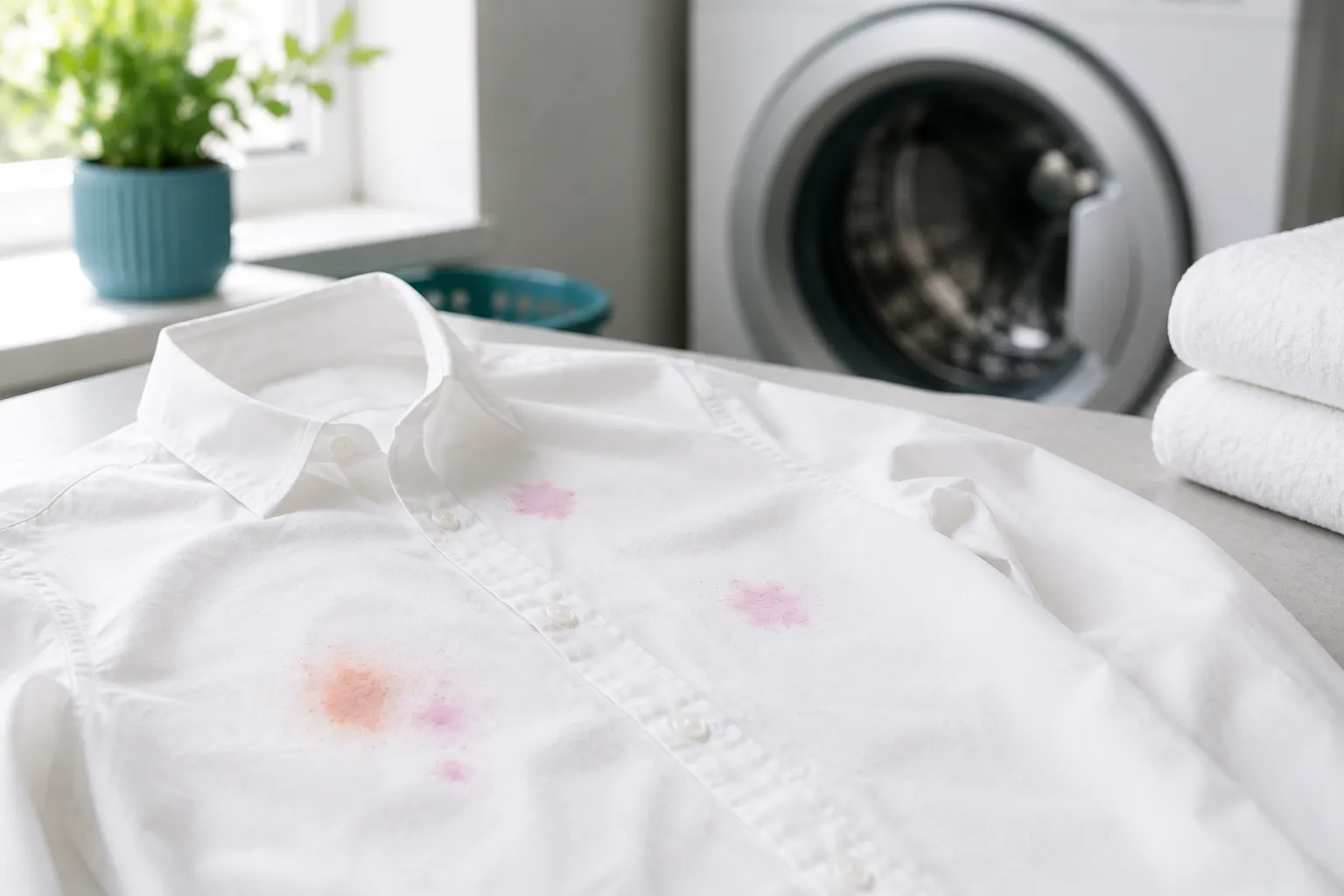
Pink mold on clothes is not always mold. Pink, red, or orange marks can come from bacterial residue, fungal growth, dye transfer, rust, cosmetics, laundry products, or buildup inside the washing machine.
Before treating the item, check the mark’s texture, timing, location, odor, and pattern. A raised patch that appeared during damp storage needs a different response from a flat pink stain that appeared after washing.
Pink mold on clothes may describe several different problems. Slimy pink-orange residue on damp bathroom textiles may be linked to bacteria. Fuzzy or powdery material may suggest fungal growth or another surface deposit. Flat spots that appear after washing are more likely to be dye transfer, rust, cosmetics, laundry-product residue, or washer buildup.
Are the Pink Spots on Your Clothes Actually Mold?
“Pink mold” is a common description, not the name of one confirmed organism.
The pink-orange film seen around damp showers and sinks is often associated with bacteria such as Serratia marcescens. It is a bacterium, not a mold. However, a similar color on clothing does not prove that this bacterium is present.
True fungal growth can also appear in several colors. Therefore, color alone cannot identify whether a mark is mold, bacteria, residue, or an ordinary stain.
Understanding the difference between mildew and mold on clothing can clarify the terms without treating color as a diagnosis.
You can also compare the mark with common signs of mold on fabric before selecting a cleaning method.
Color is not a diagnosis: Pink mold spots on clothes should be judged by their texture, timing, location, odor, and recurrence. A visual check cannot confirm the exact mold, bacterium, or other organism involved.
Why Do Clothes Develop Pink Spots?

Pink marks can have several unrelated causes. Use the pattern, texture, and timing of the problem to choose the safest first action.
Swipe horizontally to view the full table.
| What You Notice | Possible Explanation | First Action |
|---|---|---|
| Slimy pink-orange film on a damp towel, bath mat, or shower curtain | A bacterial biofilm may be present. | Separate the item and inspect nearby damp surfaces. |
| Raised, fuzzy, or powdery pink spots | Possible fungal growth or another surface deposit | Keep the item separate and assess it as possible growth. |
| A whole white load turns pale pink | Dye transferred from a red, pink, or dark garment | Separate the affected items and treat the color transfer. |
| Flat random marks appear after washing | Fabric softener, detergent, cosmetics, transferred color, or washer buildup | Inspect the laundry products and washing machine. |
| Marks appear around collars or underarms | Deodorant, makeup, skincare products, sweat, or transferred pigment | Treat the mark according to the likely stain source. |
| Pink-orange, reddish, or rust-colored marks affect several items | Iron in the water or rust from plumbing or washer parts | Check the water and machine before applying bleach. |
| Spots return during closet storage | Damp storage, high humidity, or incomplete drying | Correct the moisture and airflow problem. |
A whole load turning pink usually points to transferred dye rather than mold. Use a suitable process for removing color bleed from clothes instead of treating the load as fungal growth.
Do not use chlorine bleach on suspected rust. Chlorine bleach can set or intensify iron and rust discoloration. Check the water supply, plumbing, washer drum, and metal parts before choosing a treatment for reddish or rust-colored marks.
How to Tell Pink Growth From a Normal Stain
No home inspection can identify a microorganism with certainty. However, the following clues can guide the next step.
Texture: Raised, fuzzy, powdery, or slimy material may be growth or another surface deposit. A completely flat mark is more likely to be dye, pigment, rust, or staining.
Timing: A patch that developed while the item was stored damp may be moisture-related. A mark that appeared only after washing may come from color transfer, laundry products, cosmetics, rust, or washer residue.
Location: Pink-orange residue on towels, bath mats, and shower curtains may be connected to a damp bathroom. Marks around collars, sleeves, backs, or underarms often come from products that touched the fabric.
Odor: A musty smell supports the possibility of a moisture problem, but odor alone does not prove that active growth is present. Do not hold a visibly affected item close to your face.
Recurrence: Marks affecting several loads may point to the washer or water supply. Spots that return during storage suggest that dampness or high humidity remains.
Quick Decision Guide
- Raised, fuzzy, powdery, or slimy material should be treated as possible growth.
- A flat mark that appeared after washing is more likely to be dye, residue, rust, or another stain.
- When the whole load changes color, begin with dye transfer.
- When spots return during storage, investigate moisture and airflow.
How to Remove Pink Mold on Clothes Safely
Choose the treatment that matches what you found. Possible microbial growth, dye transfer, rust, and laundry-product residue require different responses.
If the Mark Is Raised, Fuzzy, Powdery, or Slimy
Keep the affected item separate from clean laundry. Avoid shaking it or brushing it aggressively indoors because loose surface material may spread.
Check the complete care label before using detergent, bleach, hot water, soaking, or machine drying. Its instructions apply to the whole garment, including elastic, prints, trim, linings, coatings, and decorative parts.
For a sturdy washable item:
- Separate it from unaffected clothing.
- Check the fabric for weak, brittle, or damaged areas.
- Pretreat the affected area with a garment-safe laundry detergent.
- Use only one additional compatible treatment when the garment label and product instructions both permit it.
- Wash at the warmest care-label-approved temperature.
- Rinse the item thoroughly.
- Dry every part completely.
- Inspect the clothing only after it is fully dry.
The complete mold-removal process for washable clothes explains how to assess the fabric and choose an appropriate treatment before relying on a normal wash.
After cleaning and drying, a flat pink mark may remain as discoloration. Treat it as a separate stain only when no raised, fuzzy, powdery, or slimy material remains.
Never mix cleaning products. Do not mix chlorine bleach with vinegar, ammonia, acids, laundry sanitizer, or another cleaner. Use one compatible treatment at a time and follow both the garment label and product directions.
Washing has limits: A wash cycle may remove light surface material, residue, and odor. However, it cannot identify the cause, guarantee sterilization, repair damaged fibers, or correct a moisture problem. The explanation of what washing can and cannot remove from moldy clothes covers these limits in more detail.
People with immune suppression, serious mold allergies, asthma, chronic respiratory disease, or underlying lung disease should avoid cleaning visibly affected items when possible.
Why Did Pink Spots Appear After Washing?
Pink spots that appear after laundry are usually linked to dye transfer, laundry products, rust, cosmetics, pocket items, or washer buildup rather than new mold growth.
The Whole Load Turned Pink
A red, pink, or dark garment may have released dye into the wash water. Separate the affected clothing and treat it according to its care label before drying it again.
The process for correcting transferred color is different from cleaning visible mold-like material.
Random Flat Spots Appeared
Check the detergent and fabric-softener dosage. Concentrated fabric softener may leave greasy or discolored spots when too much is used, it is poured directly onto fabric, or the load is too crowded for proper distribution.
Also inspect cosmetics, lipstick, skincare products, markers, colored paper, or other objects left inside pockets.
Several Loads Have Similar Marks

Inspect the washer drum, detergent dispenser, and door gasket. Repeated marks across different loads usually point to the machine, laundry products, or water supply rather than one affected garment.
For a front-loading machine, inspect and clean the rubber door seal and its hidden folds.
When the machine also has a stale or musty odor, check the common causes of a bad-smelling washing machine.
When reddish or rust-colored spots affect several loads, inspect the water supply and metal washer parts before applying chlorine bleach.
What If Pink Residue Appears on Damp Bathroom Textiles?
Towels, bath mats, and shower curtains may stay damp long enough for pink-orange residue to develop. Similar material may appear around the shower, sink, drain, hamper, or washer.
Separate the textile and clean it according to its care label. Dry it completely before placing it back in the bathroom.
Improve bathroom ventilation, spread towels out after use, and avoid leaving wet bath mats or shower curtains folded. Keep the hamper dry and allow damp fabric to breathe.
What If a Flat Pink Stain Remains?
A flat pink stain can remain after visible surface material has been removed. Remaining color alone does not prove that active growth is still present.
- Raised, fuzzy, powdery, or slimy material
- Flat pink discoloration
- Musty odor
- Weak, brittle, or damaged fibers
- Marks that return after washing or storage
Remaining color alone does not prove that active growth is still present.
When the fabric is clean but discolored, use a fabric-safe method for treating remaining mold stains. Test colorfastness first and follow the complete care label.
Can You Wear or Save Clothes With Pink Spots?
Do not wear an item while raised, fuzzy, powdery, or slimy material remains.
A flat stain after correct cleaning is a different issue. Before wearing or storing the clothing, confirm that it is fully dry, has no strong musty odor, shows no returning growth, and still has strong, normal-feeling fibers.
- Growth covers a large area.
- The fibers feel weak, brittle, thin, or damaged.
- The care label does not allow a suitable cleaning method.
- Odor or visible surface material keeps returning.
- Cleaning causes fading, stretching, or distortion.
Delicate, padded, structured, valuable, or dry-clean-only items may require professional care.
The save-or-discard decision process can help when the item remains affected after careful cleaning.
How to Prevent Pink Spots From Returning
Prevention depends on what caused the pink marks.
- Remove wet laundry from the washer promptly.
- Dry towels, bath mats, and shower curtains completely.
- Keep hampers dry and ventilated.
- Measure detergent and fabric softener correctly.
- Wash new red, pink, and dark garments separately at first.
- Correct washer buildup, bathroom moisture, and damp storage.
When marks return during closet storage, focus on humidity, drying, spacing, and airflow. The process for preventing mold on clothes in a closet explains how to correct those storage conditions.
Cleaning the garment without fixing a damp washer, bathroom, hamper, or closet may allow the problem to return.
Final Takeaway
Pink mold on clothes is a description, not a confirmed diagnosis. Check whether the mark is raised or flat, when it appeared, where the item was used or stored, and whether similar marks affect other laundry.
Treat possible growth, dye transfer, rust, washer residue, and cosmetic stains differently. Follow the care label, avoid mixing cleaners, dry the clothing completely, and correct the moisture source before returning it to use or storage.
Reviewed Sources
- Centers for Disease Control and Prevention: Serratia marcescens
- Centers for Disease Control and Prevention: Mold Cleanup Guidelines
- U.S. Environmental Protection Agency: Mold Colors and Identification
- U.S. Environmental Protection Agency: Mold, Moisture and Your Home
- Federal Trade Commission: Complying With the Care Labeling Rule
- University of Georgia Extension: Removing Iron and Rust Stains
