


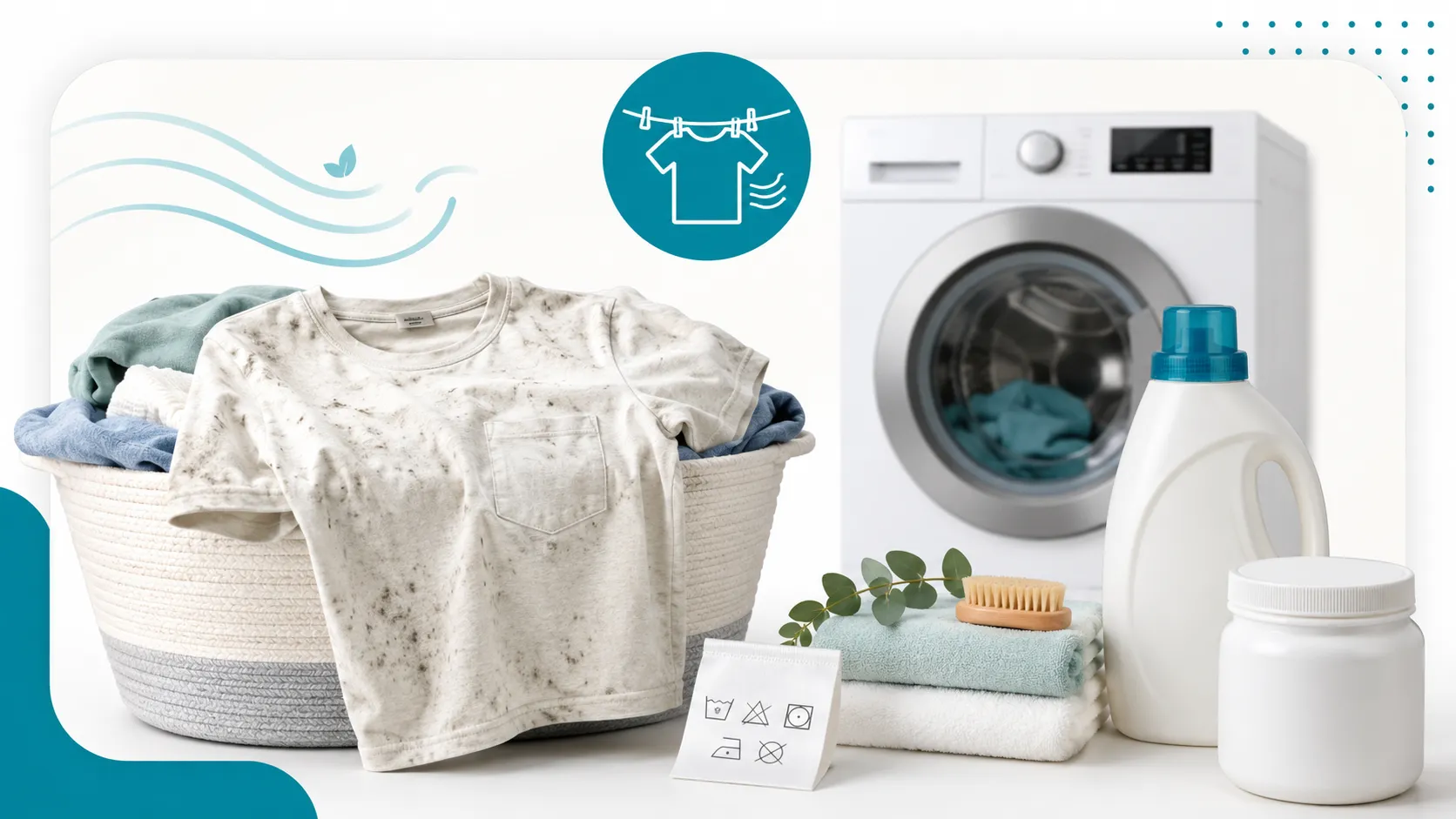
Finding visible growth on clothing can make you wonder whether a normal wash cycle is enough. The item may have been left wet in a basket, forgotten inside the washer, or stored in a damp closet.
Washing can remove loose surface material, residue, and some spores from washable textiles. However, a household cycle does not guarantee that every spore is removed or made unable to grow. Results depend on the material, how extensive the problem is, the cleaning method, detergent dose, rinsing, and complete drying.
The practical goal is to remove visible growth and residue, dry the item thoroughly, and correct the source of moisture. Otherwise, the problem or musty odor may return after storage.
Quick Answer
| Laundry problem | Can a wash cycle help? | Best next step |
|---|---|---|
| Light surface growth | Usually | Clean separately and dry thoroughly. |
| Loose residue or spores | It may remove some | Use detergent, sufficient rinsing, and prompt drying. |
| Musty smell | Sometimes | Treat the remaining odor separately. |
| Flat discoloration | Not always | Identify and treat the remaining stain. |
| Heavy or widespread growth | A normal cycle may not be enough | Assess the material or consult a textile cleaner. |
| The problem returns after storage | Not by itself | Correct the dampness or storage issue. |
Can You Put Moldy Clothes in the Washing Machine?
Yes, most washable items with limited surface growth can go into the washer when the fibers remain strong and the care label permits machine laundering.
Cleaning affected pieces separately gives you better control over pretreatment, detergent dosage, water setting, rinsing, and post-cycle inspection. It also reduces the chance of moving loose residue or musty odor into a normal load.
Do not place heavily affected, weakened, delicate, leather, silk, structured wool, or dry-clean-only items directly into the machine without checking their care instructions.
| Condition | Machine wash? | Recommended action |
|---|---|---|
| Light surface growth on a durable material | Usually | Pretreat, clean separately, and dry fully. |
| Musty odor without visible growth | Usually | Run a suitable cycle, dry, and inspect. |
| Loose or powdery material | With care | Handle loose material outdoors before laundering. |
| Heavy, widespread growth | Not immediately | Assess the item or consult a textile cleaner. |
| Weak or deteriorated fibers | No | Consider replacement or specialist advice. |
| Dry-clean-only piece | No | Tell the cleaner about the problem. |
| Leather, silk, or structured wool | Usually not | Follow specialist care instructions. |
A washer is most useful when the issue is recent, limited, and present on a durable, washable textile.

Can Mold Be Washed Out of Clothes?
Light surface growth can often be removed when the item is washable and the problem has not deeply affected the fibers.
A normal cycle is more likely to succeed on cotton shirts, towels, bedding, polyester blends, sportswear, denim, and other durable materials. Results are less predictable on wool, silk, leather, structured pieces, dry-clean-only items, weakened textiles, or anything with extensive growth.
Can you wash mold out of clothes every time? No. Cleaning may remove loose material while leaving behind:
- flat discoloration;
- a musty odor;
- weakened fibers;
- residue in thick or absorbent material;
- signs that the original moisture source remains.
Laundering is more likely to work when the problem is recent, limited, and confined to the surface.
Signs That One Normal Cycle Was Not Enough
Further treatment or assessment may be necessary when:
- fuzzy or powdery material remains;
- a strong musty odor remains after drying;
- marks continue spreading;
- the problem returns after storage;
- the fibers feel weak or deteriorated;
- the washer itself smells musty.
Do not keep repeating the same method when the result is not improving. First decide whether the remaining issue is visible growth, odor, discoloration, washer buildup, or permanent damage. For detailed pretreatment and cleaning steps, follow this mold-removal method for clothing.
Does Washing Clothes Kill Mold Spores?
A full wash and rinse can carry away loose surface material, residue, and some spores. However, household laundering should not be treated as sterilization.
Removing growth and killing it are different:
- Removal means loose material is detached and rinsed away.
- Killing means it can no longer grow.
- Staining is discoloration that may remain within the fibers.
- Odor can remain even when no raised material is visible.
The practical objective is to remove loose material, rinse thoroughly, and eliminate lingering dampness. Focusing only on whether spores have been killed does not address residue, staining, fiber damage, or the conditions that caused the problem.
Can Spores Be Washed Out?
A suitable cycle may physically carry away some loose spores, particularly when the problem is light and the item can be cleaned thoroughly.
Results may be less reliable when:
- the drum is overloaded;
- visible growth is extensive;
- the material is thick or highly absorbent;
- rinsing is inadequate;
- the load remains wet after the cycle;
- the original moisture source remains unresolved.
Because mold spores can travel on clothing before cleaning, keep affected pieces apart from clean laundry until they are ready for treatment.
It is not possible to confirm that every spore has been removed simply by looking. Instead, check whether visible material, strong odor, spreading marks, or rapid recurrence remains after cleaning and drying.
How to Wash Moldy Clothes Without Spreading the Problem
Follow this process only when the care label permits laundering.
1. Check the Care Label
Confirm the allowed cleaning method, water setting, drying method, bleach restrictions, and special precautions. Hot water, soaking, chlorine bleach, and machine drying are not suitable for every textile.
2. Separate the Affected Items
Keep affected laundry apart from normal loads. Several pieces may be cleaned together when their colors, materials, cycle requirements, and drying instructions are compatible.
3. Handle Loose Surface Material Carefully
Do not shake affected items indoors. For a sturdy washable piece with loose surface material, handle or remove that residue outdoors before laundering. Avoid aggressive brushing when the fibers appear weak.
4. Pretreat With One Compatible Product
Apply detergent or another textile-safe treatment according to its label. Before using chlorine bleach, review the guidance on using bleach on mold-affected clothing and confirm that the care label permits it.
Safety warning
Never mix chlorine bleach with ammonia, acids, vinegar, or other cleaning products. Use one treatment method at a time unless the product labels explicitly state that the combination is safe.
5. Select the Warmest Safe Setting
Choose the warmest water setting allowed by the care label. Excessive heat can damage dyes, elastic, wool, silk, structured pieces, and shrink-prone materials.
6. Leave Enough Space in the Drum
The load needs room to move. Water and detergent must reach the affected areas, and loosened residue needs enough rinsing to leave the fibers.
7. Remove the Load Promptly
Take everything out as soon as the cycle finishes. Leaving wet laundry inside the drum creates damp conditions that can bring back musty odor and recurring growth.
8. Dry Thoroughly
Use a dryer only when the care label permits it. Otherwise, air-dry in an area with steady airflow. Wait until the item is fully dry before returning it to a closet, drawer, suitcase, basket, or storage container.
9. Inspect the Result
Before wearing or storing the item, check for:
- raised, fuzzy, or powdery material;
- strong musty odor;
- spreading discoloration;
- weakened fibers;
- incomplete drying;
- recurrence after storage.

Does Laundry Detergent Kill Mold on Clothes?
Laundry detergent helps loosen soil, oils, residue, and surface material so they can be carried into the water and rinsed away.
Ordinary detergent should not be described as a guaranteed mold killer. Its main role is cleaning and physical removal.
Using extra product does not necessarily improve the result. Follow the correct laundry detergent dose for the load size, machine type, soil level, and water conditions. Excess product may remain in the fibers or washer when it does not rinse away fully.
What Detergent Actually Does
Detergent can:
- wet the material;
- loosen surface residue;
- separate soil from fibers;
- suspend loosened material in water;
- support effective rinsing.
Performance depends on correct dosing, water conditions, movement, rinsing, and the condition of the item.
Which Laundry Add-Ins May Help?
| Product | Appropriate use | Main caution |
|---|---|---|
| Laundry detergent | General cleaning and removal of surface residue | More product does not guarantee a better result. |
| Oxygen bleach | May help with stains on compatible washable materials | Test for colorfastness and follow the product label. |
| Chlorine bleach | May be suitable for some bleach-safe white items | Can damage colors, elastic, wool, silk, and trims. |
| Laundry sanitizer | Use only for materials and organisms listed on its label | Do not assume every sanitizer is approved for fungal growth. |
Do not describe vinegar as a proven mold killer for clothing. It also creates a serious hazard when combined with chlorine bleach.
Use the least aggressive option suitable for the material, and never combine products unless their labels explicitly allow it.
What Temperature Should You Wash Moldy Clothes At?
Use the warmest water setting permitted by the care label.
Warmer water may support detergent performance, but there is no single correct temperature for every item. High heat can shrink fibers, fade colors, damage elastic, distort structured pieces, and harm wool or silk.
The right setting balances cleaning performance with material protection.
Can Mold Survive a Cold Wash?
A cold cycle cannot guarantee that all surface material or spores will be removed. However, cold water may be necessary for dark, delicate, or shrink-prone items.
When the label permits only cold water:
- pretreat the affected area;
- use the correct amount of detergent;
- avoid overloading the drum;
- complete the full cycle and rinse;
- remove the load promptly;
- dry it thoroughly;
- inspect the item before storage.
Do not ignore the care label solely to use hotter water.
Does Dryer Heat Kill Mold on Clothes?
A household dryer should not be relied on as a verified method for killing every spore.
Its most reliable role is removing moisture after the item has been cleaned and rinsed. Thorough drying helps eliminate the damp conditions that allow growth to return.
| Dryer function | Reasonable claim | Do not assume |
|---|---|---|
| Removes moisture | Helps prevent damp storage and regrowth | That drying alone cleans the material. |
| Applies heat | Speeds drying on compatible items | That every spore is killed. |
| Tumbles the load | Helps fibers dry more evenly | That tumbling removes embedded residue. |
| Finishes the laundry process | Prepares properly cleaned items for storage | That it replaces cleaning and rinsing. |
Clean and rinse first. Use the dryer only when the care label permits machine drying.
When a noticeable stain remains, inspect and treat it before using high heat. Some stains become harder to address after a hot cycle.
Can Mold Spread in the Washing Machine?
Loose residue and musty odor can move through a mixed or overloaded load. Growth may also develop inside a machine that remains damp or already has buildup around its gasket, dispenser, drum, or drainage system.
This does not mean every item cleaned with an affected piece will develop an active problem.
Transfer or persistent odor is more likely when:
- affected laundry is mixed with normal items;
- the drum is overloaded;
- the load remains wet after the cycle;
- the gasket or drum already smells musty;
- detergent or softener buildup is present;
- the door stays closed while the interior is damp.
When the machine smells musty, follow the manufacturer’s maintenance instructions before cleaning more affected laundry. Visible growth, recurring odor, or buildup around the gasket, dispenser, or drum may require a complete process for cleaning mold from a washing machine safely.
Allow the interior to dry between loads when the manufacturer recommends it.
Can You Wash Moldy Clothes With Other Clothes?
It is better to clean visibly affected items separately.
A separate load gives you better control over:
- textile-safe pretreatment;
- water setting;
- detergent dosage;
- rinsing;
- drying;
- post-cycle inspection.
Avoid adding affected pieces to loads containing baby wear, delicate items, towels, bedding, or normal clean laundry.
When several affected pieces need cleaning, group them only when their colors, materials, care labels, and drying requirements are compatible.
When an affected item has accidentally been cleaned with a normal load, inspect everything for visible residue or musty odor. Reclean problem items separately when necessary, and check whether the machine itself smells musty.
Is It Safe to Wear Clothes After Washing Mold Out?
An item may be suitable to wear after cleaning when:
- no fuzzy, raised, or powdery material remains;
- there is no strong musty odor;
- the marks are not spreading;
- the fibers show no obvious weakening;
- the item is fully dry;
- the problem does not quickly return.
A flat mark may be residual staining rather than visible surface growth. However, appearance alone cannot confirm that the issue has been fully resolved.
People who are sensitive to fungal growth may prefer not to wear anything that continues to smell strongly musty or shows recurring marks.
Do not wear an item that still has visible growth, significant odor, spreading marks, or deteriorated fibers.
For valuable, delicate, dry-clean-only, or extensively affected pieces, ask a textile-cleaning professional whether treatment is practical. When the fibers are weakened, growth is widespread, or the issue returns after cleaning, use the decision criteria for whether moldy clothes should be discarded.
What If Clothes Still Smell or Have Mold Spots After Washing?
A remaining odor or mark does not always indicate the same problem. Determine whether you are dealing with mustiness, active surface growth, flat staining, detergent residue, or washer buildup.
The Item Still Smells Musty
Odor may remain when:
- the piece stayed damp for too long;
- the drum was overloaded;
- excess detergent was difficult to rinse;
- the machine already smells musty;
- drying was too slow;
- the item was stored before becoming fully dry.
Do not keep adding more detergent after a complete cycle and thorough drying. Use a targeted method for removing mildew smell from clothes after checking that the odor is not coming from the machine itself.
Spots Remain After Cleaning
A cycle may remove loose surface material while leaving discoloration inside the fibers.
A remaining mark could be:
- raised or powdery growth;
- flat residual staining;
- detergent residue;
- mineral residue;
- permanent discoloration or fiber damage.
Do not assume that a flat mark is inactive based only on color or texture. When identification is uncertain, compare it with what mold on clothing looks like before treating mold stains on fabric.
Final Moldy-Laundry Checklist
Before wearing or storing the item:
- No raised or powdery material remains.
- No strong musty odor remains.
- The fibers are not visibly weakened.
- The item is fully dry.
- The washer does not smell musty.
- The original leak, humidity, damp storage, or delayed drying problem has been corrected.
A normal cycle can remove surface growth from many washable items, but results are best when the problem is limited, the correct method is used, and everything is rinsed and dried thoroughly. When damp storage caused the issue, take steps to prevent mold on clothes in a closet before returning the item to storage.
