

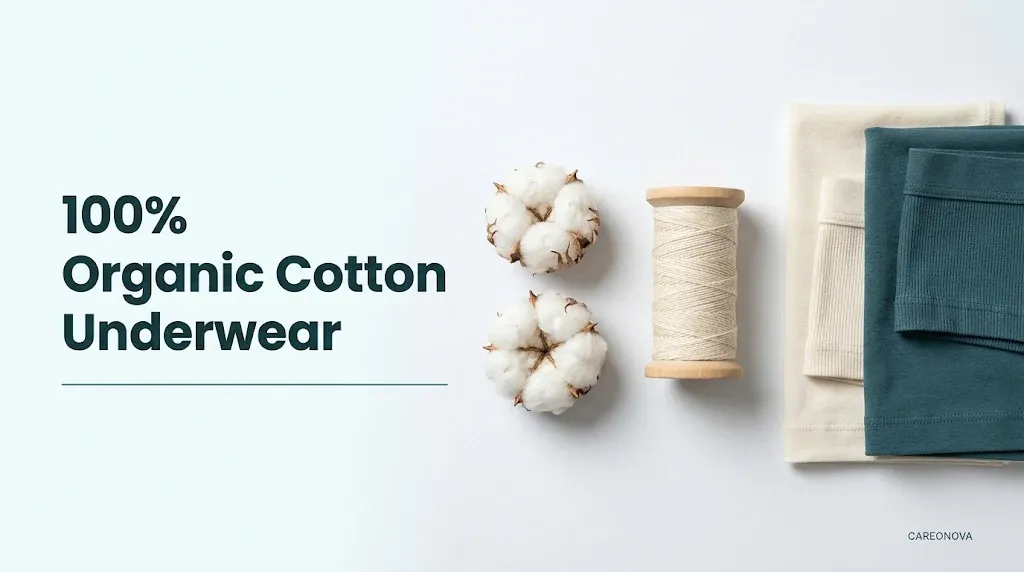
True 100% organic cotton underwear does exist, though it is rarer than most product titles suggest. Most “organic cotton” briefs on store shelves blend 95% organic cotton with 5% elastane for stretch recovery. Even pairs labeled “100% cotton” often hide synthetic or natural-rubber elastic inside the waist and leg trims.
To cut through vague marketing, we audited eight widely available brands purely on verifiable textile data. Every pick below reflects published fiber percentages, waistband trim disclosures, and third-party certifications (GOTS and OEKO-TEX Standard 100). We also weighed size inclusivity and wash durability—never sponsored hype or invented wear tests.
True 100% Organic Cotton vs. 95/5 Cotton-Elastane Blends
Picking the right organic cotton underwear starts with one practical trade-off. Pure 100% cotton fabric breathes best and keeps synthetic polymers off reactive skin, yet it relaxes slightly during wear. Adding 5% elastane pulls the fit back into place and smooths lines under fitted pants.
| Purity Tier | Body & Waistband | Fit & Stretch Recovery | Best For |
|---|---|---|---|
| Tier 1: True 100% & Elastic-Free | 100% organic cotton body; cotton drawstring or latex/spandex-free elastic | Relaxed, looser fit; stretches slightly with wear until next wash | Severe allergies, eczema, latex sensitivity, breathable sleepwear |
| Tier 2: 100% Cotton Body + Trim | 100% organic cotton body & gusset; natural rubber or nylon trim elastic | Classic cotton feel; holds waist shape while seat softens slightly | Plastic-free buyers (natural rubber) or lightweight breathable daily wear |
| Tier 3: Certified Stretch Blends | 95% organic cotton / 5% elastane (or 90/10); synthetic stretch waistbands | Snug, stay-put recovery all day; smoother under fitted pants | Everyday wear under jeans/leggings, budget multipacks, modern cuts |
Why “100% Organic Cotton” Labels Can Still Contain Elastic
Textile labeling rules create an easy blind spot for shoppers. Both US guidelines and the Global Organic Textile Standard (GOTS) classify functional waistbands and leg trims as accessories. That puts elastics outside the main body fiber percentage.
Because of that exemption, a brand can label a brief “100% organic cotton” even with nylon, elastane, or natural rubber in the waistband. Look past the headline and check three separate lines: main body fabric, gusset lining, and waistband trim.

When to Pick Pure Cotton vs. a Stretch Blend
Neither construction wins for every body or every outfit. Match the tier to your skin sensitivity and daily wardrobe.
Choose True 100% Cotton If…
Pick Tier 1 or Tier 2 if you manage eczema, vulvar irritation, contact dermatitis, or synthetic fiber sensitivities. True 100% organic cotton underwear—especially loose cotton underwear like woven boxers or drawstring briefs—maximizes airflow for sleep and sensitive daytime wear.
Choose a 95/5 GOTS Blend If…
Pick Tier 3 if you wear fitted jeans, tailored trousers, or leggings all day. Just 5% spandex keeps the seat from bagging out by afternoon. It also creates sleeker high-rise, cheeky, and thong silhouettes.
Best 100% Organic Cotton Underwear & GOTS Brands Compared
We grouped these eight material-audited brands by Purity Tier rather than popularity. That lets you compare true 100% cotton directly against stretch blends. Still weighing briefs, bikinis, hipsters, or boyshorts? Review our guide to women’s underwear styles before choosing a cut.
| Brand & Tier | Exact Fiber & Trim | Certifications | Sizes, Fit & Price |
|---|---|---|---|
| Cottonique (Tier 1) | 100% organic cotton; drawstring or latex/spandex-free elastic | GOTS, OEKO-TEX 100 thread, MyMicrobiome options, B Corp | Sizes 4–9 + Queen 8–10; ~$17–$22.50/pair; best for allergies |
| Kent (Tier 2) | 100% organic Supima & Pima cotton; natural tree-rubber elastic | Organic cotton, OEKO-TEX trims & finishes, fair-wage factory | XS–3XL; ~$24+; plastic-free & compostable (contains latex) |
| Q for Quinn (Tier 2) | 100% organic cotton + cotton thread; 50% natural rubber covered band | GOTS organic cotton; undyed Natural & plant-dyed options | XS–3XL; ~$24.50–$32; cleanest dye-free cotton (contains latex) |
| Oddobody (Tier 2) | 100% organic Peruvian Pima cotton; separate nylon elastic trim | Organic Peruvian Pima, Fair Trade Peru factory | XS–3XL; ~$22–$28; lightweight airy Pima feel |
| Pact (Tier 3) | 95% organic cotton / 5% elastane; organic cotton gusset | GOTS, Fair Trade Certified | XS–3XL; ~$16+ (less in packs); best budget multipacks |
| Subset (Tier 3) | 95% organic cotton / 5% elastane; nylon-elastane trim (100% cotton boxers) | GOTS, Fair Trade Certified, OEKO-TEX Standard 100 | 2XS–4XL (US 00–28); ~$18–$22 (~$16 in 3-packs); inclusive basics |
| La Coochie (Tier 3) | 95% organic cotton / 5% elastane; minimal elastic or lace trim | GOTS, OEKO-TEX trims, azo-free dyes | 2XS–3XL; ~$12–$20; best high-rise, thongs & boxers |
| Thunderpants USA (Tier 3) | 90% organic cotton / 10% spandex; self-fabric leg bindings | GOTS-certified organic cotton fabric; sewn in Portland, OR | S–4XL (select 6XL); ~$26–$38; best plus-size & zero-sag fit |
Tier 1 — True 100% Organic Cotton & Elastic-Free Picks
Tier 1 designs remove both synthetic elastane and natural rubber latex from skin contact. They set the benchmark for severe textile allergies.
1. Cottonique — Best Overall for Allergies & Elastic-Free Wear
Built for reactive skin, Cottonique sews its women’s line from 100% organic cotton jersey inside its own B Corp, GOTS-certified facility. Shoppers can pick true elastic-free drawstrings (Nothing But Cotton) or latex-free, spandex-free elastic (Classic). Select options carry OEKO-TEX Standard 100 or MyMicrobiome certification across sizes 4–9 and Queen sizes 8–10 (~$17–$22.50 per pair in 2-packs).
- Watch-out: Earlier dyed batches (such as older Melange Blue stock) used cotton-wrapped polyester-core thread. For strict allergy safety, pick undyed Natural or newer 100%-cotton-thread colorways.
Tier 2 — 100% Organic Cotton Body (With Natural Rubber or Nylon Trim)
Tier 2 brands keep the body and gusset 100% organic cotton. Elastic stays confined to the waist and leg openings for everyday shape.
2. Kent — Best Plastic-Free & Compostable Organic Cotton
Designed to leave zero microplastics behind, Kent pairs 100% organic Supima and Pima cotton with plant-based thread and a bio-based natural tree-rubber waistband. The briefs skip spandex, nylon, and polyester entirely. Trims and finishes hold OEKO-TEX certification, backed by above-living-wage factory pay in sizes XS–3XL (starting near $24).
- Watch-out: Natural tree rubber solves plastic concerns, yet it is unsafe for rubber-latex allergies. Substantial finished seams also show through thin athletic leggings.
3. Q for Quinn (Basics by Quinn) — Best Undyed Cotton for Sensitive Skin
For dye-sensitive skin, Q for Quinn offers unbleached, undyed Natural and plant-dyed briefs cut from 100% organic cotton. Every piece uses 100% organic cotton thread and tagless flat seams across sizes XS–3XL (~$24.50–$32 per pair).
- Watch-out: The cotton-wrapped waist and leg bands contain 50% natural rubber and 50% organic cotton. Skip this brand if you react to latex.
4. Oddobody — Best Lightweight 100% Organic Pima Cotton
Prized for its airy, barely-there drape, Oddobody sews modern low-bulk cuts from hand-harvested 100% organic Peruvian Pima cotton. A Fair Trade Peruvian factory produces the fine jersey across sizes XS–3XL (~$22–$28 per pair).
- Watch-out: Oddobody finishes waist and leg openings with separate nylon elastic, so the garment is not plastic-free. Check individual style charts when choosing between the Mid-Rise and Full Coverage Briefs for rear coverage.
Tier 3 — Certified Organic Cotton Stretch Blends (95/5 & 90/10)
Tier 3 blends combine organic cotton with 5% to 10% elastane. They deliver steady snapback, lower prices, and broader everyday silhouettes.
5. Pact — Best Affordable Everyday Multipacks
If budget multipacks top your list, Pact offers the easiest entry into certified organic cotton underwear using 95% organic cotton and 5% elastane. Every pair combines a 100% organic cotton gusset with Fair Trade Certified production across sizes XS–3XL. Singles start near $16, while bundle packs lower the per-pair price further.
- Watch-out: The lightweight 95/5 jersey feels thinner than boutique cottons. It will not suit shoppers avoiding synthetic stretch.
6. Subset (Formerly Knickey) — Best Size-Inclusive Basics (Up to 4XL)
Standing out for inclusive 2XS–4XL sizing (US 00–28) and transparent trim labeling, Subset crafts its briefs from 95% organic cotton and 5% elastane (~$18–$22, or ~$16 in 3-packs). Fabrics hold GOTS, Fair Trade, and OEKO-TEX Standard 100 certification. Subset also sells loose 100% organic cotton boxers.
- Watch-out: Waist and leg trims use synthetic nylon-elastane elastic. Because the cut runs slightly roomy, Subset suggests sizing down between sizes.
7. La Coochie — Best Modern High-Rise, Thong & Boxer Silhouettes
Focused on sleek, non-frumpy cuts, La Coochie blends 95% organic cotton and 5% elastane across high-rise briefs, mid-rise thongs, delicate lace styles, and anti-chafe boxers. Fabrics meet strict organic standards with azo-free dyes and OEKO-TEX trims in sizes 2XS–3XL (~$12–$20 per pair).
- Watch-out: The body contains 5% elastane and lace styles use synthetic lace trim. Popular black and neutral sizes also sell out quickly between restocks.
8. Thunderpants USA — Best Plus-Size (Up to 6XL) & Zero-Sag Fit
Cut and sewn in Portland, Oregon, Thunderpants USA uses sturdy 90% organic cotton and 10% spandex custom-milled from certified organic fabric. Soft self-fabric leg bindings replace hard elastic to prevent riding up. Core styles cover S–4XL, with select prints reaching 6XL (~$26–$38 per pair).
- Watch-out: At 10% spandex, this blend falls under GOTS’s “made with organic” allowance rather than the 95%+ “organic” tier.
How to Verify Truly Non-Toxic Underwear (GOTS, OCS & OEKO-TEX)
Unregulated hangtag buzzwords like “natural” or “eco-friendly” never guarantee non-toxic underwear. Even organically grown cotton can pick up harsh dyes or formaldehyde anti-shrink coatings without third-party audits. Certified organic cotton also avoids the trapped heat and moisture linked to polyester underwear breathability.
| Certification | What It Verifies | What It Does NOT Guarantee |
|---|---|---|
| GOTS (Global Organic Textile Standard) | 95%+ certified organic fiber (“Organic”) or 70%+ (“Made with organic”), plus bans on toxic azo dyes, heavy metals, formaldehyde, and unsafe factory labor | Does not automatically mean 0% elastane—functional waistbands and leg trims count as accessories |
| OCS (Organic Content Standard) | Tracks chain-of-custody verification that organically grown cotton entered the supply chain | Does not restrict chemical dyes, finishing resins, wastewater practices, or factory labor standards |
| OEKO-TEX Standard 100 | Lab-tests every finished component (fabric, thread, elastic, lace) against over 1,000 harmful substances, including PFAS bans | Does not require organic farming or audit agricultural pesticide use |
Under GOTS, the top “Organic” label requires at least 95% certified organic fiber. The “Made with organic materials” grade requires at least 70% and caps virgin elastane at 10%. Version 7.0 applies today, while updated Version 8.1 audits become mandatory on March 1, 2027. To check any brand’s non-toxic underwear claim, look up its license number in the official GOTS public database.
Latex-Free vs. Elastic-Free: The Allergen Trap Most Guides Miss
Many eco-guides treat “plastic-free” and “hypoallergenic” as synonyms, which can backfire on reactive skin. Keep these three waistband builds straight:
- Natural rubber waistbands (Kent, Q for Quinn) eliminate synthetic plastic, yet they can trigger severe rubber-latex allergies.
- Spandex and nylon elastics (Pact, Subset, Oddobody, La Coochie) avoid natural latex, yet they add synthetic stretch polymers.
- Elastic-free drawstrings (Cottonique Nothing But Cotton) remove both natural rubber and synthetic stretch completely.
PFAS, Dyes & Undyed Cotton: Real Risks vs. Myths
Plain 100% organic cotton underwear rarely contains PFAS (“forever chemicals”). In underwear, PFAS appears mainly in moisture-barrier coatings on leakproof period underwear, not plain cotton jersey. Both OEKO-TEX Standard 100 (enforcing a 100 mg/kg total-fluorine cap) and GOTS Version 8.1 screen strictly against PFAS.
For people managing eczema or contact dermatitis, textile dyes pose a bigger daily trigger than PFAS. Choosing undyed (“Natural”) organic cotton eliminates dye chemicals completely, while azo-free dyes offer the safest colorful option.
Fabric Quality, Fit & Common Cotton Underwear Problems
Two briefs can carry identical certifications and still age completely differently after ten washes. Fiber length, knit structure, and natural-fiber purity explain most of that gap.
Standard Organic Cotton vs. Organic Pima & Supima (Plus Knit Type)
Extra-long-staple varieties like organic Pima cotton (Oddobody) and organic Supima (Kent) spin into smoother, stronger yarns. Fewer short fiber ends stick out, so the fabric resists thinning and pilling much longer than budget cotton.
Knit weave matters just as much as fiber length. Flat jersey knit feels ultra-soft yet loosens without elastane, while rib knit builds gentle spring right into pure cotton. We also excluded bamboo lyocell and modal brands here: those regenerated fibers undergo chemical pulping rather than remaining true natural fiber underwear like cotton.

Solving 4 Everyday Fit Frustrations
Use these quick swaps when common organic cotton underwear annoyances show up in your drawer.
“My 100% cotton underwear bags out by afternoon”
Pure jersey cotton relaxes with body heat and movement. Try a rib-knit 100% cotton cut, check your hip measurement, or switch to a 95/5 blend for all-day snapback.
“Waistbands dig in or leave red marks”
Narrow exposed elastic presses into one tight line. Look for wide fabric-covered bands (Thunderpants), soft minimal elastic (La Coochie), or adjustable cotton drawstrings (Cottonique).
“I need no-show organic cotton under leggings”
True laser-cut seamless underwear is rarely 100% cotton because pure cotton frays without stitched hems. For minimal lines under leggings, pick thin, flat-seam 95/5 jersey thongs or cheekies.
“I deal with thigh chafing or trapped sweat”
Skip tight synthetic shapewear under skirts and dresses. Breathable loose cotton underwear—like organic cotton boxer briefs or high-rise boyshorts—stops skin friction while letting moisture escape.
How to Wash Organic Cotton Underwear (Stopping Shrinkage & Elastic Failure)
True certified 100% organic cotton underwear shrinks more readily than conventional mall multipacks. That is actually a sign of cleaner chemistry, because GOTS bans formaldehyde-based anti-shrink finishes. Knowing the basics of stopping clothes shrinking protects both your fit and your budget.
If you sit between sizes, consider sizing up in true 100% organic cotton for a small shrinkage buffer. Stretchy 95/5 blends hold their original dimensions more predictably with gentle washing.
5-Step Wash Protocol for Fiber & Waistband Longevity
- Zip fine Pima and lace inside a protective bag. Placing delicate pairs in a mesh laundry bag stops waistbands and fine knits from snagging or stretching during spin cycles.
- Wash in cold or cool water (30°C / 86°F max). Cool water prevents untreated cotton fibers from tightening and slows heat decay in spandex and natural rubber elastics.
- Use a fragrance-free, gentle formula. Pick an eco-friendly laundry detergent without optical brighteners or heavy perfumes to protect sensitive intimate skin.
- Skip fabric softener and chlorine bleach. Softener coats breathable cotton in a waxy film. Chlorine bleach weakens organic yarns and turns rubber elastic brittle.
- Air dry flat or hang dry. High tumble-dryer heat shrinks 100% organic cotton fast and snaps elastic waistbands months ahead of schedule.
Start by matching your purity tier to your skin rather than chasing hangtag buzzwords. Pick Tier 1 for strict latex or synthetic allergies, Tier 2 for plastic-free 100% cotton, or Tier 3 for affordable, stay-put daily wear. Verify a real GOTS or OEKO-TEX label on the tag, and wash cold so every pair outlasts disposable multipacks.
Sources & Further Reading
- Global Organic Textile Standard (GOTS): Key Features of GOTS — Official breakdown of the 95% (“Organic”) and 70% (“Made with organic materials”) fiber grades, chemical input bans, and supply-chain traceability rules.
- Global Standard gGmbH: Standard Updates in GOTS Version 8.1 (June 2026) — Official Version 8.1 release and March 1, 2027 implementation deadline governing additional fibers, accessory exemptions, and PFAS controls.
- OEKO-TEX: OEKO-TEX Standard 100 — Official laboratory testing scope covering over 1,000 regulated substances across finished fabrics, sewing threads, elastics, and trims.
