

For practical wool care, a wool-safe detergent is a mild, relatively neutral detergent that is clearly suitable for washable wool. The safest choice is usually a product specifically labeled for wool or otherwise confirmed as wool-suitable. Avoid heavy-duty detergents, enzyme-containing formulas, and chlorine or oxygen bleach. Most importantly, a detergent being safe for wool does not automatically mean the garment itself can be machine or hand washed.
What Makes a Detergent Wool-Safe?
A detergent is wool-safe when its formula and use instructions are appropriate for cleaning washable wool without relying on the stronger chemistry found in many general-purpose laundry products.
Wool is a natural protein fiber made largely from keratin. That does not mean you need to study detergent chemistry before washing a sweater. The practical approach is simpler: choose a mild detergent that is clearly suitable for wool and avoid formulas that established wool care guidance identifies as unsuitable.
One easy mistake is assuming that every reassuring word on the front of a detergent bottle means the same thing. It does not.
| Term | What It Actually Tells You |
|---|---|
| Wool-specific detergent | Designed or marketed specifically for wool. |
| Wool-safe detergent | Clearly identified as suitable for wool. |
| Mild or gentle detergent | A useful characteristic, but not proof of wool suitability. |
| Delicates detergent | May be suitable for wool, but should still be verified. |
A dedicated wool wash can be the easiest option because its intended use is clear. But a product does not always have to be made exclusively for wool to be suitable.
What matters more is whether the specific detergent is confirmed for wool use.
Words such as gentle, natural, premium, hypoallergenic, or for delicates may describe a product, but they do not replace an actual wool-suitability check.
How Can You Tell if a Detergent Is Safe for Wool?
What I’d check first is not the scent, packaging, or whether the front says “gentle.” I’d look for a clear statement that the detergent can be used on wool.
A product specifically labeled for washable wool gives you a much clearer signal than general marketing terms. A Woolmark recommendation can also be useful. Woolmark’s detergent guidance recommends a mild, relatively neutral detergent for wool and advises against heavy-duty detergents, enzyme-containing bio detergents, and bleach.
You do not need to hunt for an exact pH number if the manufacturer does not publish one. Confirmed wool suitability is more useful than guessing from vague wording or an unsupported numeric rule.
Watch for Heavy-Duty Detergent, Enzymes, and Bleach
A detergent can work very well on everyday cotton and still be a poor choice for wool.
Heavy-duty detergents are designed for more demanding everyday laundry and are not the preferred choice for routine wool washing.
Enzyme-containing formulas also deserve attention. In Woolmark’s guidance, the term bio detergent refers to enzyme-containing products. U.S. detergent labels may use different terminology, so the practical approach is to check whether the formula contains enzymes and whether the manufacturer specifically confirms wool suitability.
You do not need to identify every enzyme on the ingredient list unless you are researching the formula in depth. For most shoppers, the simpler question is:
Does the manufacturer clearly say this detergent is suitable for wool?
Bleach is more straightforward. Both chlorine bleach and oxygen-based bleach should be avoided when washing wool under current Woolmark guidance.
Wool-Safe Detergent: Safe, Avoid, or Depends?
This quick reference makes the decision easier.
| Detergent Feature | Practical Decision |
|---|---|
| Specifically suitable for wool | Strong choice |
| Woolmark recommended | Strong signal |
| Mild / relatively neutral formula | Positive characteristic |
| Heavy-duty detergent | Avoid for routine wool washing. |
| Enzyme-containing bio detergent | Avoid under current Woolmark guidance. |
| Chlorine bleach | Avoid |
| Oxygen bleach | Avoid |
| “Delicates” only | Verify actual wool suitability. |
| Powder detergent | Depends. It is not automatically unsafe. |
| Lanolin | Optional feature, not proof of wool safety. |
| No-rinse formula | Follow the specific product directions. |
| Fabric conditioner | Optional; keep the amount minimal if permitted. |
The goal is not to turn detergent shopping into a chemistry exam. It is to separate strong evidence of wool suitability from marketing language and secondary product features.
A Simple Detergent-Label Example
Imagine three bottles on a store shelf.
Product A says “Gentle Care for Delicates,” but its directions do not mention wool.
Product B clearly says it is suitable for wool and gives instructions for washing wool garments.
Product C is marketed as a powerful heavy-duty stain-fighting detergent and uses an enzyme-based formula.
For a washable wool item, Product B gives the clearest answer.
Product A may or may not be suitable, so I would verify it rather than assume that delicates automatically includes wool.
Product C conflicts with the general wool-care guidance discussed above.
That sounds simple, but it addresses one of the biggest problems with this topic: marketing language is not the same thing as fabric compatibility.
How to Choose the Best Wool-Safe Detergent
The best detergent for wool is not automatically one brand or one bottle. It is the product that clearly fits both the wool fiber and the garment’s permitted care method.
When comparing suitable options, prioritize these five things:
- Confirm wool suitability. The detergent should clearly permit use on wool.
- Check the garment care method. A wool-safe detergent does not make every item washable.
- Prefer a mild formula. Avoid choosing a heavy-duty product simply because it cleans aggressively.
- Watch enzymes and bleach. Current Woolmark guidance advises against enzyme-containing bio detergents and chlorine or oxygen bleach.
- Follow the product directions. Use the recommended dose, rinse method, and washing instructions.
Only after those basics are settled should preferences such as fragrance-free versus scented, liquid versus suitable powder, rinse versus no-rinse, or lanolin versus no lanolin decide between otherwise appropriate products.
Those features can affect convenience and personal preference. They should not distract from the main question:
Is this detergent actually appropriate for my wool?
Can You Use Regular, Gentle, or Delicates Detergent on Wool?
Sometimes, but only if the specific detergent is actually suitable for wool.
You do not need to think of regular detergent and wool detergent as two completely separate categories. At the same time, you should not assume that whatever detergent is already beside the washing machine will work.
A general-purpose detergent may be heavy-duty, contain enzymes, or include bleaching ingredients that do not fit wool-care recommendations.
A product marketed for delicates may be a better candidate, but the word delicates alone still does not confirm wool compatibility.
If you are comparing a normal detergent with a wool-specific product, ask:
- Does the manufacturer explicitly permit use on wool?
- Is it a mild formula rather than heavy-duty?
- Does it avoid detergent features discouraged for wool?
- Do its instructions fit the way the garment itself can be washed?
If the bottle leaves you guessing, a clearly labeled wool detergent is the simpler choice.
Do Liquid, Powder, Lanolin, or No-Rinse Formulas Matter?
They matter, but none of these features alone proves that a detergent is wool-safe.
Liquid vs Powder Detergent
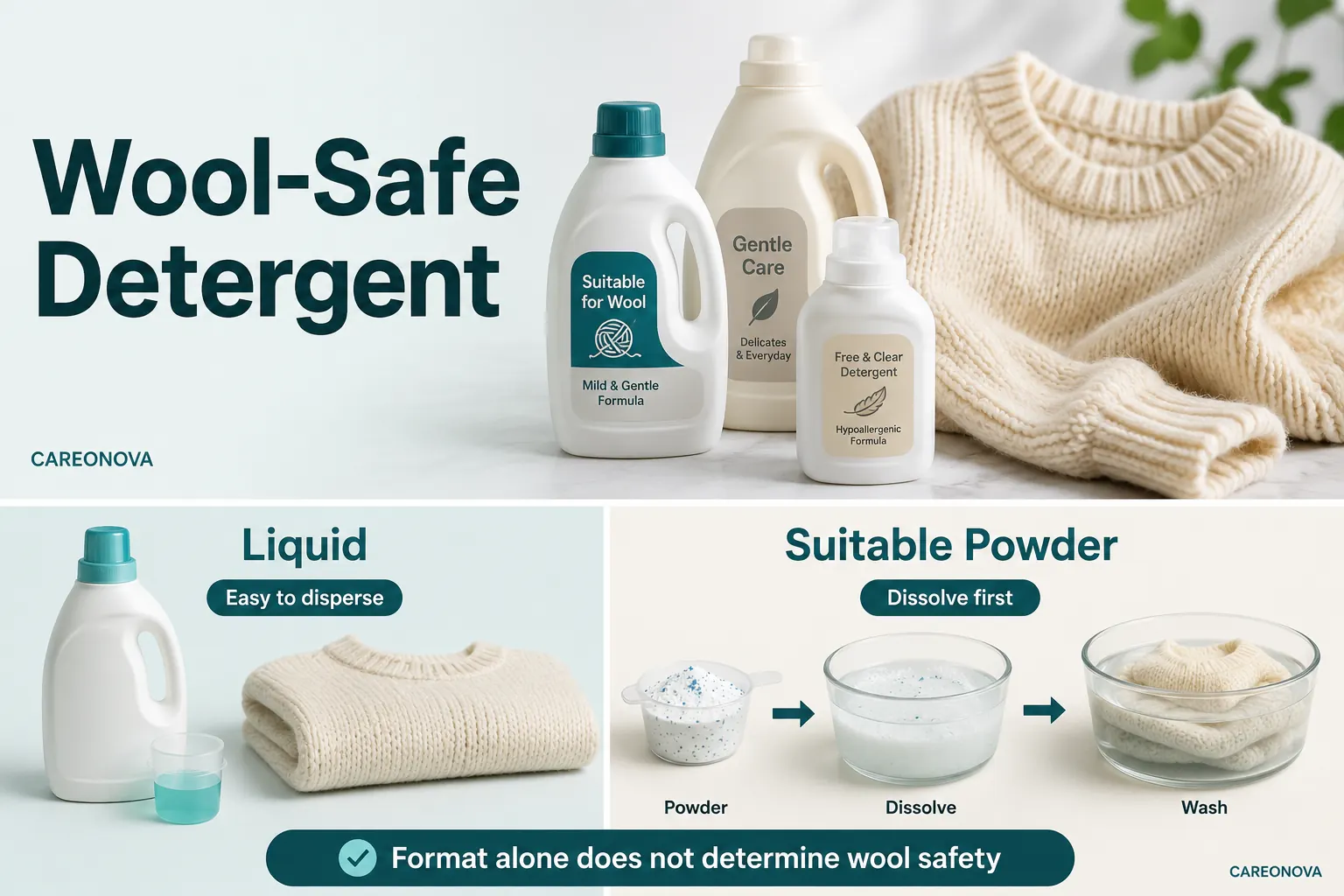
Liquid detergent can be convenient because it disperses easily, but powdered detergent is not automatically unsafe for wool.

If a suitable powder is used, current wool-care guidance recommends dissolving it before it comes into direct contact with the garment. This reduces the chance of concentrated detergent particles sitting against the fabric.
So I would not use liquid vs powder as the first test.
First establish whether the detergent itself is suitable for wool. Then use it according to the product directions.
Does Wool Detergent Need Lanolin?
No. Lanolin is not a basic requirement for a detergent to qualify as wool-safe.
Some specialty wool washes contain lanolin or advertise it as an added feature. That can matter to shoppers choosing between formulas, but it should not become the main safety test.
A product containing lanolin is not automatically better for every wool item, and a detergent without lanolin is not automatically unsuitable.
What matters first is confirmed wool compatibility.
What About No-Rinse Wool Wash?
A no-rinse formula mainly changes how the product is intended to be used.
It does not automatically mean that the detergent cleans better, protects wool better, or is safer than a rinse formula.
Follow the dose and rinse instructions for the particular product.
I wouldn’t overthink this feature. Establish wool suitability first; decide between rinse and no-rinse afterward.
Does the Same Detergent Work for Merino and Wool-Silk Products?
For washable Merino wool, the same basic detergent principles apply: use a mild detergent that is suitable for wool and follow the garment’s own care instructions
Products marketed for wool and silk may also be suitable for wool, but the front label should not be treated as proof by itself. Check the product directions and confirm that the manufacturer permits its use on the particular wool item you intend to wash.
There is no need to create separate detergent rules for every sweater, scarf, base layer, or wool blend. Start with the detergent’s stated fabric compatibility and the garment care instructions.
Final Takeaway
A good wool-safe detergent does not need complicated marketing claims. Look for clear wool suitability, a mild formula, and instructions that match the item you are washing.
Do not assume that words such as gentle, delicates, natural, hypoallergenic, or lanolin automatically mean wool-safe.
Heavy-duty detergents, enzyme-containing bio formulas, and chlorine or oxygen bleach do not fit current Woolmark wool-washing guidance. Powder is not automatically off-limits, and a wool-only detergent is not always the sole suitable option.
The simplest rule is also the most useful:
Choose the detergent based on confirmed wool suitability, not marketing language alone
