


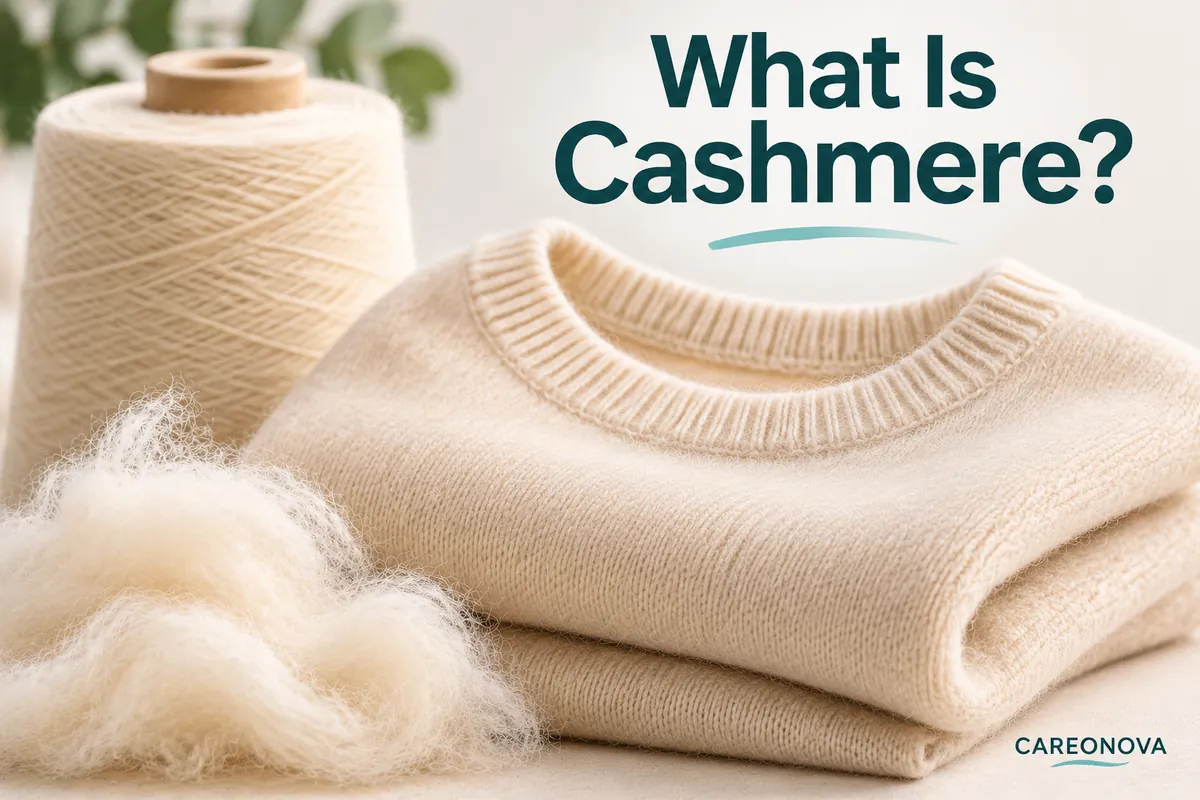
Cashmere is a soft, natural animal fiber that comes from the fine undercoat of cashmere goats. This undercoat helps protect the animals from cold weather. After collection, workers separate the fine fibers from coarser guard hairs and process them into yarn and fabric. Cashmere is valued for its softness and lightweight warmth, but its quality and durability can vary.
Cashmere at a Glance
| Feature | Details |
|---|---|
| Fiber type | Natural animal fiber |
| Source | Fine undercoat of cashmere goats |
| Composition | Protein fiber made mainly of keratin |
| Main qualities | Softness, warmth and lightweight feel |
| Processing | Collection, sorting, cleaning and dehairing |
| Common uses | Sweaters, scarves, shawls and blankets |
| Main limitation | Can develop pills through friction |
What Is Cashmere Made From?
Cashmere comes from the fine, soft undercoat of cashmere goats. Their coats generally contain two types of hair that serve different purposes.
The outer layer contains longer, coarser guard hairs. These help protect the animal from wind, rain and other environmental conditions. Beneath them is a finer layer of down that provides insulation during cold weather.
The fine undercoat is the part used to produce genuine cashmere. It must be separated from the coarser hair before it can be processed into yarn.
The Difference Between Undercoat and Guard Hair
The two layers have different properties and functions.

| Feature | Undercoat | Guard Hair |
|---|---|---|
| Texture | Fine and soft | Coarser and longer |
| Main role | Helps provide insulation | Helps protect the outer coat |
| Processing | Used to produce cashmere | Separated during dehairing |
| Fiber diameter | Generally finer | Generally coarser |
Not all hair from a cashmere goat qualifies as cashmere. The fine undercoat must meet specific fiber requirements, including limits on average diameter and the amount of coarse fiber present.
Cashmere is a natural protein fiber made mainly of keratin. This is the same broad type of protein found in other animal hair fibers.
Is Cashmere Wool?
Cashmere comes from goats, while conventional sheep's wool, such as Merino wool, comes from sheep. Both are natural animal fibers, but they have different sources and fiber characteristics.
There is also an important difference between everyday language and US labeling rules. People often use the word wool to mean sheep's fleece. However, the US Wool Products Labeling Act also includes cashmere goat hair within its legal definition of wool.
Where Does Cashmere Come From?
Cashmere goats are raised in cold and dry regions of Central and East Asia. China and Mongolia are important sources of cashmere, while production also takes place in parts of India, Pakistan, Afghanistan, Iran and other regions.
These areas have climates where goats have traditionally developed fine winter undercoats to help them cope with cold conditions.
The exact amount and quality of fiber can vary with the goat, local climate, breeding practices and animal care.
Why Is Cashmere Associated With Kashmir?
The name cashmere is historically linked to Kashmir, a region known for its traditional fine shawls and textile production.
However, this does not mean that all modern cashmere comes from Kashmir. The fiber is now produced in several countries, with China and Mongolia playing important roles in the global supply chain.
It is also useful to distinguish the origin of a fiber from the origin of a finished garment. Cashmere may be collected in one country, spun into yarn in another and made into clothing somewhere else.
A garment's country of manufacture does not necessarily identify where its raw fiber came from.
How Is Cashmere Made?
Cashmere production begins with the goat's fine winter undercoat. Workers collect the fiber, separate it from coarse hair and prepare it before spinning it into yarn.
The exact methods and order of processing can vary between producers and regions, but the main stages are similar.

1. Collecting the Undercoat
Cashmere goats develop a fine undercoat during colder months. In many production systems, they begin shedding this layer as temperatures rise in spring.
Producers can collect the fiber through combing or shearing.
Combing usually removes loose undercoat fibers while leaving much of the outer coat in place. Shearing cuts the coat and may collect both fine and coarse hair together, which requires further separation.
The collection method alone does not determine whether the final material is genuine cashmere. Fiber quality and proper processing also matter.
2. Sorting the Raw Fiber
After collection, workers sort the raw fiber by characteristics such as color, fineness and length.
This helps separate different fiber types and prepare the material for cleaning and processing. Raw fleece may also contain dirt, plant matter and other impurities.
Careful sorting helps create a more consistent supply of usable fiber.
3. Cleaning and Dehairing
Cleaning and dehairing are important stages in cashmere production.
Scouring, or washing, removes dirt, grease and other impurities from the raw fiber. Dehairing then separates the fine undercoat from coarser guard hairs.
These processes may take place in a different order depending on the processing system. The goal is to obtain clean, fine fibers suitable for textile production.
4. Preparing and Spinning the Fiber
After cleaning and dehairing, the fibers are prepared for spinning.
Processes such as carding help separate and align the fibers into a more workable form. The prepared material is then spun into yarn.
Fiber length, fineness and preparation can influence the properties of the resulting yarn.
5. Making Cashmere Fabric
Cashmere yarn can be knitted or woven into fabric.
Knitting is common for products such as sweaters, while weaving can be used for scarves, shawls and other textiles.
The final feel and appearance depend on the fiber, yarn construction, fabric structure and finishing process.
What Makes Cashmere Soft, Warm and Lightweight?
Cashmere is valued for its fine texture and ability to provide warmth without always feeling heavy.
These qualities are linked to its fiber characteristics and the structure of the finished fabric. However, different cashmere garments can perform differently because their yarn, thickness and construction may vary.
Why Does Cashmere Feel So Soft?
Softness is closely linked to fiber fineness.
Fine fibers generally feel smoother against the skin than coarser fibers. The amount of coarse hair remaining after dehairing can also affect the comfort of the finished fabric.
Fiber diameter is measured in microns. One micron is one-millionth of a meter. A smaller diameter generally means a finer fiber, but diameter alone does not determine how a finished garment feels.
Yarn construction, fabric structure and finishing can also change the final texture.
Why Is Cashmere Warm?
Cashmere fabrics can provide good insulation because their structure helps trap pockets of still air.
This trapped air slows heat transfer and helps retain warmth. As a result, some cashmere garments can feel warm without being especially heavy.
However, warmth depends on more than the fiber itself. Fabric thickness, knitting density, yarn construction and garment design all play a role.
A thick wool garment may provide more insulation than a lightweight cashmere garment. When comparing Merino wool and cashmere, consider fiber properties alongside garment weight, knit density and construction.
Is Cashmere Breathable?
Cashmere can feel comfortable in different conditions, but breathability depends on the finished fabric.
Fiber properties, yarn thickness, knit structure and garment weight all affect how heat and moisture move through clothing.
For example, a loosely knitted sweater may allow more airflow than a dense, tightly constructed fabric.
This is why the performance of one cashmere garment should not be used to describe every other cashmere product.
How Do You Judge Cashmere Quality?
Not all cashmere products have the same quality. Fiber characteristics matter, but the way the fiber is spun and turned into a garment also makes a difference.
Fiber Quality: What Matters?
Several characteristics influence the quality of raw cashmere.
| Factor | Why It Matters |
|---|---|
| Fiber fineness | Influences softness and comfort |
| Fiber length | Affects yarn formation and fiber retention |
| Diameter variation | Shows how consistent fiber thickness is |
| Dehairing | Reduces the amount of coarse hair |
| Fiber cleanliness | Helps prepare the material for spinning |
Fiber fineness is important, but it does not tell the whole story. Two batches with similar average diameters may still differ in fiber length, consistency and coarse-fiber content.
A more complete assessment considers several characteristics together.
Why Does Garment Construction Matter?
Two sweaters made from cashmere can have different levels of comfort, strength and durability.
This can happen because of differences in:
- Yarn thickness and construction.
- Number of yarn strands.
- Knitting density.
- Fabric weight.
- Finishing methods.
- Overall garment construction.
For example, a garment made from fine fiber may still have problems if its yarn or construction is weak.
A well-constructed garment can also perform better in everyday use than a poorly made product with similar fiber content.
Are Cashmere Grades a Reliable Quality Measure?
Some sellers use terms such as Grade A, Grade B and Grade C to describe cashmere quality.
These grades often refer to characteristics such as fiber fineness and length. However, commercial grading systems can differ between sellers and manufacturers.
They should not be treated as one universal legal grading system.
A higher grade claim does not automatically prove that a finished sweater is better. Buyers should also consider fiber content, yarn construction, fabric density and finishing.
How Can You Identify Genuine Cashmere on a Clothing Label?
A garment label is a useful starting point when checking cashmere content.
In the United States, the Wool Products Labeling Act sets specific requirements for products identified as cashmere. The term can only be used for fine, dehaired undercoat fibers from a cashmere goat that meet the legal fiber standards.
US Legal Requirements for Cashmere
The US definition includes these requirements:
| Requirement | Legal Standard |
|---|---|
| Fiber source | Fine, dehaired undercoat of a cashmere goat |
| Average diameter | No more than 19 microns |
| Coarse-fiber limit | No more than 3% by weight may have average diameters exceeding 30 microns |
| Diameter variation | Coefficient of variation around the mean must not exceed 24% |
The coefficient of variation measures how much fiber diameter varies around the average. It helps describe consistency within a fiber sample.
These are legal labeling criteria, not a complete quality grading system. A garment can meet the legal definition of cashmere without automatically being a premium-quality product.
For the full US requirements, see the FTC's cashmere labeling guidance.
How to Read a Cashmere Garment Label
The fiber-content label helps consumers understand what a garment is made from.
| Example Label | What It Means |
|---|---|
| 100% Cashmere | The product claims to contain only cashmere fiber |
| 90% Cashmere, 10% Wool | The garment contains two disclosed fiber types |
| 50% Cashmere, 50% Merino Wool | A blend of cashmere and sheep's wool |
Examples are illustrative and do not represent actual product labels.
If a US wool product contains cashmere mixed with sheep's wool and identifies cashmere on its label, it must disclose the actual fiber percentages. A general claim such as "Cashmere Blend" without the required percentages is not sufficient.
The label also provides other useful information. Most wool products must identify their country of origin and the name or registered identification number of the responsible manufacturer or marketer. Apparel care instructions are required under a separate FTC rule.
A label is a declaration of fiber content, not proof that the garment has been independently tested. Consumers should be careful with products that make strong cashmere claims but provide unclear or incomplete composition information.
Can You Identify Cashmere by Touch?
Softness alone cannot prove that a garment contains genuine cashmere.
Other fine animal fibers and synthetic materials can also feel soft. Some sheep produce very fine wool with a diameter similar to cashmere.
Trained textile experts can distinguish cashmere from sheep's wool through microscopic examination of fiber structure. They look at surface scale patterns as well as other characteristics, not just fiber diameter.
This type of examination uses established textile-testing methods. It is more reliable than judging authenticity by touch alone.
Does Cashmere Pill? Is It Durable?
Cashmere can pill during normal use. Pilling happens when loose fibers move to the fabric surface and become tangled into small balls.
It often appears in areas that experience repeated friction, such as the underarms, sleeves and sides of a sweater.
Why Does Cashmere Pill?
Several factors can affect pilling:
- Fiber length and characteristics.
- Yarn construction.
- Knitting structure.
- Friction during wear.
- Washing and garment handling.
Loose surface fibers can become tangled as the garment rubs against other surfaces. The amount of pilling varies between fabrics and products.
Some initial pilling can occur as loose fibers work their way out of the fabric. This does not automatically mean that the garment is fake or poor quality.
Is Cashmere Durable?
Cashmere can be durable enough for regular wear, but its performance varies between garments.
Fiber length, yarn construction, fabric density and finishing all influence how well a product handles repeated use. These characteristics can vary across different wool fibers, making garment construction important when judging durability. Proper wool care and storage also affect its condition over time.
A lightweight cashmere sweater may need more careful handling than a heavier, more tightly constructed garment.
It is therefore better to judge durability through the complete construction of the product rather than the fiber name alone.
Why Is Cashmere So Expensive?
Cashmere often costs more than ordinary wool because producing fine, usable undercoat requires several stages of collection and processing.
The amount of fine fiber available is limited. Raw fleece also contains coarser guard hairs that must be separated before the fine undercoat can be used.
Several factors contribute to the final cost:
| Cost Factor | How It Affects Production |
|---|---|
| Limited fine undercoat | Restricts the supply of usable fiber |
| Sorting | Separates fibers by their characteristics |
| Dehairing | Removes coarser hair from the fine undercoat |
| Spinning | Converts prepared fiber into usable yarn |
| Manufacturing | Adds knitting, weaving and finishing costs |
| Retail pricing | Includes distribution, brand and business costs |
The final retail price is not determined by raw fiber alone.
Two cashmere garments can have very different prices because of differences in fiber quality, manufacturing, design, brand positioning and retail costs.
A higher price does not automatically guarantee better cashmere. The fiber content and garment construction still matter.
Is Cashmere Ethical and Sustainable?
Cashmere production can create environmental and animal-welfare concerns. Its impact depends on how goats are raised, how the fiber is collected, how grazing land is managed and how the supply chain operates.
It is not accurate to describe all cashmere as sustainable or all production as harmful.
Animal Welfare and Cashmere Collection
Cashmere is commonly collected through combing or shearing, but the method alone cannot show whether the process is humane.
Animal welfare also depends on handling, handler training, collection timing and the condition of the animals. Protection from cold after collection can also matter, particularly in regions with harsh weather.
A responsible production system should consider the animal's health and welfare throughout the process, not only during fiber collection.
Cashmere Production and Grassland Health
Cashmere goats are raised in several dry and cold regions where grazing land supports both animals and local communities.
When grazing pressure becomes too high, vegetation may struggle to recover. In some areas, this can contribute to soil degradation and changes in grassland ecosystems.
However, the impact varies with herd size, grazing practices, local climate and land management. Not every production area faces the same conditions.
Responsible grazing aims to balance animal needs, land recovery and the livelihoods of herding communities.
What About Recycled and Responsibly Sourced Cashmere?
Recycled cashmere uses fiber recovered from manufacturing waste or previously used textiles.
The recovered material is sorted and processed before it can be used again. Its final quality depends on the condition of the original fibers, the recycling method and the way the material is blended or spun.
Recycled content can reduce the need for some virgin fiber, but it does not automatically make a product more sustainable. Collection, processing, transport and manufacturing also have environmental effects.
Responsible sourcing standards can address issues such as animal welfare, land use, biodiversity, working conditions and fiber quality.
However, standards differ in their scope and verification methods. Some focus on conditions at the farm or herder level, while separate chain-of-custody systems may track fiber through later stages of the supply chain.
Consumers should check what a certification actually covers rather than assuming that a logo guarantees zero environmental impact.
The Sustainable Fibre Alliance's Animal Fibre Standard outlines its approach to animal welfare, responsible land use, biodiversity, decent work and fiber quality.
