


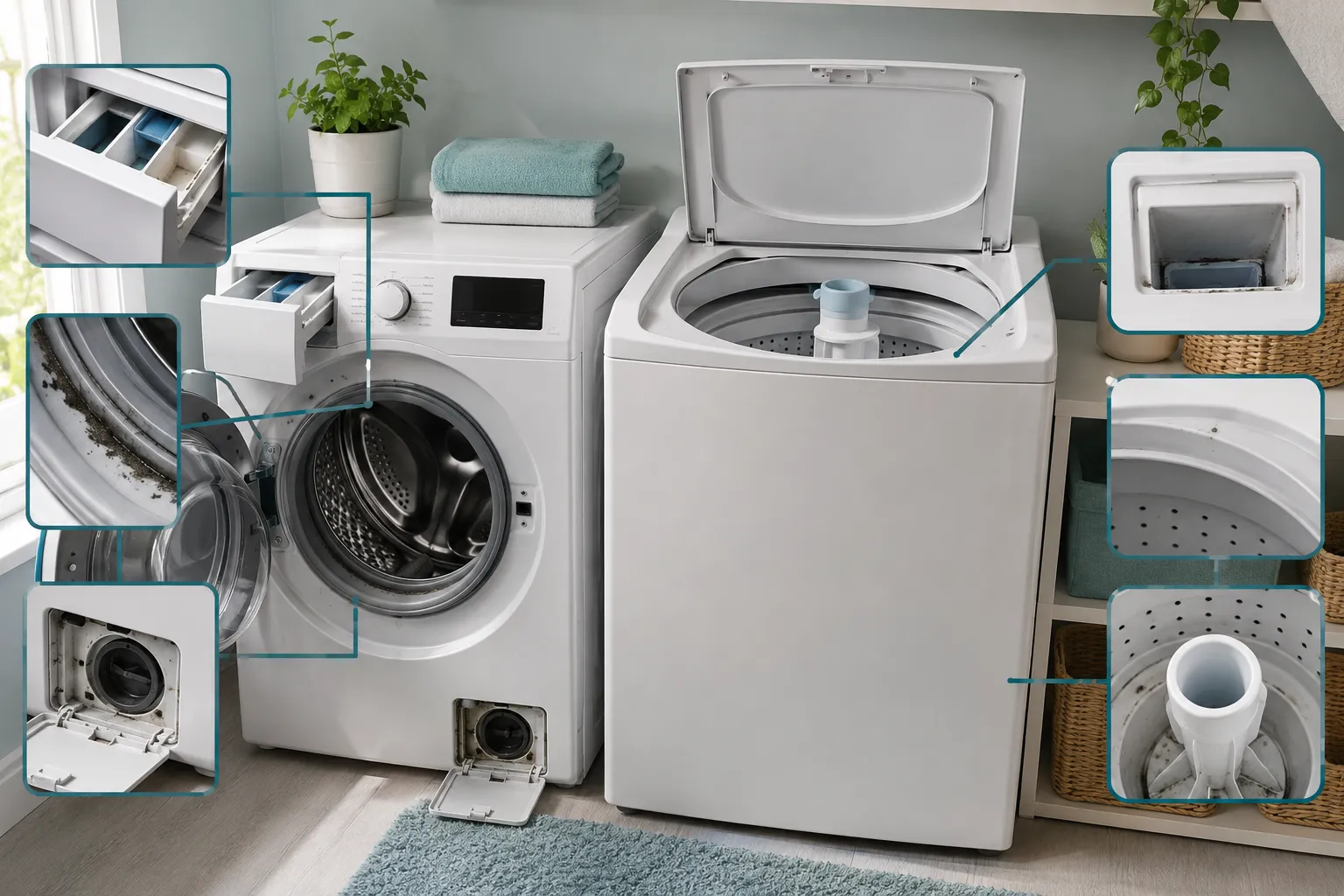
To clean mold in a washing machine, empty the washer, remove visible buildup from the parts that trap moisture, and run the Self Clean, Tub Clean, or Clean Washer cycle listed in the appliance manual. Front-load machines need attention around the rubber gasket, detergent drawer, and pump filter, while top-load washers often collect residue around the lid, tub rim, dispensers, and agitator area.
Start with the seven-step process below, then follow the instructions for your washer type. The later sections explain which cleaners may be suitable, why a musty smell can remain when no mold is visible, and when recurring odor, standing water, or dark debris needs professional service.
How to Clean Mold From a Washing Machine
Visible spots are only part of the problem. Mold and musty odor can return when detergent residue, standing water, poor drainage, or hidden moisture remains inside the machine.
- Empty the washer. Remove all laundry and check the drum for standing water, dark flakes, residue, or trapped objects.
- Read the maintenance instructions. Confirm which product, compartment, dose, and cleaning cycle your washer requires.
- Wash removable parts. Remove and rinse drawer inserts, dispenser cups, lint filters, or caps only when the manual allows it.
- Wipe the door or lid area. Clean the gasket folds on a front-loader or the lid, hinges, and upper tub rim on a top-loader.
- Check the filter and drainage system. Clear any filter the owner can safely access and look for retained water or slow drainage.
- Run the cleaning cycle. Add the specified product in the correct location and run Self Clean, Tub Clean, or Clean Washer with an empty drum.
- Rinse, wipe, and dry. Complete any required rinse, remove loosened residue, and leave the door, lid, and detergent drawer open until the washer is dry.
Do not automatically select the hottest or longest normal wash. When the washer does not have a labeled cleaning cycle, use the maintenance process stated in its manual.
Where Does Mold Hide in a Washing Machine?
Mold commonly develops where water, detergent, lint, and fabric softener remain after a wash. Dark buildup is often called black mold, but color alone cannot identify the organism or confirm that every mark is active growth.
| What You Notice | Possible Cause | Inspect First |
|---|---|---|
| Dark spots inside gasket folds | Mold, residue, or permanent staining | Gasket folds and lower drain openings |
| Slimy film in the detergent drawer | Detergent, softener, bacteria, or mold | Drawer inserts and housing |
| Black flakes in the drum | Product sludge, gasket debris, or hidden tub buildup | Gasket, drawer, and tub |
| Musty smell without visible marks | Standing water, filter buildup, drainage trouble, or residue | Pump filter and drain setup |
| Dark, cracked, or sticky rubber | Gasket damage rather than removable buildup | Seal condition |
| Orange or brown marks | Rust, iron, manganese, or mineral deposits | Water supply and metal parts |
Appearance can provide clues, but it cannot confirm mold by itself. Rubber that remains cracked, sticky, rough, or warped after washing may be damaged rather than dirty.
Orange or brown marks are more likely to come from rust or minerals than mold. When similar stains also appear on clothing, investigate whether iron and mineral deposits in laundry water are affecting the washer and fabrics.
What Cleaner Should You Use for Washer Mold?
Use the product specified for your washer and the part being treated. There is no universal bleach dose, vinegar ratio, compartment, water temperature, or soaking time that works safely for every machine.
| Cleaner | When It Fits | Main Limitation |
|---|---|---|
| Recommended washer cleaner | Self Clean or Tub Clean when listed in the manual | Placement and dosage vary by product and model |
| Liquid chlorine bleach | Only when the washer’s mold-removal procedure permits it | Incorrect use can damage rubber, finishes, fabric, or metal |
| Diluted oxygen bleach | Recommended for some gaskets and machines | Not suitable for every washer |
| Mild detergent and water | Drawers, inserts, dispensers, and surface residue | Does not replace an internal cleaning cycle |
| White vinegar | Only when the appliance instructions permit it | Acidic and not approved for every gasket or component |
Do not mix cleaning products. Complete one method, finish every required rinse, and allow the washer to air out before considering another product.
Does Bleach Kill Mold in a Washing Machine?
Chlorine bleach may help remove and control mold on compatible, nonporous washer surfaces when the manufacturer permits it. Physical wiping is still necessary, and the bleach must be used at the stated dose and in the correct compartment.
Never pour undiluted chlorine bleach directly onto a rubber seal. Straight bleach can discolor or weaken rubber and may damage other washer components.
Can You Use Vinegar for Washing Machine Mold?
Some manufacturers allow white vinegar for specific maintenance tasks, while others warn against acidic products on certain seals and internal parts.
Use vinegar only when the instructions for your washer permit it. Never use vinegar and chlorine bleach together. Finish one method, complete every required rinse, and let the machine air out before using a different product later.
How to Remove Mold From a Front-Load Washer

To remove mold from a front-load washer, focus on the rubber door gasket, detergent drawer, pump filter, and internal tub. Wiping only the visible stainless-steel drum can leave the main moisture traps untreated.
How to Clean Mold From the Washer Gasket
Open the washer door and gently pull back the rubber folds. Remove lint, hair, coins, buttons, and other trapped objects. Pay close attention to the lower section, where water often collects.
Use only the product and dilution permitted for the machine. Wipe the outer surface and inside each fold with a soft cloth or nonmetal brush. Do not use knives, screwdrivers, or stiff metal tools that could puncture the seal.
Rinse when the instructions require it, then dry the gasket fully. For more detailed maintenance, clear residue from the hidden folds and drainage areas around the front-load door seal without pulling or soaking the rubber.
How to Clean Mold From the Detergent Drawer
Mold in the detergent drawer can remain inside removable inserts, softener channels, the drawer housing, and the water openings above it.
Remove the drawer only when the manual permits it. Separate the liquid-detergent cup, softener insert, and other removable pieces. Rinse away sticky detergent and fabric-softener film, then use a soft brush on corners and narrow channels.
Wipe the space behind the drawer as well. Do not push metal tools into the water openings or force fixed parts out of the washer. Let the drawer and inserts dry before reinstalling them.
Check the Pump Filter and Drainage
Many front-load washers have a pump filter behind a small panel near the bottom of the machine. Confirm that your model has a filter the owner can safely open.
Turn off and unplug the washer unless its instructions provide another safe process. Place towels and a shallow container nearby because stored water may escape. Remove lint, hair, coins, sludge, and other debris, then reseal the filter before restoring power.
Do not force a stuck filter. A loose cap or damaged seal can cause leakage. When the washer drains slowly or holds water, the washing-machine drain hose may also need attention according to the model instructions.
Run the Self Clean or Tub Clean Cycle
After treating the accessible areas, run the washer’s cleaning cycle with an empty drum. Use the product, dose, and compartment stated for the machine.
Do not add clothing or regular laundry detergent unless the instructions require it. When the cycle ends, remove loosened residue, complete any listed rinse, and leave the door and drawer open to dry.
How to Remove Mold From a Top-Load Washer

Mold in a top-load washer commonly develops around the underside of the lid, upper tub rim, detergent and softener dispensers, lint filters, and agitator or impeller area.
Top-load washers do not have a front-door gasket, so their main moisture traps are usually around the lid, dispenser openings, upper tub ring, and central wash mechanism.
Clean the Lid, Rim, and Dispensers
Wipe the underside of the lid, hinges, seams, and the full upper edge of the tub. These covered surfaces can stay damp after the visible drum has dried.
Remove dispenser cups or inserts only when the manual allows it. Wash away detergent, fabric softener, lint, and slime, then wipe the openings where each part sits. Dry everything before reassembly.
Check the Agitator or Impeller Area
Wipe the visible surfaces around the agitator, wash plate, or impeller. Remove a cap or lint filter only when the manual provides a safe method.
Do not dismantle the agitator, wash plate, inner tub, or fixed panels to reach suspected growth. Dark flakes that keep returning may come from hidden residue or deteriorating parts that require service access.
Run the Tub Clean Cycle
Empty the washer and add the recommended product in the stated location. Powder, liquid, and tablet cleaners may require different placement.
Run the full Tub Clean or Clean Washer cycle. Do not add clothing or select a separate hot-water setting unless the instructions tell you to. When the cycle ends, wipe away loosened residue and leave the lid safely open until the tub dries.
Why Does the Washer Smell Moldy When No Mold Is Visible?
A musty smell can come from hidden mold, but detergent buildup, a dirty pump filter, standing water, poor drainage, or wet laundry left inside can cause the same odor.
Check the detergent drawer, gasket, lid, and dispensers first. Look for water remaining in the drum, and clear any filter the owner can safely access. Thick detergent or softener film can hold moisture and smell musty even when no obvious mold is visible.
When the source is unclear, inspect the washer parts and laundry habits that commonly cause bad odors before adding another product.
A front-loader that remains musty after the drum looks clean may need a closer check for moisture trapped around the seal, drawer, and filter.
Request service when the odor quickly returns after accessible parts have been treated and the cleaning process in the manual has been completed.
Why Does Mold Keep Coming Back?
Mold returns when moisture, laundry-product residue, poor drainage, or hidden buildup remains after treatment. Removing visible marks without correcting those conditions leaves another damp surface for growth.
| Why It Returns | What to Change |
|---|---|
| Door or lid stays closed while damp | Leave it safely ajar after use |
| Gasket holds water | Wipe the folds and door glass dry |
| Too much detergent is used | Measure the amount for the load and machine |
| Standard detergent is used in an HE washer | Use HE detergent when required |
| Softener coats the drawer and channels | Reduce the dose and wash the dispenser |
| Wet clothes remain inside | Remove laundry promptly |
| Filter or drain is blocked | Clear accessible parts and correct the drainage problem |
| Laundry room remains humid | Improve ventilation or use a dehumidifier |
| Gasket is damaged | Request inspection or replacement |
| Hidden buildup remains | Follow the stated treatment or request service |
Remove laundry soon after the cycle ends and dry the gasket, door glass, lid, or tub rim. Leave the door or lid safely ajar and let the detergent drawer dry when its design permits it.
Use the correct detergent type and measure the amount for the load, washer, and water conditions. Excess detergent and softener can leave a film that holds moisture and soil.
Run the maintenance cycle when the washer displays a reminder or at the interval stated in its manual. Between mold problems, follow a regular washer-care routine matched to the machine.
What Should You Do With Laundry From a Moldy Washer?
After treating the washer, rewash clothing that smells musty or contains visible dark debris. Follow the garment’s washing symbols and care instructions, then dry every item fully.
This does not mean every garment has active mold growth. Clothes with visible mold need separate treatment suited to the fabric, while musty clothing may only need rewashing after the washer has been restored.
When Should You Replace the Gasket or Request Service?
Many moldy washing machines can be cleaned successfully when buildup is limited to accessible parts and the washer drains normally. Service becomes more likely when growth is behind sealed components, the gasket is damaged, or odor and dark debris continue to return.
Request service when:
- mold or odor remains after the manufacturer-directed cleaning process;
- standing water remains or drainage stays slow;
- the pump filter cannot be opened, cleared, or resealed;
- the gasket is cracked, sticky, warped, or leaking;
- dark flakes return after treatment;
- growth appears behind fixed panels or around the outer tub;
- the washer leaks onto the floor or wall;
- the odor resembles sewage, burning rubber, or chemicals rather than mildew.
Permanent dark staining alone does not always mean the gasket needs replacement. Cracks, leaks, stickiness, warping, or recurring embedded growth are stronger reasons to request an inspection.
Final Takeaway
To clean mold from a washing machine, treat the areas that hold moisture before running the cleaning cycle listed for the model. Focus on the gasket, drawer, dispensers, filter, lid, tub rim, and drainage system. Never mix cleaning products or apply straight bleach to rubber. Dry the machine after use and correct detergent, drainage, leakage, or humidity problems when mold or musty odor keeps returning.
