


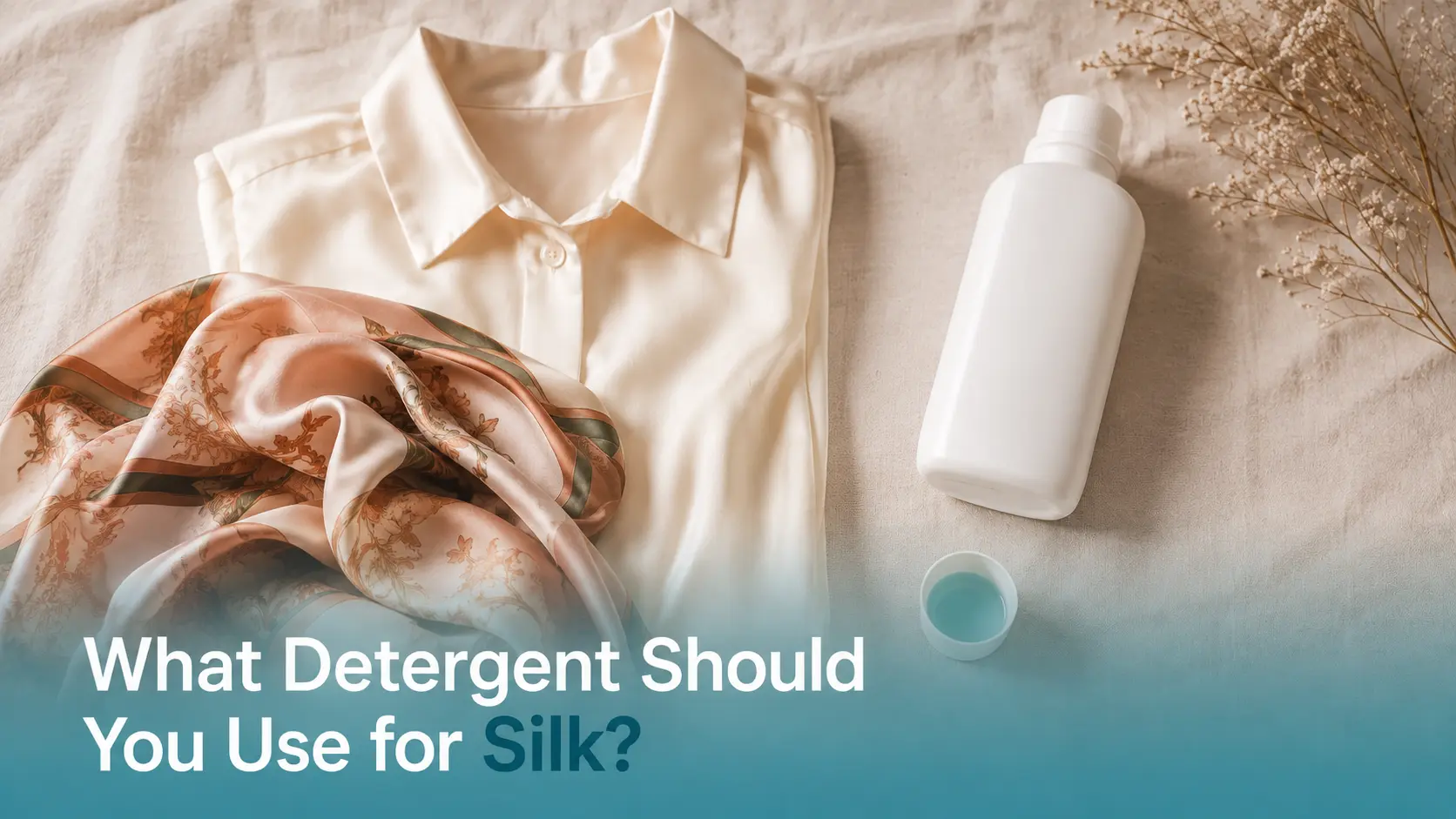
The best silk detergent is one made specifically for washable silk, or a gentle delicate or wool formula whose label clearly confirms it’s safe for the fabric. This protein fiber reacts poorly to regular, heavy-duty, whitening, and unapproved enzyme detergents, which can weaken it, dull its shine, or damage the dye. Before you wash anything, check the care label, since linings, trims, and garment construction can make home washing risky even when the outer material is silk.
This guide walks through how to check whether the item is washable, what to look for on a silk-specific detergent label, and how enzymes, bleach, and pH claims affect the fiber. It also covers how much to use, how to match a silk-friendly detergent to different pieces like pillowcases, blouses, and scarves, and what to do if the fabric comes out of the wash stiff, dull, or scented.
What Detergent Should You Use for Silk?
A good silk detergent often marketed as a mild or gentle detergent for silk should clean at a low temperature, rinse without excessive residue, provide clear dosage instructions, and avoid ingredients that are unsuitable for the fabric.
You do not need one particular brand. You need a formula whose fabric claim, ingredients, washing directions, and dose are suitable for the item in front of you.
| Detergent type | Suitability | What to confirm |
|---|---|---|
| Silk-specific detergent | Best starting option | Approved hand- or machine-washing method and the correct dose. |
| Delicate detergent | Check first | The label or manufacturer must clearly include silk. |
| Wool detergent | Check first | The formula must be approved for both wool and silk. |
| Regular detergent | Usually avoid | Check for enzymes, strong builders, bleach, and optical brighteners. |
| Heavy-duty detergent | Avoid | These formulas are designed for tougher soil and mixed everyday loads. |
| Whitening detergent | Usually avoid | Check for chlorine bleach, oxygen bleach, and optical brighteners. |
| No-rinse wash | Conditional | Follow explicit silk-safe and no-rinse directions. |
A front label that says “gentle,” “natural,” or “free and clear” is not enough. These claims describe only part of the product. They do not confirm its pH, enzyme system, concentration, rinsing behavior, or suitability for protein fibers.
The garment and detergent instructions must also agree. A silk-safe formula cannot make a dry-clean-only dress, lined jacket, or structured garment safe to wash at home.
Check Whether the Silk Item Can Be Washed at Home
The care label decides whether the item should be hand washed, machine washed, or professionally cleaned. Check it before comparing detergent ingredients or choosing a washing cycle.
Care instructions cover more than the main fabric. A garment may contain a washable silk outer layer but still have a lining, shoulder structure, glued detail, padding, embroidery, or dye that cannot tolerate water.
Use CareOnova’s washing-symbol explanations to interpret the label correctly.

Follow these basic decisions:
- Machine wash: Use a machine-compatible silk formula only when the label permits a delicate machine cycle.
- Hand wash: Use a product that disperses in a small amount of cool water and provides a hand-wash dose.
- Dry clean only: Do not attempt home washing because you found a mild detergent.
- No clear label: Use extra caution with valuable, vintage, structured, deeply dyed, or embellished pieces.
When the item is washable, test a diluted detergent solution on a hidden seam before treating a larger area. Stop if the color transfers or the fabric’s texture changes. A successful hidden-area test lowers the risk, but it does not guarantee that the entire item will react in the same way.
Silk and satin also describe different things. Silk is a fiber. Satin is a weave that may be made from silk, polyester, nylon, or another material. Select detergent using the fiber-content and care labels, not the fabric’s shine.
Choose a Formula That Protects Silk
A good detergent for silk should clean at a low temperature, rinse without excessive residue, provide clear dosage instructions, and avoid ingredients that are unsuitable for the fabric.
Look for Clear Silk Compatibility
The strongest label statement is direct wording such as:
- For washable silk
- Safe for silk delicates
- Suitable for silk and wool
- Approved for hand-washing silk
- Suitable for machine-washable silk
A general “delicates” claim is weaker when silk is not mentioned. Check the manufacturer’s current product directions when the bottle is unclear because formulas and fabric recommendations can change.
Treat pH Claims as One Part of the Decision
A pH-neutral claim is a useful sign, but it does not prove that the complete formula is suitable for every silk item. The enzyme system, bleach, brighteners, fragrance, concentration, and washing directions still matter.
“pH-balanced” is less specific. It does not always mean neutral, and it may refer to the concentrated detergent rather than the diluted wash solution.
Do not try to correct an unsuitable detergent by adding vinegar, baking soda, or another household ingredient. Home adjustments cannot turn an uncertain formula into a tested silk product.
Check the Enzyme System
Silk is a protein-based fiber. Protease is an enzyme designed to break down protein-based soil, so a general protease or multi-enzyme formula should not be assumed safe for silk.
Different enzymes have different jobs. Protease targets proteins, amylase targets starch, and lipase helps break down fats. Carefully controlled enzyme treatments can be useful in specialist textile care, but those conditions are different from routine home laundry.
Unless the manufacturer clearly approves its enzyme system for silk, an enzyme-free detergent is the simpler choice. CareOnova’s explanation of how laundry enzymes work covers the differences between common enzyme types.
Avoid Harsh Whitening Systems
Do not use chlorine bleach on silk. It can weaken the fiber and permanently affect its color.
Oxygen or color-safe bleach is gentler than chlorine bleach, but it is not automatically suitable for silk. Use it only when both the garment label and product directions clearly allow it. For routine washing, choose a silk-safe formula without added bleach.
Optical brighteners do not remove dirt. They change how the fabric reflects light and may not suit delicate dyes or finishes. Take the same care with detergents marketed as whitening or color-renewing products.
Fragrance-free detergent can be helpful for pillowcases and other items kept close to the skin, but the absence of fragrance does not prove silk compatibility. Fabric conditioner is also unnecessary for cleaning and may leave a coating that changes the fabric’s feel or appearance.
Can You Use a Detergent You Already Own?
A regular or heavy-duty detergent is usually not the safest option because it may contain enzymes, strong builders, whitening agents, or other features intended for mixed everyday loads.
A gentle, delicate detergent is a better candidate when its label includes silk. A wool wash may also work, but do not assume that all wool products suit silk simply because both fibers are protein-based.
No-rinse formulas can reduce handling during hand washing, but only use them according to silk-specific directions. Do not leave an ordinary rinse-out detergent in the fabric.
CareOnova’s comparison of liquid, powder, pod, sheet, and specialty detergents explains how detergent formats and ingredients affect fabric compatibility.
Match the Detergent to the Silk Item and Washing Method
The right formula depends on the whole item, not only the word “silk” on the fiber label. A pillowcase, scarf, lined blouse, sleep mask, and silk-wool blend can require different levels of caution.
| Silk item | Main detergent priority | Washing consideration |
|---|---|---|
| Pillowcase | Easy rinsing and an accurate low dose. | Protect the zipper, piping, and seams. |
| Sheets | A machine-compatible silk formula. | Keep them away from towels, denim, and rough items. |
| Blouse or dress | Full care-label compatibility. | Check the lining, shape, trims, and garment structure. |
| Scarf | Dye and edge-finish stability. | Avoid rubbing and prolonged soaking. |
| Pajamas | Gentle removal of body soil. | Use a small measured dose and rinse thoroughly. |
| Bonnet or sleep mask | Compatibility with the entire item. | Check elastic, glue, padding, filling, and decorative parts. |
| Silk-wool blend | A formula approved for both fibers. | Follow whichever care instruction is more restrictive. |
A silk pillowcase needs a formula that rinses well because the fabric remains near your face for several hours. A fragrance-free option can be more comfortable when you dislike scent on bedding, but the product must still be approved for silk.
When machine washing is allowed, close or protect zippers and use a mesh laundry bag. Keep silk away from towels, jeans, hooks, fasteners, and rough garments that can create friction.
Hand-washing detergent should disperse in a small amount of cool water. A machine formula must be suitable for the washer and delicate cycle. Do not assume that a product designed only for basin washing will behave correctly in a high-efficiency machine.
The guide to washing different types of fabric safely explains how fiber, dye, trims, structure, and garment construction affect the final method. For the full hand-washing process, follow the steps for washing delicate clothes by hand.
Use the Right Amount of Detergent
Use the product’s hand-wash, small-load, or delicate-cycle dose. Do not copy a tablespoon or capful recommendation from another brand because detergent concentrations vary.
For safer dosing:
- Measure according to the actual amount of water in the basin.
- Use the labeled small-load dose in a washing machine.
- Measure concentrated formulas instead of estimating.
- Mix hand-wash detergent into the water before adding silk.
- Do not add extra product automatically because the water is hard.

Never pour concentrated detergent directly onto silk. Direct contact can leave an uneven mark and make the product harder to rinse from the fabric.
More detergent does not mean better cleaning. Excess product can leave silk stiff, dull, strongly scented, or coated with residue. CareOnova’s detergent-measuring guidance explains how concentration, load size, washer type, and water volume affect the correct amount.
Hard water can reduce cleaning performance and leave minerals on fabric. Adding more detergent without confirming the cause can increase buildup. Check the signs of hard-water laundry residue before changing the dose.
Handle Stains, Stiffness, and Dullness Safely
Silk detergent can remove light body soil and some fresh water-based marks, but it will not safely remove every stain. The result depends on the stain, dye stability, fabric finish, item construction, and how long the mark has remained.
Blot fresh liquid with a clean white cloth without rubbing. Check the care label before applying a stain product, and do not use a general stain remover unless its manufacturer confirms that it is suitable for silk.
Oil, makeup, ink, old stains, and marks on valuable, deeply dyed, structured, or dry-clean-only silk are safer to leave to a professional cleaner. Avoid applying heat until you know whether the stain has been removed.
If silk feels stiff or looks dull after washing, the cause may be detergent residue, hard-water minerals, excess product, concentrated detergent contact, or damage from agitation.
| Problem | Possible cause | Safer next step |
|---|---|---|
| Stiff feel | Excess detergent, incomplete rinsing, or hard-water minerals. | Use a gentle additional rinse only when the care label permits it. |
| Dull appearance | Detergent residue, mineral buildup, or surface damage. | Stop repeated washing and identify the cause before treating it again. |
| Pale or chalky mark | Concentrated or poorly dispersed detergent. | Rinse gently when the item is washable and color remains stable. |
| Strong lingering scent | Too much detergent or incomplete rinsing. | Use less product next time and follow the measured dose. |
| Uneven texture | Rubbing, twisting, strong agitation, or poor drying. | Stop further handling and avoid trying to smooth it with heat. |
| Color change | Dye instability, bleach, heat, or an incompatible treatment. | Stop home treatment and seek professional textile-care advice. |
Do not keep rewashing a valuable silk item in the hope that the problem will disappear. Stop if color transfers, the fabric weakens, the sheen changes, or the texture becomes uneven.
Avoid household fixes such as baking soda, washing soda, dish soap, or homemade detergent. These products are not designed as dependable silk treatments, and their pH or rinsing behavior may create another problem. CareOnova’s comparison of baking soda and washing soda in laundry explains why alkaline products need extra caution around protein fibers.
Final Silk Detergent Checklist
Before washing, make sure the item, detergent, dose, and washing method all agree.
- Confirm that the silk item is washable.
- Look for direct silk compatibility on the detergent.
- Check pH claims, enzymes, bleach, brighteners, and conditioning agents.
- Match the formula to hand or machine washing.
- Measure the smallest label-approved dose.
- Dilute hand-wash detergent before adding the item.
- Stop if color transfers, residue remains, or the fabric changes.
- Use professional cleaning for valuable, structured, vintage, or dry-clean-only silk.
Find a Detergent That’s Actually Safe for Your Silk
Answer a few quick questions about the item, your washer, and your water conditions to get a detergent match instead of guessing from the label.
Use the Detergent comparison tool