


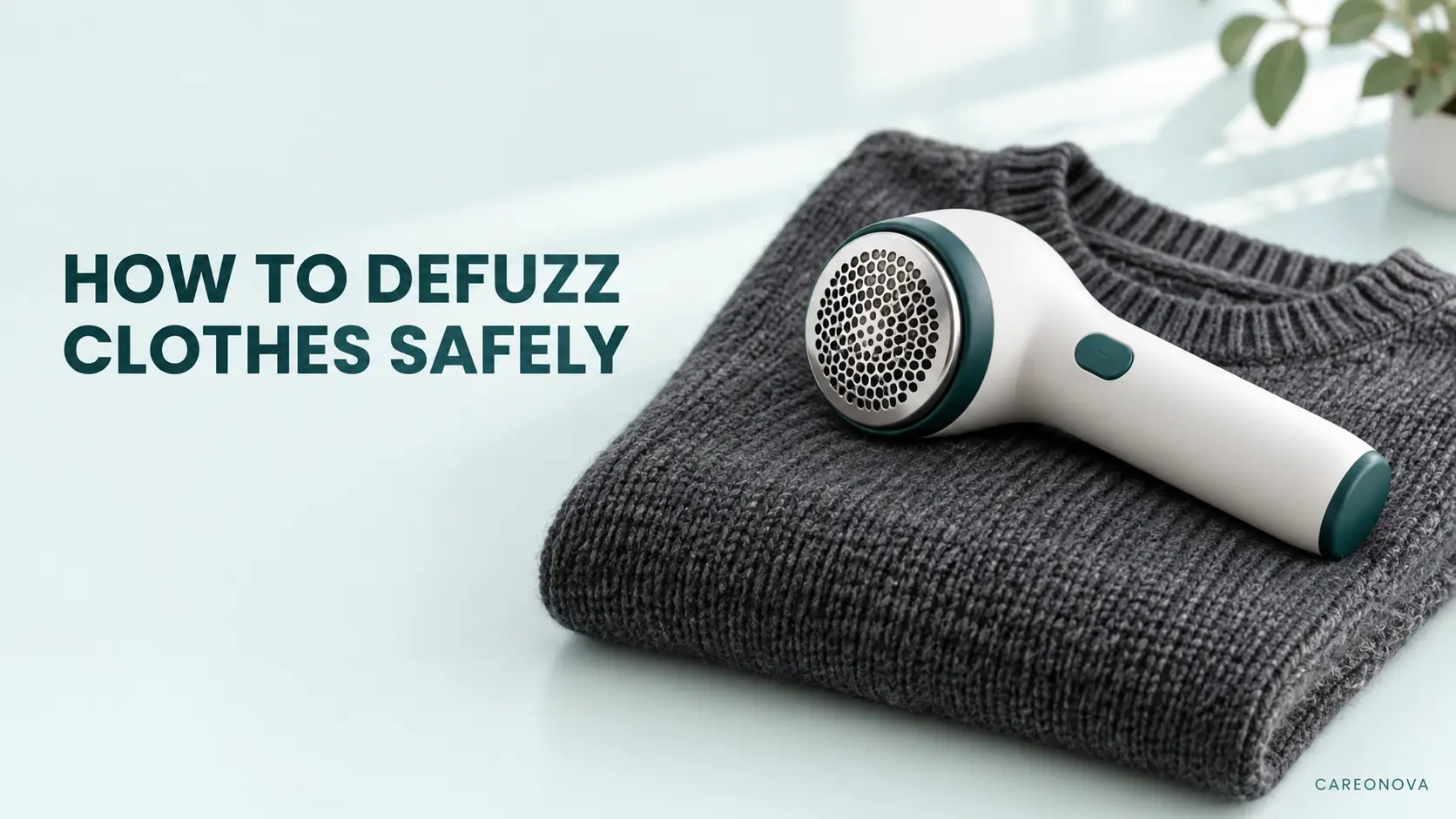
- Mechanism: Fabric shavers use high-speed rotary blades behind a perforated honeycomb foil to shear anchored pills without touching base yarns.
- The Core Divide: Motorized shavers excel on tight weaves, synthetics, and upholstery; delicate cashmere and fine merino demand manual wire-mesh combs; chunky woolens require porous pumice stones.
- The #1 Cause of Fabric Damage: Holes occur when downward hand pressure pushes slack fabric into foil slots. Never shave garments on a soft mattress or while wearing them.
- The Re-Pilling Factor: Natural wool stops pilling once loose surface fibers exhaust; synthetic blends (poly-wool, acrylic) pill indefinitely because high-tensile plastic anchor filaments never break naturally.
What Is a Fabric Shaver (and How Does It Actually Work?)
A fabric shaver is a precision mechanical tool designed to physically shear tangled balls of fiber from the surface of a textile without severing the structural yarns underneath. It uses a high-speed rotary blade assembly spinning behind a perforated metal honeycomb foil guard to safely restore worn garments and upholstery.
While often called a lint shaver, the device serves an entirely different mechanical function than an adhesive lint roller:
- Adhesive Lint Rollers: Rely on surface tackiness to lift unattached foreign debris like pet hair, dust, and dandruff.
- Clothing Pill Removers (Fabric Shavers): Act as a micro-cutting apparatus to slice off knotted fibers that are physically anchored into the garment’s weave.
When the device glides over a textile, the raised, tangled pills poke through the tiny apertures of the metal foil screen, where the internal multi-blade impeller immediately shears them off. Because the rigid foil sits between the spinning blades and the flat base of the fabric, the structural warp and weft yarns remain protected from the cutting plane. Rather than cleaning fabric, a shaver performs surface-level micro-surgery to restore a textile’s original finish.
The Science of the Pill: Why Fabrics Fuzz and Cluster
Before applying any mechanical tool to a garment, you must understand the textile physics behind the damage. Fabrics do not spontaneously sprout fuzz; pilling is the direct result of cyclic mechanical friction and surface abrasion.
When a garment undergoes constant rubbing—from swinging arms, backpack straps, or washing machine agitation—the microscopic ends of short-staple fibers break loose from the spun yarn. Rather than falling away, these loose fibrils migrate to the surface and tangle into tight, knot-like spheres.
These spheres remain attached to the garment face because they are tethered by unbroken anchor fibers still woven into the main yarn structure. Using a fabric shaver for pilling cleanly severs these tethers to release the tangled ball.
The fiber composition of the garment dictates how aggressive this pilling becomes:
- Pure Natural Fibers: Premium natural wool fibers possess a natural crimp and moderate tensile strength. When pure wool pills, the weak anchor fibers eventually snap off naturally under normal wear, allowing the fuzz to shed on its own.
- Synthetic Blends: Extruded plastics like synthetic polyester and nylon possess extremely high tensile strength. When a poly-wool blend experiences friction, the weaker wool breaks down into fuzz, while the unbreakable polyester filament acts as a permanent tether that traps the pill indefinitely until physically cut.
The De-Pilling Toolkit: Rotary Shavers vs. Sweater Combs vs. Pumice Stones
A motorized electric fabric shaver is not universally safe for every item in your closet. Treating a delicate cashmere cardigan with the same high-torque tool you use on a polyester couch is a guaranteed recipe for fabric damage.
Proper textile care requires choosing between three distinct clothing pill remover mechanisms based on the gauge and tension of your knitwear:
1. Motorized Rotary Foil Shavers
- Mechanism: Uses a high-speed internal blade impeller to cleanly slice through tough anchor fibers behind a slotted metal guard.
- Best For: Flat weaves, synthetic blends, cotton sweatshirts, and upholstery.
- Trade-off: Highly efficient over large areas, but lacks tactile feedback and can snag loose or raised knitting stitches.
2. Wire-Mesh Sweater Combs
- Mechanism: Features a stationary, beveled brass or fine wire-mesh edge with zero moving parts. It gently catches and snaps micro-pills off the surface without applying rotational torque.
- Best For: Fine-gauge delicates, silk blends, and luxury animal fibers.
- Trade-off: Slower manual operation, but offers complete tactile control and near-zero risk of cutting holes.
3. Porous Pumice Sweater Stones
- Mechanism: Made from vulcanized volcanic glass that uses a porous, abrasive cellular surface to physically grab and pull away coarse pills.
- Best For: Heavy, chunky woolens, Aran cable knits, and thick outerwear.
- Trade-off: When evaluating a sweater stone vs fabric shaver on thick knits, the stone wins because it cannot suck raised structural yarn loops into a spinning blade chamber. However, it is too abrasive for ultra-fine fabrics.

| Tool Format | Cutting Mechanism | Ideal Fabrics | Risk Level & Best Application |
|---|---|---|---|
| Rotary Electric Shaver | High-speed shearing behind a slotted foil guard | Tight weaves, synthetics, fleece, heavy cotton, upholstery | Moderate Risk (High on loose knits): Fast, broad coverage on dense, flat textiles. |
| Wire-Mesh Sweater Comb | Stationary friction catching and snapping | Cashmere, fine merino, silk blends, delicate knits | Very Low Risk: High-precision manual restoration of luxury delicates. |
| Pumice Sweater Stone | Abrasive cellular snagging and pulling | Chunky cable knits, Shetland wool, heavy fleece | Low-to-Moderate Risk: Heavy outer knits and robust woolen coats where blades snag. |
The Fabric-to-Tool Diagnostic Matrix: Matching Tool to Textile
Selecting the right tool requires evaluating the garment’s fiber composition, yarn twist, and structural density. Relying exclusively on an aggressive furniture fabric shaver for your entire wardrobe will inevitably result in ruined knitwear.
- Delicate Cashmere & Fine Merino: When readers ask, “Can I use a fabric shaver on cashmere?” the answer requires strict boundaries. Cashmere uses delicate 2-ply, low-twist yarns that high-torque blades can easily suck into the foil slots. For fine merino wool and cashmere, a manual wire-mesh comb is the safest choice. If you use an electric sweater shaver, you must attach a height spacer ring set to maximum clearance.
- Chunky & Cable-Knit Woolens: Using a motorized fabric shaver for wool sweaters with raised cable patterns is a major liability. A spinning blade cannot distinguish between a tangled pill and a raised structural knit loop. Always use a pumice sweater stone on heavy, textured knits.
- Synthetics, Fleece & Upholstery: Dense weaves and high-tensile synthetic anchors require the high-RPM shearing power of a motorized rotary shaver with flat foil contact.
Use the diagnostic matrix below when comparing fabric types to match your garment to the safest tool and setting:
| Fabric / Garment Type | Recommended Tool | Clearance / Setting | Primary Hazard / What to Watch Out For |
|---|---|---|---|
| 2-Ply Cashmere & Fine Merino | Wire-Mesh Sweater Comb | Direct flat contact | Yarn ingestion; avoid steep angles that snag the fine-gauge knit loops. |
| Medium-Gauge Wool Blends | Rotary Electric Shaver | High-clearance spacer ring attached | Applying downward hand force that pushes knit slack through the foil slots. |
| Chunky Knits & Cable Sweaters | Pumice Sweater Stone | Gentle parallel strokes | Motorized rotary blades will slice the raised structural cable yarn loops. |
| Cotton/Poly Fleece Sweats | Rotary Electric Shaver | Flat foil contact (No spacer) | Seam and cuff fraying; ensure garment edges are pulled completely taut. |
| Woven Linen or Poly Couches | Heavy-Duty Furniture Shaver | Flat foil contact (No spacer) | Snagging raised decorative embroidery or loose weave threads on cushions. |
The Non-Negotiable Shaving Protocol: How to Shave Clothes Without Cutting Holes
The primary reason consumers ask, “Do fabric shavers ruin clothes?” comes down to user error regarding fabric tension and surface resistance. Fabric shavers do not inherently damage textiles; holes occur only when the physical cutting plane is compromised.
A rotary blade spins millimeters beneath the metal honeycomb foil. As long as the base garment remains flat against the outside of the screen, only the protruding pills enter the cutting chamber. If the fabric slackens, bunches, or folds, that localized mound of material pushes through the foil apertures and directly into the rotating blades.
A fabric shaver requires a firm, unyielding substrate beneath the garment. Resting a sweater on a bed, couch cushion, or your lap creates slack. As the shaving head moves across unsupported fabric, downward hand pressure forces the loose textile to buckle upward into the foil perforations, instantly severing the structural knit loops and creating a permanent hole. Always work on an ironing board or a flat wooden table.
Follow these four non-negotiable operational rules to defuzz any garment safely:
Rule 1: Anchor on a Hard, Flat Surface (The Ironing Board Imperative)
Place the garment on an ironing board, a stone countertop, or a solid wooden table. The rigid backing prevents the textile from dipping or buckling under the toolhead. Never shave a garment while wearing it or holding it in mid-air.
Rule 2: Tension the Fabric Taut with Your Free Hand
Never run a shaver over loose, unanchored fabric. Use your non-dominant hand to firmly grip the garment a few inches ahead of the shaver, pulling the weave completely taut to eliminate all micro-folds, wrinkles, and slack.

Rule 3: Use Zero Downward Pressure and Controlled Circular Strokes
Do not press the shaver down into the garment; the weight of the tool itself is enough. Allow the foil guard to lightly skim the surface plane using smooth, overlapping circular motions. This catches anchor fibers from multiple directions while letting the motor’s RPM and blade sharpness do the work.
Rule 4: Skirt Raised Seams, Hems, and Hardware
Stop the shaving head before reaching structural boundaries. Raised seam stitching, pocket edges, buttonholes, embroidery, and zipper tracks act as topographical hazards. The foil slots will catch these elevated ridges, allowing the blades to instantly sever the garment’s binding threads.
The DIY Razor Myth: Why Disposable Bathroom Razors Ruin Clothes
A pervasive trend on social media promotes using cheap disposable bathroom razors as a DIY fabric razor to depill knitwear. Treating a garment with an unguarded straight blade violates the basic principles of textile architecture and shear mechanics.
Unlike a flat sheet of paper, knitted fabrics consist of microscopic peaks and valleys formed by interlocking hills of yarn loops. A disposable shaving razor stacks multiple exposed blades together without a perforated depth-limiting shield. When dragged across a sweater, the open blade does not just slice the pill—it catches the apex of the raised knit loops and slices through the crown of the structural warp and weft yarns.
The danger of the bathroom razor hack lies in its deceptive immediate results:
- Immediate Appearance: The sweater looks remarkably smooth the moment you finish shaving because the surface fuzz is gone, and residual knit tension temporarily holds the sliced yarn ends in place.
- Delayed Failure: The structural integrity of the knit is already severed. During the next laundry cycle, water and mechanical agitation cause those cut yarns to lose tension and unravel, turning invisible micro-cuts into gaping holes.
Guarded rotary foils exist specifically to keep the cutting edge safely elevated above these structural yarn crowns.
Key Features to Look for in a Quality Fabric Shaver
When buying an electric fabric shaver, look past aesthetics and evaluate the tool’s mechanical engineering. A poorly built shaver will bog down, chew fibers, and snag threads. Whether you need a compact garment tool or a heavy-duty furniture fabric shaver for upholstery, prioritize three core technical specifications:
Power Delivery and Motor Torque
Standard shavers powered by replaceable AA batteries suffer from rapid voltage drop as the cells drain, causing motor RPM to plummet. A slow-spinning blade lacks the kinetic energy to slice tough synthetic anchor fibers cleanly; instead, it catches the pill and drags the yarn into the foil, causing snags. Choose USB-C rechargeable lithium-ion models or continuous AC mains corded units, which deliver consistent cutting torque from start to finish.
Variable Honeycomb Foil Apertures
Pills form in wildly different dimensions depending on fiber staple length and weave density. Avoid cheap foil guards drilled with uniform hole sizes. Look for a precision-milled metal foil featuring at least three different aperture diameters across the screen, allowing the head to capture microscopic surface fuzz and large, knotted bobbles simultaneously.
Adjustable Height Spacer Rings
Manual control over blade clearance is essential if you own delicate knitwear. Quality shavers include snap-on plastic spacer rings or adjustable dials that elevate the metal foil several millimeters above the textile surface. This allows the blades to shear tall surface pills without risking contact with the base yarns of loose-gauge fabrics.
The Re-Pilling Reality: Why Some Garments Stop Pilling and Others Never Do
Many garment owners worry whether repeated shaving permanently thins out fabric, and why some sweaters immediately fuzz up again. Every pass of a shaver removes a microscopic amount of fiber mass, but whether a garment stops pilling depends entirely on its fiber composition:
- Natural Fiber Exhaustion (Finite Pilling): Garments spun from 100% natural fibers like virgin wool, cashmere, or combed cotton experience a finite pilling cycle. They pill noticeably during the first few wears as loose, short-staple surface fibers migrate outward. Once you shave away this initial fuzz, the reservoir of loose ends is exhausted, the yarn stabilizes, and pilling largely stops.
- Synthetic Core-Spun Blends (Perpetual Pilling): Garments containing high percentages of polyester fabric or acrylic pill indefinitely. Because the plastic anchor filaments never snap naturally, every new microscopic fibril that works loose is permanently trapped on the surface. If you are shaving a fast-fashion sweater every week, the culprit is the synthetic blend—not your tool. To avoid thinning these garments through endless shaving, you must actively prevent wool pilling during wear and laundering.
Tool Maintenance: Keeping Blades Sharp and Motors Running
A neglected fabric shaver quickly becomes a textile hazard. When blades dull or internal chambers clog, the impeller stops shearing cleanly and begins pulling yarns. Follow this three-step maintenance checklist to protect your clothing and prevent motor burnout:

- Empty the Lint Bin at 50% Capacity: Never let the collection receptacle pack full. Once the bin exceeds 50% capacity, airflow backpressure builds up inside the head, forcing sheared lint backward into the spinning blades and jamming the cutting path.
- Clear Winding Micro-Lint from the Drive Spindle: Fine fiber dust inevitably slips behind the blade assembly and wraps tightly around the central metal drive spindle. Over time, this wound lint creates friction that slows the RPM and burns out the motor. After every major session, unscrew the metal foil, pop off the blade impeller, and brush the central shaft completely clean.
- Replace Rotary Blades Annually: High-tensile synthetic fibers dull stainless steel blades faster than natural wool. If you use your shaver monthly, swap in a fresh replacement blade head once a year to maintain crisp, snag-free shearing.
Prevention First: Laundry Habits That Minimize Friction and Pilling
While mechanical de-pilling restores damaged surfaces, long-term garment care relies on minimizing the cyclic friction that causes fiber migration in the first place. Use this laundry prevention checklist to protect yarn integrity in the wash:
- Turn Garments Inside Out: To prevent wool pilling and protect synthetic blends, turn clothing inside out before washing. This confines drum and garment-to-garment abrasion to the unexposed interior face, keeping the exterior smooth.
- Isolate Knits in Mesh Wash Bags: Never wash soft knits alongside heavy denim, canvas, or garments with exposed metal zippers and velcro. Place vulnerable sweaters inside fine-mesh laundry bags to create a physical slip-barrier against drum friction.
- Switch from Powder to Gentle Liquid Detergents: Standard laundry powders contain undissolved abrasive granules that act like micro-sandpaper during wash agitation. Always use liquid formulas, and choose pH-neutral, enzyme-free wool-safe detergents for animal fibers.
- Eliminate High-Heat Tumble Drying: Mechanical clothes dryers combine intense heat with violent tumbling friction, rapidly accelerating fiber breakage. When deciding how to wash wool or delicate knits, always use cool water, low-spin gentle cycles, and dry the garment flat on a mesh rack.
Restoring Quality Over Replacing It
Fabric shaving is a practical cornerstone of sustainable wardrobe stewardship. In an era of disposable fast fashion, mechanically rejuvenating a pilled garment keeps textiles out of landfills and extends the wearable lifespan of your clothing and home upholstery by years.
By matching the right tool mechanism—whether a high-torque rotary shaver, a gentle wire-mesh comb, or a porous pumice stone—to your specific textile gauge, you eliminate the guesswork and fear of cutting holes. Pair the ironing board protocol with friction-reducing laundry habits, and your finest knitwear and woven fabrics will maintain their showroom finish for decades.
