


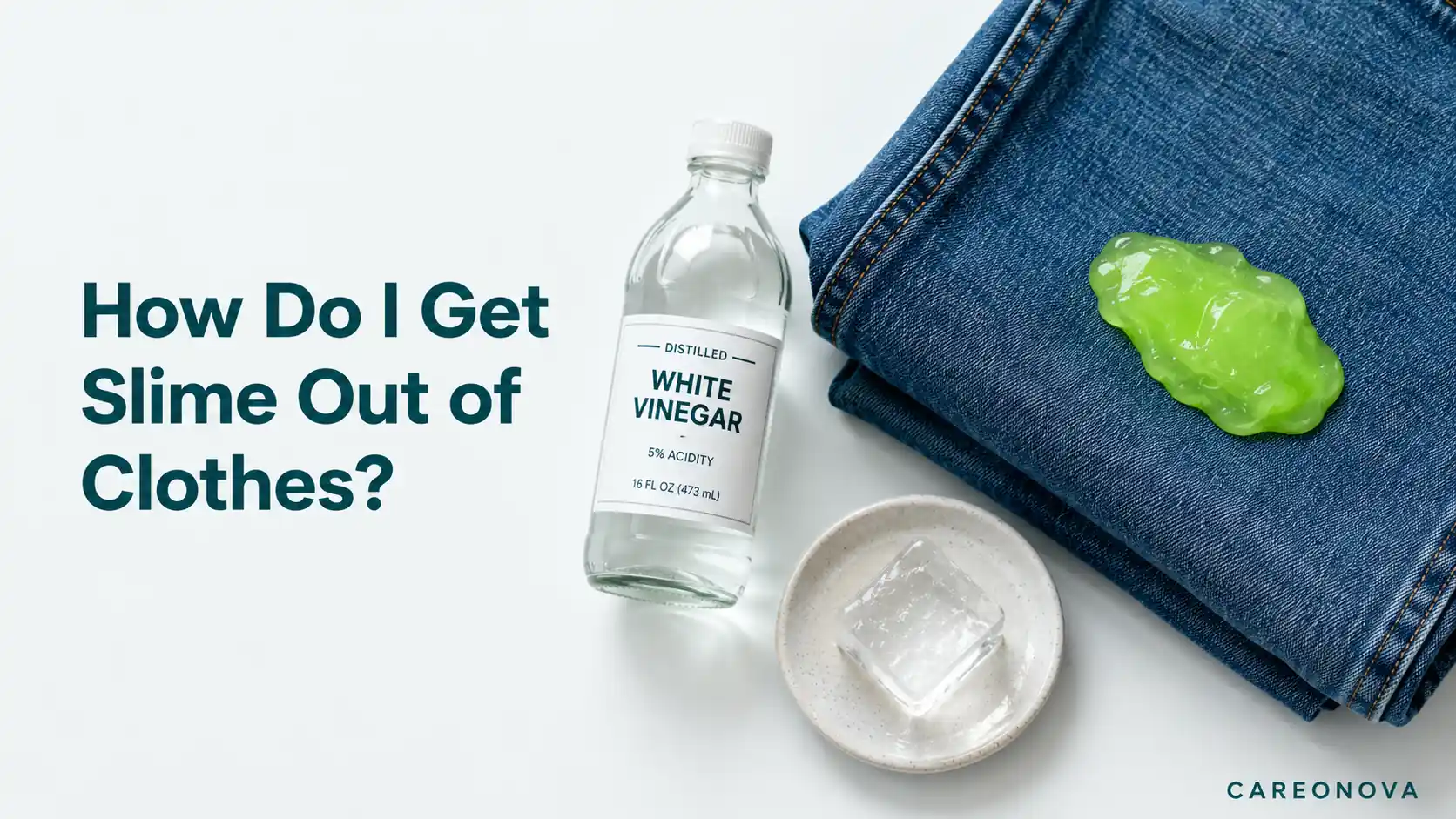
It usually happens right after a quiet afternoon of crafting—you find a bright, sticky mess mashed into a favorite shirt and panic, wondering, how do I get slime out of clothes? The safest fix is already sitting in your kitchen pantry. First, rub an ice cube over the area to freeze the slime, then gently scrape off the hardened pieces. Next, pour plain white vinegar over the stain to dissolve the remaining glue, scrub gently with an old toothbrush, and wash the garment in cold water.
As a fabric care researcher, the biggest mistake I see is parents using hot water, which permanently bakes this liquid plastic into the textile fibers. Vinegar works because its acetic acid safely breaks the chemical bonds of the glue instead. This guide will show you exactly how to use this science to rescue your fabrics, including how to handle dried-on accidents, delicate clothes, living room couches, and stubborn specialty slimes.
The Science: What Actually Dissolves Slime?
To understand how to permanently remove a stain, you have to understand exactly what you are trying to dissolve. Slime is not a standard organic stain like grass or blood; it is a synthetic chemical reaction. Furthermore, the type of slime you are dealing with changes how you must treat it.
Homemade DIY Slime:
The vast majority of slime made at home or in classrooms consists of PVA (polyvinyl acetate)—commonly known as liquid school glue—mixed with a boron-based activator like Borax, liquid starch, or contact lens saline solution. When these two ingredients meet, they create a chemical cross-link, turning liquid glue into a rubbery, non-Newtonian polymer.
Because homemade slime is essentially a liquid plastic, standard laundry soap struggles to break it apart. However, plain white distilled vinegar contains acetic acid. This mild acid attacks and breaks the chemical cross-links between the glue and the boron activator. When you pour vinegar on slime, you are literally melting the rubber back into a liquid state so it can be washed away safely.
Commercial Store-Bought Slime:
Store-bought slimes (like Nickelodeon Gak or Flarp) are often made differently. To increase shelf life, manufacturers frequently use guar gum or synthetic thickeners instead of PVA glue. While vinegar will still work to break down the consistency of commercial slime, these products often contain heavy industrial food dyes that DIY slimes do not. If you are dealing with neon green or hot pink store-bought slime, the immediate threat is the dye transferring to your clothes, requiring a heavy-duty enzyme soak immediately after the vinegar treatment.
What You Need to Remove Slime from Fabric
Before you start scrubbing, gather these household items. Having them on hand prevents you from pushing the stain deeper into the weave while searching for supplies:
- White distilled vinegar (The primary glue dissolver)
- Ice cubes (For hardening the slime)
- A dull butter knife or spoon (For scraping)
- An old, soft-bristled toothbrush (For gentle agitation)
- Dawn dish soap (For cutting grease)
- A high-quality enzyme laundry detergent
How to Get Slime Out of Clothes (Step-by-Step)
If the slime is still relatively fresh and wet, follow this core four-step extraction method.

Step 1: Scrape Off the Excess Slime
Do not grab a paper towel and start rubbing. Rubbing pushes the glue polymers deeper into the fabric yarns. Instead, use a dull butter knife or the edge of a spoon to gently lift and scrape as much of the thick surface slime off the garment as possible.
Step 2: Apply White Vinegar to Dissolve the Glue
Lay the clothing flat in a sink or basin. Pour white distilled vinegar directly over the remaining slime stain until the area is fully saturated. (Don’t worry about the strong salad dressing smell—it will completely wash out in Step 4). Let it sit undisturbed for 5 to 10 minutes. You will actually see the slime begin to break down and turn stringy or liquid.
Step 3: Scrub Gently and Rinse
Take an old, soft toothbrush and work the vinegar into the fabric using gentle, circular motions, working from the outside of the stain inward. This prevents the dissolved glue from spreading into a wider ring. Once the visual residue is gone, rinse the garment under cold running water.
Step 4: Wash in Cold Water
Throw the treated garment into the washing machine using your regular detergent. Set the machine to a delicate or normal cycle. Crucially, allow the garment to air-dry after this first wash. Never put it in the dryer immediately, just in case 5% of the invisible glue residue remains.
Because slime is fundamentally a plastic glue, heat will permanently bake the polymers into the fabric fibers. Use only cold water in your washing machine, and never put the item in the dryer until you are 100% certain the stain is completely gone.
The 3 Worst Mistakes to Make When Cleaning Slime
When parents discover slime mashed into a school uniform, panic often leads to making the stain significantly worse. Before you try any DIY hacks you saw on social media, avoid these three disastrous mistakes:
1. Never Use Hot Water
This is the single most common mistake. Because PVA slime is fundamentally a plastic-based glue, exposing it to heat will permanently bake the polymers into the microscopic fibers of your clothing. If you run a slime-stained shirt under hot water, or worse, put it in the dryer before the stain is completely gone, the plastic will cure. Once cured, it is nearly impossible to remove without destroying the garment. Use only cold water during the entire removal process.
2. Never Use Paper Towels to Scrub

When you see wet slime, your instinct is to grab a paper towel and wipe it. Do not do this. Paper towels are made of fragile wood pulp. When you rub wet glue with paper, the paper shreds, binds with the slime, and creates a dense, papier-mâché paste that gets shoved deep into the weave of your clothing. Always use a rigid, smooth edge (like a butter knife or credit card) to lift and scrape the slime rather than wiping it.
3. Never Reach for Bleach
Bleach is an oxidizer, not a solvent. Pouring bleach on a slime stain will do absolutely nothing to dissolve the glue or the polymers. It will, however, permanently ruin the dye of your clothing. Bleach should never be used on synthetic adhesive stains.
How to Remove Dried Slime from Clothes
If you found a shirt at the bottom of the laundry basket with a rock-hard clump of slime attached to it, the standard vinegar method won’t work immediately because the liquid cannot penetrate the hardened glue shell. (In my experience, dried PVA glue acts very similarly to acrylic paint, which is why the removal methods closely mirror how to get dried paint out of clothes).
The Ice Cube Method: Take an ice cube and rub it directly over the hardened slime for a minute or two. The freezing temperature makes the plastic polymers extremely brittle. Once it feels frozen, use your butter knife to crack, chip, and peel the large chunks off the fabric. Once the bulk of the dried crust is removed, apply vinegar to the remaining stain to rehydrate and dissolve the residue.
How to Remove Slime from Clothing Without Vinegar
If you don’t have white distilled vinegar in your pantry, you cannot simply use whatever cleaner is under your sink. Slime requires a solvent. Here are the only three safe alternatives:
Alternative 1: Isopropyl (Rubbing) Alcohol
Rubbing alcohol breaks down PVA polymers even faster than vinegar, evaporating the moisture within the slime. However, alcohol acts as a heavy solvent and can easily strip cheap dyes from clothing.
- The Colorfastness Test: Before pouring alcohol on a colored shirt, dab a cotton swab in alcohol and rub it on an inside hem. If color transfers to the swab, the garment is not colorfast, and alcohol will ruin it.
- Safety Warning: Never confuse rubbing alcohol with nail polish remover (acetone). Acetone will instantly melt synthetic fabrics like polyester and elastane.
Alternative 2: Hydrogen Peroxide (For White Clothes Only)
If the slime was dropped on a plain white cotton shirt, 3% hydrogen peroxide is an excellent alternative to vinegar. It acts as a mild solvent and a bleaching agent, which is perfect if the slime contained heavy food coloring. Pour the peroxide on the stain, let it bubble for 10 minutes, and rinse. Do not use peroxide on dark or colored clothing, as it will bleach the fabric.
Alternative 3: Heavy-Duty Dish Soap and Warm Water
If you have no solvents at all, run lukewarm (never hot) water over the stain, apply a heavy squirt of a premium degreasing dish soap (like Dawn), and manually massage the fabric together. Dish soap contains heavy surfactants that will eventually lift the slime, but this method requires significantly more manual scrubbing and patience than the chemical reaction provided by vinegar.
Fabric Safety: Blankets, Jeans, and Delicates
The internet is full of advice telling you to pour aggressive chemicals onto stains. What matters more is matching the chemical to the fabric type.
| Fabric Category | Primary Safe Solvent | Crucial Care Warning |
|---|---|---|
| Sturdy Naturals (Jeans, Canvas, Heavy Cotton) | Straight White Vinegar | Highly durable. Safe for aggressive toothbrush scrubbing. Do not use bleach. |
| Synthetics & Blends (Fleece Blankets, Polyester, Spandex) | Straight White Vinegar | ✕ NEVER use acetone (nail polish remover). It acts as a heavy solvent and will instantly melt plastic fibers. |
| Delicates (Silk, Wool, Rayon) | Diluted Vinegar (50/50 with water) | Prone to dye fading and fiber breakage. Dab gently with a damp cloth; do not scrub with a brush. |
How to Get Slime Out of a Blanket (Fleece & Polyester)
Most throw blankets are made of synthetic fibers (polyester or fleece). You can safely use vinegar on these. When inspecting blankets for other types of marks, the method for identifying stains on duvet covers and blankets follows a different process entirely.
Cotton, Denim (Jeans), and Sturdy Shirts
Sturdy cottons and heavy denim jeans can handle straight white vinegar and aggressive scrubbing with a toothbrush without showing signs of wear.
Delicate Fabrics (Silk, Wool, and Rayon)
If slime gets onto a delicate blouse or a rayon fabric
dress, do not pour straight acidic vinegar or alcohol onto it, as this can easily fade the dye or weaken the fibers. Instead, dilute the vinegar 50/50 with plain water, and use a damp cloth to dab the stain rather than scrubbing it with a brush.
How to Get Slime Out of a Couch or Carpet (Non-Washable Fabrics)
If the slime is mashed into your living room sofa, upholstery, or carpet, you cannot simply throw it into a washing machine for Step 4. The scraping and vinegar steps remain exactly the same, but the rinsing method changes entirely.
Once the vinegar has dissolved the slime, you must manually extract the glue residue so it doesn’t dry back into the cushion.
- The Best Method: Use a portable upholstery cleaner (like a Bissell Little Green) or a wet/dry shop vacuum to suck the dissolved slime and vinegar directly out of the fabric.
- The Manual Method: If you don’t have an extraction vacuum, take a heavily dampened microfiber cloth and press it firmly into the stain to “rinse” it. Follow immediately by pressing a dry towel into the spot to absorb the moisture. Repeat this wet-blot and dry-blot process until the area is completely free of soap and vinegar.
How to Treat Different Types of Slime (Butter, Fluffy, and Glitter)
Not all slime is just glue and Borax anymore. If your kids make specialty slimes, the vinegar will dissolve the glue, but it will leave behind the secondary ingredients.
Use this quick-reference matrix to treat specialty slime residues:
| Specialty Slime Base | Chemical Problem & Secondary Treatment |
|---|---|
| Butter Slime (Contains lotion, baby oil, or soft clay) | Problem: Leaves a hydrophobic grease stain. Treatment: After dissolving the glue with vinegar, massage Dawn Dish Soap into the wet fabric to cut the heavy lipid (oil) barrier. |
| Fluffy Slime (Contains shaving cream/foaming agents) | Problem: Leaves trapped foaming surfactants. Treatment: Wash immediately with a high-quality Protease Enzyme Detergent to chemically break down the protein and foam structures. |
| Glitter Slime (Contains craft glitter / micro-plastics) | Problem: Acid cannot dissolve solid plastic glitter. Treatment: Wait until the garment is completely washed and dried, then use packing tape or a lint roller to pull the micro-plastics from the weave. |
Crucial Mistakes: Does Slime Wash Out in the Washing Machine?
A common—and disastrous—mistake is assuming that a heavy-duty washing machine cycle will simply wash the slime away.
No, slime does not wash out in the washing machine on its own.
If you throw a slime-covered shirt into the wash without pre-treating it with vinegar or scraping it first, the water will soften the glue and spread it to the other garments in the drum. In severe cases, large chunks of slime can actually clog your washing machine’s drain pump. Always dissolve the glue over a sink before putting the garment into your laundry basket.
The Bottom Line: How Do I Get Slime Out of Clothes?
Finding slime stuck to your clothes or couch is very annoying. But, it rarely ruins the fabric if you clean it the right way. Just remember the golden rules: never use hot water, use ice to freeze dried clumps, and trust plain white vinegar to melt the glue. Above all, just be patient while the vinegar soaks. Letting the vinegar sit does most of the hard work for you.
