


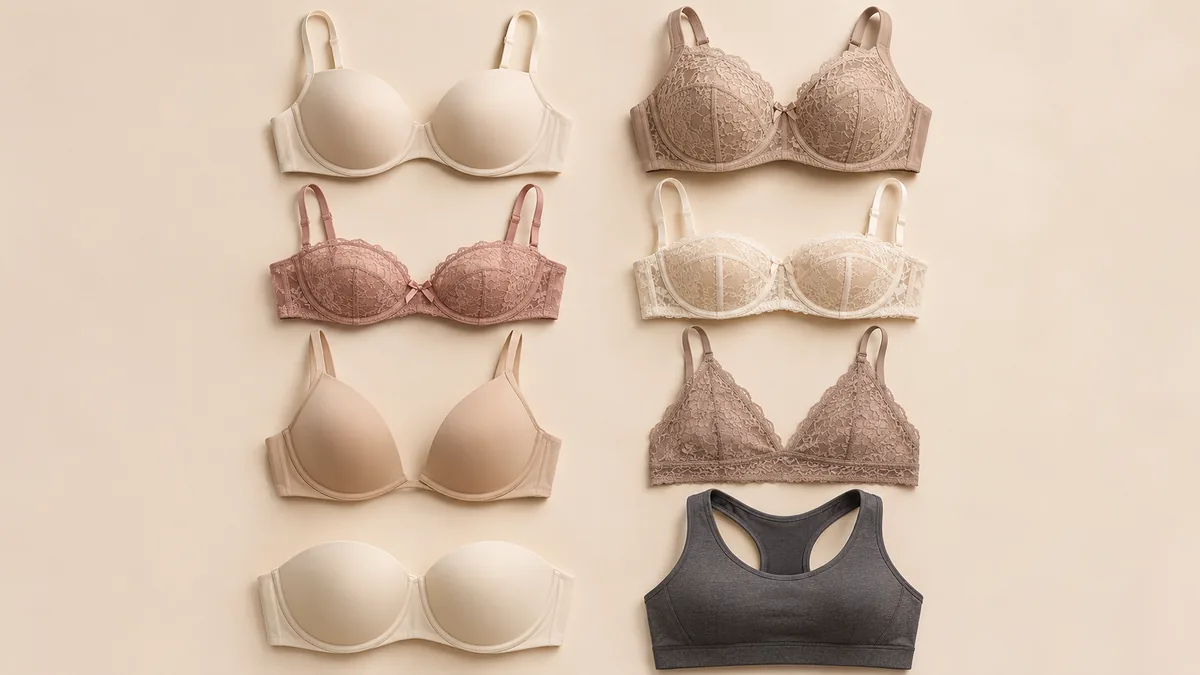
Bras come in different shapes, constructions, and levels of coverage. Some are designed for everyday clothing, while others work better with particular necklines, offer additional lift, or provide support during physical activity. Understanding the different types of bras makes it easier to compare styles and find one that suits your clothing, comfort preferences, and support needs.
The names can sometimes be confusing because a single bra may combine several features. A T-shirt bra, for example, can also be padded, wireless, or plunge-shaped. This guide explains 15 common bra styles and design categories, how they differ, and when each may be useful.
Quick Answer: What Are the Different Types of Bras?
Common bra styles include T-shirt, full-coverage, demi-cup, balconette, plunge, push-up, padded, unlined, minimizer, wireless, underwire, bralette, strapless, adhesive, and sports bras.
They differ in cup shape, coverage, padding, support construction, and intended use. Some are suited to everyday clothing, while others work better with low necklines, backless outfits, or exercise.
15 Common Types of Bras and What Each One Does
Bra styles are easiest to understand when you look at what distinguishes their construction. Some are defined by cup shape, others by padding or support, and some are designed for particular clothing or activities.
The comparison below provides a quick reference before looking at each style in more detail.
| Bra Type | Key Feature | Best For | Shop Option |
|---|---|---|---|
| T-Shirt Bra | Smooth, molded or contour cups | Fitted tops and everyday wear | ThirdLove 24/7 ↗ |
| Full-Coverage Bra | Higher cup coverage | More breast coverage | — |
| Demi-Cup Bra | Lower-cut cups | Open necklines | — |
| Balconette Bra | Open neckline and wider-set straps | Square and wide necklines | — |
| Plunge Bra | Low center front | Deep V-neck outfits | — |
| Push-Up Bra | Strategically placed padding | Additional lift and cleavage | — |
| Padded Bra | Added cup padding | Shaping and coverage | — |
| Unlined Bra | No added cup padding | A less padded appearance | — |
| Wireless Bra | No underwire | Wire-free everyday wear | Warner’s Olga ↗ |
| Underwire Bra | Structured wire beneath the cups | Defined cup structure and support | — |
| Bralette | Often softer, less structured construction | Casual wear and layering | — |
| Strapless Bra | No shoulder straps | Off-shoulder outfits | Bali One Smooth U ↗ |
| Adhesive Bra | Adheres directly to the skin | Backless and open-back outfits | Puff Body ↗ |
| Minimizer Bra | Redistributes breast tissue | A less projected silhouette | — |
| Sports Bra | Designed to limit breast movement | Exercise and physical activity | Panache Power ↗ |

Bra Styles by Cup Shape and Coverage
These styles are mainly distinguished by how much of the breast they cover and the shape of their cups and neckline.
1. T-Shirt Bra
A T-shirt bra has smooth cups, often made with molded or contour construction, to create a relatively seamless appearance under clothing. Its main purpose is to reduce visible seams and texture beneath fitted shirts, thin fabrics, and everyday tops.
T-shirt bras come in different shapes, including full-coverage and plunge designs. Some are lightly padded, while others use unpadded molded or spacer cups.
They are a practical option for T-shirts, lightweight tops, workwear, and fitted dresses where you prefer a smooth finish. The cup shape still needs to match your body; a molded cup that does not suit your shape may gap or sit awkwardly beneath clothing.
2. Full-Coverage Bra
A full-coverage bra has cups designed to cover more of the breast tissue than lower-cut styles. Its higher cup design can help contain breast tissue and provide a more covered appearance.
These bras are available in different constructions, including padded, unlined, wired, and wireless versions. The actual support depends on the fit, band, cups, and overall design rather than coverage alone.
Consider a full-coverage bra if you prefer more coverage, want less breast tissue exposed at the neckline, or need a versatile style for everyday clothing.
3. Demi-Cup Bra
A demi-cup bra has shorter cups that cover less of the upper breast than many full-coverage designs. Its neckline is usually more open, making it suitable for clothing that reveals more of the upper chest.
Demi bras can provide lift and shaping without extending as high as a full-cup bra. Their exact coverage varies between brands and designs.
They may work well with lower necklines and open-neck tops when a full-coverage cup would be visible. Check the actual cup height rather than relying entirely on the style name.
4. Balconette Bra
A balconette bra has a relatively horizontal cup neckline and often wider-set shoulder straps. Its construction lifts the breasts from beneath and creates a more open neckline than many full-cup designs.
Although it is sometimes confused with a demi-cup bra, the two are not always identical. Balconette styles generally have a more distinctive horizontal neckline and strap placement, while demi designs can vary in their cup shape.
A balconette can work well with square-neck tops, wider necklines, and outfits that reveal more of the upper chest. The amount of coverage and lift depends on the specific design.
5. Plunge Bra
A plunge bra has a low center front, where the two cups meet. Its deep center design allows it to sit beneath clothing with a lower neckline without showing as much fabric between the cups.
The cups are often angled toward the center, and some designs include additional padding or shaping. Plunge bras are available with different levels of coverage and support.
Choose a plunge style for deep V-neck tops, low-cut dresses, and outfits where a traditional center gore might be visible. Check that the cups still provide the coverage and stability you need.
Bra Styles by Padding and Shaping
Padding and shaping describe how a bra’s cups are constructed. These features can appear in several different bra styles rather than belonging to only one specific shape.
6. Push-Up Bra
A push-up bra uses strategically positioned padding, often concentrated toward the lower or outer portions of the cups, to lift breast tissue and create a fuller-looking neckline.
Some designs provide subtle shaping, while others have more pronounced padding for additional cleavage. Push-up bras may also include underwire and molded cups.
Consider one when you want additional lift or a more defined neckline under dresses, fitted tops, and lower-cut outfits. The amount of padding varies, so check the product’s construction before buying.
7. Padded Bra
A padded bra has additional material inside its cups, which may be lightly lined or contain thicker padding. The amount and placement of padding vary considerably between designs.
Unlike a push-up bra, an ordinary padded bra does not necessarily have angled padding intended to lift the breasts toward the center. Some padded bras are designed mainly to provide a smooth shape or additional coverage.
A padded bra may suit you if you prefer extra cup coverage, a more defined shape under clothing, or less visible nipple outlines.
8. Unlined Bra
An unlined bra has no additional padding inside its cups. Instead, it uses the fabric and construction of the cup itself to provide coverage and shape.
Some unlined bras have seams that help create structure, while others use softer materials for a more natural appearance. They can be underwired or wireless, depending on the design.
This style may suit you if you prefer less padding or want a cup that follows your natural breast contour. Remember that unlined does not necessarily mean sheer or unsupported.
9. Minimizer Bra
A minimizer bra is designed to make the bust appear less projected beneath clothing. Its cups distribute breast tissue across a broader area to create a smoother, less forward-projecting silhouette.
It does not physically reduce breast size. The effect depends on the cup construction, fit, and amount of coverage.
Consider a minimizer if shirts pull across your chest or you prefer a less projected appearance under fitted clothing. A correctly fitted design should shape without painfully compressing the breasts.
Bra Styles by Support and Structure
Support can come from different parts of a bra, including its band, cups, straps, and overall construction. Wired and wireless bras are two common approaches, while bralettes generally have a softer structure.
10. Wireless Bra
A wireless bra does not have the traditional underwire beneath its cups. Instead, it relies on its band, fabric, cup construction, and other structural features to provide support.
Some wireless bras are lightly structured, while others have wider bands, reinforced side panels, or molded cups. They are not all simple, unstructured garments.
A wireless bra is worth considering if you prefer to avoid underwire or want a softer construction for everyday wear. Support levels vary, so compare the band and cup design rather than assuming all wireless bras provide minimal support.
11. Underwire Bra
An underwire bra contains a curved wire beneath each cup, following the lower breast contour. The wire helps define the cup structure and can contribute to lift, separation, and support when the bra fits correctly.
The wire should sit beneath the breast tissue rather than pressing against it. A poorly fitted underwire can dig into the skin, pinch, or cause discomfort.
Consider an underwire bra if you prefer a more structured cup design and find that its shape and fit provide the support you want. It is not a requirement for everyone, and wireless alternatives can also provide useful support.
12. Bralette
A bralette is generally a softer, less structured type of bra. Many bralettes are wireless and use fabric cups rather than molded or heavily reinforced construction.
However, not every bralette is completely unstructured. Some include light padding, adjustable straps, wider bands, or even underwire for additional support.
Bralettes are popular for casual clothing, lounging, and outfits where you prefer a softer or less structured bra. Choose a design with appropriate coverage and support for your needs.
Bra Styles for Specific Outfits
Some bras are designed primarily to solve clothing-related problems, such as visible shoulder straps or a traditional backband beneath an open-back dress.
13. Strapless Bra
A strapless bra is designed without traditional shoulder straps, allowing it to remain hidden beneath strap-free clothing.
To stay in place, many designs use a wider underband, structured cups, silicone grip strips, or additional internal support. Some also include detachable straps, making them convertible.
A strapless bra works with off-shoulder dresses, strapless tops, one-shoulder outfits, and clothing with exposed shoulders. Fit is particularly important because the band and cup construction must provide stability without shoulder straps.
14. Adhesive Bra
An adhesive bra uses sticky cups or adhesive panels that attach directly to the skin. Unlike traditional bras, it does not rely on conventional shoulder straps and a backband.
Some adhesive bras consist of two separate cups joined at the center, while others use individual adhesive panels. Their coverage and lifting ability vary by design.
Adhesive bras can be useful with backless dresses, open-back tops, and certain outfits where a conventional bra would be visible. They are not suitable for every skin type or garment.
Follow the specific product’s application, removal, cleaning, and reuse instructions. Avoid applying adhesive to irritated or damaged skin, and discontinue use if a reaction occurs.
Bras Designed for Physical Activity
15. Sports Bra
A sports bra is designed to limit breast movement during exercise. Its construction differs from an everyday bra because it focuses on stability and support during physical activity.
There are three common construction approaches:
| Bra Styles | Main Difference | Which to Choose |
|---|---|---|
| Demi vs. Balconette | Demi bras have lower-cut cups, while balconette bras typically have a wider neckline and wider-set straps. | Demi for lower cup coverage; balconette for wider necklines. |
| Padded vs. Push-Up | Padded bras have added cup material, while push-up bras use strategically placed padding for extra lift. | Padded for added coverage; push-up for enhanced lift. |
| T-Shirt vs. Seamless | T-shirt describes the intended smooth appearance under clothing; seamless describes a construction with fewer or no visible seams. | T-shirt styles for fitted tops; seamless construction for fewer visible lines. |
| Wireless vs. Underwire | Wireless bras have no underwire, while underwire bras use a structured wire beneath the cups. | Wireless for a wire-free design; underwire for structured cup support. |
| Bandeau vs. Strapless | Bandeaus are usually simple band-like designs, while strapless bras may have structured cups and underwire. | Bandeau for simple layering; structured strapless styles for more defined support. |
| Compression vs. Encapsulation | Compression sports bras hold breast tissue closer to the chest, while encapsulation bras support each breast separately. | Compression for a compressed fit; encapsulation for individual cup support. |
Sports bras also vary by impact level. A lower-support design may be suitable for activities such as walking or yoga, while running and high-impact workouts generally require more support.
For a more detailed explanation of these construction differences, see REI’s sports bra guide.
Choose a sports bra according to the activity, fit, and amount of movement involved. A bra that works for yoga may not provide enough support for running or jumping.
Other Bra Styles and Design Variations
Beyond the 15 common styles, several other designs serve specific clothing, fastening, and personal needs. Some are variations of the styles already discussed rather than entirely separate cup constructions.
| Bra Style | What Makes It Different | Common Use |
|---|---|---|
| Bandeau | Simple band-style design, usually without shoulder straps. | Strap-free casual outfits. |
| Convertible or Multiway | Removable or rearrangeable straps. | Different necklines and back designs. |
| Racerback | Straps connect or cross between the shoulder blades. | Racerback tops. |
| Longline | Extended band below the cups. | Additional torso coverage and a different silhouette. |
| Front-Closure | Fastens between the cups. | Alternative fastening preference. |
| Nursing | Drop-down cups or access panels. | Breastfeeding. |
| Maternity | Flexible construction and adjustable features. | Changing comfort and fit during pregnancy. |
| Mastectomy or Post-Surgery | May include pockets for breast forms. | Specialized post-surgery needs. |
| Sleep Bra | Soft, often less structured construction. | Sleeping or lounging. |
A backless bra is better understood as a clothing solution than one fixed construction. Adhesive cups, low-back designs, and some specialized strap arrangements can all be used with open-back clothing.
A nursing bra commonly has clips or panels that allow access without removing the entire garment. Maternity bras, meanwhile, are designed to accommodate changing fit and comfort needs during pregnancy.
Mastectomy bras are a specialized category. Some include pockets for breast prostheses or forms, and the appropriate design and timing after surgery should be discussed with the healthcare team. The American College of Surgeons’ breast insert guidance explains how breast forms and pocketed mastectomy bras are used.
How Are Similar Bra Styles Different?
Some bra names sound interchangeable because they share similar features. Their construction and intended use can still be different.
| Comparison | Main Difference | Key Distinction |
|---|---|---|
| Demi vs. Balconette | Cup shape, neckline, and strap placement. | Demi has lower-cut cups; balconette typically has a more horizontal neckline. |
| Padded vs. Push-Up | General cup padding versus targeted lift. | Push-up designs use strategically placed padding for additional lift. |
| T-Shirt vs. Seamless | Smooth appearance versus seam-free construction. | A T-shirt bra focuses on a smooth finish; seamless describes construction. |
| Wireless vs. Underwire | Absence or presence of underwire. | Wireless bras rely on other structural features; underwire bras use a supporting wire beneath the cups. |
| Bandeau vs. Strapless | Simple band-style design versus structured strap-free cups. | Bandeaus are generally simpler; strapless bras may include structured cups and underwire. |
| Compression vs. Encapsulation Sports Bra | Breast compression versus individual cup support. | Compression holds breast tissue closer to the chest; encapsulation supports each breast separately. |
Demi vs. Balconette Bra
Both styles have relatively open necklines, but their cup designs differ. A demi bra generally has shorter cups with partial coverage, while a balconette bra typically has a more horizontal neckline and wider-set straps.
The exact distinction can vary between brands, so comparing the actual cup shape is more useful than relying on the name alone.
Padded vs. Push-Up Bra
A padded bra has extra material inside its cups, but that padding does not necessarily create additional lift.
A push-up bra uses more targeted padding or angled cup construction to lift breast tissue and create a more pronounced neckline. A push-up bra is generally padded, but not every padded bra is designed for a push-up effect.
T-Shirt vs. Seamless Bra
A T-shirt bra is intended to create a smooth appearance beneath fitted clothing. It commonly uses smooth molded or contour cups.
Seamless describes a construction or finish without visible seams. The terms overlap, but they are not necessarily interchangeable. A bra can have seamless construction without every feature associated with a traditional T-shirt bra.
Wireless vs. Underwire Bra
The main difference is the support structure. An underwire bra uses a curved wire beneath each cup, while a wireless bra relies on other construction features.
Neither design is automatically more comfortable or supportive for everyone. The band, cup fit, fabric, and overall construction all influence how a bra feels.
Which Bra Should You Wear With Different Outfits?
The right bra often depends on the neckline, back design, and fabric of the clothing you plan to wear. Rather than choosing a style only by its name, consider which parts of a traditional bra might be visible beneath your outfit.
| Outfit | Bra Styles to Consider | Why |
|---|---|---|
| Fitted T-Shirt | T-Shirt or Seamless Bra | Smooth appearance beneath fabric. |
| Deep V-Neck Dress | Plunge Bra | Lower center neckline works with deeper necklines. |
| Square-Neck Top | Balconette or Demi Bra | More open cup neckline. |
| Off-Shoulder Dress | Strapless Bra | No visible shoulder straps. |
| Backless Dress | Adhesive or Low-Back Bra | Minimal back coverage. |
| Racerback Top | Racerback or Convertible Bra | Strap configuration follows the garment. |
| Everyday Tops | T-Shirt or Full-Coverage Bra | Versatile coverage. |
| Workout Clothing | Sports Bra | Designed to manage breast movement during physical activity. |

What to Check Before Choosing an Outfit-Specific Bra
A bra that looks suitable with an outfit on a hanger may not work as well once you start moving. Before buying one for a particular garment, consider:
- Neckline: A plunge bra may work better than a full-coverage design under a deep V-neck.
- Back design: Open-back clothing may require adhesive cups or a specialized low-back style.
- Shoulder coverage: Strapless and convertible bras can help with off-shoulder and one-shoulder outfits.
- Fabric: Smooth molded cups can be useful beneath thin or fitted clothing.
- Movement: The bra should remain secure when you sit, bend, raise your arms, and move.
Check the bra with the actual garment whenever possible. This helps you identify visible edges, insufficient coverage, or straps that may show when you move.
How to Choose the Right Bra for Comfort and Support
Once you understand the different types of bras, narrow your options according to your preferred coverage, support construction, and fit. The most suitable style is not necessarily the one with the most padding or structure. It is the one that works comfortably for your body and intended use.
Consider Your Preferred Level of Coverage
If you prefer more breast coverage, a full-coverage bra may be a useful starting point. If you like lower necklines, demi, balconette, or plunge designs may be more suitable.
For less padding, unlined bras are another option. Those who want additional cup shaping can compare lightly lined and padded designs.
Coverage and support are not the same thing. A bra with higher cups does not automatically provide more support than a lower-cut design.
Choose Between Wired and Wireless Support
Underwire bras use a structured wire beneath the cups, while wireless bras rely on the band, fabric, and cup construction.
Consider whether you prefer a structured or softer feel, whether the band remains in place during movement, and whether the cups contain breast tissue comfortably. If the bra has an underwire, it should follow the breast crease rather than pressing against breast tissue.
For a visual breakdown of the band, cups, center gore, straps, and underwire, Wacoal’s bra anatomy guide is a useful reference.
Consider Breast Shape and Projection
Breast shape can influence how a particular cup design fits. Common descriptions include round, bell-shaped, east-west, side-set, shallow, projected, asymmetrical, full-on-top, and full-on-bottom.
These terms describe differences in breast fullness, spacing, and projection. They can help explain why the same bra fits two people differently, but they are not strict rules for selecting a particular style.
Two people with similar breast shapes may prefer different cup constructions. The actual fit matters more than matching a shape label to a particular bra name.

Check These Basic Bra Fit Indicators
A few simple checks can help you assess whether a style is suitable:
- Band: It should sit level around your body and feel snug without digging in or riding up.
- Cups: Breast tissue should sit comfortably inside the cups without significant spilling or empty spaces.
- Straps: They should remain in place without slipping or digging into your shoulders.
- Underwire: If present, it should follow the breast crease rather than resting on breast tissue or pressing uncomfortably.
- Center gore: On many structured bras, it should sit appropriately against the chest without causing discomfort. Some plunge and softer designs fit differently.
- Movement: Raise your arms, bend, and move naturally to check whether the bra shifts excessively.
If a bra repeatedly pinches, gaps, slips, or causes discomfort, the size or construction may not be right for you. A professional fitting can help when you are unsure.
Fabric, Elasticity, and Construction
Fabric composition also affects how a bra stretches and feels. Cups, bands, straps, and lining can use different materials, so the fiber label does not always describe the entire garment.
Spandex, also called elastane in many markets, is commonly blended with other fibers to provide stretch and recovery. However, its percentage alone cannot tell you how supportive or comfortable a finished bra will feel. Fabric density, knit construction, elastic placement, and garment design also matter.
Careonova’s guide to spandex and elastane explains how the same stretch fiber can behave differently in finished garments.
Follow the Care Label
Fit and construction are not the only things that affect how long a bra remains wearable. Lace, molded cups, elastic, and decorative details may need gentler handling than ordinary clothing.
Always follow the garment’s care label. If it permits hand washing, avoid twisting or wringing the bra and let it dry according to the manufacturer’s instructions. Careonova’s hand-washing guide includes garment-specific advice for bras and lingerie.
Final Thoughts on Choosing Between Different Types of Bras
There is no single bra style that works for every outfit or every person. T-shirt and full-coverage bras can be useful for everyday clothing, plunge and balconette designs suit different necklines, and strapless, adhesive, and sports bras address more specific needs.
Understanding the differences in cup shape, padding, support, and construction makes it easier to compare options. Start with the clothing and coverage you need, then check the actual fit rather than relying on the style name alone.
If you are also comparing lower-body lingerie cuts, see Careonova’s guide to women’s underwear styles.
Sources and Further Reading
- Wacoal — Bra Anatomy
https://wacoal-america.com/pages/bra-anatomy - REI Expert Advice — Sports Bras: Sizing and Measuring
https://www.rei.com/learn/expert-advice/sports-bras.html - Dritz / Prym Americas — Adhesive Bra Use and Care Instructions
https://prymamericas.com/products/dritzadhbra
