


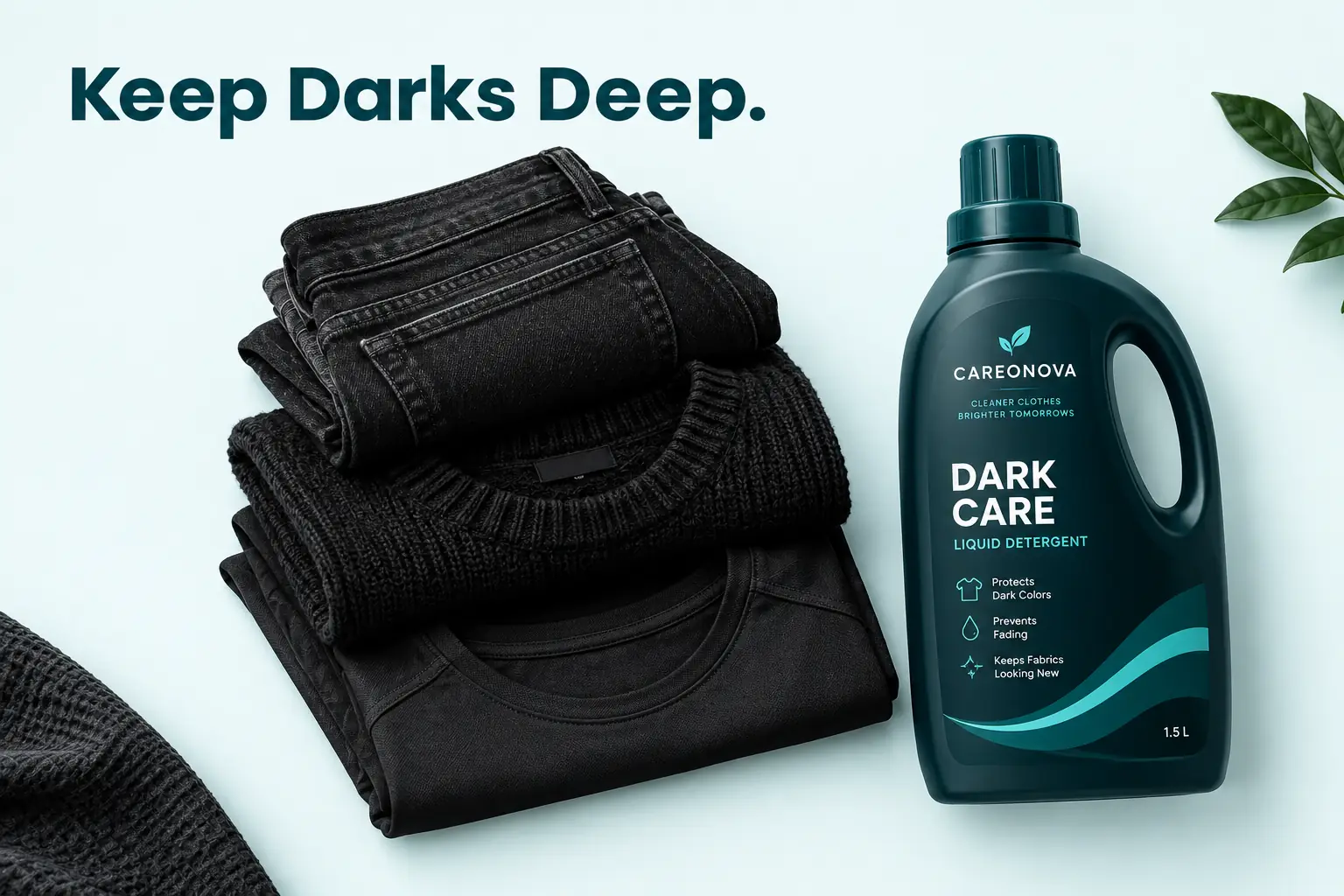
Specialty laundry detergent for black clothes is not marketing hype. Standard household detergents contain optical brighteners that leave a hazy, pale residue on dark fabrics, making them look washed out. Formulas built specifically for darks preserve deep tones by omitting fluorescent brighteners and using targeted cellulase enzymes to smooth light-scattering cotton fuzz. If you are struggling with how to keep black clothes from fading, using a liquid dark detergent in cold water keeps garments rich and saturated far longer than standard wash routines.
If your favorite dark jeans or tees are starting to look tired, here is how to protect your fabrics and choose the right formula.
Key Takeaways
- Avoid Optical Brighteners: Conventional detergents leave invisible fluorescent dyes that make whites look brighter but give black fabrics an ashy, chalky cast under natural light.
- Prioritize Cellulase Enzymes: This biological agent shaves microscopic, broken cotton fibers (fuzz), eliminating the surface refraction that causes dark fabrics to look dull.
- Always Choose Liquids: Dry powders and detergent pods struggle to dissolve in cold cycles, often leaving streaks of undissolved builder salts across dark weaves.
- Wash in True Cold Water: Keeping wash temperatures below 85°F (30°C) prevents textile fibers from swelling and releasing bound dye molecules.
- Turn Garments Inside Out: Protecting the outer face-fabric from the abrasive rubbing of the washing drum preserves the surface finish.
Top Picks: The Best Laundry Detergent for Dark Clothes
Choosing a detergent comes down to matching the chemistry of the wash to the fibers in your closet. Everyday cotton basics, raw denim, and synthetic activewear each interact differently with surfactants and water conditions.
| Product Name | Best For | Key Cleaning Technology | Optical Brighteners? |
|---|---|---|---|
| Woolite Darks Defense | Everyday Blended Knits | Color-lock technology, neutral pH | None |
| Perwoll Renew Black | Faded Cotton Restoration | Fiber-smoothing cellulase complex | None |
| Cheer ColorGuard | Budget / Chlorine Defense | Chlorine-scavenging agents, Protease | None |
| Puracy Natural Liquid | Sensitive Skin / Athleisure | Four-enzyme plant-based formula | None |
Woolite Darks Defense: The Reliable Everyday Standard
Woolite Darks remains the most accessible dark-care formula in North America, and for good reason. Its primary advantage is an ultra-mild surfactant system formulated at a neutral pH. While conventional heavy-duty detergents lean alkaline (often reaching a pH of 9 to 10 to cut heavy grease), this alkalinity forces cotton fibers to swell, unsealing the dye matrix. Woolite maintains fabric tension, contains zero optical brighteners, and incorporates a polymer that catches stray dye molecules in the wash bath before they can redeposit elsewhere.
Perwoll Renew Black: The Restoration Specialist
Imported from Europe, Perwoll is legendary in textile care circles. Rather than simply protecting fabric, Perwoll acts on garments that have already begun to take on a faint grayish cast. It accomplishes this through a generous concentration of cellulase. If the grayness on your cotton sweatshirts or t-shirts is caused by surface fuzz rather than complete dye destruction, a few washes in Perwoll physically smooths those fibers, restoring the rich light absorption of the original dark shade.
Cheer ColorGuard: The High-Volume Chlorine Defense
Municipal tap water in many regions is treated with chlorine. While safe to drink, residual free chlorine in your wash drum acts as a mild bleach, slowly oxidizing sensitive dark dyes cycle after cycle. Cheer ColorGuard includes chemical neutralizers that deactivate chlorine in the wash water before it can degrade reactive black pigments. It is affordable, highly effective for heavy loads, and well-suited for families doing frequent wash cycles.
Puracy Natural: The Plant-Derived Alternative
For households avoiding synthetic fragrances or harsh sulfates, Puracy offers a clean, four-enzyme system. It relies on a balanced blend of protease, amylase, mannanase, and cellulase. Because it lacks dyes, sulfates, and optical brighteners, it safely launders black bamboo, modal, and modern synthetic athletic leggings without leaving irritants behind on the fabric.
Why Do Black Clothes Turn Gray? The Science of Fading
A faded black garment is rarely the result of a single problem. Fading is driven by two distinct mechanisms: actual chemical dye loss and surface fiber damage that alters how light reflects off the fabric.
Chemical Dye Loss (Bleed and Desorption)
Most commercial black cottons are colored using reactive or direct dyes. During manufacturing, these dye molecules form bonds with the hydroxyl groups in cellulose fibers. When you wash clothes in hot water
or expose them to aggressive alkaline detergents, those bonds weaken. The dye molecules detach, dissolve into the wash water, and drain away. Once those pigments are gone from the yarn, they cannot be returned by washing.
Micro-Fibrillation and Light Scattering
Here is the scenario that catches most people off guard: you look at a black t-shirt that looks faded, but the wash water never turned gray or dark. Where did the color go?
In many cases, the dye never left. During machine washing, yarns experience friction, flexing, and mechanical abrasion. This friction breaks tiny surface fibers, creating a microscopic layer of fuzz across the surface of the fabric. This process is called micro-fibrillation.
Instead of light passing cleanly into the dyed fibers and being absorbed by the black pigment, incoming light hits that chaotic layer of broken fuzz and scatters in every direction. This diffuse reflection reads to the human eye as gray, white, or dusty, even though the core yarn remains saturated with black dye.
Regular Detergent vs. Dark Detergent: What Makes Them Different?
As mentioned earlier, the secret to dark detergents lies in what they leave out, not just what they put in. If you line up two clear glasses of liquid detergent—one standard, one formulated for darks—they may look similar, but their chemical design serves opposite goals.
The Optical Brightener Trap
Most standard laundry detergents are formulated to make white laundry look brilliant. To achieve this without chlorine bleach, manufacturers add synthetic chemicals called Optical Brightening Agents (OBAs) or Fluorescent Whitening Agents (FWAs).
These chemical compounds bind to textiles during the wash cycle. They are designed to absorb invisible ultraviolet (UV) light waves and re-emit them as visible blue light. On white fabrics, this blue emission cancels out natural yellowing, tricking the eye into seeing an ultra-clean, glowing white.
On black, navy, or charcoal clothing, optical brighteners are disastrous. When these fluorescent compounds coat dark yarns, they cast an unnatural, hazy blue-gray sheen over the fabric. If you have ever noticed dark clothes looking strangely chalky or dusty outdoors on a sunny day, optical brightener residue is almost always the cause. Dark detergents completely eliminate these additives.

The Role of Cellulase Enzymes
The other essential component in high-end dark detergents is the targeted use of enzymes, particularly cellulase. While proteases break down protein stains like sweat or blood, cellulase targets cellulose (cotton, linen, and rayon).
Instead of aggressively degrading the fabric, cellulase works like a microscopic pair of scissors. It selectively cleaves the microscopic structural bonds in stray, broken surface fibrils, digesting the micro-fuzz without harming the main structural yarn. By shearing away the fuzzy layer, the fabric surface becomes smooth again. Specular reflection is restored, and the deep, light-absorbing black returns. For a deeper look at how enzymatic cleaners break down specific soils without damaging base textiles, explore our complete guide on enzyme laundry detergent

.
Powder, Pods, or Liquids: Which Format Works for Darks?
The physical format of your detergent matters just as much as its ingredient list, particularly because dark loads demand low water temperatures.
The Solubility Problem with Powders and Pods
To protect black dyes from thermal bleeding, you need to wash garments in cold water—ideally between 60°F and 80°F (15°C to 27°C).
At these low temperatures, dry laundry powders struggle. Powders rely heavily on sodium carbonate and sodium sulfate as builders. In cold wash cycles, these mineral salts often fail to dissolve completely.Instead of rinsing away, tiny undissolved particles get trapped within the weave of dark garments, drying into cloudy streaks and white spots
Single-dose pods present a similar issue. The outer pouch is made of polyvinyl alcohol (PVA) film, which is engineered to dissolve in water. However, in short, gentle cold-water cycles, the film can dissolve unevenly. It can leave a gummy, gelatinous residue on dark fabrics that attracts lint and is difficult to remove without re-washing.
Why Liquids Reign Supreme
Liquid detergents are already dissolved solutions. They disperse immediately and evenly through the wash drum the moment water enters, regardless of temperature. Liquid surfactants coat the textile yarns smoothly, lift soils away without abrasive friction, and rinse cleanly through the drain cycle without leaving behind mineral grit. For dark loads, liquid is the only format that consistently delivers clean, streak-free results.
The Hidden Threat: Hard Water Minerals and DIY Myths
Sometimes, black clothes lose their luster even when you use the correct liquid detergent. When this occurs, the water chemistry in your home is usually to blame.
Calcium and Magnesium Carbonate Crusts
If you live in an area with hard water, your supply contains high levels of dissolved calcium and magnesium ions. When these minerals interact with cleaning surfactants, they precipitate out of solution, forming insoluble salts.The USGS defines water hardness based on these concentrations.
Over multiple wash cycles, these mineral deposits build up on fabric yarns like a microscopic chalk layer. On a white towel, you would never notice. On a pair of black denim jeans or a black cotton polo, this mineral buildup creates a dull, stiff, ashy surface.
If hard water is affecting your laundry, look for liquid detergents that list chelating agents or builders like sodium citrate or tetrasodium glutamate diacetate. These ingredients bind to calcium and magnesium ions, keeping them suspended in the water so they drain away harmlessly.
The Myth of Salt and Vinegar for “Setting” Commercial Dyes
A persistent piece of internet advice claims that adding a cup of table salt or distilled white vinegar to the wash will “set” black dye and prevent fading.
This advice is outdated. Decades ago, direct dyes on natural fibers benefited from salt to exhaust dye baths during traditional home dyeing. Modern commercially manufactured clothing, however, uses fiber-reactive dyes or synthetic disperse dyes that undergo industrial chemical fixation before leaving the factory. Adding table salt to your modern front-load washer does nothing to chemically lock in reactive black dye; it simply introduces mineral friction into your machine.
A Note on Vinegar: While vinegar will not “lock in” dye, a half-cup of distilled white vinegar added to the rinse cycle can be helpful for a different reason: its mild acetic acid helps dissolve alkaline detergent residues, including hard-water mineral crusts, leaving dark fibers softer and cleaner. Just remember to add it to the fabric softener dispenser, never directly into the detergent tray with your soap.
5 Steps to Wash and Preserve Dark Garments
Using the right detergent is step one. Pairing that detergent with careful mechanical habits ensures your dark garments hold their color for years.
- Sort by Weight and Lint Potential: Never wash black cotton clothing in the same load as high-lint items like white towels, flannel bedding, or chenille robes. Cotton knits act like magnets for loose lint fibers. Additionally, separate heavy items (like work jackets and heavy raw denim) from delicate cotton tees to prevent aggressive surface friction during the spin cycle.
- Turn Every Garment Inside Out: The majority of fabric abrasion happens when garments rub against each other and against the metal drum walls during machine agitation. By turning shirts, trousers, and sweaters inside out, you confine that friction to the inside of the garment, leaving the visible face-fabric smooth and unfuzzed.
- Dose Accurately (Avoid Overuse): Pouring extra detergent will not make your clothes cleaner; it only makes the rinse cycle work harder. Excess detergent leaves surfactant films behind in thick cotton weaves, attracting dirt and creating a cloudy surface cast. Measure carefully according to the load size.
- Select Cold Water on a Gentle or Delicate Cycle: Keep the water cold (below 85°F / 30°C). Opt for a cycle with slower agitation speeds and a lower final spin RPM (such as 600–800 RPM instead of 1200 RPM). This limits fiber stress, prevents seam abrasion, and minimizes dye bleed.
- Air Dry Flat or on a Line (Away from the Sun): Tumble dryers subject wet garments to intense heat and prolonged mechanical tumbling, baking out remaining moisture, shrinking fibers, and causing widespread micro-fibril breakage. Whenever possible, hang dark garments indoors or dry them flat
on a drying rack. If you dry clothes outside, keep them in full shade; ultraviolet radiation from direct sunlight will photochemically break down dark dye bonds within hours.
Fabric Softener Warning: Avoid standard liquid fabric softeners and dryer sheets on black athleisure wear, synthetic blends, or moisture-wicking fabrics. Traditional softeners work by depositing a thin layer of silicone or tallow-based quaternary ammonium compounds across yarns.On dark performance fabrics, this coating traps body oils, seals in odor-causing bacteria, and leaves a greasy, light-distorting sheen that makes black fabrics look patchy.
What to Do Next
Protecting your dark wardrobe does not require an overhaul of your laundry room; it simply requires removing the elements that actively degrade dark dyes. Start by swapping your everyday white-and-color powder or pods for a dedicated, liquid dark-care formula that skips optical brighteners. Keep your wash dial turned firmly to cold, flip your garments inside out before they hit the drum, and let them air-dry away from direct heat and sunlight. These small adjustments will preserve the deep, rich finish of your favorite dark pieces for years to come.
