

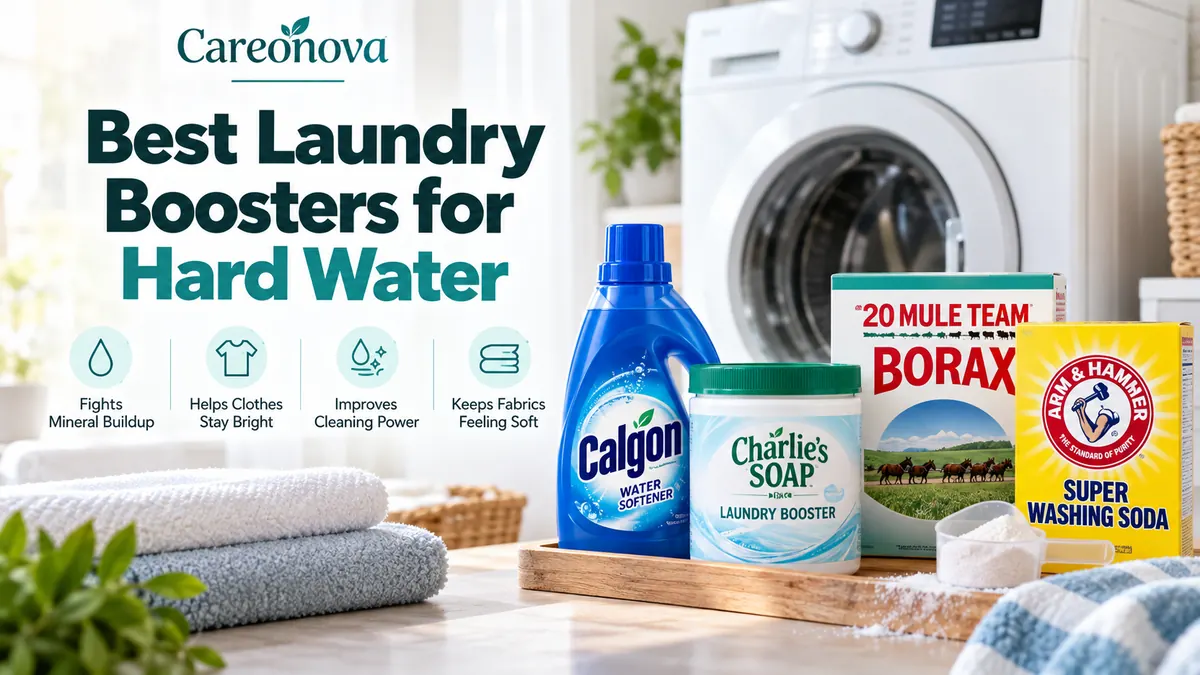
Hard water can leave towels stiff, make colors look dull, and reduce how effectively detergent washes away soil. A laundry booster may help, but the products sold for this problem do different things.
Calgon and Charlie’s Soap are dedicated hard-water treatments. Borax and washing soda are multipurpose alkaline additives that can support cleaning in hard water. The right choice depends on the minerals in your water, your detergent, your washer, and the fabrics you’re washing.
Best laundry boosters for hard water at a glance
| Product | Main Purpose | Best For | Limitation | Shop |
|---|---|---|---|---|
| Calgon Liquid Water Softener | Dedicated liquid water conditioner | Convenient treatment of mineral-heavy wash water | Contains fragrance; adds cost per load | Amazon |
| Charlie’s Soap Laundry Booster | Phosphate-based water conditioning | Concentrated powdered hard-water treatment | Phosphate considerations; check local availability | Amazon |
| 20 Mule Team Borax | Alkaline buffering and laundry boosting | Multipurpose laundry use on compatible fabrics | Handling precautions; unsuitable for some delicates | Amazon |
| Arm & Hammer Super Washing Soda | Alkaline cleaning and mineral precipitation | Everyday laundry that tolerates higher alkalinity | Higher pH; possible residue and fabric concerns | Amazon |
Affiliate disclosure: Careonova may earn a commission from qualifying purchases at no additional cost to you. Recommendations are based on published product information, not independent comparative testing.
The products are grouped by their published ingredients and intended use. Careonova has not conducted independent side-by-side cleaning tests, so the categories above are not performance rankings. All four products are intended to accompany an appropriate laundry detergent rather than replace it.
Four laundry boosters worth considering
1. Calgon Liquid Water Softener: A dedicated liquid option
Calgon is formulated specifically for laundry in hard water. Its liquid format makes it convenient for people who would rather measure a capful than handle another powdered product.
The published US ingredient disclosure identifies sodium citrate as a mineral-sequestering ingredient. It binds hardness minerals so cleaning ingredients can work with less interference. The formula also lists a sodium acrylic acid/MA copolymer that helps discourage loosened soil from redepositing onto fabrics. Those are different jobs, and both matter when laundry looks dull after repeated washes.
Calgon’s published US directions call for one capful (¼ cup) alongside detergent, with adjustments permitted for very hard water, larger loads, or heavy soil. Always follow the directions on your actual bottle and check where your washer manufacturer wants liquid additives placed.
A reason to choose it: It is an easy-to-measure conditioner that does not rely on extra powder dissolving during a short, cool wash.
The trade-off: It adds cost to every treated load and contains fragrance. Manufacturer claims about brighter laundry do not establish that it cleans better than the other products in this comparison.
2. Charlie’s Soap Laundry Booster: A dedicated powdered treatment
Charlie’s Soap Laundry Booster & Hard Water Treatment uses potassium diphosphate, which the manufacturer identifies as its water-softening ingredient. The product is intended to help manage the effects of calcium and magnesium during washing.
Unlike a complete detergent, this booster does not supply the surfactants needed for regular soil removal. It belongs alongside laundry detergent. Charlie’s Soap publishes a starting direction of at least ½ tablespoon per wash, added directly to the drum, and suggests 1 tablespoon for exceptionally hard water or tough conditions.
The manufacturer says the booster works in conventional and high-efficiency washing machines. Check your washer manual as well as the product instructions, particularly when using a powder in a front-loader.
A reason to choose it: A relatively small measured dose provides a treatment intended specifically for hard-water laundry. The formula is fragrance-free, according to the manufacturer.
The trade-off: This is a phosphate-based product. Availability can depend on location, and phosphate discharge into waterways deserves consideration. Claims about environmental safety or universal fabric compatibility should not be treated as independently established.
3. 20 Mule Team Borax: A multipurpose laundry booster
20 Mule Team Borax contains sodium tetraborate. Borax is alkaline and has buffering properties, meaning it can help stabilize wash-water conditions as detergent works. It also has roles in household cleaning and some odor-control routines.
In hard-water laundry, those properties may be useful, but borax is not the same kind of product as a dedicated nonprecipitating water conditioner. Results depend on the detergent formula, the water’s chemistry, the load, and the dose.
A reason to choose it: It may be convenient if you already keep borax for compatible laundry tasks and want an additive with more than one household use.
The trade-off: Handle the powder carefully. Avoid eye contact and swallowing it, keep it away from children and pets, and follow the package directions. It should not be assumed suitable for wool, silk, or garments with sensitive finishes.
For persistent problems with hard-water laundry residue, confirm that hardness is the cause before increasing the amount of borax or detergent. Too much product can add to rinsing problems.
4. Arm & Hammer Super Washing Soda: A budget-minded alkaline additive
Arm & Hammer Super Washing Soda is based on sodium carbonate, a more strongly alkaline substance than ordinary baking soda. It can support the removal of certain greasy soils, while carbonate ions react with dissolved calcium to form less-soluble calcium carbonate. This is one way to reduce dissolved hardness in wash water.
The chemical reaction has a practical limitation: the resulting mineral particles must stay dispersed and be rinsed away. Heavy dosing or poor rinsing can make residue problems worse rather than better.
Arm & Hammer’s US instructions specify ½ cup for a regular wash and 1 cup for hard-water conditions, used with ordinary detergent. Its guidance also addresses HE machines, but the product label and your appliance manual should take priority.
A reason to choose it: Washing soda is a straightforward additive for suitable everyday fabrics and is often sold in a comparatively inexpensive box. Actual value depends on the amount used per load.
The trade-off: Its higher alkalinity makes it a poor choice for delicate protein fibers or vulnerable dyes and finishes. Avoid putting concentrated powder directly onto delicate garments. Do not confuse washing soda with baking soda, which has a different chemical formula and milder behavior.
Calgon vs. borax vs. washing soda: What changes in the wash?
The main distinction is how each additive deals with water chemistry. Products containing sequestering ingredients can bind calcium and magnesium so those minerals interfere less with detergent. Calgon’s published formula includes sodium citrate for this purpose. Charlie’s Soap uses a phosphate-based conditioning ingredient.
Washing soda works in part by precipitation: dissolved calcium can form solid calcium carbonate. That reaction can lower the calcium left in solution, although suspended particles then have to rinse away. Borax mainly contributes alkaline buffering and other supporting effects; it should not be treated as chemically interchangeable with either conditioner.
Modern detergents often already contain builders or other ingredients that limit mineral interference. If your laundry comes out clean with the correct detergent dose, an extra booster may offer little practical benefit.
Do you need a hard-water laundry booster?
First, check how hard your water actually is. A utility water-quality report or a suitable hardness test kit can help you make a decision based on a measurement rather than on how stiff one load of towels feels.
The U.S. Geological Survey uses the following categories, measured as milligrams per liter of calcium carbonate equivalent (mg/L as CaCO₃):
| Water Classification | Hardness (mg/L as CaCO₃) |
|---|---|
| Soft | 0–60 |
| Moderately hard | 61–120 |
| Hard | 121–180 |
| Very hard | Above 180 |
Source: U.S. Geological Survey. Values express water hardness as calcium carbonate equivalents.
These ranges describe the water; they are not product-dosing instructions. A good detergent may already perform adequately in moderately hard water. In hard or very hard water, an additive becomes more worth considering if you repeatedly notice stiff towels, dull fabrics, or unsatisfactory cleaning despite following the detergent label.
Before buying, check the dose recommended for your water conditions. Changing several products at once makes it difficult to tell which change improved your wash.
How to use hard-water laundry boosters safely
Use each product according to its own directions. A quarter-cup liquid conditioner, a small spoonful of phosphate-based powder, and a cup of washing soda cannot be treated as equivalent doses.
- Read the garment care label. Check for delicate fibers, finishes, or restrictions on machine washing.
- Check the washer manual. Confirm whether the selected additive belongs in a dispenser, in the drum, or somewhere else.
- Measure detergent and booster separately. Do not automatically increase both.
- Use the recommended cycle and temperature. Powder dissolution and rinse performance depend partly on wash conditions.
- Review the result. Watch for white streaks, powder residue, unusually rough fabric, or irritation after handling products.
Wool, silk, and some color-sensitive garments need special caution around alkaline chemicals. Avoid mixing laundry additives without product guidance. Store all cleaning products securely and follow label precautions when handling powders.
When a laundry booster won’t solve the problem
Too much detergent: An oversized detergent dose can leave fabric feeling coated or harder to rinse. More cleaning product is unlikely to solve an overdosing problem.
Fabric-softener buildup: Repeated softener use can affect how towels absorb water. A hard-water conditioner is not necessarily designed to remove softener residues.
Poor washer maintenance: Dirty drawers, gaskets, or a poorly maintained drum can contribute to smells and deposits. Cleaning the machine may matter more than adding another product.
Overloading or set-in stains: An overcrowded drum restricts movement and rinsing. Old oil or food stains may require pretreatment rather than water conditioning.
If very hard water also causes scale on faucets, shower doors, and other appliances, investigating a household water-softening system may be more practical than treating every laundry load separately.
How we selected these products
Careonova compared four different additive categories using their published ingredients, intended chemical function, product directions, and known fabric or handling limitations. Manufacturer information is identified as such.
Careonova has not performed controlled cleaning tests on these four products. We have not calculated or ranked cost per load because equivalent current US prices and package-specific dose information were not independently verified. Product selection does not guarantee particular cleaning results.
Final recommendation
Calgon and Charlie’s Soap make sense to investigate when mineral interference is your main washing problem and you want a product formulated for it. Borax offers broader household uses, while washing soda supplies stronger alkalinity for fabrics that can tolerate it.
Check water hardness and detergent directions before adding anything. The most useful booster is the one that addresses a problem your existing wash routine has not solved.
