


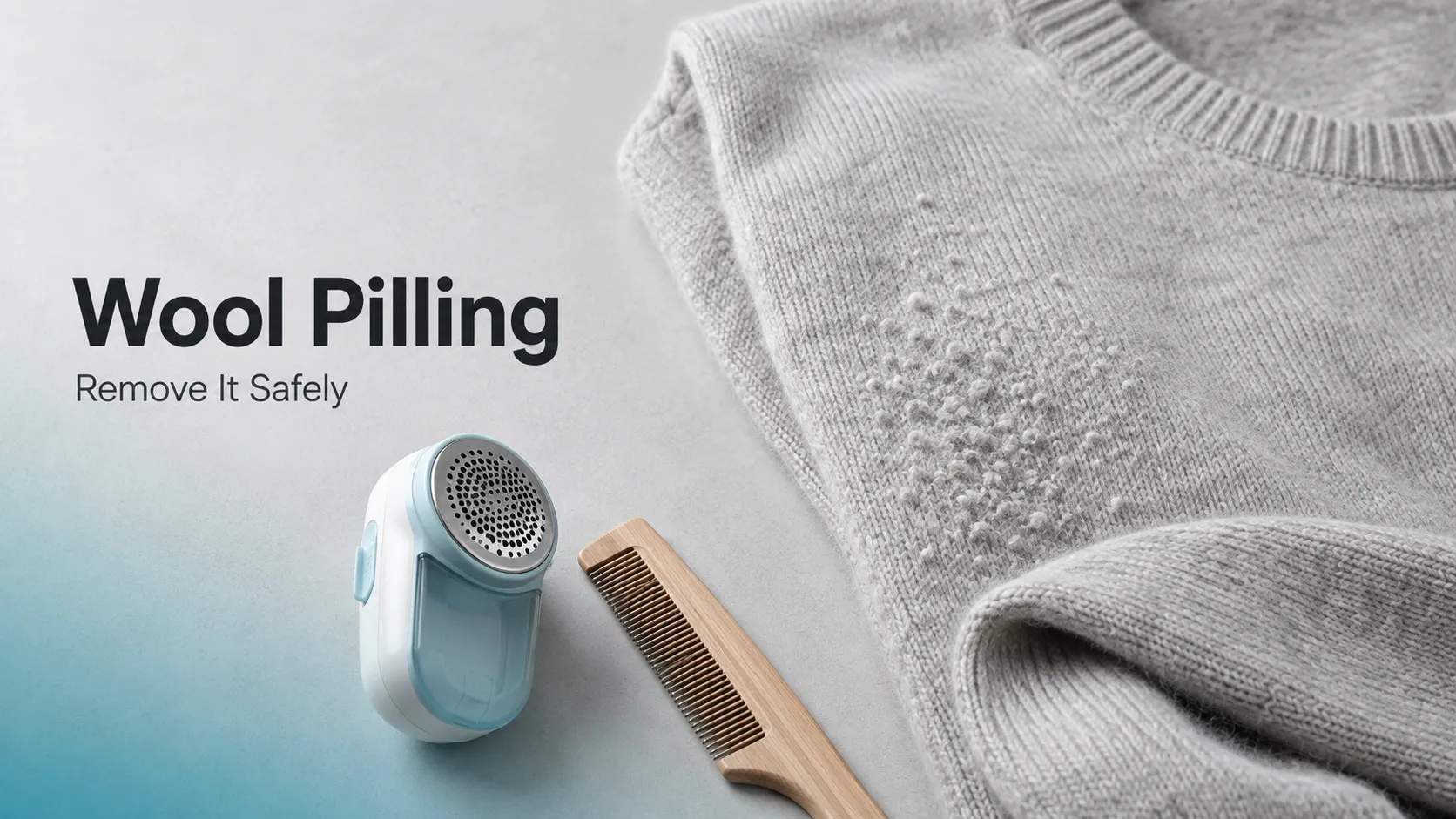
Wool pilling happens when loose surface fibers rub together and form small, tangled balls. It is common on sweaters, coats, cashmere, merino, and other wool garments, especially in high-friction areas. A few pills do not automatically mean the wool is poor quality. Many can be removed safely, but the right method depends on the fiber, fabric construction, and condition of the garment.
The goal is not to strip away every raised fiber. It is to improve the surface without cutting yarn, pulling loops, or thinning the wool. No wool garment is guaranteed never to pill, but gentle treatment and less friction can keep the problem under control.
What Is Wool Pilling?

Wool pilling is the formation of small balls of tangled fibers on the outside of a garment. These balls are also called pills, bobbles, or fuzz balls.
Pilling begins when friction lifts loose fiber ends from the yarn. Continued rubbing causes those fibers to wrap around one another. Some remain attached to the material, which is why the pills do not simply fall away.
The same process can affect many textiles, as explained in the broader guide to why fabric pilling happens. Wool often needs gentler treatment because fine fibers, soft finishes, and knit loops can be damaged by aggressive scraping or shaving.
Not every fuzzy-looking wool surface is pilling.
| Surface problem | What it looks like | What it means |
|---|---|---|
| Pilling | Small, attached balls of tangled fibers | Can often be removed carefully |
| Lint | Loose hair, dust, or fibers resting on the fabric | Usually lifts away easily |
| Surface fuzz | Raised fibers without firm balls | May be part of the fabric finish |
| Snagging | A loop or yarn pulled out of position | Should not be shaved or pulled |
| Felting | Fibers compressed into a dense, matted area | De-pilling will not reverse it |
A lint roller may collect loose debris, but it usually cannot remove firmly attached pills. A snag needs repair rather than de-pilling because a comb or shaver may pull the yarn farther out of place.
Is Wool Pilling Normal?
Some wool pilling is normal, especially when it develops slowly in areas exposed to regular rubbing. It becomes more concerning when heavy pilling appears after very little wear, spreads across low-contact areas, or occurs with thinning, holes, loose yarn, or loss of shape.
For practical garment care, it helps to recognize three patterns.
Initial pilling may appear during the first few wears as loose surface fibers work their way outward.
Persistent pilling means new pills continue to form after earlier ones have been removed. Repeated friction or a loose yarn or knit may be contributing.
Excessive pilling or damage involves rapid, widespread pills along with thinning, stretched areas, broken yarn, weak seams, or heavy shedding.
Wool may pill less after the loosest fibers have been removed, but it may not stop permanently. New pills can form whenever more fibers reach the surface and friction continues.
Does Wool Pilling Mean Poor Quality?
Pilling alone does not prove that wool is poor quality. Fine or softly finished wool can still pill, and price alone does not predict how well a garment will perform.
The speed, location, and severity of the pilling provide better clues. Light pilling beneath the arms of a frequently worn sweater is different from a coat becoming covered in pills after one careful use.
Pilling depends on how securely the fibers are held, how tightly the material is constructed, how much surface fuzz it has, and how much rubbing it experiences.
It deserves closer attention when it appears quickly in areas that receive little contact or occurs with distorted fabric, loose stitching, heavy shedding, or visible thinning.
Why Does Wool Pill?
Wool pills mainly because of friction. Fiber characteristics, yarn construction, fabric density, and repeated wear influence how easily loose fibers reach the surface and become tangled.
Friction and High-Contact Areas
Friction is the repeated rubbing of wool against the body or another surface. The location of the pills often reveals what is causing them.
| Wool item | Common pilling areas | Likely source of friction |
|---|---|---|
| Sweater or jumper | Underarms, sides, cuffs, and elbows | Arm movement, layering, desks, and chairs |
| Wool coat | Shoulders, sleeves, sides, and collar | Bags, backpacks, seat belts, and outer layers |
| Wool trousers | Seat, pockets, and inner thighs | Sitting and walking |
| Wool socks | Heels, soles, and toes | Shoes and repeated pressure |
| Wool scarf | Neck and coat-contact areas | Skin, collars, and outerwear |
Even gentle rubbing can create visible wear when it affects the same place every day. One side of a coat may pill faster when a shoulder bag is always carried there. A merino base layer may pill beneath backpack straps, while a sweater may show more pills beneath the arms.

Wool Fibers and Fabric Construction
Wool yarn contains many individual fibers. Some fiber ends gradually move toward the outside during wear. Once exposed, they can catch on nearby fibers and form pills.
Shorter or loosely held fibers may reach the surface more easily, but fiber length is only one factor. Wool made with longer fibers can still pill when the garment has a fuzzy finish, loose yarn, open knit, or frequent exposure to abrasion.
Yarn and fabric construction also matter. Firm yarn usually holds fibers more securely than very soft, loosely twisted yarn. Dense woven wool may expose less movable fiber than an open knit.
These are tendencies, not guarantees. A woven coat can still pill where a bag rubs against it, while a stable knit may remain smooth with careful wear.
Brushed finishes, chunky knits, fine-gauge sweaters, boiled wool, and tightly woven coat fabric can all behave differently even when their labels list similar wool fibers.
Washing may make loose fibers more visible when the garment rubs against towels, denim, zippers, or an overloaded wash load. Follow the care label rather than using one cleaning rule for every wool item. Detailed instructions for washing wool safely should always be adapted to the garment’s fiber blend, finish, and construction.
How to Remove Wool Pilling Safely
The safest way to remove wool pilling is to use the gentlest tool that works for the fabric. Inspect the wool first, keep it flat, and stop before the treatment begins to affect the garment itself.
Follow these steps:
- Check the care label and fiber composition.
- Confirm that the problem is pilling, not snagging or felting.
- Inspect the item for holes, loose loops, weak seams, or thinning.
- Make sure the wool is clean and completely dry.
- Lay it flat on a firm, smooth surface.
- Test the tool on a concealed area.
- Work in small sections with light pressure.
- Check the fabric after every few passes.
- Stop when the surface looks even.
- Remove detached fibers with a soft brush or lightly used lint roller.
Mechanical de-pilling may remove some loose surface fibers along with the pills. Repeated or aggressive treatment can gradually thin the wool.
What Is the Best Wool Pilling Remover?
There is no single best remover for every wool garment. The safest choice depends on fiber delicacy, knit structure, fabric stability, and how firmly the pills are attached.
| Wool item or surface | Safer starting method | Main caution |
|---|---|---|
| Cashmere | Fine cashmere or wool comb | Use minimal pressure |
| Fine merino knit | Gentle comb or carefully tested guarded shaver | Do not stretch the knit |
| Stable wool sweater | Wool comb or guarded fabric shaver | Keep the fabric completely flat |
| Woven wool coat | Tested fabric shaver on broad, flat areas | Avoid lapels, seams, and edges |
| Open or loose knit | Gentle comb or limited hand removal | Tools may catch raised loops |
| Coarse, sturdy wool | Comb, shaver, or suitable sweater stone | Stop before the surface thins |
A wool or cashmere comb is often a good starting point for fine knits. Move it gently in one direction and clear collected fibers regularly. Stop if it catches a loop or makes the area look rougher.
A guarded fabric shaver can work well on stable sweaters and woven coats. Smooth the fabric completely and use the least aggressive setting. Avoid seams, buttons, zippers, embroidery, pocket edges, raised stitching, and loose loops.
A sweater stone may suit coarse, sturdy wool, but it can be too abrasive for cashmere, lightweight merino, or an open knit.
A lint roller is useful for cleanup after de-pilling. It does not usually remove attached pills.

How to Remove Pilling From Different Wool Items
For a wool sweater, keep the garment fully supported while you work. Treat one flat panel at a time and use extra care around the underarms, cuffs, and side seams. Work around raised cables or open-knit patterns rather than moving a comb or shaver directly across them.
If the sweater needs cleaning, follow its care label and use an appropriate method for washing a wool sweater without shrinking or stretching it.
For a woven wool coat, a carefully tested fabric shaver may work on broad, flat areas. Use short, light passes and avoid lapels, collars, buttonholes, pocket openings, seams, and structured edges. Consider professional care for a tailored, vintage, or high-value coat.
For cashmere and fine merino, begin with a fine wool comb and use minimal pressure. Keep the knit flat, avoid stretching it, and stop if the tool catches a loop or makes the surface look thinner. Follow label-approved instructions when washing merino wool.
What Should You Never Use on Wool?
Avoid methods that can cut yarn, pull loops, or create uncontrolled abrasion.
Do not use:
- a disposable shaving razor;
- scissors close to the fabric;
- strong adhesive tape;
- aggressive scrubbing brushes;
- a shaver on wet, wrinkled, or stretched wool;
- force to pull firmly attached pills;
- repeated passes over a thin or damaged area.
After de-pilling, brush away loose fibers and inspect the treated area in good light. Reshape the garment if needed and let it rest before wearing it again. Do not repeat the treatment simply because a small amount of natural fuzz remains.
Which Types of Wool Pill More or Less?
All wool types can pill. The fiber name on the label does not predict performance by itself because yarn stability, fabric density, surface finish, and garment use also matter.
| Wool type or construction | Typical pilling behavior | Important qualification |
|---|---|---|
| Cashmere | May pill in high-friction areas | Yarn stability and knit density matter |
| Merino wool | May pill in soft or lightweight knits | Dense merino can behave differently from brushed base layers |
| Lambswool | May show loose surface fibers | Yarn twist and finish affect performance |
| Alpaca | Can pill depending on yarn and fabric structure | Blends and knit density change the result |
| Boiled wool | Often has a compact surface | Repeated rubbing can still cause wear |
| Firm woven wool | Often shows less fiber movement than an open knit | Bags and straps may still cause pills |
| Wool blends | Behavior varies by fiber mix and construction | Composition alone does not predict pilling |
Cashmere Pilling
Cashmere may pill because its fine, soft fibers can move toward the surface during wear. Underarms, sides, cuffs, and areas that rub against a coat or bag are common trouble spots.
A few pills do not prove that cashmere is fake or poorly made. Pilling deserves closer attention when it appears heavily across low-friction areas after very little wear or occurs with thinning, shedding, or loss of shape.
Merino Wool Pilling
Merino can pill, especially in soft, lightweight garments or where it rubs against other layers.
A merino base layer may develop pills beneath backpack straps or around the waist, while a sweater may pill beneath the arms and along the sides. Dense merino fabric may behave differently from a loose or brushed knit, so the word “merino” does not guarantee high or low pilling.
Do Wool Blends Pill?
Wool blends can pill, but their behavior depends on the full combination of fibers, yarn structure, fabric density, finish, and use.
A wool-acrylic sweater may behave differently from a wool-polyester coat even when both contain a similar percentage of wool. Fiber percentages alone cannot predict how quickly pills will form or how firmly they will remain attached.
How to Prevent Wool Pilling
You cannot stop every pill, but these steps can reduce the friction that causes wool fibers to tangle:
- Limit rubbing during wear. Keep rough bags, backpack straps, seat belts, and coarse outer layers away from delicate wool where possible.
- Rotate frequently worn items. Giving sweaters and coats a break reduces repeated friction in the same areas.
- Turn washable wool inside out. This protects the visible side during washing.
- Separate wool from rough laundry. Avoid washing it with towels, denim, exposed zippers, or heavy garments.
- Follow the care label. Use a wool-safe detergent and only the washing and drying methods approved for that item.
- Dry and store it carefully. Dry knitwear flat when required, fold heavy sweaters, and store wool clothes clean and dry.
- De-pill only when needed. Frequent combing, shaving, or scraping may gradually thin the fabric.
These steps can reduce pilling, but they cannot make wool completely pill-proof.
When Should You Stop De-pilling Wool?
Stop when the treatment begins to affect the fabric rather than just the pills.
Put the tool down if:
- the surface starts looking thin or uneven;
- a comb or shaver catches the yarn;
- loose loops or snags become visible;
- holes or weak seams are present;
- the item has delicate embroidery or an unstable open knit;
- severe pilling returns soon after careful removal;
- the garment is vintage, valuable, or structurally tailored.
A professional cleaner may help with general garment care, but holes, loose loops, and structural damage are better handled by a knitwear or textile repair specialist.
Consider contacting the retailer when severe, widespread pilling develops after minimal normal use, especially when the item also loses shape, sheds heavily, or shows weak construction.
Final Takeaway
Wool pilling is usually a manageable surface problem, not proof that a garment is ruined. First, check where the pills formed and whether the material is otherwise sound. Then match the removal method to the wool type and construction.
Use the gentlest tool that works, avoid repeated aggressive treatment, and reduce friction where possible. The goal is not to remove every visible fiber. It is to improve the surface without weakening the wool.
