


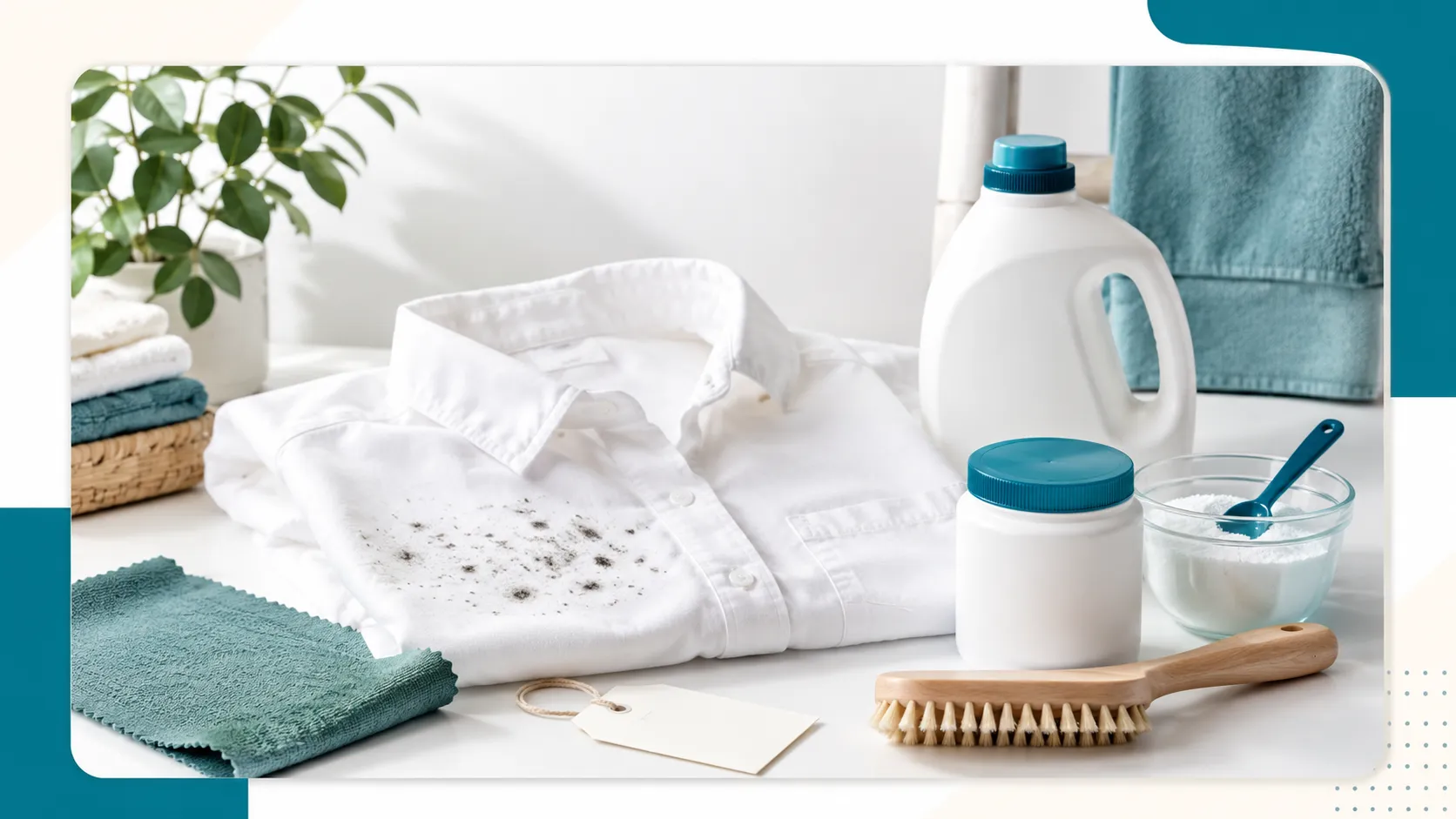
Mold and mildew stains can remain on clothing after the visible growth has been removed. The marks may appear as black dots, gray patches, yellow discoloration, or brown damp-storage stains.
The safest treatment depends on whether mold is still growing, whether the item is washable, its color and fiber type, and what the care label allows.
This guide focuses on removing leftover mold and mildew discoloration from clothes and fabric. If the item is still fuzzy, spreading, damp, or strongly musty, address the active mold problem before treating it as an ordinary stain.
Quick Answer: How to Remove Mold Stains From Clothes
To remove mold or mildew stains from washable clothes:
- Take the item outside and gently remove loose surface residue.
- Apply liquid laundry detergent directly to the mark.
- Let the detergent work for 10 to 15 minutes.
- Wash at the warmest temperature allowed by the care label.
- Air-dry the item and inspect the stain before using dryer heat.
- If discoloration remains, use oxygen bleach on suitable colorfast fabric or chlorine bleach only on white, bleach-safe clothing.
Use one cleaner at a time. Never combine bleach with vinegar, ammonia, detergent, or another cleaning product.
If the area remains fuzzy, continues to spread, or has a strong musty odor, address the active mold on the clothing before treating the remaining discoloration as an ordinary stain.
Is It Active Mold or a Leftover Stain?

A mold stain is not always the same as active mold. Flat discoloration may remain after visible growth is gone, and the difference between mold and mildew on clothes is not always clear from color alone. Appearance cannot prove that the growth is inactive.
| What You Notice | Safer Interpretation | Next Step |
|---|---|---|
| Fuzzy or powdery growth | Mold may still be active | Address the active growth first |
| Flat mark on fully dry fabric | May be leftover discoloration | Use the stain-removal method |
| Strong musty odor | Moisture or mold may remain | Identify and treat the source |
| Weak, brittle, or thinning fibers | Possible permanent fabric damage | Stop treatment |
| Mark returning after storage | Moisture problem may still exist | Dry the item and storage area fully |
Do not aggressively brush heavily moldy clothing indoors. Moving or brushing the item can disturb particles and spread residue into the surrounding area. Before handling an uncertain mark, compare it with the common signs of mold on clothing.
If the visible stain disappears but a musty smell remains after complete drying, use a separate process for removing mildew odor from clothes instead of repeatedly applying stronger stain treatments.
Check the Care Label First
Always check the care label before using any cleaner. Some clothes can handle warm water and oxygen bleach. Others can shrink, fade, or weaken if treated too strongly.
Look for these details:
- whether the item is washable
- the safest water temperature
- whether bleach is allowed
- whether the fabric needs dry cleaning
- whether tumble drying is safe
White cotton towels can usually handle stronger treatment than wool, silk, rayon, or dark clothing. So do not use one method on every item.
For fabric couches, cushions, and upholstery, follow the upholstery care code instead of washing-machine steps.
What Removes Mold Stains From Clothes?
For most washable clothing, start with liquid laundry detergent. Escalate only if the stain remains and the care label allows a stronger treatment.
Liquid Laundry Detergent
Liquid detergent is the safest starting treatment for most washable garments. It helps loosen soil, residue, body oils, and material trapped around the stained fibers.
Apply a small amount directly to the mark and work it in gently with your fingers or a soft cloth.
Oxygen Bleach
Oxygen bleach can help lighten remaining discoloration on many white and colorfast washable fabrics.
Before using it:
- Check the care label.
- Confirm that the product is suitable for the fabric.
- Test a hidden area for colorfastness.
- Follow the product’s dilution and soaking instructions.
Avoid using standard oxygen-bleach treatments on wool, silk, leather, or other materials excluded by the product label.
Chlorine Bleach
Chlorine bleach may help lighten mold stains on some white, bleach-safe cotton fabrics. It is not appropriate for every white garment.
Do not use chlorine bleach on:
- Colored or dark clothing
- Wool
- Silk
- Elastane or spandex
- Leather
- Garments marked “do not bleach”
- Items with bleach-sensitive prints, trims, or finishes
Treat chlorine bleach as a fabric-compatible stain treatment, not as a universal mold solution. The EPA does not recommend biocides such as chlorine bleach as a routine requirement for every mold-cleanup situation.
White Vinegar
Diluted white vinegar may help with light mildew residue or a musty odor on some washable fabrics. It is not the best first treatment for deep, dark, or old pigmentation.
Use vinegar only when the care label permits it, and test a hidden area first.
Never combine vinegar with chlorine bleach.
How to Remove Mold Stains From Washable Clothes
This method works best for cotton, polyester, towels, denim, bedding, and other washable fabrics. Still, check the care label first.
Step 1: Take the Clothing Outside
Take the stained clothing outside before brushing it. This helps keep loose residue away from indoor air and clean laundry.
Do not shake the item hard. A light brush is enough.
Step 2: Brush Away Loose Residue
Use a soft brush or old toothbrush. Brush the affected area gently. Do not scrub hard because rough scrubbing can damage fibers.
If the fabric is thin, old, or delicate, use a clean cloth instead of a brush.
Step 3: Pre-Treat the Mark
Apply a small amount of liquid laundry detergent directly to the area. Rub it in gently with your fingers or a soft cloth.
Let it sit for about 10 to 15 minutes. This gives the detergent time to loosen residue from the fibers.
For stronger discoloration, use a fabric-safe stain remover. Test it on a hidden seam first.
Step 4: Wash at the Warmest Safe Temperature
Wash the garment at the warmest temperature permitted by its care label. Washing helps remove residue, but whether washing clothes kills mold depends on the cycle, temperature, detergent, fabric, and extent of contamination.
Use the normal recommended amount of detergent. Extra detergent does not make the treatment stronger and may leave residue behind.
Step 5: Air-Dry and Check Before Using Heat
Do not put the item in the dryer right away. High heat can make some marks harder to remove.
Instead, air-dry the clothing first. Then check the area in natural light. If the mark is still there, repeat the treatment before using dryer heat.
How to Remove Mold Stains From White Clothes
White cotton, towels, and bedding may tolerate stronger treatments, but the care label still controls what is safe.
- Pretreat the mark with liquid detergent.
- Allow it to work for 10 to 15 minutes.
- Wash at the warmest safe temperature.
- Air-dry and inspect the area.
- If the stain remains, use oxygen bleach according to its label.
- Use chlorine bleach only if the item is white, bleach-safe, and free from bleach-sensitive fibers or trims.
Do not assume every white item can tolerate chlorine bleach. White wool, silk, elastane blends, printed fabric, and some synthetic materials may yellow, weaken, or become damaged.
If the care label permits outdoor drying, sunlight may help brighten some white cotton items. However, ordinary sunlight should not be treated as a dependable mold-removal or sanitizing method.
How to Remove Mold Stains From Colored Clothes
Colored clothing needs a cautious method because strong treatments can remove dye along with the stain.
Start by applying liquid detergent directly to the mark. Wash the item according to the care label and air-dry it before deciding whether another treatment is needed.
If discoloration remains:
- Test color-safe oxygen bleach on a hidden seam.
- Use it only if the fabric remains unchanged.
- Follow the product’s dilution and soaking directions.
- Rinse the item thoroughly.
- Air-dry it again before using heat.
Avoid chlorine bleach on colored, black, or dark clothing unless the care label and product instructions explicitly permit it.
Dry dark garments in shade or indirect light to reduce fading.
Can Black, Yellow, or Brown Mold Stains Be Removed?
Dark or old marks are often more difficult to remove, but stain color alone does not reveal which cleaner will work safely.
Black dots, yellow patches, gray marks, and brown discoloration may come from mold pigments, mildew residue, long-term moisture, dye changes, or damaged fibers.
Start with detergent regardless of the stain’s color. If the fabric is washable and colorfast, move to a compatible oxygen-bleach treatment. Reserve chlorine bleach for suitable white, bleach-safe fabric.
Some old marks may lighten without disappearing completely. Stop treatment if the fabric becomes thin, rough, faded, brittle, or distorted.
Old Mold Stains or Marks That Remain After Washing
A mold stain may remain after one wash because the mark needed pretreatment or because the discoloration has penetrated deeper into the fibers.
If the item has not been dried with heat:
- Apply liquid detergent directly to the stain again.
- Let it work for 10 to 15 minutes.
- Use oxygen bleach if the fabric and color allow it.
- Wash at the warmest safe temperature.
- Air-dry and inspect.
If the garment has already been through a dryer, the mark may be harder to remove. Repeat a gentle treatment rather than immediately applying a stronger chemical.
For old stains on white or colorfast washable fabric, a product-directed oxygen-bleach soak may help. Test colored clothing before soaking it.
If the stain does not improve after two or three careful treatments, stop. Additional scrubbing or stronger chemicals may cause more damage than the remaining mark.
How to Treat Mold Stains on Delicate Fabrics
Delicate fabrics need extra care. Strong stain removers can damage them quickly.
Wool
Do not use hot water on wool. Also, do not use chlorine bleach. Use cool water and a wool-safe detergent.
Gently blot the affected area. Do not scrub hard. If the mark is deep, professional cleaning may be safer.
Silk and Rayon
Silk and rayon can weaken when soaked too long. They can also lose shape or color.
Avoid bleach and strong stain removers. Use a gentle cleaner only if the care label allows washing. For valuable items, use professional cleaning.
Dry-Clean-Only Clothes
Do not soak dry-clean-only clothing at home. Moisture and scrubbing can damage the fabric structure.
Take the item to a cleaner and explain that the mark is a mold or mildew stain.
What Not to Use on Mold Stains
Some cleaning mistakes can make mold stains worse or damage the fabric.
Avoid these mistakes:
- Do not mix bleach with vinegar.
- Do not mix bleach with ammonia.
- Do not mix bleach with any other cleaner.
- Do not use chlorine bleach on colored clothes unless the label allows it.
- Do not scrub wool, silk, rayon, or thin fabric hard.
- Do not put marked clothes in the dryer before checking them.
- Do not use hot water on fabrics that can shrink.
- Do not keep repeating strong treatments if the fabric feels weak.
Use one cleaner at a time. Also, rinse the fabric well before trying a different method.
Can Mold Stains Become Permanent?
Yes. Some mold and mildew stains can become permanent, especially when moisture, pigmentation, or fiber damage has remained for a long time.
A mark may be permanent when:
- It remains after several careful treatments.
- Dark pigment appears embedded in the fibers.
- The fabric feels rough, thin, or brittle.
- The original dye has changed.
- The stained area has weakened.
- A musty odor returns after complete washing and drying.
- Further treatment causes fading or distortion.
Cleaning may improve the appearance without restoring the item completely. The EPA notes that mold can cause cosmetic staining and damage that may prevent an item from returning to its original condition.
Stop treatment when the risk of damaging the fabric becomes greater than the benefit of further stain removal..
How to Prevent Mold Stains From Returning
Mold and mildew stains usually begin with prolonged moisture. Drying garments completely, improving airflow, and preventing mold in stored clothing are especially important in humid closets and enclosed storage areas.
If stains keep returning, inspect the room, closet, wall, basket, or washing machine for an unresolved moisture source.
Final Answer
The safest way to remove mold and mildew stains from clothes is to begin with liquid detergent, wash at the warmest care-label-approved temperature, and air-dry before checking the result.
If discoloration remains, use oxygen bleach on suitable colorfast fabric or chlorine bleach only on white, bleach-safe items. Stop if the fibers weaken, and seek professional cleaning for delicate, non-washable, valuable, or heavily affected fabric
Editorial Sources
- University of Georgia Extension — Remove Stains From Mildew, Mold
- CDC — Mold Clean Up Guidelines and Recommendations
- EPA — Should I Use Bleach to Clean Mold?
- Clorox — Mold and Mildew Cleaning Safety Guidance
