


If your washer spins but clothes come out wet, the machine isn’t removing water properly during the final cycle. This usually comes down to a drainage issue, spin problem, or load imbalance—not necessarily a broken washer. In this guide, you’ll learn how to quickly diagnose the cause, fix common problems, and know when it’s time for repair.
After a normal spin cycle, clothes should feel damp—not soaking wet or dripping. If they feel heavy or take much longer to dry, something isn’t working as it should.
What Does It Mean When a Washer Spins but Clothes Are Still Wet?
When this happens, your washer is either not spinning fast enough to push water out of fabrics or not draining that water properly once it’s removed.
A healthy washer does both at the same time. If either step fails—even slightly—you’ll notice it quickly in how wet your clothes feel.
What’s normal vs not normal
- Normal: Clothes feel lightly damp
- Not normal: Clothes feel heavy, soaked, or dripping
If you’re in the second category, it’s time to troubleshoot.
Why Does a Washer Spin but Leave Clothes Wet?
This problem almost always falls into one of three buckets:
- Drainage problem → water isn’t leaving the machine
- Spin issue → clothes aren’t being spun dry enough
- Load/setup issue → the washer is limiting performance
The fastest way to figure it out is to check what’s happening inside the drum.
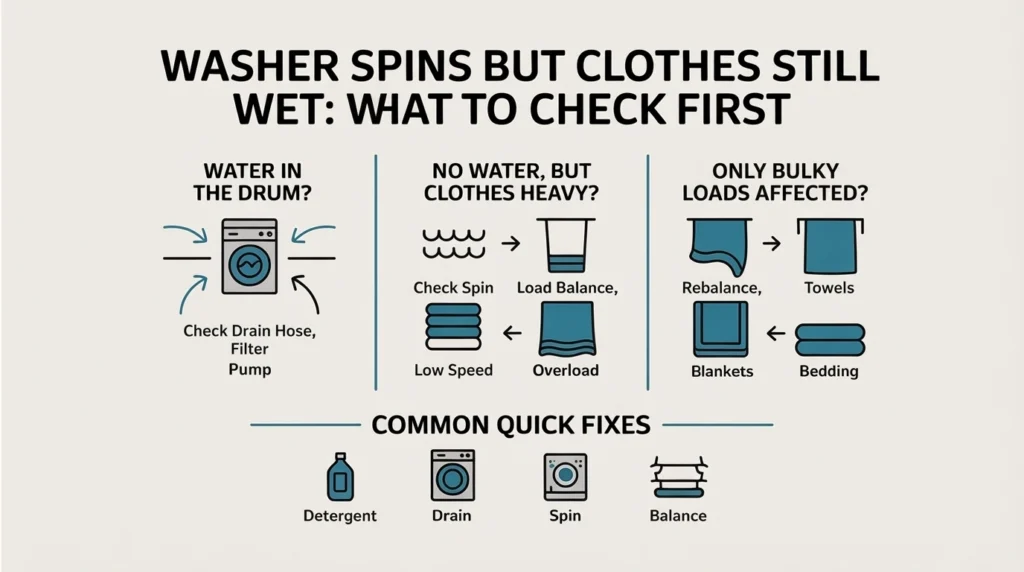
Start Here: Drain Problem or Spin Problem?
Before digging into detailed causes, take a few seconds to check what the washer is doing at the end of the cycle.
If there’s water sitting in the drum
You’re likely dealing with a drainage issue. Start by checking the drain hose, filter, and drain pump.
If there’s no water, but clothes are very wet
This usually points to a spin or load issue. Check the spin speed setting, load balance, overloading, and whether the washer is level.
If it only happens with towels or blankets
That’s usually a bulky load imbalance. The washer may reduce spin speed automatically to protect itself.
What to Check First (5-Minute Fix List)
Before assuming anything is broken, run through this quick checklist:
- Rerun a drain and spin cycle
- Reduce or rebalance the load
- Increase the spin speed setting
- Check for a kinked drain hose
- Use less detergent if you see foam
- Try a smaller load
These simple steps fix a surprising number of cases.
Most Common Reasons Clothes Stay Wet After Spin
Here are the most likely causes, starting with the easiest to fix.
Low spin speed or wrong cycle
Some cycles, especially gentle or delicate ones, use slower spins. Lower speed removes less water, so clothes come out wetter than expected. Switching to a higher spin setting often solves the issue.
Unbalanced load
Clothes can bunch up on one side of the drum. When that happens, the washer may slow down or shorten the spin cycle to prevent damage. Pause the cycle and redistribute the load evenly.
Overloading the washer
Too many clothes restrict movement inside the drum. That makes it harder for the washer to spin efficiently and remove water properly. Remove a few items and try again.
Too much detergent
Extra detergent creates too many suds. Excess foam traps water and interferes with proper rinsing and spinning. If you see foam or soap residue, reduce the detergent amount.
Washer not level
An uneven washer affects balance, especially during high-speed spin. If the machine rocks or vibrates more than usual, check the feet and level it properly.
Blocked or kinked drain hose
The hose behind the washer may be bent, pinched, or partially clogged. That slows drainage and can leave water behind in the drum or the clothes.
Incorrect drain hose installation
If the drain hose is positioned incorrectly, water may not leave the washer efficiently. Check your washer manual for the correct hose height and placement.
Clogged drain filter
Some washers have a drain filter that collects lint and debris. If it gets blocked, water may not drain fully, leaving clothes wetter than expected after the spin cycle.
If your model allows it, check and clean the filter regularly. For deeper buildup or odor inside the washer, following a simple washing machine cleaning guide can help improve drainage and overall performance.
Drain pump issue
If the hose and filter look fine but the washer still drains slowly, the drain pump may be clogged, weak, or failing. That usually shows up as repeated wet loads and slow draining across multiple cycles.
Drive belt or motor issue
If the drum cannot reach full spin speed, clothes stay wetter than they should. Belt or motor issues are deeper mechanical problems and usually need a technician.
Door lock or lid switch problem
Many washers won’t complete a full high-speed spin unless the door or lid is securely locked. If the cycle behaves oddly or stops early, this may be part of the problem.
Interrupted cycle or power issue
If the cycle pauses, loses power, or ends before the final spin finishes, clothes may stay overly wet even though the washer did spin for part of the cycle.
Why the Problem Gets Worse Over Time
Leaving this issue unresolved can cause more than just longer drying times. Wet clothes can develop musty odors, the dryer has to work harder, and repeated imbalance or drainage problems can put extra strain on washer parts.
Fixing the cause early usually saves time, energy, and frustration later.
How to Prevent Clothes From Coming Out Wet
A few simple habits make a big difference:
- Don’t overload the washer
- Balance loads evenly
- Use the right spin speed
- Measure detergent properly
- Use the correct cycle for bulky items
- Check the drain hose occasionally
Step-by-Step Troubleshooting Process
Follow this order for the best results:
- Check for standing water
- Run drain and spin cycle
- Adjust load size and balance
- Confirm spin speed setting
- Inspect drain hose
- Reduce detergent use
- Clean filter if applicable
- Move to deeper checks only if needed
Clothes Are Wet but No Water in the Drum
If there’s no standing water but clothes still feel heavy, the washer likely didn’t spin fast enough. That often happens because of low spin speed, an unbalanced load, bulky items, or a cycle that automatically reduced speed.
Focus on load distribution, cycle choice, and washer leveling first.
If It Only Happens with Towels or Blankets
Bulky items absorb more water, shift more during spin, and are more likely to trigger imbalance detection. That doesn’t always mean the washer is broken. It often means the load needs better distribution.
Wash bulky items separately, spread them more evenly, and use a bulky or bedding cycle if your washer offers one.
Washer Settings That Help Clothes Come Out Less Wet
Small setting changes can improve results more than many people expect:
- Use higher spin speed when possible
- Select bulky cycle for heavy items
- Avoid mixing very heavy and very light fabrics
- Use the correct detergent type for your machine
What Not to Do
- Don’t keep rerunning overloaded spin cycles
- Don’t keep adding more detergent
- Don’t ignore repeated standing water in the drum
- Don’t put dripping clothes straight in the dryer as the only solution
- Don’t attempt unsafe repairs without knowing your washer model and access points
When It’s a Setup Issue vs a Washer Problem
Most wet-load issues are caused by settings or loading habits, not failed parts.
It’s more likely a setup issue if:
- the problem happens only sometimes
- it mainly affects bulky loads
- there is no standing water in the drum
- changing the spin speed or balancing the load helps
It’s more likely a washer problem if:
- it happens on every cycle
- water regularly remains in the drum
- the washer makes unusual sounds
- the spin cycle fails repeatedly even on normal loads
When to Call a Repair Technician
You should get help if water won’t drain even after basic checks, the washer makes loud or unusual noise, the spin cycle doesn’t complete, or the same problem continues across multiple loads.
FAQs
Should clothes be fully dry after the spin cycle?
No. After the spin cycle, clothes should usually feel damp, not fully dry. If they come out dripping, unusually heavy, or much wetter than normal, the washer is likely not spinning or draining properly.
Can too much detergent make clothes come out wetter?
Yes. Too much detergent can create excess suds, and heavy foam can reduce rinse and spin performance. That can leave clothes wetter than expected, especially in high-efficiency washers.
Why does this happen mostly with towels or blankets?
Bulky items absorb more water and shift more during spin. That can throw the load off balance and cause the washer to reduce spin speed automatically.
Is it worse if there is still water in the drum?
Yes. Standing water in the drum usually points to a drainage issue rather than just a spin-speed issue. In that case, the drain hose, filter, or pump should be checked first.
What if there is no water in the drum but clothes are still very wet?
If the drum is empty but the clothes are still heavy, the washer likely did not spin fast enough to remove enough water from the fabric. Load balance, spin setting, or cycle selection are more likely than a drainage failure.
Can I run another spin cycle instead of repairing anything?
You can try one extra drain-and-spin cycle as a quick test. If the washer keeps leaving clothes wet, repeating the cycle is only a temporary workaround and will not solve the underlying problem.
Can I put very wet clothes straight into the dryer?
You can, but it is not ideal. Very wet clothes increase drying time, use more energy, and may hide a washer problem that needs attention.
When is this probably a washer fault and not just a loading issue?
If it happens on every load, including small balanced loads, or if water keeps staying in the drum, the issue is more likely a washer fault than a one-time loading problem.
Final Takeaway
If your washer spins but clothes are still wet, the issue is usually simple: load balance, spin settings, or drainage flow. Start with quick checks, follow a logical troubleshooting process, and only move to deeper repairs if the problem continues.
