

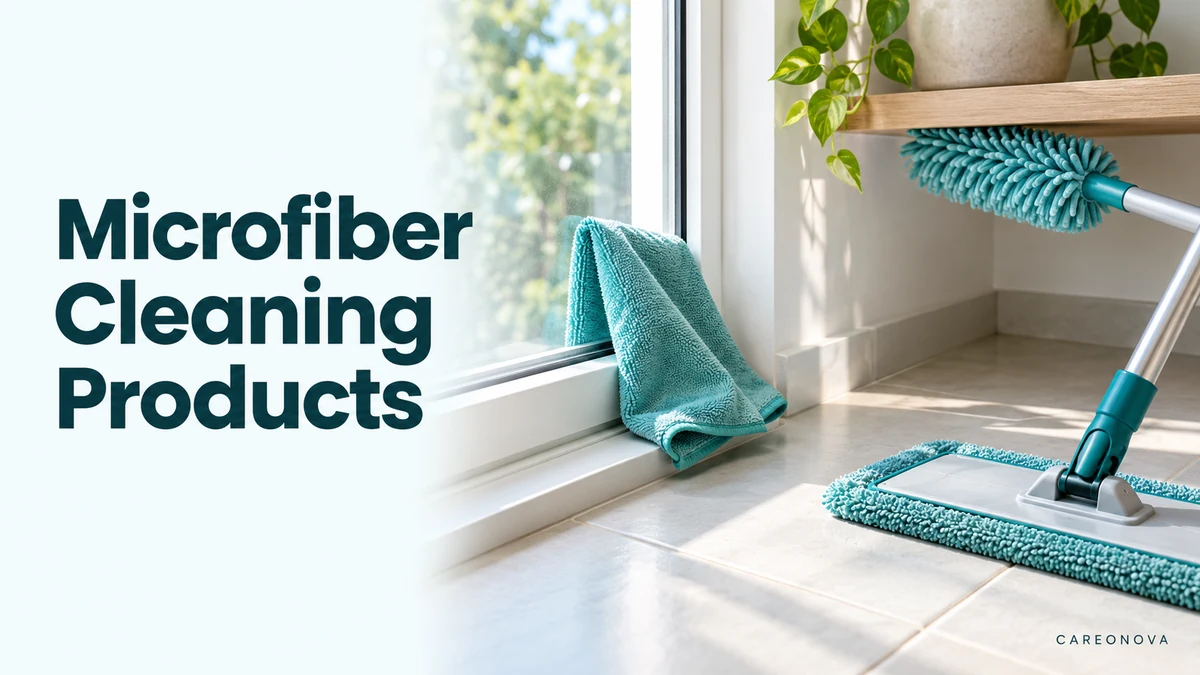
The right microfiber cleaning products depend on what you clean: general-purpose cloths for everyday wiping, glass cloths for finishing mirrors and windows, dusters for awkward spaces, and compatible mop pads for floors. Before buying, check the intended surface, construction, and washing instructions. A useful starter set covers your regular tasks and gives you enough clean replacements between washes.
Here, “microfiber cleaning products” means tools made from microfiber. Detergents for washing those tools and cleaners for microfiber couches are separate categories.
Which microfiber cleaning products do you need?
Start with the surfaces you clean most often. Then choose a product designed for each task, checking any restrictions from the surface manufacturer.
| Cleaning task | Product to consider | What to check before buying |
|---|---|---|
| Everyday wiping and spills | General-purpose microfiber cloth | Manageable size, intended use, and washable construction |
| Windows and mirrors | Glass-cleaning or polishing cloth | Whether it cleans, dries, or serves as a finishing cloth |
| Shelves, furniture, and awkward spaces | Dusting cloth or microfiber duster | Reach, head shape, and whether the head is washable |
| Loose floor dust and hair | Dry microfiber mop pad | Floor suitability and secure attachment to the frame |
| Damp floor cleaning | Microfiber wet mop pad | Floor-care instructions, cleaner compatibility, and pad fit |
| Screens and delicate surfaces | Manufacturer-approved cloth | Device-specific cloth and cleaning restrictions |
You may already have some of these jobs covered. If your existing mop works well and replacement pads are available, buying compatible refills can make more sense than replacing the entire system.
Think about your cleaning routine, too. Moving through a kitchen, bathroom, and several dusty rooms calls for more clean cloths than wiping one countertop. The useful quantity depends on keeping tasks separate and how often you can wash the cloths.
Types of microfiber cleaning products—and when to choose each
Choose the product shape and construction that make the task easier. A large collection offers little value if most pieces duplicate the same job.
General-purpose cleaning cloths
General-purpose cloths are the most practical starting point for everyday wiping. Look for a size you can comfortably hold and fold, along with instructions that cover your intended surfaces.
Folding a cloth into quarters gives you several sections to work with. Turn to a fresh section as it becomes dirty, and replace the cloth when needed. This is more useful than continuing to wipe with the same soiled face.
For household organization, assign separate colors to different tasks—for example, one for bathrooms and another for kitchens. The colors are reminders, so choose a system everyone using the cloths understands. A color change does not replace proper washing between uses.
Glass and polishing cloths
Choose a glass-specific cloth when mirrors and windows are regular cleaning tasks. Check whether it is designed to remove dirt or to finish a surface after cleaning; some systems use separate cloths for those steps.
A finishing cloth is not necessarily the best tool for removing a dirty buildup. Its job may be to collect remaining moisture and polish a surface that has already been cleaned.
For a dirty mirror, separate those jobs. Remove the soil first, then use a clean finishing cloth if the product instructions call for it. Trying to polish with the cloth that just collected the dirt can leave you chasing the same marks around.
Microfiber dusters
A duster is worth considering when its shape or reach solves a problem. A handheld tool may suit shelves, while an extendable model can help reach high trim.
Check the practical details: Does the head fit the spaces you need to clean? Can you remove it for washing? Are replacement heads available?
For accessible, flat surfaces, a suitable cloth may already do the job. Add a duster when it makes cleaning easier rather than because it completes a matching set.
Microfiber mops and replacement pads
Choose pads according to whether you need dry dusting or damp cleaning. Some products support both uses, but verify that in their instructions.
Pad compatibility deserves close attention. Check the exact dimensions, attachment method, and supported frame models. A pad described as “universal” still needs to fit securely on your particular mop.
Before committing to a system, look for replacement pads. An inexpensive starter mop becomes less convenient if compatible refills are difficult to find. A spare pad also lets you continue cleaning while another is being washed or dried.
How to compare microfiber quality before buying
Judge microfiber quality through several details together: construction, intended use, care requirements, and clearly documented specifications. No single number tells the whole story.
GSM: what fabric weight tells you
GSM means grams per square meter, a measure of fabric weight. It helps describe a cloth, but it does not measure cleaning performance by itself.
At the same size, a higher-GSM cloth has more fabric mass than a lower-GSM cloth. That comparison does not tell you which one will finish glass more cleanly, fit into a narrow space, or feel easier to handle.
For example, a lightweight, flat glass cloth and a heavier, plush towel may serve different purposes. Choosing the heavier one simply because its GSM is higher overlooks the job you need it to do.
Compare cloths intended for the same task, then consider construction and handling alongside weight. If a listing promotes a very high GSM but barely explains the intended use, an important part of the buying decision is still missing.
Weave and pile: match construction to the task
Weave or knit describes how the fabric is constructed. Pile refers to the raised fibers on its surface. These differences affect how the cloth feels and how it is intended to be used.
For general wiping, look for a terry-style cleaning cloth with raised loops that the manufacturer recommends for that task. For glass finishing, a smooth, flat cloth may be the intended second step. In a two-cloth method, one cloth removes the soil while another finishes the cleaned surface.
A scrubbing section is another distinct feature. It may help with stuck-on soil on approved surfaces, but it also introduces a compatibility question. Do not assume a textured or abrasive section is suitable for a delicate finish.
Waffle, plush, and short-pile labels can help describe a product. Look for an explanation of what that construction is designed to do rather than treating those labels as a ranking from poor to excellent.

Fiber blend and split microfiber
Many microfiber cleaning cloths contain polyester and polyamide, also called nylon. An 80% polyester/20% polyamide label may be shortened to “80/20.” Always verify which material comes first rather than interpreting the numbers on their own.
“Split microfiber” refers to fibers divided into finer sections during manufacturing. Fiber blend and splitting describe different characteristics: the percentages tell you the material proportions, while splitting describes part of the fiber’s construction.
Neither an 80/20 nor a 70/30 ratio, by itself, proves that one finished cloth will clean better. Before paying more, look for a meaningful advantage in intended use, construction, care, or documented performance.
Size, edges, and product instructions
Choose a size that suits both your hand and the area you clean. An oversized cloth may feel awkward around faucets, handles, or narrow spaces.
Inspect edging, sewn-in labels, and any scrub sections, particularly when buying for delicate finishes. A microfiber label does not establish compatibility with every surface.
Clear instructions are a useful purchasing feature. You should be able to find out what the product is for, how to use it, and how to wash it before placing the order.
Should you buy a microfiber kit, individual tools or a bulk pack?
Buy a kit when its pieces match your routine, individual tools when you have a specific gap, and a bulk pack when you need several copies of a suitable cloth.
When a cleaning kit offers useful value
A kit can simplify shopping if you need several different tools. Compare its contents with the jobs you actually do.
Count the pieces you will use regularly. A larger kit may include duplicate cloths, specialty tools you do not need, or a mop system that replaces something you already own.
Also check whether the pieces share care instructions. A set that requires different washing methods may be less convenient than it first appears.
When individual products or bulk packs make more sense
Individual purchases suit a specific problem: a glass cloth for persistent mirror marks, a duster for high shelves, or replacement pads for an existing frame.
Bulk packs suit tasks where several identical cloths are useful. Before buying a large quantity, consider trying a smaller pack from the same range if available. That lets you assess handling, fit, and care requirements without committing to a cabinet full.
Are expensive microfiber products worth it?
A higher price is easier to justify when it buys a useful feature: better fit for a task, available refills, or documented durability under conditions relevant to you.
Compare cost per usable item, not just package price. In a hypothetical example, a $24 kit containing only four pieces you need costs $6 per useful piece. A $15 pack of five suitable cloths costs $3 per cloth. That calculation does not measure performance, but it makes unused extras easier to spot.
Include delivery and replacement costs where they affect the decision.
Be careful with wash-count claims, too. Check the conditions behind them, including washing temperature and whether bleach is permitted. A durability claim is most useful when your care routine can follow those conditions.
Can you clean with microfiber and water alone?
Some microfiber products are designed for water-only cleaning on specified surfaces. Whether that is enough depends on the product, the soil, and the surface.
When water may be enough—and when to use a cleaner
Water-only use should follow the product’s actual method. If a cloth is designed for damp wiping, follow its directions for wetting and wringing it. Do not assume soaking the cloth or leaving more water on the surface will improve the result.
For a two-cloth glass-cleaning method, the instructions may call for a damp cleaning cloth followed by a separate dry polishing cloth. Each has a different role.
When soil remains, use a cleaner suitable for the surface and compatible with the tool. Follow the cleaner’s directions rather than adding more product by guesswork. A microfiber cloth does not make every cleaning product or method suitable for the surface beneath it.
Does microfiber disinfect surfaces?
Wiping with microfiber does not, by itself, establish that a surface has been disinfected.
Cleaning removes dirt and germs. Disinfection uses an appropriate product to kill remaining germs according to its directions. If disinfection is needed, follow the label’s application method and contact time—the period the surface must stay wet. Do not immediately polish the surface dry.
The CDC’s household cleaning and disinfection guidance explains this distinction and the importance of keeping surfaces wet for the required contact time.
Treat microbial-removal percentages as product-specific claims. Check which product was tested, on what surface, and under which conditions. A result for one commercial microfiber system cannot be applied to every household cloth.
What to check before cleaning delicate surfaces
Use the surface manufacturer’s instructions first, especially for electronics and specialty coatings.
A cloth approved for ordinary household glass is not automatically suitable for every display. Some screens and specialty finishes have specific cloth, moisture, or cleaner restrictions. Keep cloths used on these surfaces separate from general cleaning cloths that may carry debris or residue.
For floors, check the flooring instructions before choosing a damp-mopping method or cleaner. Start with what the surface permits, then select the tool.
Check the care requirements before you buy
Choose microfiber products you can clean and dry according to their instructions. Care requirements are part of the purchase, particularly when comparing household cloths with commercial systems.
Bleach restrictions, washing temperatures, and drying methods can differ between products. Some commercial microfiber systems permit procedures that would be unsuitable for a household cloth. Do not transfer instructions from one product to another simply because both are microfiber.
Before buying, check:
- Whether cloths, pads, and duster heads are washable.
- The permitted wash temperature and drying method, including any laundry symbols on the label.
- Restrictions on detergent, bleach, fabric softener, or dryer sheets.
- Whether you have enough replacements while used pieces are being cleaned.
For general laundering steps, see our guide to washing microfiber towels. Where general advice differs from your product’s instructions, follow the product instructions, including its temperature, bleach, and drying restrictions.
Why microfiber sometimes leaves disappointing results
When results disappoint, check the cloth’s condition, the cleaning method, and its suitability for the task before replacing the whole set.
| Problem | What to check first | Practical next step |
|---|---|---|
| Streaks or greasy film | A soiled cloth, retained residue, too much cleaner, or unsuitable cloth type | Try a freshly laundered cloth and follow the cleaner’s dose and finishing instructions |
| Lint on the surface | Debris caught in the cloth, laundry contamination, or visible deterioration | Inspect and wash as directed; reserve a clean, suitable cloth for finishing |
| Poor absorption | Retained soil, laundry-product residue, or a product intended for a different task | Review the product’s purpose and care instructions |
| Lingering odor | Soil remaining after washing, incomplete drying, or damp storage | Launder as directed and dry completely before storing |
| Poor mop performance | A saturated or dirty pad, loose attachment, or an unsuitable pad | Fit a clean, compatible pad and confirm the intended use |
Change one thing at a time. For example, comparing a freshly washed cloth with the one currently leaving marks can help you investigate whether condition is contributing to the problem.
Laundry history is particularly useful when performance changes after washing. If the care instructions prohibit fabric softener or dryer sheets, check whether either was used accidentally and follow the product’s recovery advice.
Also review how much detergent to use for the load. Use the detergent label and any product-specific washing directions rather than assuming that a small batch of cleaning cloths needs a full-load dose.
If a cloth or pad remains unsuitable after correct care, choose a better match for that job. Repeatedly adding stronger surface cleaners will not resolve a poor product-to-task fit.
A practical microfiber starter set
Start with a small set that covers your regular cleaning and leaves clean replacements available:
- General-purpose cloths: Enough to separate tasks and replace dirty cloths during cleaning.
- A glass or polishing cloth: Useful if mirrors and windows are frequent jobs.
- A compatible mop with spare pads: Appropriate if your flooring permits the intended cleaning method.
- A duster: Optional when extra reach or a shaped head makes a real difference.
The right quantity depends on your home and laundering schedule. Begin with the jobs you do most often, keep suitable tools you already own, and add specialty microfiber products when they solve a clear problem.
