


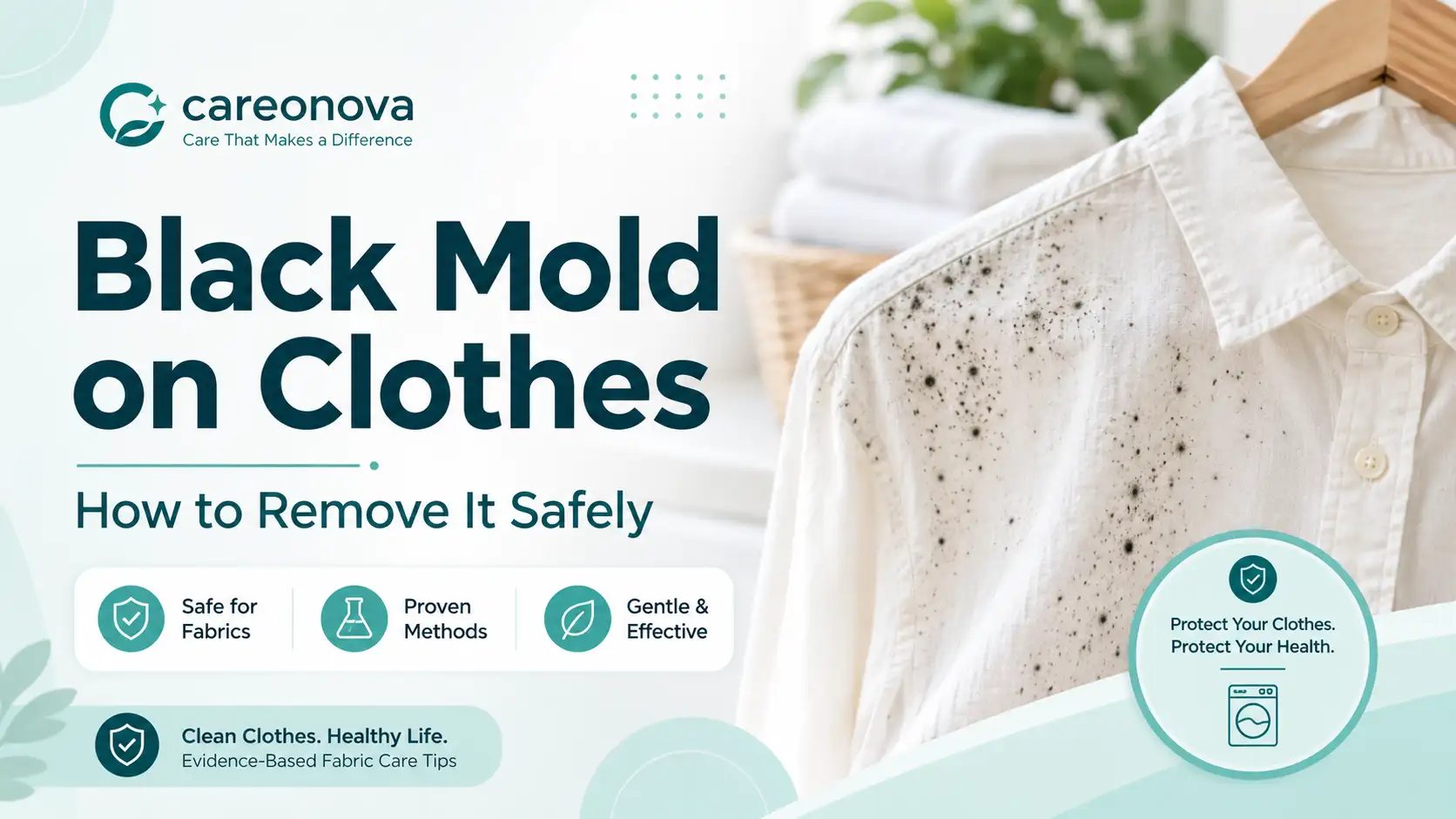
Black mold on clothes can sometimes be cleaned when the affected area is limited, the item is washable, and the fabric is still sound. But black color alone does not prove that the mold is Stachybotrys chartarum, often called “toxic black mold.” First inspect the clothing, follow its care limits, use a suitable cleaning method, dry it completely, and check it again before wearing or storing it.
For a quick first response:
- Keep the affected clothing separate from clean laundry.
- Check the fabric, care label, and extent of the growth.
- Handle loose surface material carefully.
- Pretreat and wash using products and temperatures the clothing can tolerate.
- Dry completely, then inspect again for growth, staining, odor, or damage.
How to Get Black Mold Out of Clothes
To get black mold out of clothes, focus on two things at the same time: removing the mold-like material and protecting the fabric. The strongest cleaner is not automatically the smartest cleaner if it leaves the shirt faded, stretched, or damaged.

1. Inspect the clothing before you clean it
Keep obviously affected clothing away from clean laundry while you assess it.
Check both sides of the fabric, then look closely at seams, pockets, cuffs, waistbands, folds, hoods, and lined areas. These parts can stay damp longer than flat sections of fabric.
Next, judge how extensive the problem is.
A small patch on a sturdy, machine-washable shirt is a very different situation from mold spread across a lined jacket, wool sweater, or dry-clean-only item.
Also check the condition of the fibers. If the material feels brittle, weak, distorted, or damaged, repeated scrubbing and washing may make things worse.
Finally, read the care label. It sets the limits for:
- washing method;
- water temperature;
- bleach use;
- drying method.
If the item cannot tolerate the treatment you are considering, use a fabric-safe mold-removal method that stays within its care limits or consider professional cleaning.
2. Check what the fabric can safely tolerate
A sturdy white cotton shirt may tolerate treatments that would be a poor choice for wool, silk, viscose, dark dyes, stretch fabrics, or clothing with special finishes.
Look at the whole item, not just the main fiber listed on the label. Linings, prints, coatings, elastic, trims, and decorative details can change what is safe.
Let the care label set the limits, then use the mildest treatment that can reasonably do the job. More heat is not a shortcut if the clothing comes out smaller, faded, or misshapen.
3. Handle loose surface growth carefully
If you can see fuzzy or powdery material on the surface, avoid shaking or aggressively brushing the clothing around clean laundry or living areas.
When visible mold will be disturbed, mold-cleanup guidance recommends protective gloves, eye protection, and at least an N95 respirator to help reduce exposure. Avoid shaking moldy clothing around clean laundry or living areas.
Handle the clothing gently instead of scrubbing delicate fibers aggressively. Rough treatment can damage the material without fixing the moisture problem that allowed the mold to develop.
If mold covers a large area, the item is valuable, or its construction makes home washing unsuitable, professional cleaning may be the better choice.
4. Pretreat the affected area
Use a laundry pretreatment or stain-removal product that is suitable for the clothing and follow the product directions.
For a washable, colorfast item, a fabric-compatible laundry pretreatment is a practical starting point.
A white item that is specifically labeled chlorine-bleach-safe may allow different treatment options from a colored or delicate piece. Bleach can affect dyes, elastic, and some fibers, so compatibility matters more than how strong the product sounds.
Take extra care with:
- wool and silk;
- viscose and rayon;
- stretch fabrics;
- dark or unstable dyes;
- structured or lined clothing;
- special finishes and embellishments.
Dry-clean-only or particularly delicate pieces are usually better candidates for professional care than aggressive home treatment.
Do not treat vinegar, bleach, baking soda, borax, or another household product as a universal mold cure. A product can affect staining or microorganisms and still be a poor match for a particular fiber, dye, finish, or construction.
Never mix chlorine bleach with other household cleaners. Follow the product label exactly.
5. Wash the clothing appropriately
After suitable pretreatment, wash a machine-washable item with laundry detergent.
Use a cycle and water temperature the clothing can safely tolerate. The hottest washer setting is not automatically the best setting.
Washing moldy clothes is often an important part of treatment when the affected area is limited and the item is washable, but one normal wash cycle is not a guarantee.
The result depends on several factors:
- how much mold-like material is present;
- the condition of the fabric;
- the pretreatment used;
- the wash conditions;
- how thoroughly the clothing is dried;
- whether the original moisture source has been corrected.
If visible surface material remains after appropriate cleaning, repeatedly reaching for harsher treatments can damage the fabric more than it helps.
6. Dry the clothing completely
Complete drying matters because mold depends on moisture.
A cleaned item put back into a closet, drawer, hamper, suitcase, or storage container while still damp can end up in the same conditions that caused the problem in the first place.
Use a drying method that suits the fabric.
Check slow-drying areas carefully, especially:
- cuffs;
- waistbands;
- pockets;
- hoods;
- thick seams;
- linings and layered sections.
The outside can feel dry while these areas are still holding moisture.
Do not put the clothing back into enclosed storage until the whole item is dry.
7. Check the clothing again after cleaning
Once the item is completely dry, inspect it in good light.
Not every remaining dark mark means the same thing.
| Clothing condition | Practical next step |
|---|---|
| Small, localized area on washable clothing | Cleaning may be worth attempting. |
| Fabric is strong and undamaged | Treat within the item’s care limits. |
| Only flat discoloration remains after cleaning | The remaining issue may be staining rather than surface growth. |
| Fibers are weakened or deteriorating | Replacement may be more practical than repeated treatment. |
| Wool, silk, structured, or dry-clean-only item | Consider professional cleaning instead of aggressive home treatment. |
| Mold repeatedly returns | Find and correct the moisture source before treating the clothing again. |
| Valuable or sentimental item | Consider specialist textile care before trying stronger cleaning methods. |
Surface growth, staining, odor, and recurrence are not the same problem. A flat dark stain can remain after mold-like material has been addressed, while fuzzy or powdery material deserves another look.
If the marks disappear and then return, stop treating the detergent as the main suspect. Look for where the moisture is coming from.
What Does Black Mold on Clothes Look Like?
Black mold on clothes can appear as dark dots, clustered specks, irregular black or dark greenish patches, or fuzzy or powdery-looking surface material. A musty smell and a history of dampness make mold more likely.
The circumstances matter as much as the color.
Mold becomes more plausible when marks appear after clothing has:
- stayed wet for an extended period;
- sat in a damp hamper or gym bag;
- been stored before fully drying;
- remained in a humid storage area.
Slow-drying sections such as cuffs, waistbands, pockets, thick seams, folds, hoods, and linings are worth checking closely.
When identifying mold on clothes, remember that black marks are not always mold.
Lint, pilling, dirt, dye transfer, and old staining can look surprisingly similar. A flat mark with no surface texture, musty smell, or moisture history should not automatically be labeled mold.
Black-colored mold does not automatically mean “toxic black mold”
Color alone cannot reliably identify a mold species.
Stachybotrys chartarum can appear dark green or black, but a black patch on clothing does not confirm that this particular species is present.
Mold occurs in many colors, and darker does not automatically mean more dangerous.
For someone trying to save a piece of clothing, identifying the exact species is usually less useful than answering four practical questions:
- Is there mold-like growth?
- How much of the item is affected?
- Has the fabric been damaged?
- Why did the clothing stay damp?
Those answers are more useful for deciding what to do next.
Is Black Mold on Clothes Dangerous?
Black-colored mold is not automatically more dangerous than mold of another color, but visibly moldy clothing should still be dealt with before it returns to normal wear or storage.
Mold exposure can cause irritation or allergic reactions in some people. People with asthma, mold allergies, chronic lung conditions, or weakened immune systems may be more sensitive and should use extra caution around moldy materials.
Do not let the color decide how seriously you take the problem. Visible mold-like growth deserves attention whether it appears black, green, or another color.
Mold spores can also settle on clothing and move with it. That does not mean every item carrying spores will develop mold. Growth requires enough moisture and suitable conditions.
Can clothes with black mold be saved?
Sometimes. The decision depends more on the condition and construction of the clothing than on the color of the mold, and those same factors help determine when moldy clothes are no longer worth saving.
| What remains | What it may mean | What to do next |
|---|---|---|
| Fuzzy, powdery, or textured material | Possible unresolved surface growth | Do not assume it is only a stain. Reassess whether further cleaning is appropriate for the fabric. |
| Flat black or brown mark | Residual discoloration or staining | Treat it as a stain only after visible surface growth has been addressed. |
| No visible marks but a musty smell | Residual odor or an unresolved moisture issue | Make sure the item is completely dry and check its storage environment. |
| Spots disappear, then return later | The moisture or exposure source may still be present | Investigate the washer, drying routine, hamper, closet, humidity, or another shared moisture source. |
| Fabric feels weak or damaged | The fibers may have deteriorated | Avoid increasingly aggressive treatment. Replacement or professional care may be safer. |
A dark stain after cleaning does not automatically mean active mold remains. Mold can leave discoloration even after visible surface material has been addressed.
How to Prevent Black Mold From Returning to Clothes
Preventing black mold from returning is mostly about keeping clothing dry and correcting whatever keeps exposing it to moisture.
Changing detergent or stain remover will not solve a recurring mold problem if the same clothes keep returning to damp conditions.
Keep clothing from staying damp
Remove washed clothes promptly and dry them fully.
Do not leave sweaty gym clothes, swimsuits, rain-soaked garments, damp workwear, or wet towels packed in a closed hamper or bag for long periods.
A tightly packed pile traps humid air and slows drying.
If damp clothing cannot be washed right away, avoid sealing it inside a bag or container where the moisture has nowhere to go.
After washing, check the slow-drying parts before putting clothes away. Waistbands, pockets, cuffs, hoods, seams, and linings can remain damp even when the rest of the item feels dry.
Keep hampers, bags, and storage areas dry
Sometimes the clothes are only where the problem shows up, not where it starts.
A damp laundry hamper, gym bag, suitcase, drawer, or storage container can repeatedly expose clean clothing to moisture.
Closets can contribute too, especially when humidity stays high, airflow is poor, or clothing is packed tightly against damp surfaces. If the problem appears mainly after storage, focus on keeping clothes from molding in a closet instead of repeatedly treating each item as a separate stain problem.
If mold keeps returning, find the shared moisture source
Repeated problems across several pieces of clothing usually point to something they have in common.
Possible sources include:
- a damp hamper or laundry bag;
- clothing stored before it is completely dry;
- a musty or mold-affected washer;
- poor drying conditions;
- high indoor humidity;
- condensation;
- a damp closet or storage area;
- a nearby leak or other water problem.
Your detergent probably is not the main issue anymore. Check where the moisture is coming from: the drying routine, hamper, washer, closet, humidity, condensation, or a nearby water problem.
Black mold on clothes is best handled as both a fabric-care problem and a moisture problem. Clean the clothing in a way the material can tolerate, dry it completely, and judge what remains carefully. If dark marks return after cleaning, find the source of the moisture before reaching for a stronger product.
