


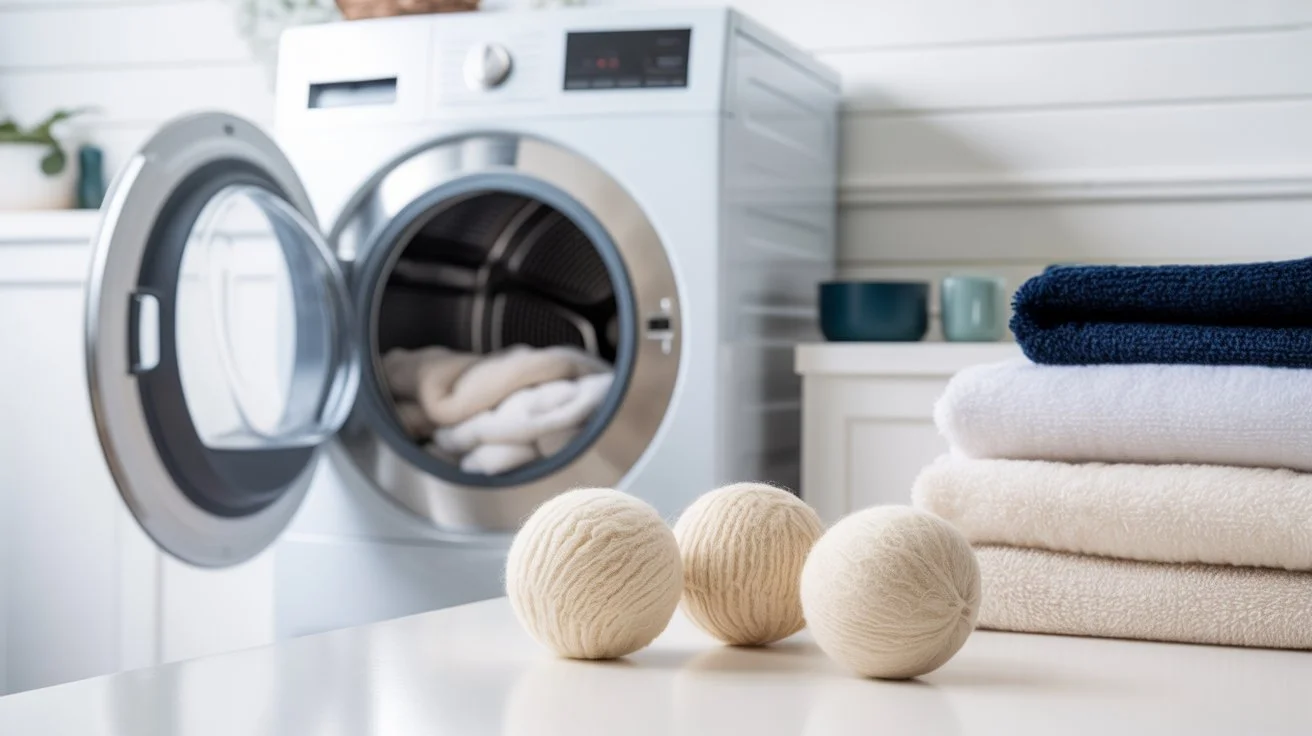
Do wool dryer balls work? Yes, they can help separate wet laundry, reduce clumping, and improve airflow inside a tumble dryer. This may help towels, sheets, and medium-to-large loads dry more evenly or slightly faster.
However, dryer balls do not produce the same result in every load. Their effectiveness depends on fabric type, load size, dryer airflow, cycle settings, starting moisture, and how freely the balls can move.
They are also less reliable for controlling static cling, adding fragrance, removing pet hair, or creating the coated softness associated with liquid fabric softener.
What Do Wool Dryer Balls Do?
Wool dryer balls keep wet fabrics moving and separated while they tumble. They are made from tightly felted wool and move between clothes, towels, sheets, and other dryer-safe items.
Wet fabrics often press together or form heavy bundles. When this happens, warm air cannot reach every surface evenly. Dryer balls create small spaces between items, allowing heated air to move through more of the load.
This movement may help moisture escape more evenly. It can also reduce damp areas caused by twisted sheets, bundled towels, or clothing trapped inside larger items.
Dryer balls work mechanically. They do not:
- produce heat;
- release detergent;
- absorb all the water in a load;
- add fragrance naturally;
- coat fibers with conditioning ingredients.
This makes them different from dryer sheets and liquid fabric softener. Dryer balls mainly improve movement and separation, while many softening products add ingredients to the fabric.
Do Wool Dryer Balls Reduce Drying Time?
Wool dryer balls may reduce drying time when they improve fabric separation and airflow. However, there is no fixed percentage that applies to every dryer or load.
The possible time saving depends on:
- how full the drum is;
- how much moisture remains after the washer’s spin cycle;
- whether the fabrics are light, heavy, natural, or synthetic;
- the heat and drying program;
- the condition of the lint screen, vent, and exhaust duct;
- the number and size of the dryer balls;
- whether the laundry can tumble freely.
A medium load of towels or sheets may show a clearer difference than a small load of lightweight clothing. Large, flat items often wrap around one another, so better separation may help them dry more evenly.
Dryer balls may provide little noticeable benefit when a load already tumbles freely and dries efficiently. They also cannot correct a blocked dryer vent, weak heating system, clogged lint screen, or drum packed too tightly for warm air to circulate.
Evidence note: The separation-and-airflow mechanism is reasonable, but published drying-time estimates vary. A specific percentage should only be claimed when the test uses the same dryer, load weight, fabrics, cycle, and starting moisture.
What Results Can You Realistically Expect?
The most dependable purpose of dryer balls is improving fabric movement. Other benefits are possible, but results vary between loads.
| Claim | Realistic Verdict | Important Condition |
|---|---|---|
| Shorter drying time | Possible | The balls must move freely between items. |
| More even drying | Often useful for towels, sheets, and bulky loads | The drum must not be overloaded. |
| Less clumping | A reasonable expected benefit | Most noticeable with large or flat fabrics. |
| Fewer wrinkles | Possible | Avoid overloading and remove laundry promptly. |
| Softer-feeling towels | May reduce stiffness | They do not coat fibers like liquid fabric softener. |
| Less static cling | Inconsistent | Synthetic fabrics and over-drying remain common causes. |
| Less lint or pet hair | Unreliable | They are not a replacement for a lint or hair-removal tool. |
| Added fragrance | No natural fragrance benefit | Wool balls do not add scent by themselves. |
Results vary because laundry loads are not identical. Cotton towels behave differently from polyester activewear, while a small load behaves differently from a tightly packed drum.
Static cling can be especially unpredictable. Synthetic fibers, dry air, high heat, and long cycles can all increase static. When static is the main problem, reducing the drying time or using a sensor-dry cycle may be more helpful than adding extra balls.
Pet-hair results are also mixed. Some people notice loose hair collecting on the balls, while others see little change. Dryer balls should not be treated as a dependable pet-hair solution.
How to Use Them Correctly
Wool dryer balls work best when both the laundry and balls have enough room to move.
- Check the care labels. Only tumble-dry items when their labels allow it.
- Avoid overloading the drum. A tightly packed load limits airflow and ball movement.
- Add the balls with the wet laundry. Spread them through the load instead of placing them together.
- Choose the correct cycle. Match the heat and drying program to the fabrics.
- Check the load before it over-dries. Excess drying can increase static, wrinkles, shrinkage, and fabric wear.
- Store the balls dry. Keep them in a clean and ventilated place between cycles.
How Many Wool Dryer Balls Should You Use?
Two to six balls is a practical starting range for many loads. The product maker’s instructions should come first because ball size, weight, and density can vary.
| Load Size | Practical Starting Point |
|---|---|
| Small | 2–3 balls |
| Medium | 3–4 balls |
| Large or bulky | 5–6 balls |
Adding more balls does not always improve performance. If they cannot move through the drum, reducing the amount of laundry is usually more helpful than adding another ball.
Best Loads: Towels and Sheets
Towels and sheets are among the loads most likely to benefit from dryer balls. Towels can form heavy, damp bundles, while sheets may twist together and trap smaller items.
Dryer balls may help keep these fabrics separated so warm air reaches more surfaces. This can reduce damp pockets and may help the load dry more evenly.
However, they will not stop every sheet from twisting. Large sheets and bedding may still need to be paused, untangled, and repositioned during the cycle.
For towels, avoid using extra heat simply to make them dry faster. Over-drying can make towel fibers feel rough and may increase wear.
Safety, Cleaning and Replacement
Dryer balls do not make unsuitable fabrics safe for tumble drying. Clothing care labels and appliance instructions still apply.
Avoid placing garments in the dryer when they are marked “do not tumble dry” or contain delicate embellishments, heat-sensitive coatings, loose knitted areas, or materials that require flat drying.
Wool dryer balls are commonly used in gas and electric tumble dryers, but the appliance manual should allow their use.
Do not add essential oil unless both the dryer and dryer-ball maker clearly permit it. Heated oils may stain fabrics or create a safety concern. Dryer balls do not need fragrance to perform their separation function.
Remove loose lint or hair from the surface by hand or with a lint roller. For deeper cleaning, follow the product maker’s directions and allow the balls to dry fully before reuse.
Replace a dryer ball when it:
- loses its firm shape;
- begins to unravel;
- splits or breaks apart;
- sheds heavily;
- no longer moves effectively through the load.
Avoid relying on a fixed lifespan because durability depends on the product, cycle frequency, load type, heat, and storage conditions.
Wool Dryer Balls vs Dryer Sheets and Fabric Softener
Wool dryer balls, dryer sheets, and liquid fabric softener solve different laundry problems.
| Option | Main Action | Best Suited For | Main Limitation |
|---|---|---|---|
| Wool dryer balls | Separate laundry mechanically | Airflow, reduced clumping, and repeated use | Static and softness results vary |
| Dryer sheets | Often add anti-static and fragrance ingredients | Static control and scent | Usually single use and may leave residue |
| Liquid fabric softener | Adds fabric-conditioning ingredients | Conditioned feel and fragrance | Not recommended for every fabric |
Choose wool dryer balls when your main goal is improved separation, less clumping, or a reusable alternative to disposable dryer sheets.
Dryer sheets may provide stronger fragrance and more noticeable static control, depending on the product. Liquid fabric softener may create a more conditioned feel, but the care label should be checked before use, especially for towels and performance fabrics.
Dryer sheets and dryer balls can sometimes be used together when the appliance and product directions allow it. However, using both reduces the waste-saving benefit of replacing disposable sheets with reusable balls.
Why Wool Dryer Balls May Not Be Working
When dryer balls make little difference, the cause is often the load, cycle, or dryer airflow.
| Problem | Likely Reason | What to Check |
|---|---|---|
| Drying time is unchanged | The load is too full or already dries efficiently | Compare similar loads and reduce the drum contents. |
| Clothes remain damp | Poor airflow, lint buildup, or the wrong cycle | Clean the lint screen and inspect the dryer vent. |
| Static remains | Synthetic fabrics or over-drying | Shorten the cycle and separate fabric types. |
| Towels still feel stiff | Over-drying, detergent residue, or mineral buildup | Review the washing and drying routine. |
| Balls remain in one area | The drum is packed too tightly | Remove part of the load. |
| Sheets remain twisted | Large fabrics have wrapped around one another | Pause the cycle and reposition them. |
| Results change between cycles | Load size or starting moisture is different | Compare similar loads using the same settings. |
Dryer maintenance still matters. Clean the lint screen regularly and investigate signs of restricted airflow, such as unusually long cycles, excess heat, or clothing remaining damp.
A blocked vent or clogged exhaust duct is an appliance and safety issue. Dryer balls cannot correct it.
Are Wool Dryer Balls Worth It?
Wool dryer balls are worth considering when you regularly tumble-dry towels, sheets, cotton clothing, or bulky loads that tend to bunch together. They may also suit households that want a reusable drying aid without strong added fragrance.
They are less useful when the main goal is:
- guaranteed static control;
- strong fragrance;
- fabric-softener-style conditioning;
- reliable pet-hair removal;
- dramatic drying-time reductions.
They may also provide little value when loads already dry quickly and evenly.
So, do wool dryer balls work? They can work as a simple mechanical tool that improves fabric movement and separation. Their strongest value is helping warm air reach more of the load. They cannot fix every fabric, laundry, airflow, or appliance problem.
Editorial evidence note: Results can vary by dryer type, vent condition, fabric composition, load size, cycle, starting moisture, and dryer-ball construction. This article does not claim a universal drying-time reduction.
