

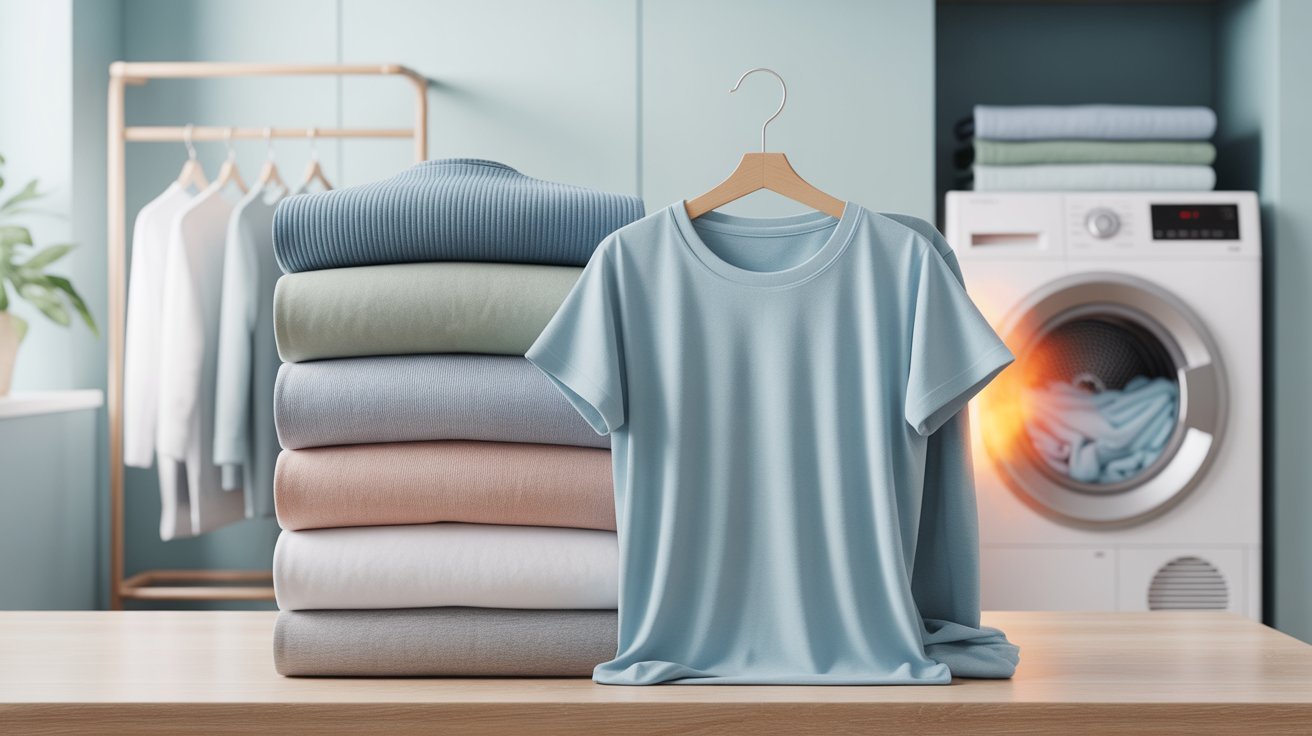
If you are wondering how to prevent clothes from shrinking, start by checking the care label, using the coolest suitable water, choosing the right cycle, and avoiding unnecessary dryer heat. Cold water and low heat reduce the risk, but cotton, wool, rayon, viscose, knits, and synthetic fabrics can all react differently to moisture, movement, and heat.
Shrinkage may begin in the washer and become more noticeable in the dryer. This guide explains safer wash and dry settings, how spin speed and hand washing affect clothing, whether air drying helps, how to protect cotton shirts, and what to do when a garment has already become smaller.
What Causes Clothes to Shrink?
Clothes shrink when water, movement, heat, or drying changes the dimensions of the fibers, yarns, or fabric structure. Heat is a common cause, but it is not the only one. Manufacturing tension, moisture absorption, agitation, finishing treatments, and garment construction can all affect the result.
There are three main types of dimensional change that commonly occur during home laundry.
Relaxation Shrinkage
Relaxation shrinkage is common in cotton, linen, and other absorbent materials because washing can release tension introduced during manufacturing. With linen specifically, shrinkage during washing and drying can also depend on construction, finishing, water temperature, and drying heat.
Felting Shrinkage
Untreated wool has microscopic scales on its fibers. Moisture and movement can cause those scales to interlock, making the fabric denser, thicker, and smaller.
Once wool has felted heavily, restoring its original size is usually not possible. Machine-washable wool may have been treated to reduce felting, but its care label still controls how it should be washed and dried.
Heat Distortion
Polyester and other synthetic fibers usually resist ordinary wash shrinkage better than cotton or wool. However, high heat may still distort thermoplastic fibers, elastic, bonded layers, prints, and garment finishes.
The damage may appear as puckering, stiffness, warped seams, weak stretch, a shiny surface, or a change in fit. This is one reason different fabrics need different washing methods.
Do Clothes Shrink More in the Washer or Dryer?
Clothes can shrink in either appliance, but the dryer often makes the change more noticeable because it combines heat, tumbling, and time.
In the washer, hot water, moisture, and strong agitation can release manufacturing tension or encourage wool fibers to felt. Even cool water may affect unstable cotton, linen, rayon, viscose, or loosely knitted fabrics.
In the dryer, heat and repeated tumbling can tighten some fabric structures, continue wool felting, or distort heat-sensitive materials. Overdrying raises the risk because the garment remains exposed to those conditions after most of its moisture has already been removed.
Some clothing changes in both stages: the fabric begins relaxing in the washer, then becomes visibly smaller after drying.
Best Wash and Dry Settings by Fabric
The safest setting depends on the complete garment, not only its main fiber. Linings, elastic, trims, prints, coatings, and blended materials may require gentler care.
| Fabric or Garment | Main Risk | Safer Wash Setting | Safer Drying Method |
|---|---|---|---|
| Cotton shirts and T-shirts | Relaxation shrinkage and overdrying | Cold or cool water; follow the labeled cycle | Brief low heat or air dry |
| Wool | Felting caused by moisture and movement | Wool cycle or careful hand washing when permitted | Reshape and dry flat |
| Linen | Relaxation and heat-related tightening | Cool water; gentle cycle when permitted | Air dry or use low heat briefly |
| Rayon or viscose | Wet distortion and dimensional change | Cold water; gentle cycle when washable | Support properly and air dry |
| Polyester | Heat distortion rather than typical wash shrinkage | Cool or warm water when allowed | Low heat |
| Loose knits and sweaters | Shrinkage, stretching, and shape loss | Cold water; gentle cycle | Reshape and dry flat |
| Mixed-fiber garments | The most sensitive component may control care | Follow the gentlest fiber requirement | Follow the finished garment’s label |
Editorial note: These settings are cautious starting points, not replacements for the care label. Results also depend on fabric construction, finishing, blend percentages, and earlier washing and drying.
How to Wash Clothes Without Shrinking
To wash clothes without shrinking, reduce unnecessary heat and movement while following the garment’s care instructions. The correct method starts before the washer begins.
Check the Care Label Before Washing
The care label tells you whether the garment can be machine washed, which cycle is suitable, and whether it should be tumble dried, line dried, or laid flat.
Read the complete instruction instead of checking only the wash temperature. An item marked “machine wash cold” may still require gentle agitation, low spin, no tumble drying, or flat drying.
The label accounts for the whole item, including seams, lining, elastic, decoration, and finishes. When a symbol is unfamiliar, check the meaning of the washing symbols on clothing labels before choosing a setting.
Sort Clothes by Fabric and Weight
Do not place delicate shirts, rayon dresses, or soft knits in the same load as heavy jeans, towels, and bedding. Heavier items create more friction and may twist or pull lighter garments.
Sort clothing by fabric type, garment weight, cycle requirement, and drying method. A mixed load should be washed using settings safe for its most sensitive item. When that makes the load impractical, separate it.
Gentle Cycle Versus Normal Cycle
A gentle or delicate cycle uses slower movement and usually runs for less time than a normal or heavy-duty cycle. It can help protect knits, sweaters, rayon, viscose, linen, silk, and other fabrics that may distort under strong agitation.
A normal cycle is often suitable for durable cotton, polyester, and everyday blended clothing when the label permits it.
The delicate cycle reduces mechanical stress, but it does not make every garment machine washable. Items labeled hand wash or dry clean still need the stated care.
Does Spin Speed Shrink Clothes?
High spin speed does not usually shrink fibers by itself. Its main purpose is to remove water before drying.
However, fast spinning can crease, stretch, twist, or distort wet knits and delicate garments. A lower spin may help unstable fabrics keep their shape and reduce the weight pulling against seams.
When the washer does not offer a separate spin control, the gentle or delicate cycle often uses softer extraction.
Does Hand Washing Prevent Shrinkage?
Hand washing can reduce agitation, but it does not guarantee that clothing will not shrink. Hot water, rubbing, wringing, twisting, and unsafe drying may still change the garment’s dimensions.
Use cool water when the label permits, move the item gently, and support its weight when lifting it from the water. Follow a proper hand-washing method instead of treating hand washing as ordinary machine washing done in a sink.
How to Prevent Clothes From Shrinking in the Dryer
To prevent clothes from shrinking in the dryer, use the lowest effective heat, avoid unnecessary drying time, and keep sensitive garments out unless their labels permit tumble drying.
Low heat reduces risk, but it does not make every item dryer-safe. Wool, silk, rayon, viscose, and many loose knits may require flat or air drying, so check the dryer symbols on the care label before placing them in the machine.
For dryer-safe cotton shirts and similar garments, check the load before it becomes excessively dry. Remove each item when it is dry instead of running another full cycle because one heavier piece is still damp.
Does Low Heat Prevent Shrinking?
Low heat lowers the risk of heat-related shrinkage, but it cannot prevent every dimensional change. The fabric may already have relaxed in the washer, and some garments remain sensitive to tumbling even at lower temperatures.
Low heat works best when combined with a shorter drying time, an uncrowded load, prompt removal, and air or flat drying for sensitive clothing.
Does Air Drying Prevent Shrinkage?
A careful air-drying routine can reduce shrinkage, stretching, wrinkles, and slow-drying odors.
Heavy wet sweaters and loose knits may become longer when hung. Lay them flat and arrange them gently into shape. Lightweight woven shirts can often dry on a rack or suitable hanger.
Proper support, airflow, and spacing can reduce shrinkage, stretching, wrinkles, and slow-drying odors.
Does Cold Water Prevent Clothes From Shrinking?
Cold water lowers the risk of shrinkage, but it does not prevent every size or shape change.
Cotton knits may still release manufacturing tension. Wool may felt because of moisture and agitation. Rayon and viscose can distort while wet, while unsafe dryer heat may shrink or damage a garment that survived the wash without visible change.
Cold water works best when paired with the correct cycle and drying method. Washing a delicate item in cold water on a heavy-duty cycle and then drying it on high heat does not make the process safe.
Choose the correct washing temperature based on the fabric, soil level, hygiene needs, and care instructions rather than treating cold water as a universal rule.
How to Prevent Cotton Shirts and T-Shirts From Shrinking
Wash cotton shirts and T-shirts in cold or cool water and avoid prolonged high dryer heat. Cotton may become smaller as manufacturing tension is released, especially during the first few wash-and-dry cycles.
- Follow the wash cycle shown on the care label.
- Use cold or cool water to reduce heat-related shrinkage.
- Dry on low heat and remove the shirt as soon as it is dry.
- Air dry when keeping the original length is the main concern.
Pre-shrunk cotton has been treated to reduce later dimensional change, but it is not shrink-proof. New, untreated cotton often shows its largest change during the first few laundering cycles. Loose cotton knits may also change more than tightly woven cotton.
Cotton-polyester blends may behave differently from pure cotton because the fiber percentages, yarn structure, and fabric construction all affect the result.
Fit tip: Choose a shirt that fits properly now rather than expecting washing to reduce it by a precise amount.
Do Clothes Keep Shrinking Over Time?
Clothes can shrink more than once, although the largest change often occurs during the first few washes and drying cycles.
Later shrinkage may continue when a garment is repeatedly exposed to hot water, strong agitation, high dryer heat, or overdrying. The amount depends on the fiber, fabric construction, finishing, and previous care.
Cotton may gradually settle into a more relaxed size. Untreated wool can continue felting under unsafe conditions. Synthetic garments may suffer cumulative heat distortion rather than ordinary fiber shrinkage.
Clothing does not necessarily become smaller by the same amount after every wash. Once a fabric reaches a more stable state, later changes may be minor unless harsher conditions are introduced.
Common Mistakes That Shrink or Distort Clothes
Most shrinkage problems come from using a routine that is too harsh for the garment rather than from one unavoidable wash.
Place the Laundry Mistakes checklist here.
- Wash fabrics on compatible settings instead of using one cycle for every load.
- Check the care label before using hot water or a sanitize cycle.
- Use high dryer heat only when the garment instructions allow it.
- Remove garments when dry instead of overdrying the entire load.
- Reshape and flat-dry heavy knits instead of hanging them while soaked.
- Separate delicate clothing from heavy towels, denim, and bedding.
- Do not rely on fabric softener to make clothing shrink-proof.
- Follow the needs of the most sensitive fiber, trim, or finish in a blended garment.
Can You Fix Clothes That Already Shrunk?
Mild dimensional change may sometimes improve, but a shrunken garment cannot always be restored.
A slightly tightened cotton item may sometimes be eased closer to its earlier dimensions while damp, but full recovery is not guaranteed. Support the whole garment on a flat surface and use light, even pressure rather than pulling one seam or area.
Rayon and viscose require extra care because they can become weaker and easier to distort while wet. Felted wool is unlikely to return fully because its fibers have interlocked.
Polyester that has become shiny, stiff, puckered, or permanently distorted by heat may not be suffering from ordinary shrinkage. Heat-damaged fibers, elastic, prints, or finishes may not recover.
Do not use boiling water, strong dryer heat, aggressive pulling, or repeated ironing to force a garment back to size. Those methods may replace shrinkage with uneven stretching, weak seams, or permanent heat damage.
Final Verdict
Preventing shrinkage is not about washing every garment in cold water and hoping for the best. It means matching the water temperature, cycle, spin, and drying method to the fabric and the care label. Cotton usually benefits from cooler washing and shorter low-heat drying, wool needs protection from felting, rayon and viscose need careful wet handling, and synthetic clothing still needs protection from excessive heat. Treat the complete garment—not just its main fiber—as the final authority, and your clothes are far more likely to keep the fit you bought them for.
